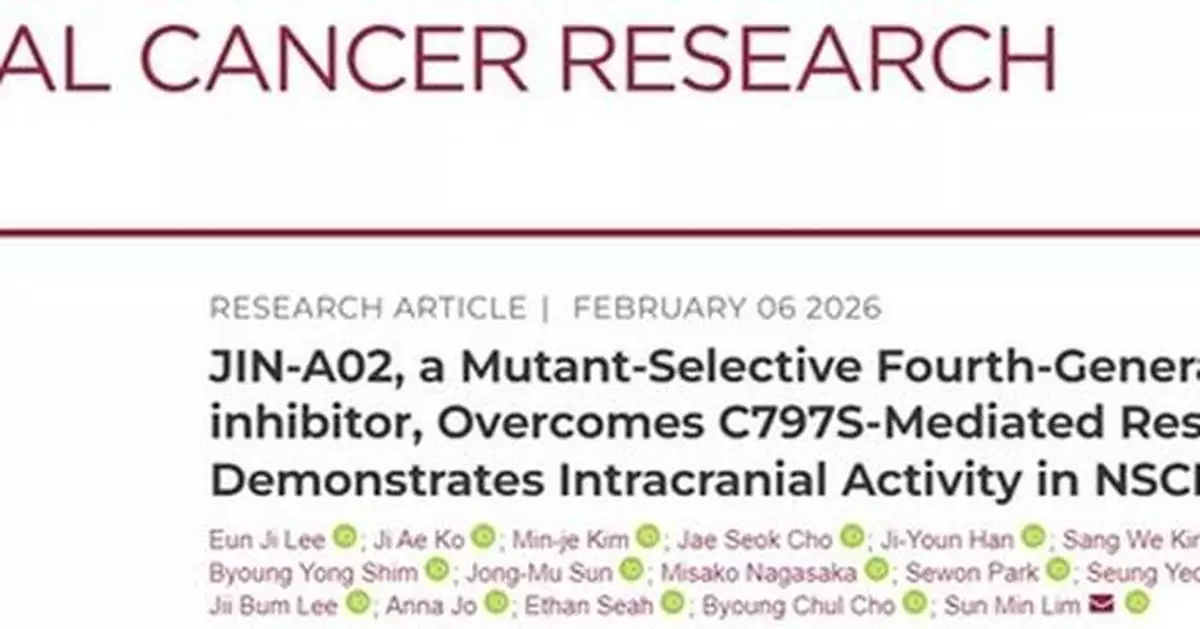
SEOUL, South Korea, Feb. 12, 2026 /PRNewswire/ -- J INTS BIO, Inc. announced that research findings on its investigational fourth-generation EGFR tyrosine kinase inhibitor (TKI), JIN-A02, have been published in Clinical Cancer Research, a leading oncology journal published by the American Association for Cancer Research (AACR). According to the most recent Journal Citation Reports (2025), the journal has an Impact Factor of 10.2, reflecting its influence in translational and clinical cancer research.
The study presents a therapeutic strategy designed to overcome EGFR C797S, a major resistance mutation that commonly emerges following treatment with the third-generation EGFR inhibitor Tagrisso. By integrating comprehensive preclinical findings with early clinical observations, the research outlines a potential new treatment approach for patients with EGFR-mutant non–small cell lung cancer (NSCLC) who have limited options after Tagrisso failure.
EGFR-mutant NSCLC is driven by aberrant activation of EGFR signaling, and while EGFR-targeted therapies have dramatically improved outcomes over the past decade, acquired resistance remains inevitable for most, if not all patients. In particular, the C797S mutation is known as a representative resistance mechanism that emerges, preventing existing third-generation EGFR targeted therapies from working effectively. Currently, there are no approved treatments targeting the C797S mutation. JIN-A02 was developed as an orally available, fourth-generation EGFR inhibitor engineered to selectively target resistance-associated EGFR mutations, including C797S and T790M, while minimizing activity against wild-type EGFR. In preclinical models derived from patients with EGFR E19del/T790M/C797S mutant NSCLC that are resistant to Tagrisso, JIN-A02 demonstrated marked antitumor activity, achieving a maximum tumor growth inhibition (TGI) of 168.2%, substantially exceeding the effects observed with Tagrisso under the same conditions and indicating tumor regression. This means that it was observed that administration of JIN-A02 could reduce tumor size beyond simple growth inhibition.
Tumor tissue analyses showed significant reductions in phosphorylated EGFR (p-EGFR) and the proliferation marker Ki-67 following JIN-A02 treatment, confirming effective inhibition of EGFR-driven signaling at the molecular level. In intracranial tumor models reflecting brain metastases, JIN-A02 produced rapid and sustained reductions in tumor burden, suggesting the ability to achieve therapeutically meaningful exposure across the blood–brain barrier (BBB).
The publication also reports early clinical observations from an ongoing Phase 1/2 trial (NCT05394831) in patients with EGFR-mutant NSCLC who progressed after prior EGFR-targeted therapies and chemotherapy. As of the data cutoff, 23 patients had been treated with JIN-A02, with partial responses and stable disease observed in multiple cases. Notably, one patient in the 300 mg dose cohort achieved a partial response, with a 39.7% reduction in lung lesion size observed at the start of the third treatment cycle. This response was sustained through the seventh cycle, reaching a maximum reduction of 44.9%. In addition, the patient's brain metastatic lesions decreased by 25% at the fifth treatment cycle, with the response maintained throughout the seventh cycle.
In addition, blood-based circulating tumor DNA (ctDNA) analysis in this patient showed complete clearance of the EGFR C797S mutation and the exon 19 deletion, along with a reduction of more than 90% in the T790M mutation. These findings are interpreted as evidence that the molecular-level target inhibition achieved by JIN-A02 translated into a meaningful clinical response.
Professor Sun Min Lim of the Division of Medical Oncology at Severance Hospital, the corresponding author of the study, stated, "JIN-A02 has demonstrated meaningful preclinical activity and early clinical signals targeting C797S-mediated resistance, for which treatment options have been extremely limited following the failure of third-generation EGFR-targeted therapies. In particular, the observed activity in brain metastases, along with a reduction in EGFR mutations detected in plasma ctDNA, provides important support for its further clinical development."
J INTS BIO plans to further accelerate the clinical development of JIN-A02, focusing on dose optimization, expansion of clinical data in patients with brain metastases, and further validation of molecular response biomarkers, with the goal of establishing a new treatment option for patients with EGFR-mutant NSCLC who have exhausted current standard therapies.
** The press release content is from PR Newswire. Bastille Post is not involved in its creation. **
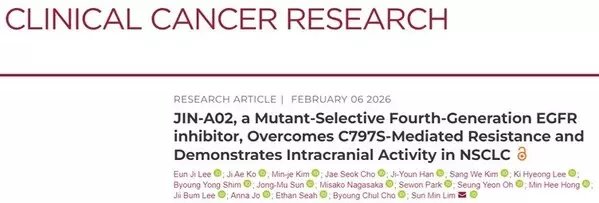
J INTS BIO Reports Fourth-Generation EGFR Inhibitor JIN-A02 in Clinical Cancer Research