Skip to Content Facebook Feature Image

Enhanced Transport Services Announced for Chinese New Year Golden Week Travel between Hong Kong and Mainland

HK

Enhanced Transport Services Announced for Chinese New Year Golden Week Travel between Hong Kong and Mainland
HK

HK

Enhanced Transport Services Announced for Chinese New Year Golden Week Travel between Hong Kong and Mainland

2026-02-13 10:00 Last Updated At:13:16

Interdepartmental working group on festival arrangements releases latest information and appeals to public and visitors to plan cross-boundary trips early during Chinese New Year Golden Week of Mainland

The interdepartmental working group on festival arrangements, led by the Chief Secretary for Administration, released the following latest information today (February 13) on the traffic and public transport arrangements during the Chinese New Year Golden Week of the Mainland (February 15 to 23):

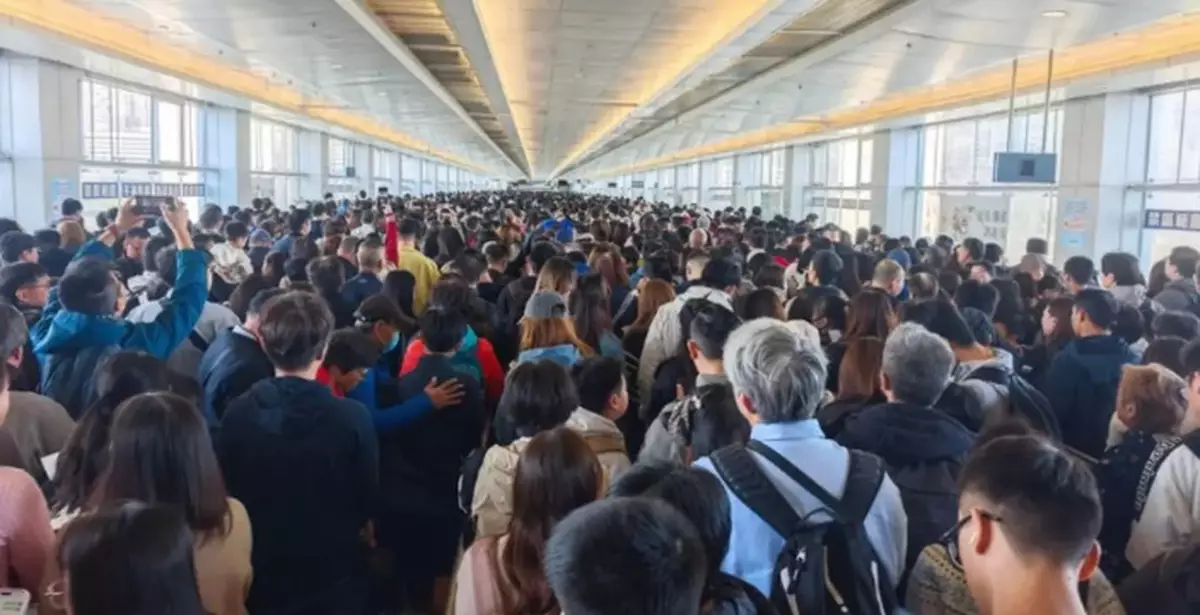
During the Chinese New Year Golden Week of the Mainland, in anticipation of a large number of members of the public, visitors and cross-boundary vehicles visiting land-based boundary control points (BCPs), the Transport Department (TD) appealed to cross-boundary travellers to use public transport services travelling between Hong Kong and the Mainland or Macao, plan their trips early and allow sufficient travelling time.

Enhancing services for travel convenience

The TD has been steering local and cross-boundary public transport operators (PTOs) to strengthen their services during the Chinese New Year Golden Week of the Mainland to accommodate the diverse travelling needs of passengers, including:

  • The MTR Corporation Limited will enhance the train services of the East Rail Line (ERL) between Admiralty and Lo Wu/Lok Ma Chau Stations at different times during the above period. Most local railway lines will operate overnight on February 16 (Monday, Lunar New Year's Eve), excluding cross-boundary journeys on the ERL between Sheung Shui and Lo Wu/Lok Ma Chau Stations, the Airport Express and the Disneyland Resort Line. Services on the relevant railway lines will be strengthened after the Night Parade on February 17 (Lunar New Year's Day) and the Fireworks Display on February 18 (second day of Lunar New Year) for the convenience of residents and visitors;

  • Increasing the frequency of the Hong Kong-Zhuhai-Macao Bridge (HZMB) shuttle bus (Gold Bus) to an average of about one minute during peak hours, if needed;

  • Increasing the frequency of the Lok Ma Chau-Huanggang cross-boundary shuttle bus (Yellow Bus) to an average of about two minutes during peak hours, if needed;

  • Increasing the quota of cross-boundary coaches to strengthen services;

  • The frequency of local franchised bus B routes connecting various land-based BCPs will also be increased to a level higher than that of normal weekends, and the operators concerned will reserve sufficient vehicles and manpower to meet passenger demand; and

  • In the early hours from February 17 (Tuesday, Lunar New Year's Day) to February 19 (Thursday, third day of Lunar New Year), after the service hours of the ERL trains to Lo Wu Station, a special bus service on KMB Route No. N73 (MTR Sheung Shui Station to San Tin) will be provided to carry passengers to interchange to the Yellow Bus for their journey to the Mainland via the Lok Ma Chau/Huanggang Port, which operates round the clock.

Travel during non-peak hours

It is anticipated that the waiting time for public transport services, including the Gold Bus and the franchised bus B routes, may be longer. Passengers are advised to travel during non-peak hours, maintain order while queuing and heed advice from on-site police and staff of PTOs concerned. Passengers planning to take cross-boundary coaches are also advised to reserve their coach tickets in advance.

Of note, motorists of cross-boundary private cars crossing the border are advised that, subject to actual traffic conditions, special traffic arrangements may be implemented at the Lok Ma Chau and the Shenzhen Bay Ports during the Chinese New Year Golden Week of the Mainland to secure smooth access for public transport vehicles to the above BCPs. Cross-boundary private cars may experience longer waiting times for crossing the BCPs during peak periods. Motorists should pay extra attention to variable message signs and traffic signs along the roads. In case of traffic congestion, they should remain patient and follow the instructions of on-site police.

Information dissemination

For the HZMB, to plan their journeys ahead, members of the public can make use of the TD's HKeMobility mobile app or website (hkemobility.gov.hk/en/traffic-information/live/cctv) to access snapshots of traffic conditions at inbound and outbound vehicle plazas of the HZMB Hong Kong Port. They can also check real-time situations of the vehicle clearance plaza of the Zhuhai Port through the WeChat official accounts "hzmbzhport" or "zhuhaifabu" (traffic-info.gzazhka.com:5015/#/) (Chinese only). Moreover, motorists are reminded to always comply with the traffic control measures implemented by the Zhuhai authority when driving on the HZMB Main Bridge. Vehicles must not occupy the emergency lane unless instructed by the Zhuhai authority.

The public and visitors may visit the one-stop information platform on immigration clearance "Easy Boundary" (www.sb.gov.hk/eng/bwt/status.html?type=outbound) of the Security Bureau or HKeMobility for the latest information on various land-based BCPs more conveniently. The TD will provide information on the services and waiting times of the Gold Bus, the Yellow Bus and the MTR. Members of the public are advised to check the latest traffic news through radio and television broadcasts, the TD's website (www.td.gov.hk) and HKeMobility.

The TD's Emergency Transport Co-ordination Centre operates round the clock to closely monitor the traffic conditions and public transport services of various districts, the BCPs and major stations, and to implement contingency measures when necessary to meet service demands.

The interdepartmental working group on festival arrangements is tasked with holistically co-ordinating and steering the preparatory work of various government departments for welcoming visitors to Hong Kong during the Chinese New Year Golden Week of the Mainland, as well as strengthening information dissemination to enable the public and visitors to plan their itineraries according to the latest situation.
Photo source: reference image

Photo source: reference image

Second cross-boundary large-scale stress test conducted at Huanggang Port

The Hong Kong Special Administrative Region Government today (August 29) conducted the second cross-boundary stress test at the Huanggang Port with the relevant units of Shenzhen. The drill focused on testing the peak carrying capacity by further increasing passenger and vehicular flows to ensure comprehensive preparation for the opening of the port.

The drill marked the first test of the "joint one-stop" vehicle lanes for vehicle clearance. Automobile associations, associations, and chambers of commerce were invited to assist in recruiting private vehicles permitted to travel between the two places. The vehicles participated in cyclical trials with more than 1 000 vehicle trips made to test the operation and tuning of the lane systems and vehicular flow management. Participating vehicles were instructed to enter the port through the new connecting road in batches. They underwent risk assessment at the "customs front kiosks", and then entered the "joint one-stop" vehicle lanes for "five-party inspection" to complete clearance procedures for the Shenzhen General Station of Exit and Entry Frontier Inspection, the Shenzhen Customs, as well as the Customs and Excise Department, the Department of Health and the Immigration Department of Hong Kong in one go, through the "integrated information collection devices" next to the lanes to complete the collection of body temperature, travel document data, facial features and fingerprints. The drill also simulated scenarios such as passengers disembarking and proceeding to the immigration clearance hall for on-board passengers to undergo passenger clearance procedures, as well as vehicles being selected at the "customs front kiosks" to proceed to the inspection area for inspection. Vehicles participating in the drill first departed and then returned to the Hong Kong Port Area via the Shenzhen side's vehicle clearance level for departure to conduct the cyclical trials.

To assess the port's capacity under sustained ultra-high passenger flow, over 20 000 civil servants from more than 70 bureaux and departments were mobilised. Participants were instructed to take various public transport to arrive at the port. They passed through the "collaborative inspection" automated channels or manual counters to depart from the Hong Kong Port Area. After returning from the Shenzhen side, they left the port by taking vehicles dispatched by public transport operators, undergoing cyclical trials involving more than 600 departures. The stress test also advanced the "crowd concentrated-flow test" by releasing large batches of people several times within a short period of time to create greater crowd pressure. This simulated a situation where a large number of arriving passengers arrive Hong Kong via the Huanggang Port during peak hours and take different public transport (including franchised buses, minibuses, cross-boundary coaches, and taxis) at the public transport interchange, thereby testing the management of passenger and vehicular flows, as well as co-ordination of supporting arrangements.

After that, the Fire Services Department conducted a fire drill, simulating an electric vehicle catching fire. Personnel from the Huanggang Fire Station fought the fire with water jets and used specialised equipment such as high-pressure fog applicators and fire blankets to extinguish the blaze. Ambulance personnel were also on-site to treat the injured.

The Secretary for Security, Mr Tang Ping-keung, inspected the drill on-site and held a meeting with participating departments immediately after the drill to review procedures and participants' feedback. Meetings will be arranged between the relevant Hong Kong and Shenzhen units to review and identify areas for improvement in the management of passenger and vehicular traffic, emergency response and collaborative mechanisms of the two places, so as to ensure the port's safe and smooth operation and a positive passenger experience to prepare for the opening of the port.

To further facilitate travel between Hong Kong and the Mainland for Hong Kong residents, both places will implement the arrangement that Hong Kong residents who hold both Mainland Travel Permits for Hong Kong and Macao Residents (including non-Chinese) (commonly known as the Home Visit Permit), and Hong Kong permanent identity card or Hong Kong non-permanent identity card, may choose to use either their Hong Kong identity card or Home Visit Permit at the first gate of the "collaborative inspection" automated channels, for completing immigration clearance procedures of both Hong Kong and Shenzhen, regardless of whether they are travelling "northbound" or "southbound".

Representatives from various bureaux, departments and organisations participated in the drill, including the Security Bureau, the Transport and Logistics Bureau, the Civil Service Bureau, the Hong Kong Police Force, the Transport Department, the Highways Department, the Immigration Department, the Hong Kong Customs and Excise Department, the Department of Health, the Fire Services Department, the Architectural Services Department, the Electrical and Mechanical Services Department, the Government Property Agency, the Digital Policy Office, the Office of the Communications Authority, the Food and Environmental Hygiene Department, the Agriculture, Fisheries and Conservation Department, the Civil Aid Service, the Auxiliary Medical Service, and various public transport operators.

Source: AI-found images

Source: AI-found images

Recommended Articles