An arbitrator determined the NFL Players Association violated the Collective Bargaining Agreement with the NFL by distributing annual “team report cards” and ordered the union to stop making public any future reports. The NFL informed teams of the decision on Friday.
“We are pleased with the decision from the arbitrator, upholding the parties’ collective bargaining agreement and prohibiting the NFLPA from disparaging our clubs and individuals through ‘report cards’ allegedly based on data and methodologies that it has steadfastly refused to disclose,” NFL spokesman Brian McCarthy said in a statement. “We remain committed to working in partnership with the NFLPA and an independent survey company to develop and administer a scientifically valid survey to solicit accurate and reliable player feedback as the parties agreed in the CBA.”
In a memo sent to the 32 teams, NFL attorneys said the NFLPA’s witness and counsel at a hearing characterized the report cards as “union speech” and admitted that: the union “cherry-picked” topics and player responses to include or not in the report cards; players had no role in drafting the commentary; the union selected which anonymous player quotes to include or exclude and the union determined the weight to give each topic and the resulting impact on the alphabetical grades.
“The arbitrator did not find that the union’s independent survey necessarily conflicts with its obligation to conduct a joint specific survey of players’ opinions regarding the adequacy of medical care under the CBA,” the league said in its memo to teams. “Therefore, the Management Council will continue to work with the NFLPA to design and conduct such a survey in the coming seasons.”
AP NFL: https://apnews.com/hub/NFL
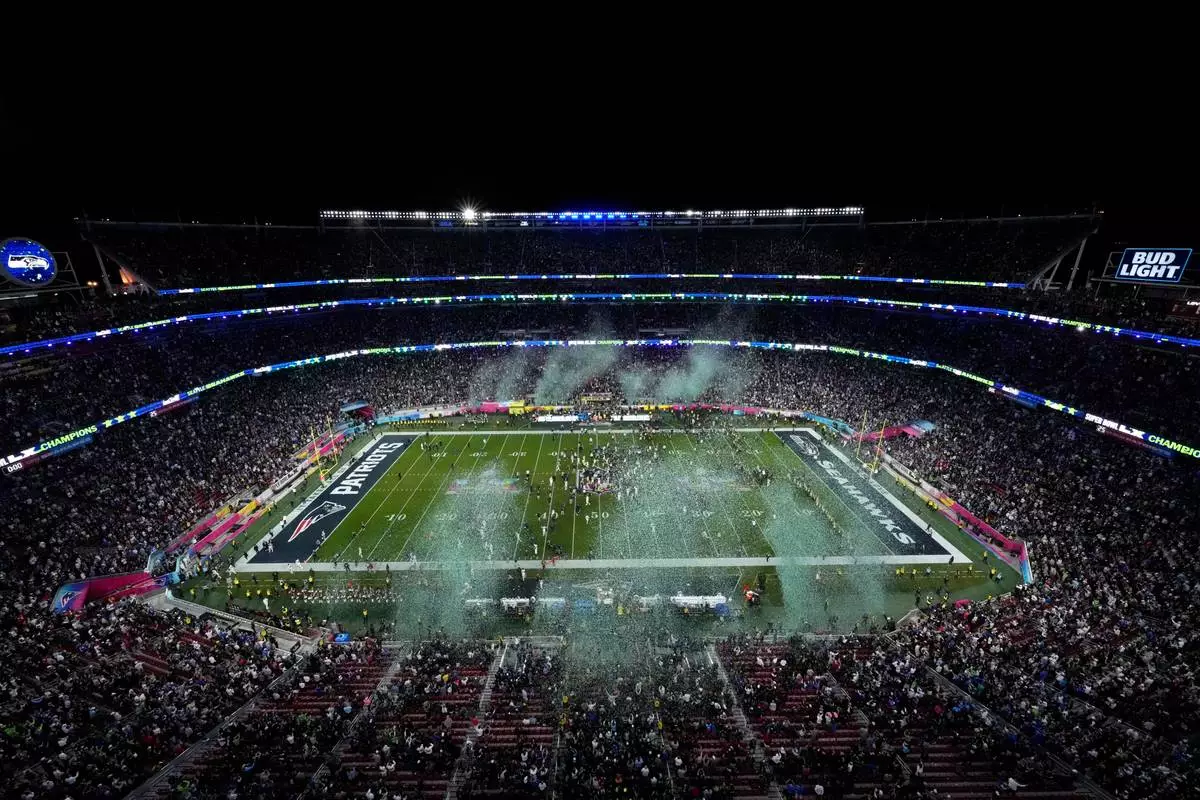
The Seattle Seahawks celebrate after defeating the New England Patriots in the NFL Super Bowl 60 football game, Sunday, Feb. 8, 2026, in Santa Clara, Calif. (AP Photo/Godofredo A. Vásquez)
FILE - The NFL logo on a goal post at Acrisure Stadium before an NFL football game between the Pittsburgh Steelers and the Baltimore Ravens in Pittsburgh Jan. 4, 2026. (AP Photo/Gene J. Puskar, File)
MUNICH (AP) — German Chancellor Friedrich Merz called on Friday for the United States and Europe to “repair and revive trans-Atlantic trust together,” arguing that even the U.S. isn't powerful enough to go it alone in an increasingly tough world.
Merz called for a “new trans-Atlantic partnership,” acknowledging that “a divide, a deep rift” has opened up across the Atlantic as he opened the Munich Security Conference, an annual gathering of top global security figures including many European leaders and U.S. Secretary of State Marco Rubio. He argued that the post-World War II world order, “as imperfect as it was at its best times, no longer exists” today.
At last year's conference, held a few weeks into U.S. President Donald Trump's second term, Vice President JD Vance stunned European leaders by lecturing them about the state of democracy and freedom of speech on the continent — a moment that set the tone for the last year.
A series of statements and moves from the Trump administration targeting allies followed, including Trump's threat last month to impose new tariffs on several European countries in a bid to secure U.S. control of Greenland, a semiautonomous territory of NATO ally Denmark. The president later dropped that threat.
“The culture war of the MAGA movement in the U.S. is not ours,” Merz said. “The freedom of the word ends here when this word is turned against human dignity and the constitution. And we don't believe in tariffs and protectionism, but in free trade.”
He added that Europe would stand by climate agreements and the World Health Organization “because we are convinced that we will only solve global tasks together.”
But Merz said Europe and the U.S. should conclude that “we are stronger together" in today's world.
“In the era of great-power rivalry, even the United States will not be powerful enough to go it alone,” he said. “Dear friends, being a part of NATO is not only Europe's competitive advantage. It's also the United States' competitive advantage, so let's repair and revive trans-Atlantic trust together.”
The Europeans, Merz said, are doing their part.
Since last year’s Munich conference, NATO allies have agreed under pressure from Trump to a large increase in their defense spending target.
NATO Secretary-General Mark Rutte said there has been a “shift in mindset,” with “Europe really stepping up, Europe taking more of a leadership role within NATO, Europe also taking more care of its own defense.”
With Rubio heading the U.S. delegation this year, European leaders can hope for a less contentious approach more focused on traditional global security concerns.
Speaking as he introduced Merz, conference chairman Wolfgang Ischinger asked: “does the Trump administration truly believe that it needs allies and partners and if so ... is Washington actually prepared to treat allies as partners?”
Before departing for Germany on Thursday, Rubio had some reassuring words as he described Europe as important for Americans.
“We’re very tightly linked together with Europe,” he told reporters. “Most people in this country can trace both, either their cultural or their personal heritage, back to Europe. So, we just have to talk about that.”
But Rubio made clear it wouldn’t be business as it used to be, saying: “We live in a new era in geopolitics, and it’s going to require all of us to reexamine what that looks like.”
Mike Waltz, the U.S. ambassador to the United Nations, told the conference that the U.S. had been sustaining the financial burden of multilateralism for too long and Europeans need to do more.
“There is a cost to the status quo and the status quo was not sustainable any more,” Waltz said.
Merz said that Europe's “excessive dependency” on the U.S. was its own fault, but it is leaving that behind. “We won't do this by writing off NATO — we will do it by building a strong, self-supporting European pillar in the alliance, in our own interest,” he said.
He acknowledged that Europe and the U.S. will likely have to bridge more disagreements in the future than in the past, but “if we do this with new strength, respect and self-respect, that is to the advantage of both sides.”
Rubio arrived in Munich on Friday. He met Merz and Chinese Foreign Minister Wang Yi separately on the sidelines of the conference. He is due to address the conference on Saturday morning.
The German chancellor, British Prime Minister Keir Starmer and several other European leaders held a meeting with Ukrainian President Volodymyr Zelenskyy in Munich, ahead of another round of U.S-brokered talks between envoys from Russia and Ukraine in Geneva next week.
Rubio was not participating in the meeting as his schedule was packed with separate bilateral meetings with European officials, including one with the leaders of Denmark and Greenland, a U.S. official said. The official, who spoke on condition of anonymity because neither the meeting nor Rubio’s attendance had been announced, said Rubio was and would be discussing Russia’s war with Ukraine in other formats.
Moulson reported from Berlin. Associated Press reporter Claudia Ciobanu in Warsaw, Poland, contributed to this report.
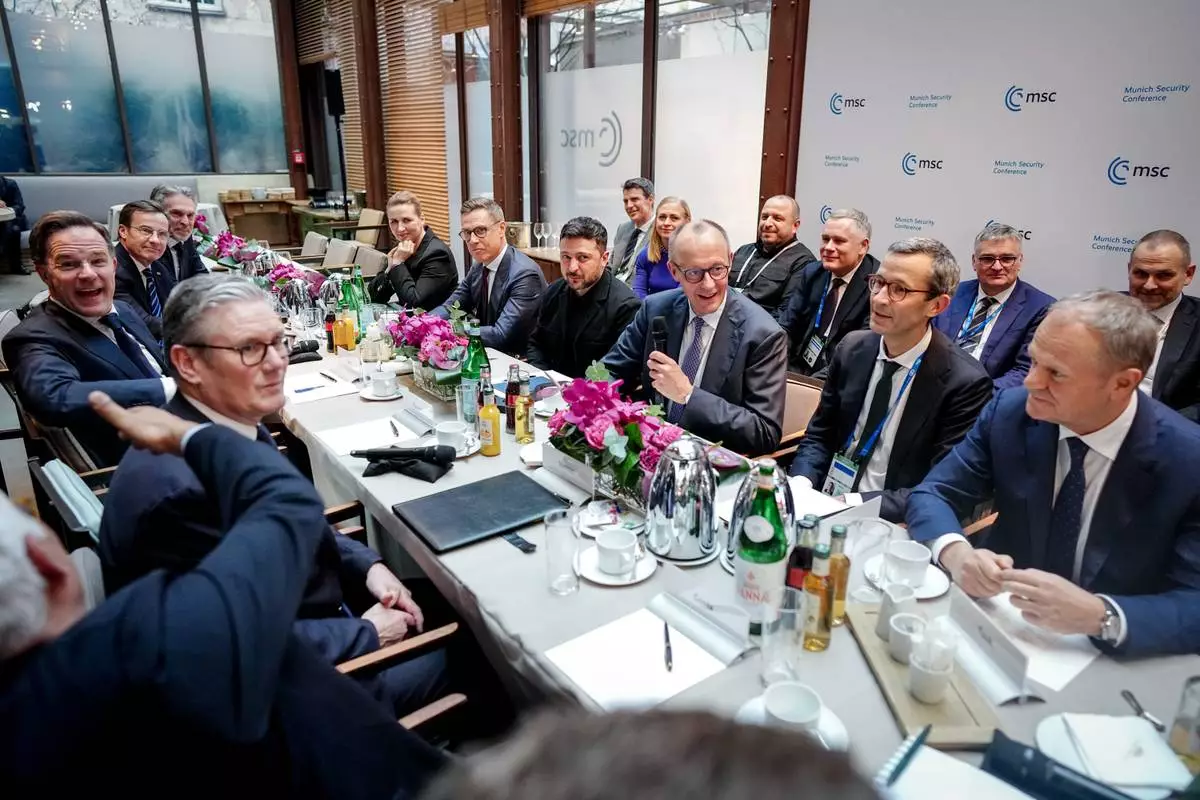
From left, Secretary General of NATO Mark Rutte, Britain's Prime Minister Keir Starmer, Prime Minister of Sweden Ulf Kristersson, Prime Minister of the Netherlands Dick Schoof, Prime Minister of Denmark Mette Frederiksen, President of Finland Alexander Stubb, Ukrainian President Volodymyr Zelenskyy, German Chancellor Friedrich Merz, Günter Sautter Foreign and Security Policy Advisor to the Chancellor, Prime Minister of Poland attend a meeting at the Munich Security Conference in Munich, Germany, Friday Feb. 13, 2026. (Kay Nietfeld/Pool via AP)
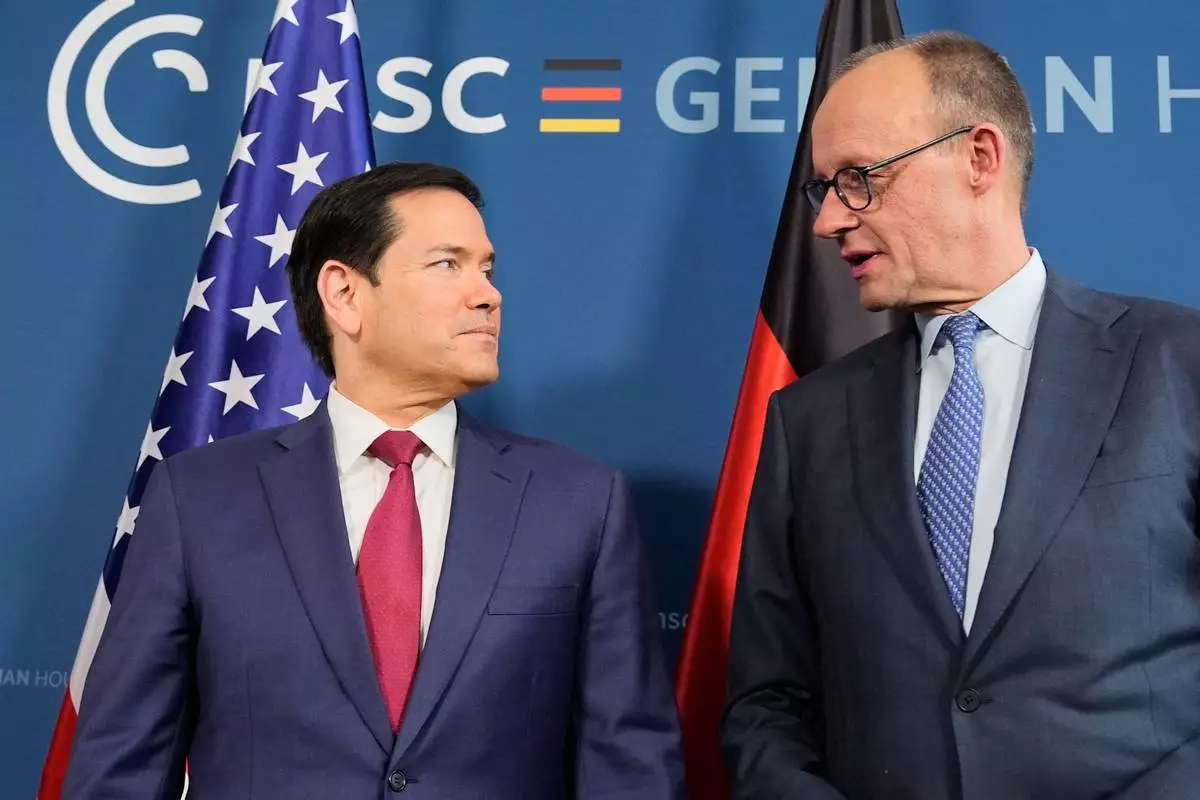
U.S. Secretary of State Marco Rubio, left, and Germany's Chancellor Friedrich Merz meet in Munich, Germany, Friday, Feb. 13, 2026, at the Munich Security Conference. (AP Photo/Alex Brandon, Pool)
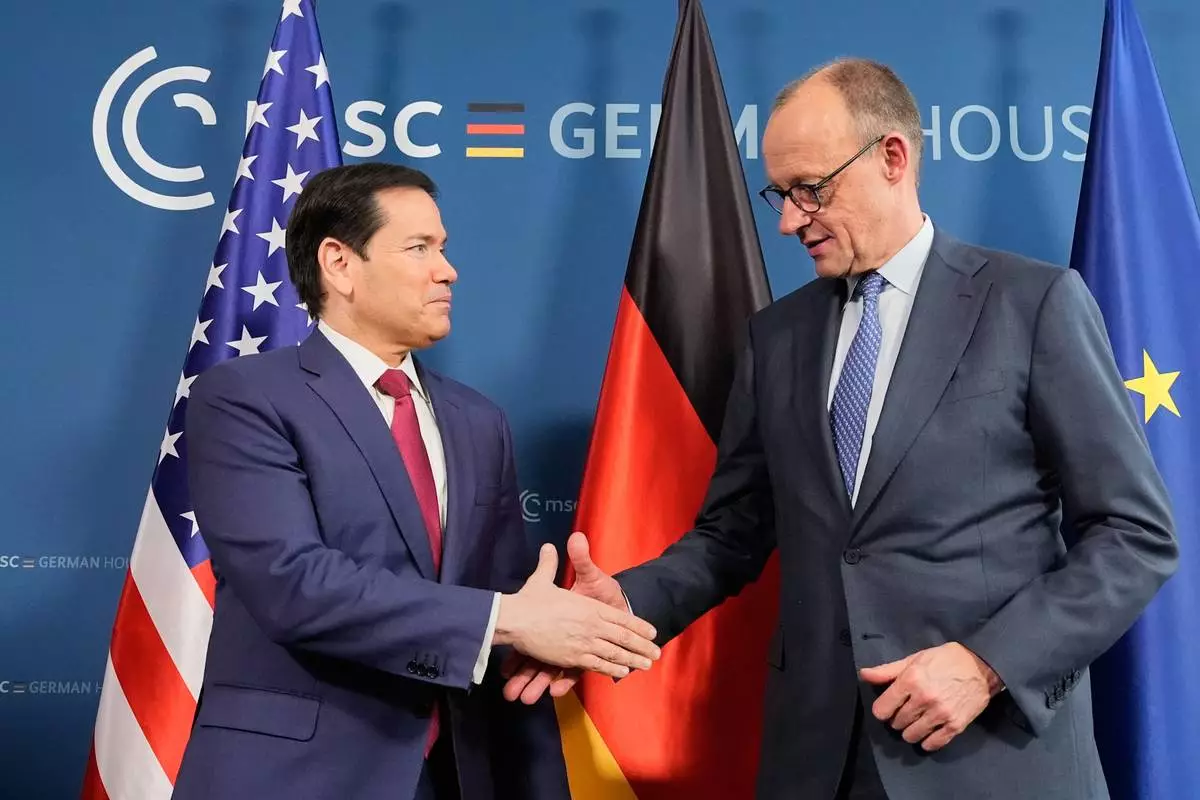
U.S. Secretary of State Marco Rubio, left, and Germany's Chancellor Friedrich Merz shake hands in Munich, Germany, Friday, Feb. 13, 2026, at the the Munich Security Conference. (AP Photo/Alex Brandon, Pool)
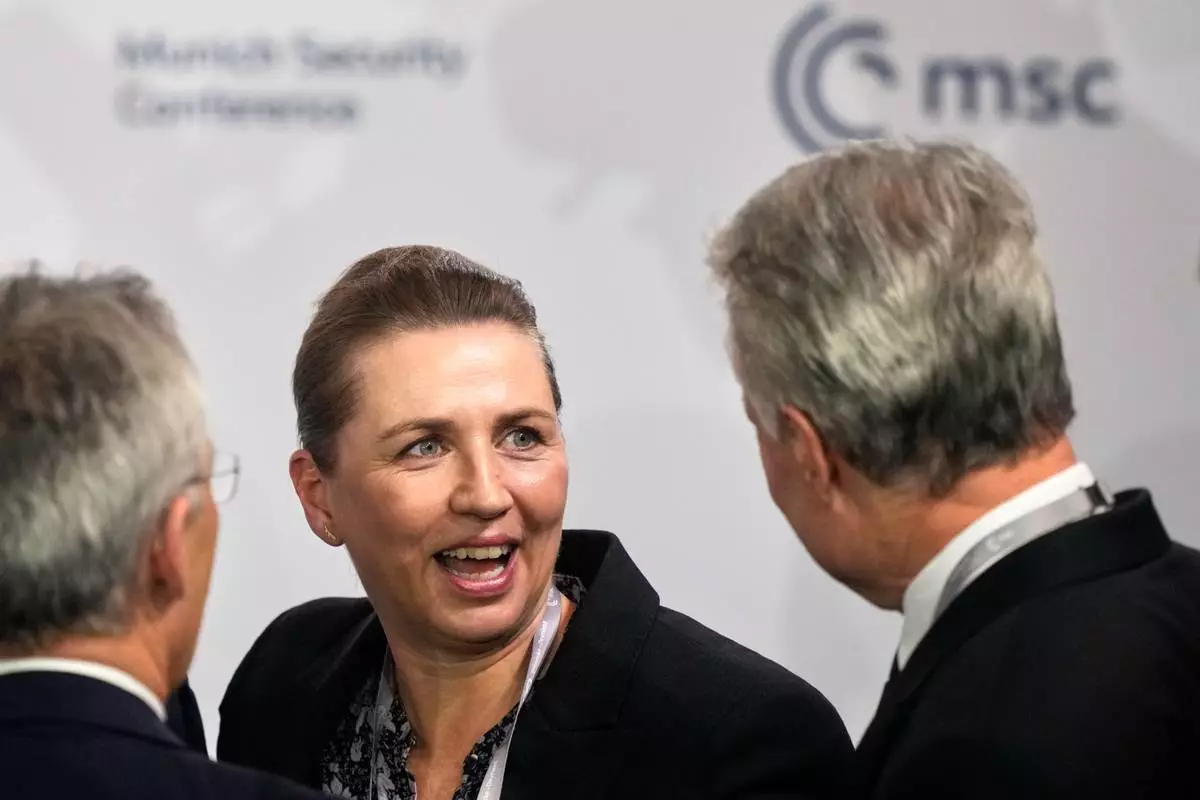
From left, Norway's Finance Minister Jens Stoltenberg, Denmark's Prime Minister Mette Frederiksen and Lithuania's President Gitanas Nauseda speak prior to a panel discussion during the Munich Security Conference in Munich, Germany, Friday, Feb. 13, 2026. (AP Photo/Michael Probst)
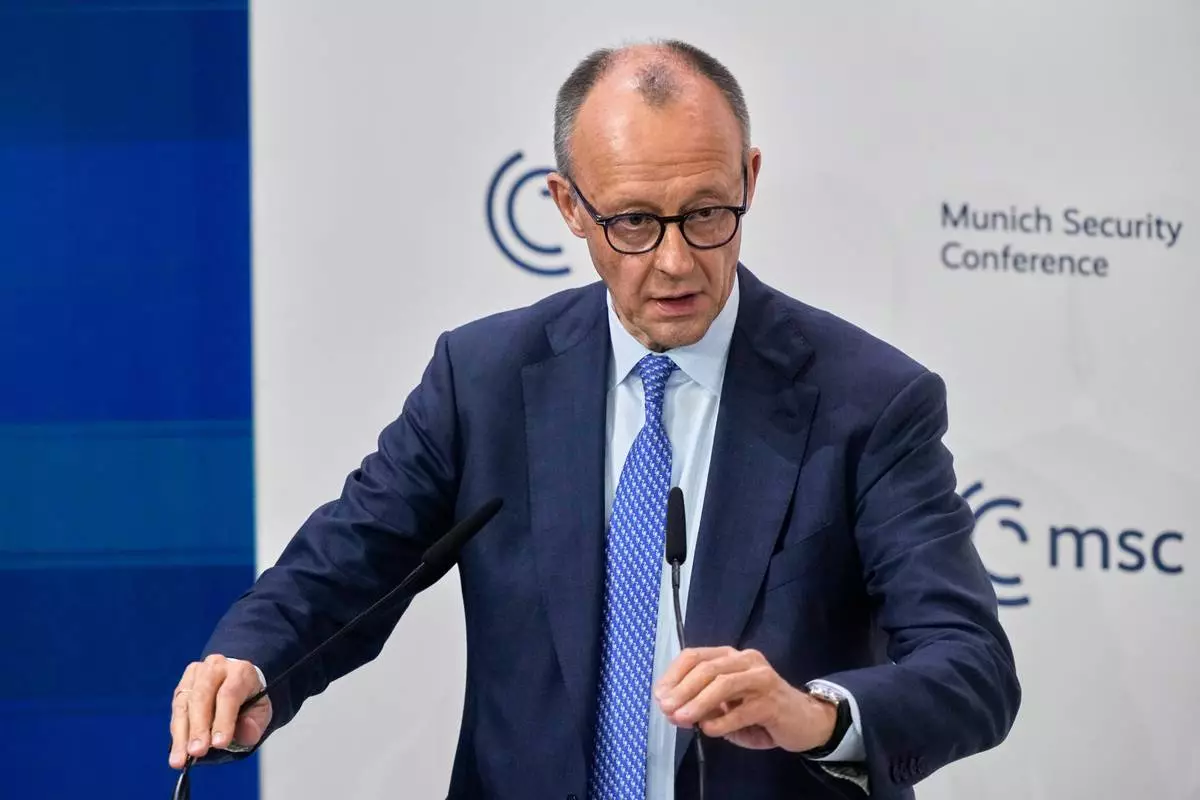
Germany's Chancellor Friedrich Merz prepares to address the audience during the Munich Security Conference in Munich, Germany, Friday, Feb. 13, 2026. (AP Photo/Michael Probst)
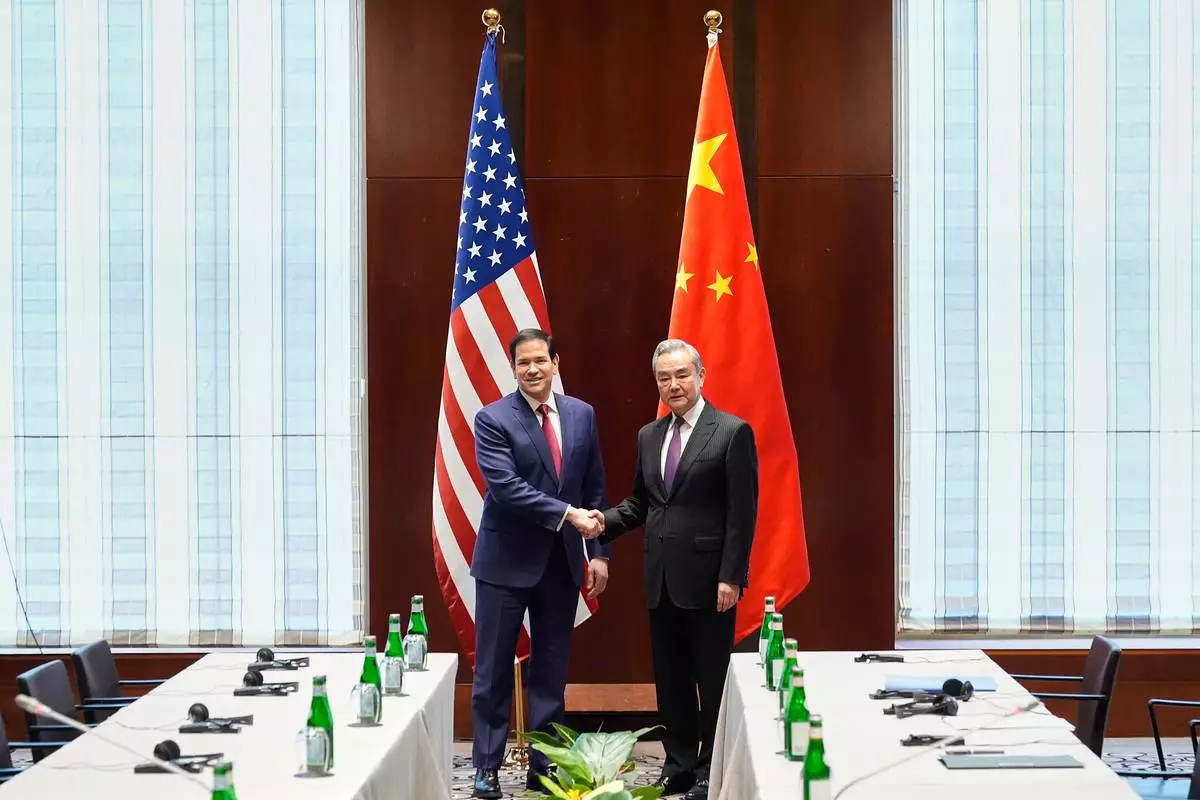
Secretary of State Marco Rubio shakes hands with China's Foreign Minister Wang Yi in Munich, Germany, Friday, Feb. 13, 2026, at the beginning of a meeting on the sidelines of the Munich Security Conference. (AP Photo/Alex Brandon, Pool)
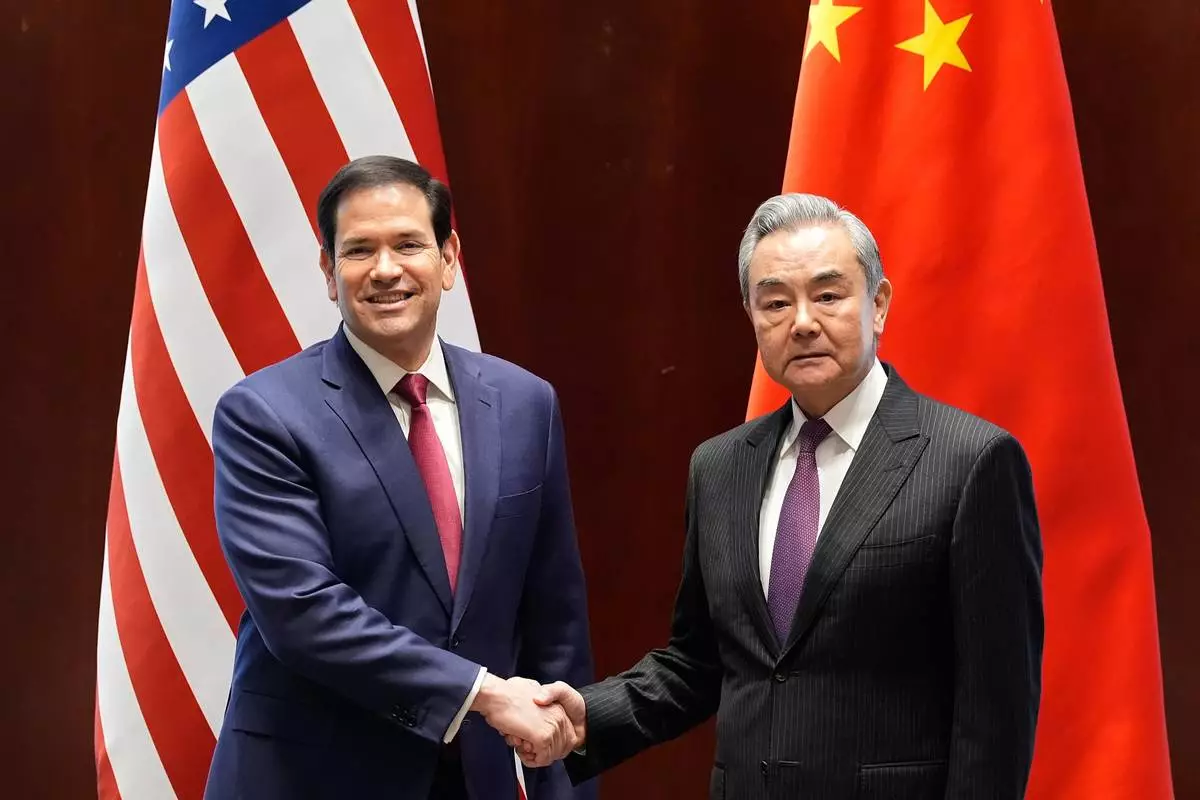
Secretary of State Marco Rubio shakes hands with China's Foreign Minister Wang Yi in Munich, Germany, Friday, Feb. 13, 2026, at the beginning of a meeting on the sidelines of the Munich Security Conference. (AP Photo/Alex Brandon, Pool)
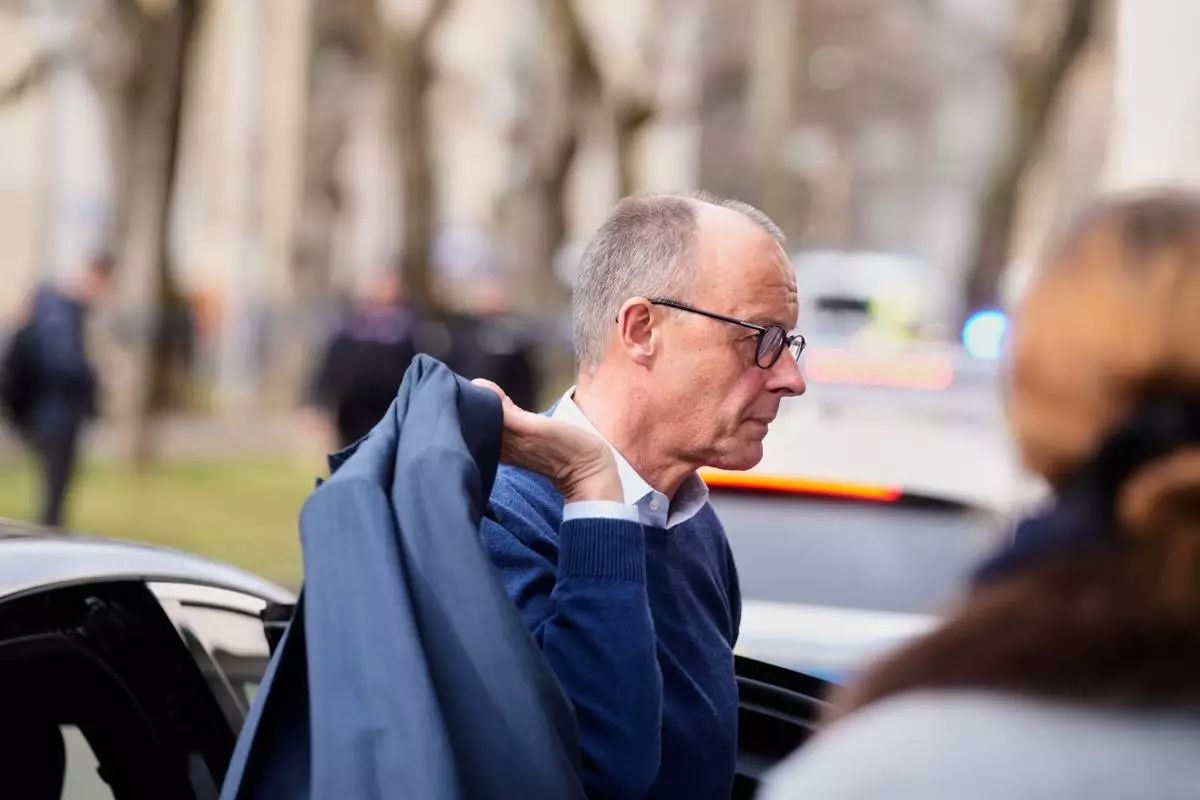
Germany's Chancellor Friedrich Merz arrives for the Munich Security Conference in Munich, Germany, Friday, Feb. 13, 2026. (AP Photo/Michael Probst)
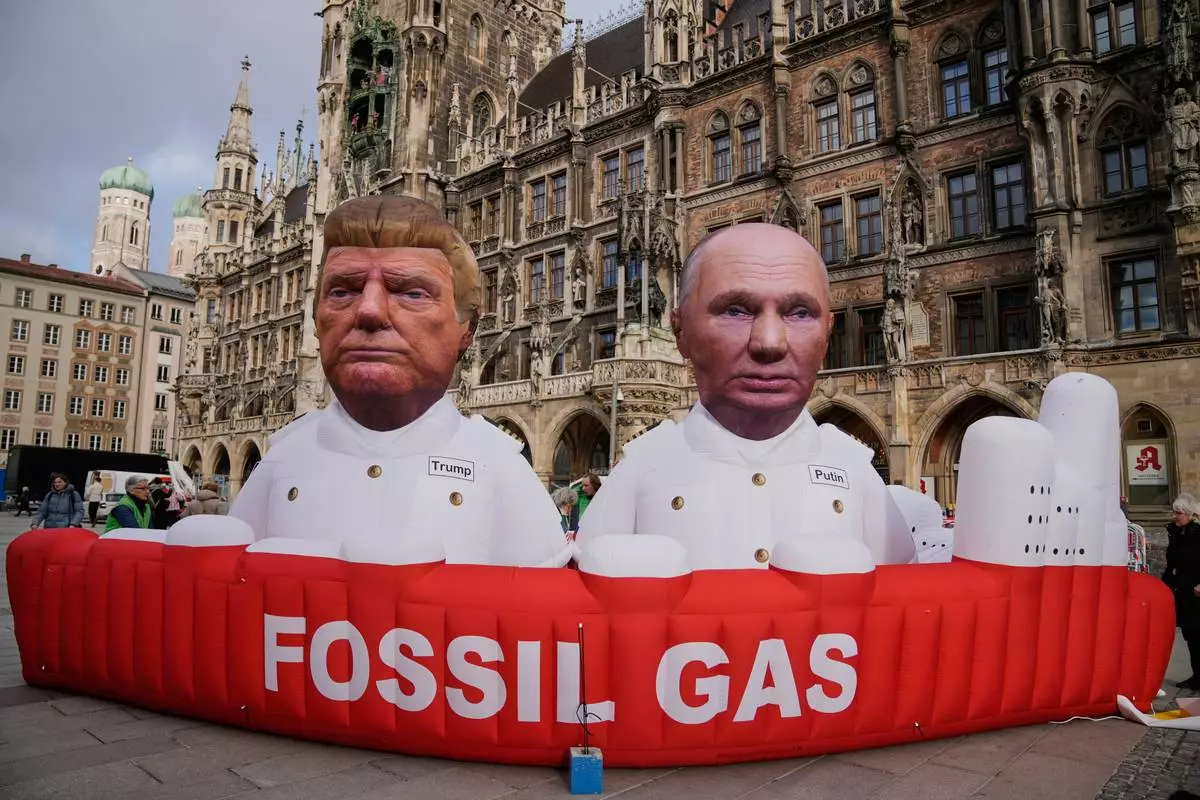
Figures depicting US President Donald Trump and Russian President Vladimir Putin, right, are displayed at Marienplatz square, as part of a protest against fossil energy by the environment organisation Greenpeace during the Munich Security Conference in Munich, Germany, Friday, Feb. 13, 2026. (AP Photo/Ebrahim Noroozi)
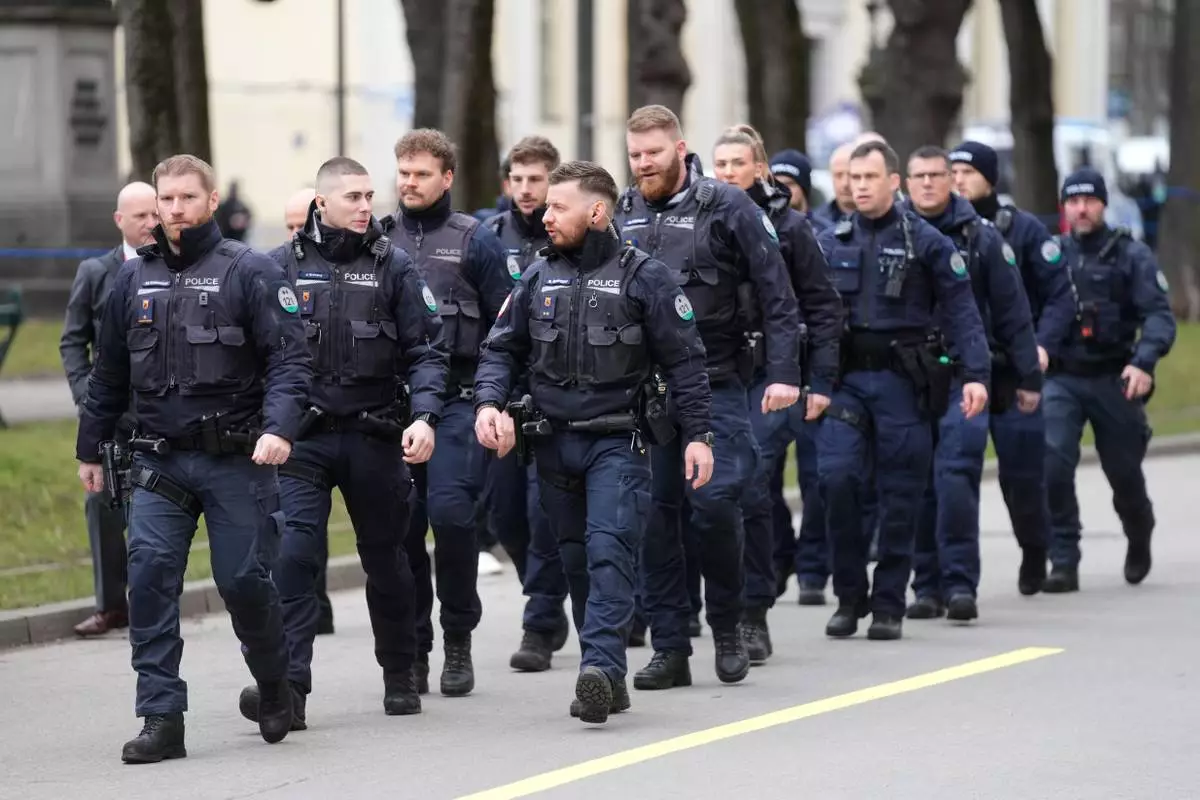
Police walk in formation to take their security positions around the Munich Security Conference in Munich, Germany, Friday, Feb. 13, 2026. (AP Photo/Michael Probst)
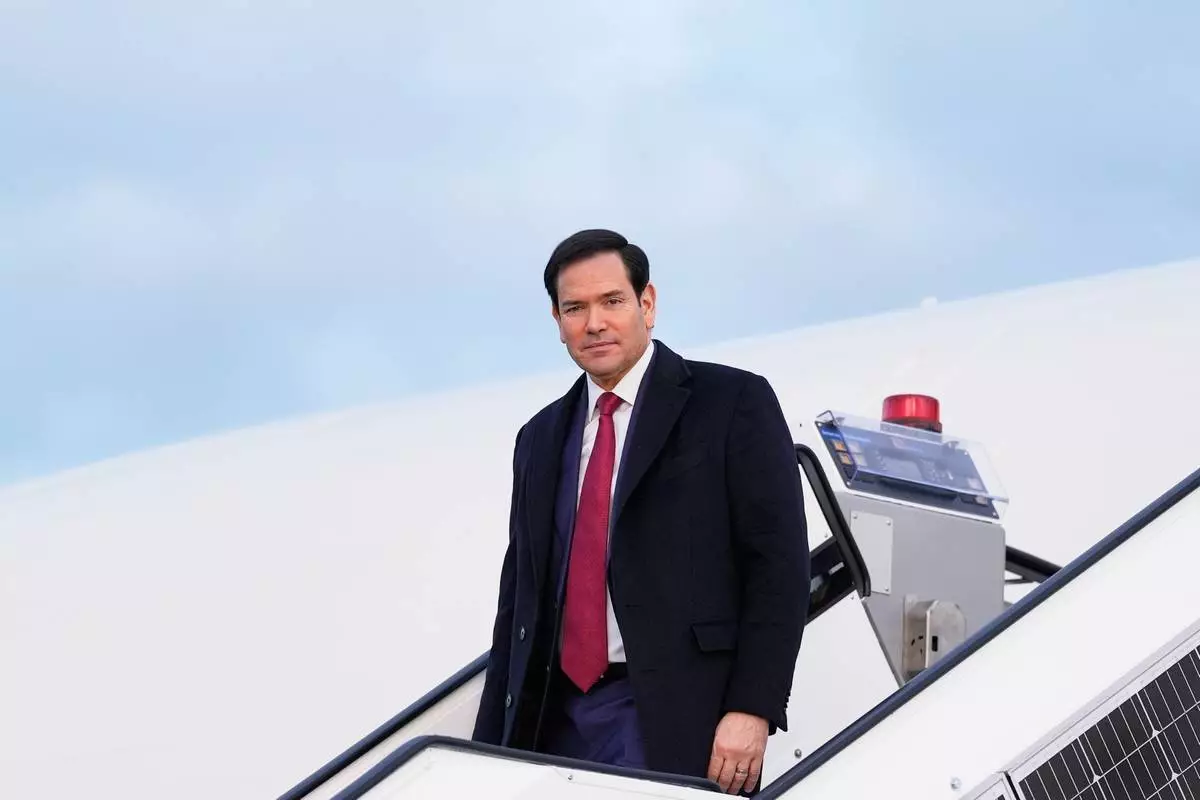
U.S. Secretary of State Marco Rubio arrives in Munich, Germany, Friday, Feb. 13, 2026, for the Munich Security Conference. (AP Photo/Alex Brandon, Pool)
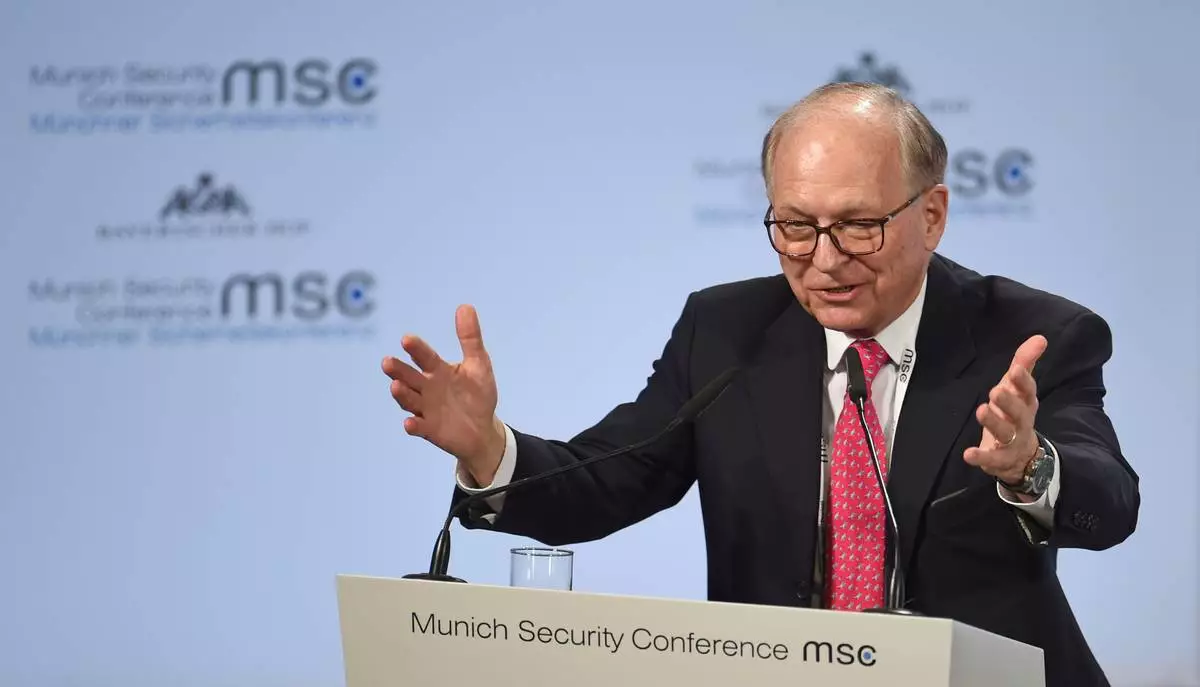
FILE - Chairman of the conference, Wolfgang Ischinger, speaks at the Security Conference in Munich, Germany, Saturday, Feb. 17, 2018. (Andreas Gebert/dpa via AP, File)