The government’s ability to deal with drones that pose a threat on American soil has been questioned this week after the use of a laser designed to shoot down drones near the border in Texas led to the abrupt closure of the airspace over El Paso, sources familiar with the situation told The Associated Press.
The details of exactly what happened before the Federal Aviation Administration shut down the busy airport in the Mexican border city on Wednesday aren’t entirely clear, but a source familiar with the situation told AP that the laser was deployed by U.S. Customs and Border Protection without coordinating with the FAA.
Two months ago, Congress agreed to give more law enforcement agencies the authority to take down rogue drones as long as they are properly trained. That could make situations like the one in El Paso more likely. Previously, only a select few federal agencies had that power.
Here's a look at what happened and the issues that raised:
The government would say only that the airspace was shut down when an incursion by Mexican drug cartel drones was neutralized.
But the two people who discussed sensitive details on condition of anonymity said the FAA grounded every aircraft in the El Paso area over concerns about the safety of the laser system being used near commercial planes. The restrictions were initially expected to last 10 days, but then they were lifted a few hours later.
Homeland Security Secretary Kristi Noem said Friday that the government agencies involved in El Paso are working to address the concerns that led to the cancellation of more than a dozen flights and sent travelers scrambling.
“This was a joint agency task force mission that was undertaken and we’re continuing to work on the communication through that,” Noem said in Arizona.
But drone warfare expert Brett Velicovich said the dysfunction in Texas raises questions about whether the U.S. will be prepared to deal with a significant drone threat.
“We need to simplify the authorities for who is really in charge and get these egos out of the way from these different agencies before an American gets hurt,” said Velicovich, who founded drone maker Power.us and consults on ways to mitigate their threats.
Armed drones carry out devastating attacks daily in Ukraine. The unmanned vehicles have also allowed Ukraine to strike deep within Russia.
Velicovich, who used to use Predator drones in the military to bomb targets, said it wouldn’t be hard for someone with malicious intent to buy a drone for a few hundred bucks and do great harm at a major public event like a World Cup match or the celebrations of America’s 250th birthday that are planned this summer.
Cartels routinely use drones to deliver drugs across the Mexican border and surveil Border Patrol officers. Officials told Congress last summer that more than 27,000 drones were detected within 1,600 feet (500 meters) of the southern border in the last six months of 2024.
The government recently handed out $250 million in grants to the 11 states that are set to host World Cup matches this summer to help them prepare for the threat of drones. Another $250 million in grants will be awarded later this year to strengthen the nation's drone defenses.
The threat to planes from drones continues to increase along with the number of near misses around airports. Homeland Security estimates there are more than 1.7 million registered drones flying in the United States, and that number has been growing.
Larger drones are required to carry a radio transponder that identifies the drone’s owner and broadcasts its position to help avert collisions. Cities can also invest in additional sensors around stadiums to help quickly detect drones.
Airspace Link, a Detroit company, created a low altitude air traffic control system to track drones and can alert authorities who might soon be able to take action. Cities can buy additional sensors to upgrade that system around stadiums or other high-profile locations.
“We don’t want something to happen," said CEO Michael Healander. “But we also want to be prepared to have the tools in place to take action, because these are such big global events.”
Common anti-drone systems use radio signals to jam or force drones to land. But the government has also developed high-powered microwaves or laser beams like the one sources say was used in Texas this week that are capable of disabling the machines.
Some other systems station small drones to take flight quickly and ram into drones that are considered a threat. And there are systems that use bullets to shoot down drones.
Michael Robbins, president and CEO of the Association for Uncrewed Vehicle Systems International trade group, said these counter drone systems are more common in warzones than across the United States. But the government is working to get them into the hands of more officers nationwide.
“It’s our belief that this is important technology that when responsibly used with proper oversight and intensive training will help to mitigate unsafe or malicious drones in the very rare instances where that needs to occur,” Robbins said.
Allied Pilots Association union spokesman Capt. Dennis Tajer said he's not sure how big of a threat the counter drone technology is to the American Airlines jets he flies because so few details have been released about what happened in Texas. And officials with Homeland Security and the FAA didn't respond to questions about it again on Friday.
Tajer said he's more concerned about the possibility of a passenger jet running into a drone because that could bring the plane down. A year ago, 67 people were killed when an American Airlines jet collided with an Army helicopter near Washington, D.C.
“You don’t have to be a pilot, an engineer or a defense expert to understand that two pieces of metal in the sky that one doesn’t know the other is there and is uncontrolled is dangerous,” Tajer said. “We’ve got to keep those two pieces of metal away from each other.”
Associated Press writer Josh Kelety contributed from Scottsdale, Arizona.
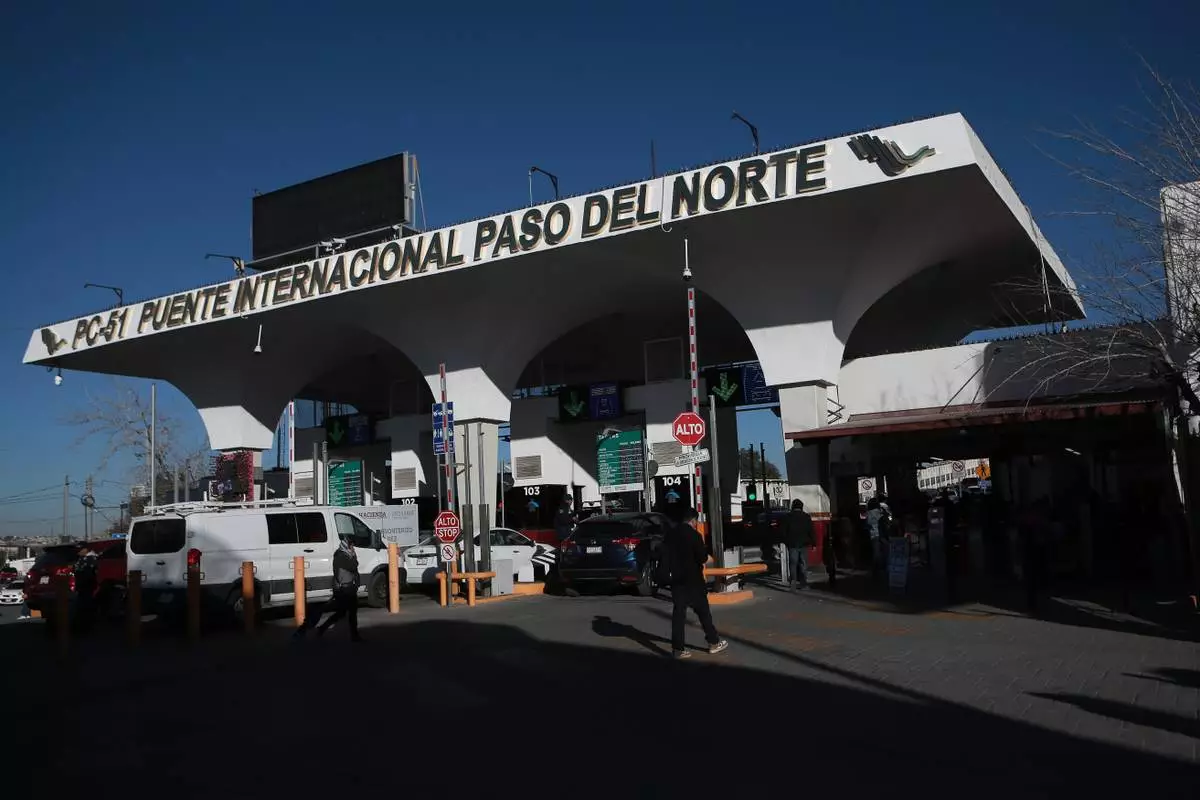
Cars cross the "Paso del Norte" International Bridge at the U.S.-Mexico border, in Ciudad Juarez, Mexico, Wednesday Feb. 11, 2026, on the border with El Paso, Texas. (AP Photo/Christian Chavez)
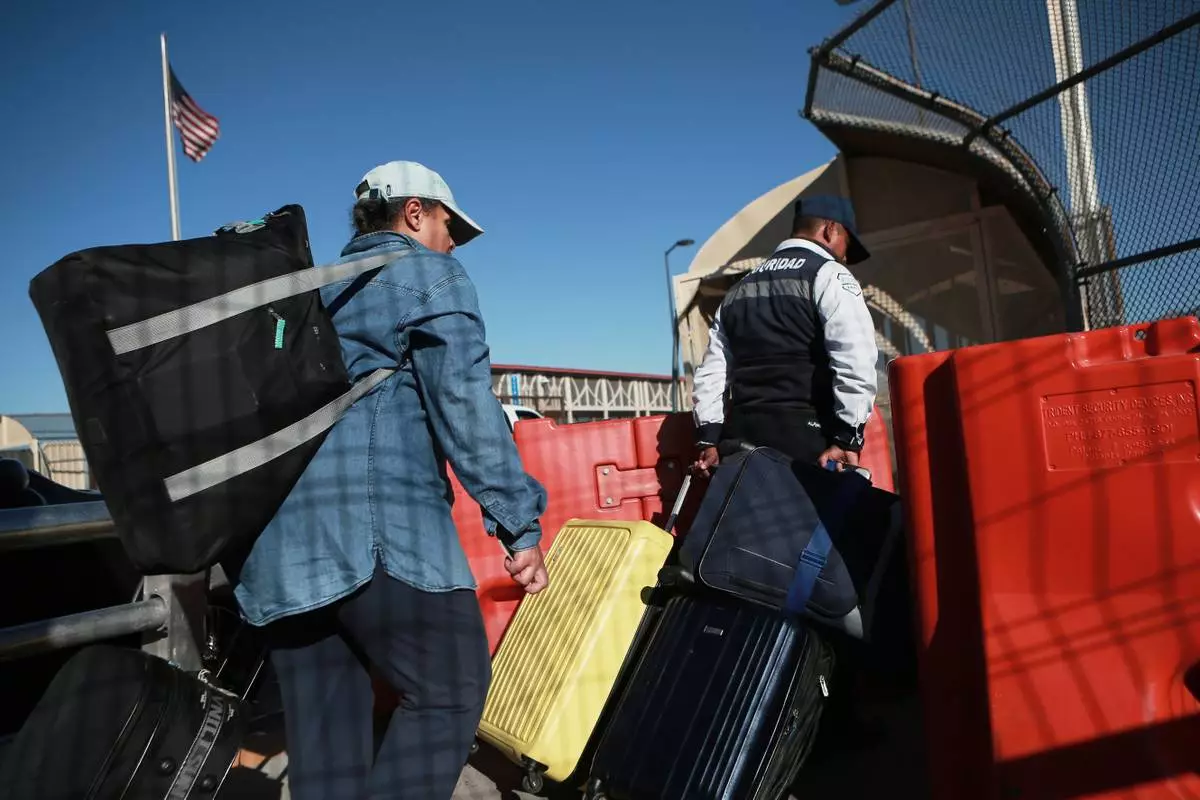
People cross the Paso del Norte International Bridge at the U.S.-Mexico border, in Ciudad Juarez, Mexico, Wednesday Feb. 11, 2026, on the border with El Paso, Texas. (AP Photo/Christian Chavez)
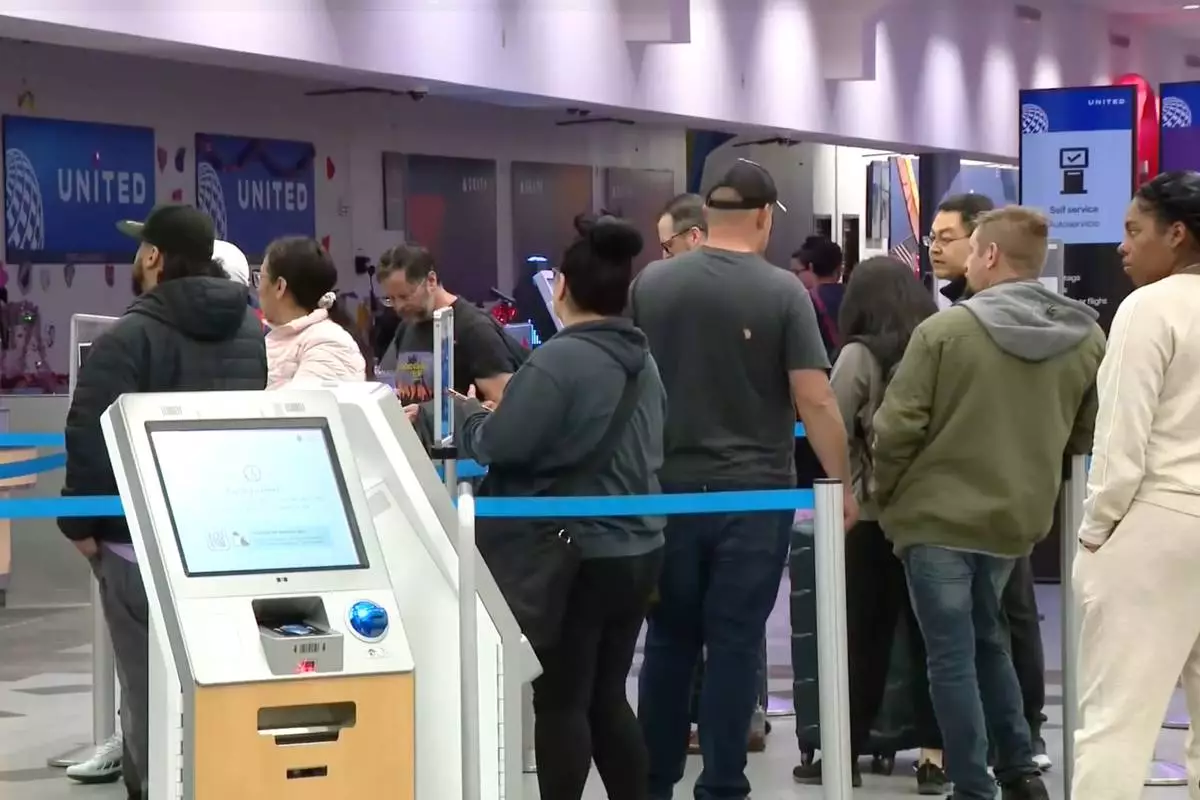
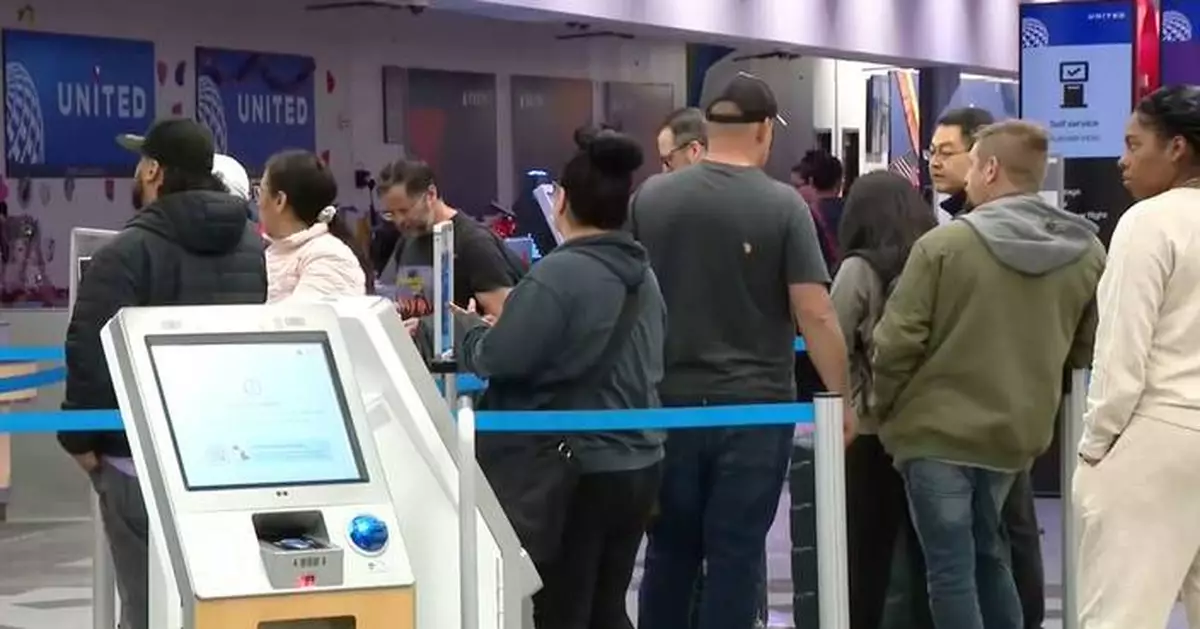
Passengers wait in line at the El Paso International Airport after all flights were grounded on Wednesday, Feb. 11, 2026. (KFOX via AP)
An Arizona sheriff's department got more than 4,000 calls within 24 hours after the release of videos of a masked person on Nancy Guthrie's porch. Many tips will be worthless. Others could have merit. Experts say one thing's certain: They can't be ignored.
Tips can solve crimes — big or small — and eerie images of a mysterious male covered head to toe have been the most significant clues shared with the public during Guthrie's nearly 2-week-old disappearance in the Tucson area.
“It's a tremendous amount of work,” said Roberto Villaseñor, a former Tucson police chief.
“In a situation like this, you really cannot do what's been done without tips and public input,” he said. “They have processed the scene. But once that’s done and exhausted, it's hard to move forward without additional information coming in.”
The Pima County sheriff and the FBI announced phone numbers and a website to offer tips about the apparent kidnapping of Guthrie, the 84-year-old mother of NBC “Today” co-anchor Savannah Guthrie. Several hundred detectives and agents have been assigned to the case, the sheriff's department said.
The FBI said it has collected more than 13,000 tips since Feb. 1, the day Guthrie was reported missing. The sheriff's department, meanwhile, said it has taken at least 18,000 calls.
"Every tip is reviewed for credibility, relevance, and information that can be acted upon by law enforcement," the FBI said Thursday on X, adding that the effort is a 24-hour operation. It said it won't comment on the tips received.
Law enforcement agencies are continuing to gather potential evidence. Investigators found several gloves, the nearest about 2 miles (3.2 kilometers) from Guthrie's home, and submitted them for lab analysis, the Pima County Sheriff’s Department said.
They collected DNA from Guthrie's property which doesn't belong to Guthrie or those in close contact with her, the department said. Investigators are working to identify who it belongs to.
The sheriff released a statement that stressed how his department is working with the FBI. “The Pima County Sheriff’s Department and the FBI continue to work jointly on this case. Our strong partnership is critical, and we remain fully committed to this collaborative investigation.”
Evidence requiring forensic analysis is being sent to the same out-of-state lab that has been used since the beginning of the case, something local FBI leadership agreed to, the department said.
Meanwhile, many people stopped Friday at KVOA-TV in Tucson, an NBC affiliate, to sign a large outdoor banner with a photo of Nancy Guthrie and the message “Bring her home.”
“They're like family, you know,” said Sandy Bryant, referring to her yearslong enjoyment of the “Today” show and the Guthrie family's local ties. “It's painful. It's scary, very scary.”
Major U.S. crimes for years have been cracked with a tip. In 1995, the brother and sister-in-law of Ted Kaczynski recognized certain tones in an anonymous, widely published anti-technology manifesto. Known by the FBI as the “Unabomber,” Kaczynski was found living in a shack in Montana and subsequently admitted to committing 16 bombings over 17 years, killing three people.
The 1989 murders of an Ohio woman and two teen daughters in Florida were solved three years later when St. Petersburg police asked the public if they recognized handwriting found in the victims' car. A former neighbor led investigators to Oba Chandler.
Retired Detroit homicide investigator Ira Todd recalled how images from a gas station camera solved the disappearance and death of a 3-month-old baby — and stopped authorities from pursuing the wrong person in 2001. “A niece of this guy saw it on TV and says, ‘That’s my uncle,’” he said.
The murders of four University of Idaho students in 2022 generated nearly 40,000 tips to state and federal authorities. None had a direct role in the capture of Bryan Kohberger, but the public's involvement nonetheless was “absolutely” important, said Lt. Darren Gilbertson of the Idaho State Police.
“That's one of the things that kept us going for weeks,” he said, while authorities awaited DNA and other evidence.
Gilbertson said much of the early vetting in the Idaho murders was done by the FBI. He said agents and analysts who were screening tips had a good grasp of what information could be spiked and what should be handed up to key investigators. Some tips arrived by regular mail.
“Aliens to bears to crazy conspiratorial ideas — don't even pass that along,” Gilbertson said.
Nancy Guthrie was last seen Jan. 31 and was reported missing the following day. Hours before her family knew she was gone, a porch camera recorded video of a person with a backpack who was wearing a ski mask, long pants, jacket and gloves — images that were released by the FBI along with a public plea for help.
The FBI on Thursday said the person, now a suspect, is a man about 5 feet, 9 inches tall with a medium build. The agency also named the brand and model of the backpack.
Neighborhood resident Laura Gargano said she's tried to be helpful. She recommended that authorities look at an underground tank at Guthrie’s home, which was checked last weekend. She also told them that a rental house, not typical for the neighborhood, had recently been vacated.
“I noticed the cars were gone,” she told The Associated Press. “It could have been nothing, it could have been coincidental, but it was a change.”
The sheriff's department has not said whether any tips from the videos have advanced the investigation.
“I'm hopeful,” said Villaseñor, the former Tucson chief. “I have seen cases where simpler and less detailed information has helped bring somebody about. Maybe someone recognizes clothing, maybe the bag. You never know what someone will key on.”
Anyone with information: (800) 225-5324; (520) 351-4900; http://tips.fbi.gov
Associated Press reporters Ty ONeil in Tucson, Arizona, Sejal Govindarao in Phoenix and Audrey McAvoy in Honolulu contributed to this report.
A banner reading "Bring her home" on a fence outside of the KVOA news station in Tucson, Ariz., on Friday, Feb. 13, 2026. (AP Photo/Ty ONeil)
Jeff Robb, a Seattle resident wintering in Tucson, signs a banner supporting Nancy Guthrie in Tucson Ariz., on Friday, Feb. 13, 2026. (AP Photo/Ty ONeil)
People walk by Nancy Guthrie’s home in the early morning under cloudy skies on Friday, Feb. 13, 2026 in Tucson, Ariz. (AP Photo/Ty ONeil)
An investigator looks inside a culvert in the neighborhood where Annie Guthrie, whose mother Nancy Guthrie has been missing for more than a week, lives just outside Tucson, Ariz., on Tuesday, Feb. 10, 2026. (AP Photo/Ty ONeil)
A small vigil grows near Nancy Guthrie's house, Wednesday, Feb. 11, 2026 in Tucson, Ariz. (AP Photo/Ty ONeil)