Skip to Content Facebook Feature Image

Federal law would stop the cars of drunk or impaired drivers, but it isn't happening yet

News

Federal law would stop the cars of drunk or impaired drivers, but it isn't happening yet
News

News

Federal law would stop the cars of drunk or impaired drivers, but it isn't happening yet

2026-02-14 13:01 Last Updated At:13:10

A federal law requiring impairment-detection devices inside all new cars survived a recent push to strip its funding but remains stalled by questions about whether the technology is ready.

Rana Abbas Taylor lost her sister, brother-in-law, nephew and two nieces when a driver with a blood-alcohol level almost four times the legal limit slammed into their car in January 2019 as the Michigan family drove through Lexington, Kentucky, on the way home from a Florida vacation.

The tragedy turned Abbas Taylor into an outspoken advocate for stopping the more than 10,000 alcohol-related deaths each year on U.S. roads. Lawmakers attached the Honoring Abbas Family Legacy to Terminate Drunk Driving Act to the $1 trillion infrastructure law that then-President Joe Biden signed in 2021.

The measure, often referred to as the Halt Drunk Driving Act, anticipated that as early as this year, auto companies would be required to roll out technology to “passively” detect when drivers are drunk or impaired and prevent their cars from operating. Regulators can choose from a range of options, including air monitors that sample the car's interior for traces of alcohol, fingertip readers that measure a driver's blood-alcohol level, or scanners that detect signs of impairment in eye or head movements.

Mothers Against Drunk Driving called it the most important piece of legislation in the organization's 45-year history. Still, implementation has been bogged down by regulatory delays, without any clear signals that final approval is near.

“The way we measure time is not by days or months or years. It’s by number of lives lost,” Abbas Taylor said in an interview with The Associated Press. “So when we hear manufacturers say, ‘We need more time,’ or ‘The tech is not ready,’ or ‘We’re not there yet,' all we hear is, ‘More people need to die before we’re willing to fix this.’”

A Republican-led effort to remove the Halt Act's funding was defeated in the U.S. House last month by a 268-164 vote. Another bill to repeal it entirely awaits a committee vote.

Most of the opposition has stemmed from suggestions that the law would require manufacturers to equip cars with a “kill switch". That would essentially allow them to “be controlled by the government,” Florida Gov. Ron DeSantis posted on the social platform X, drawing comparisons to George Orwell's dystopian novel “1984.”

The alcohol industry has fiercely defended the law against such arguments. Chris Swonger, president and CEO of the Distilled Spirits Council of the United States, said it specifically requires the technology to be passive, similar to other current safety mandates such as seat belts and air bags.

“There is no switch, there’s no government control, there is no sharing of data," he said. “That’s just an unfortunate scare tactic.”

But Rep. Thomas Massie, a Kentucky Republican who authored the defunding effort, said even the dashboard acting on its own could serve as “your judge, your jury, and your executioner." He cited the example of a mother who swerves in a snowstorm to avoid hitting a neighbor's pet, only for her car to deactivate itself because it determines she's impaired.

The Alliance for Automotive Innovation, a trade association for U.S. automakers, made a similar case to regulators in 2024, arguing that much more research was needed before mandating the technology.

“Even if 1 in 10,000 trips were expected to experience a false positive, this could result in thousands of unimpaired drivers encountering problems that prevent them from driving each day,” the Alliance wrote.

The National Highway Traffic Safety Administration, which is establishing the rules to implement the Halt Act, told the AP in an email that it's still “assessing developing technologies for potential deployment” and expects to report back to Congress soon. Even supporters predict the agency will push the decision at least into 2027, and auto companies still would have another two to three years to install it.

The Insurance Institute for Highway Safety, a research arm funded by auto insurers, recently announced that impairment detection and other technology aimed at curbing risky driving behavior would soon be included as criteria for a vehicle to earn one of its top safety awards.

Many states already have laws requiring breath-activated ignition interlock systems to be installed on the cars of DUI offenders. The system ultimately chosen under the Halt Act is intended to detect impairment beyond just drunk driving.

“We’re still sort of pushing back against this narrative that the technology doesn’t exist,” said Stephanie Manning, chief government affairs officer at MADD. “We’ve seen many different types of technology that can solve drunk driving. We just haven’t seen it deployed and implemented the way that we would like.”

To accelerate the timeline, one bill advancing in Congress would offer a $45 million prize to whoever can produce and deploy the first consumer-ready piece of technology. Abbas Taylor, whose family members were killed in the Kentucky crash, said efforts like that give her hope.

“When you've lost everything, there is nothing that will stop you from fighting for what is right,” she said. “But we see the writing on the wall, and we know it’s only a matter of time before this happens.”
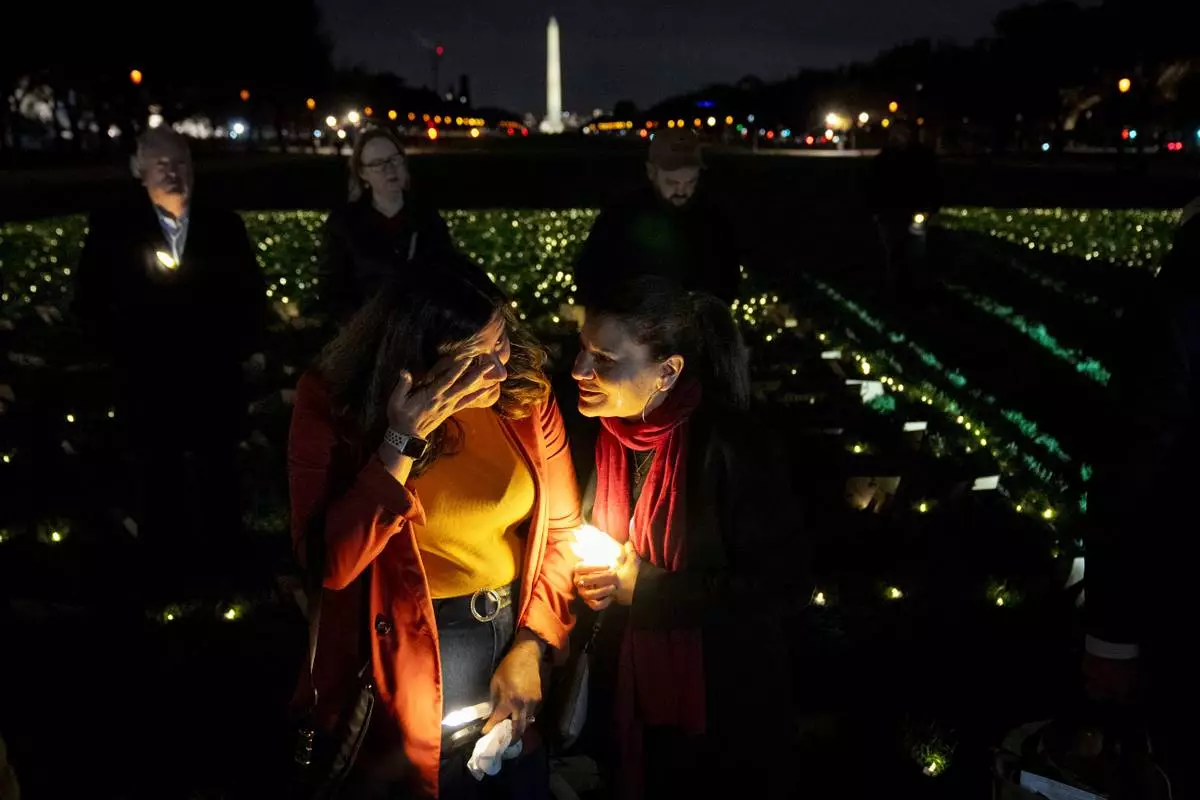
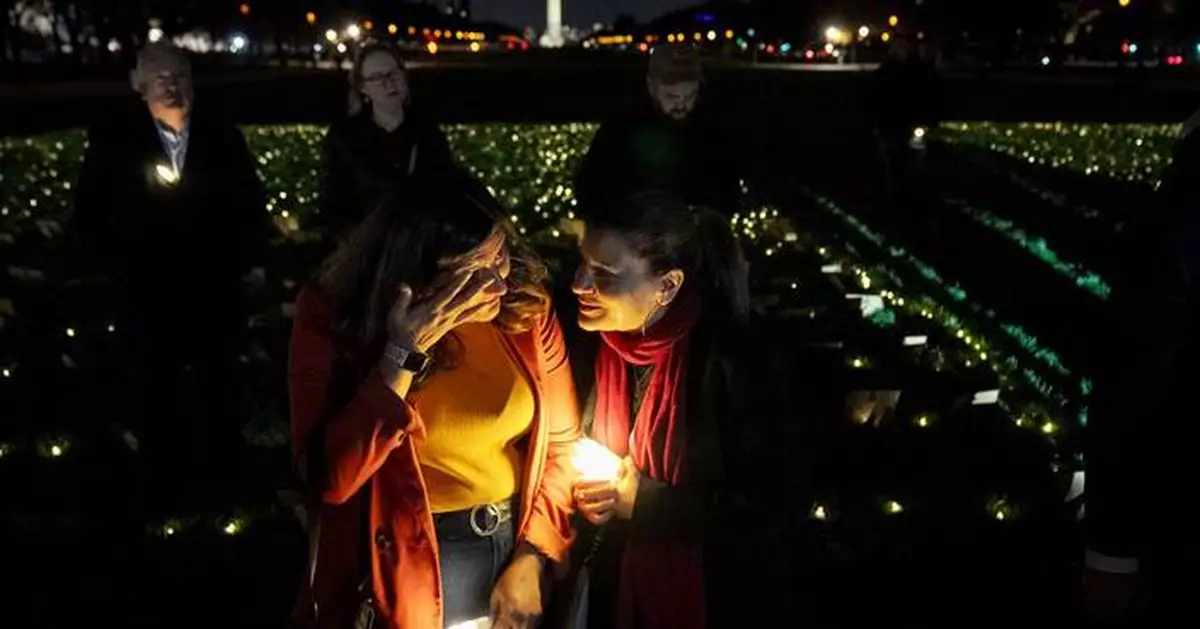
FILE - Madiha Maria, left, cries with Rana Abbas Taylor of Northville, Mich., who lost her only sister, brother-in-law and their three children to a drunk driver, during a candlelight vigil for people who had family members killed by drunk drivers, Tuesday, Nov. 19, 2024, on the National Mall, in Washington. (AP Photo/Jacquelyn Martin, File)

FILE - Madiha Maria, left, cries with Rana Abbas Taylor of Northville, Mich., who lost her only sister, brother-in-law and their three children to a drunk driver, during a candlelight vigil for people who had family members killed by drunk drivers, Tuesday, Nov. 19, 2024, on the National Mall, in Washington. (AP Photo/Jacquelyn Martin, File)

PHOENIX (AP) — Minutes after getting to a park in the middle of Phoenix, you can see flashes of green in the sky and hear chatter because love is in the air — or at least, the lovebirds are.

The small parrots are transplants from the other side of the world that are thought to be descendants of pet birds. Arizona is believed to be home to the largest colony of rosy-faced lovebirds outside southwestern Africa. They've been able to survive in a place known for sweltering weather by sticking close to humans and their air conditioning.

The lovebirds may have something to teach humans this Valentine's Day about keeping strong romantic bonds.

Rosy-faced lovebirds are originally from another arid region, the Namib Desert, which stretches from Angola, across Namibia and into South Africa. They are one of nine species of lovebirds.

Around the world, lovebirds are a popular pet. No one knows for sure how the lovebird colony started in Phoenix but they were first noticed around the city in the 1980s.

Some think pet lovebirds escaped or were let loose by their owners or escaped from a pet store, said Robert Carter, a volunteer for the Maricopa Bird Alliance who leads bird walks in the Phoenix area. Others have speculated that they could have flown all the way to Arizona but Carter thinks in that case, they would've found another arid area to stay along the way. The population has grown to an estimated 2,000 birds in Phoenix today, he said.

They can be seen sticking their heads out of the holes in cactus and palm trees that they roost in. They're also known to hang out near air conditioning vents on really hot days to at least be a little less hot, including at Arizona State University's science building.

While Carter thinks they should have been left in Africa, he admires their adaptability.

“They definitely show a sense of resilience to the situation that they're in," he said.

While Phoenix's lovebirds are believed to be the largest, most firmly established colony outside of Africa, there are also fairly well-established colonies of rosy-faced lovebirds in parts of Hawaii — on the Big Island and in Maui, said Kenn Kaufman, field editor for Audubon magazine who has written about lovebirds.

Another kind of lovebird, the Fischer's lovebird, appear to have established a small colony on the southern coast of Portugal, he said.

Lovebirds earned their name because of their tendency to form lifelong bonds with their mates, who like to perch close together, almost like they're cuddling. While many parrots mate for life, fewer than half of bird species do, Kaufman said.

While genetic testing has revealed that birds considered “socially monogamous” sometimes also breed with other birds while raising their young with their mate, lovebirds are not known to stray. They often clean their mate's feathers, especially the hard-to-reach ones, and feed one another food throughout their lives, not just when they are courting, like some other birds, Kaufman said.

People who have kept lovebirds as pets report that their mate seems depressed when they lose their partner by not being active or making abnormal calls, said Dr. Stephanie Lamb, associate veterinarian and bird specialist at the Arizona Exotic Animal Hospital.

Even when they are with other birds, lovebirds are not afraid to engage in some PDA — or as Kaufman says, “parrot display of affection." They pass food to each other with their beaks, which often looks like kissing, he said.

But the reality might strike people as not so cute: the food they're exchanging is regurgitated.

“It wouldn't be quite so romantic if humans were doing it,” he said.

All that care and attention helps keep their bonds strong over their long lives, he said. They live about 20 years, less than bigger parrots but longer than smaller songbirds, he said.

Still, Lamb said lovebirds, like other parrots, can sometimes be violent with each other, screaming and pecking one another with beaks powerful enough to crack open seeds. Sometimes they have to sit at opposite ends of their cage for a bit, until one comes over and nudges their way back into a cuddle, she said.

Robert Carter, of the Maricopa Bird Alliance, looks for lovebirds to photograph in Encanto Park, Jan. 18, 2026, in Phoenix. (AP Photo/Ross D. Franklin)

Robert Carter, of the Maricopa Bird Alliance, looks for lovebirds to photograph in Encanto Park, Jan. 18, 2026, in Phoenix. (AP Photo/Ross D. Franklin)

Lovebirds perch in a palm tree in Encanto Park, Jan. 18, 2026, in Phoenix. (AP Photo/Ross D. Franklin)

Lovebirds perch in a palm tree in Encanto Park, Jan. 18, 2026, in Phoenix. (AP Photo/Ross D. Franklin)

Lovebirds gather on the ground to feed in Encanto Park, Jan. 18, 2026, in Phoenix. (AP Photo/Ross D. Franklin)

Lovebirds gather on the ground to feed in Encanto Park, Jan. 18, 2026, in Phoenix. (AP Photo/Ross D. Franklin)

Robert Carter, of the Maricopa Bird Alliance, looks through binoculars for love birds in Encanto Park, Jan. 18, 2026, in Phoenix. (AP Photo/Ross D. Franklin)

Robert Carter, of the Maricopa Bird Alliance, looks through binoculars for love birds in Encanto Park, Jan. 18, 2026, in Phoenix. (AP Photo/Ross D. Franklin)

A lovebird sings in Encanto Park, Jan. 18, 2026, in Phoenix. (AP Photo/Ross D. Franklin)

A lovebird sings in Encanto Park, Jan. 18, 2026, in Phoenix. (AP Photo/Ross D. Franklin)

Recommended Articles