ISLAMABAD (AP) — Pakistan’s imprisoned former Prime Minister Imran Khan will undergo treatment for an eye condition at a specialized medical facility, a Cabinet minister said Saturday, days after the Supreme Court ordered a medical evaluation amid growing concerns about his eyesight.
Information Minister Attaullah Tarar wrote on X that an examination would be conducted by leading eye specialists as part of Khan’s ongoing treatment which began in late January after Khan reported a partial loss of vision in his right eye.
The minister did not say at which medical facility and when Khan would be treated.
“A detailed report will also be submitted to the Supreme Court. Conjecture, speculations and efforts to turn this into political rhetoric and mileage for vested interests may please be avoided,” Tarar said.
Earlier this week, Khan’s lawyer, Salman Safdar, told the Supreme Court that the former premier had lost roughly 85% of vision in his right eye. The court subsequently directed authorities to arrange a medical assessment by a panel of doctors and facilitate a telephone call between Khan, 73, and his sons before Feb. 16.
Supporters of Khan’s Pakistan Tehreek-e-Insaf party, or PTI, have staged protests in Islamabad and other cities, demanding he be moved from prison to a hospital for specialized treatment. Some of the lawmakers from PTI and its allies are also staging a sit-in outside the parliament.
Khan’s family angrily responded to Tarar’s announcement, saying it had not been consulted before he was taken for treatment and has called for family members and his personal physician to be present during any future procedures.
Khan’s sister, Aleema Khan, said Saturday on X that the authorities had arranged the call and Khan had spoken with his sons for about 20 minutes. Khan was “extremely happy” to hear their voices after a long gap, she said, adding the family was awaiting urgent treatment of Khan at an eye hospital under the supervision of Khan’s personal doctors.
The former cricket star turned politician has been in prison since 2023 after being convicted in a graft case.
He was removed from office in a parliamentary no-confidence vote in April 2022. He has alleged that his ouster was the result of a U.S.-backed conspiracy involving political rivals and Pakistan’s former army chief, Qamar Javed Bajwa — allegations denied by Washington, Pakistan’s military, and his political opponents.
Despite his legal troubles, Khan remains a central and popular figure in Pakistan, and the PTI wants his release. The issue of Khan’s partial vision surfaced in late January when Tarar said the former premier had undergone a medical procedure for an eye condition and was in good health.
The PTI party made a strong showing in the Feb. 8, 2024, parliamentary election but did not win a majority of the seats in the National Assembly, or lower house of the parliament. The party claimed the vote was rigged. The government denies such claims

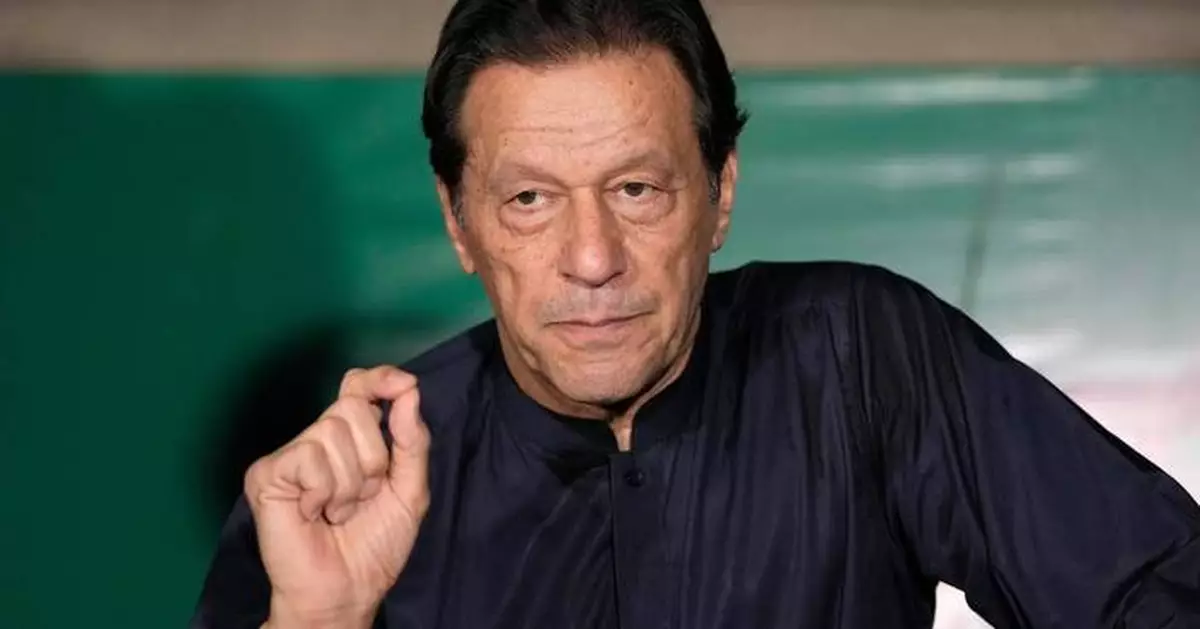
FILE - Pakistan's former Prime Minister Imran Khan gives a press conference at his home, in Lahore, Pakistan, on May 18, 2023. (AP Photo/K.M. Chaudary, File)
NEW YORK (AP) — Jack Hughes held the ball in his hands, occasionally tossing his latest souvenir in the air.
Hughes had done “Saturday Night Live” and cherished the chance to chat with Lorne Michaels, then appeared on “The Tonight Show Starring Jimmy Fallon” as part of the victory lap for the U.S. Olympic gold medal-winning men’s and women’s hockey teams. It only got better Friday when Hughes and women's goaltender Aerin Frankel threw out ceremonial first pitches at Yankee Stadium before the New York Yankees' home opener against the Miami Marlins.
“I knew a lot of things were coming, but this was the one thing I was always like wishing-slash-hoping for,” Hughes said. "Just so much fun. For both of us, it’s unreal."
Hughes scored in overtime in the men's final at the Milan Cortina Games, a few days after Frankel backstopped the women's team to also beating Canada for gold. It's the first time the U.S. has won double gold in the sport at the Olympics, and the sled hockey team made it a clean sweep at the Paralympics.
Frankel said her life hasn't changed much since other than seeing the impact the physical gold medal has on people who had never seen one.
“It’s cool to see how special that is for them,” said Frankel, who plays for the PHWL's Boston Fleet. “We’ve been super busy jumping back into pro seasons and stuff and making time for really cool opportunities like this.”
Frankel is from Westchester County and grew up in a family of Yankees fans. Hughes has become one over the seven years he has been in the area as the face of the franchise for the NHL’s New Jersey Devils.
Hughes played some baseball growing up, but needed to get his right throwing arm warmed up.
“We played in Dallas last week and my trainer ‘Frosty’ (Chris Scoppetto) brought gloves and I threw like 50 pitches right before morning skate,” Hughes said. “My shoulder was so sore, so I was like, ‘We’ve got to cool it.'”
Hughes' shoulder was fine. He scored twice that night against the Stars and had a five-point game Thursday night on the eve of his big baseball day.
Less than 24 hours after making 22 saves in a 3-0 shutout win over Winnipeg and U.S. Olympic starter Connor Hellebuyck, Oettinger threw a strike on his pitch from the top of the mound before the Texas Rangers' home opener. He got a loud ovation, with chants of “U-S-A!” when he was introduced.
That came after the national anthem, during which Rangers fans, like those at Stars games, yelled “Stars!” at both times that phrase came up in the song.
Oettinger wore his U.S. jersey and gold medal that everybody wants to see. Like Frankel, he said the coolest part to him is letting “other people wear it or take pictures with it and how excited they get. ... It just shows you how big the Olympics are. I think when you’re over there playing in it, you don’t really realize the magnitude, and then you get back and see how much it means to everyone is the best part.”
Oettinger, who played baseball until he was about 12, said he threw some Thursday with his younger brother, Thomas, who soon will turn 12. His brother was with him on the field and when they met former president George W. Bush, the former Rangers owner who was also at the game
“Brought my little brother and I got to take him through the clubhouse, and just a first-class organization,” Oettinger said. “Got to meet President Bush, so it has been a great day.”
A little over six weeks since scoring the tying goal late in the gold-medal game on a deflection of captain Hilary Knight's shot, Cleveland Heights' Laila Edwards got a rousing ovation for her first pitch from the mound over the plate before the Guardians' home opener.
“It’s so exciting, especially growing up and being a fan of Cleveland baseball,” Edwards said. “I played baseball in the backyard with my brother. He’s jealous, but I have to make him proud.”
Edwards, who's 22 and considered Knight's successor as the face of women's hockey in the U.S., has done a lot of winning so far this year. She helped Wisconsin to the second of back-to-back national titles, an experience she called surreal.
“I’m having so much fun and being grateful,” Edwards said. “We got back from the Olympics and three days later we were starting NCAA playoffs, so there was no rest there. That’s what we signed up for. And then to be able to win and meant everything."
AP Baseball Writer Stephen Hawkins in Arlington, Texas, and AP Sports Writer Joe Reedy in Cleveland contributed to this report.
AP NHL: https://apnews.com/hub/NHL
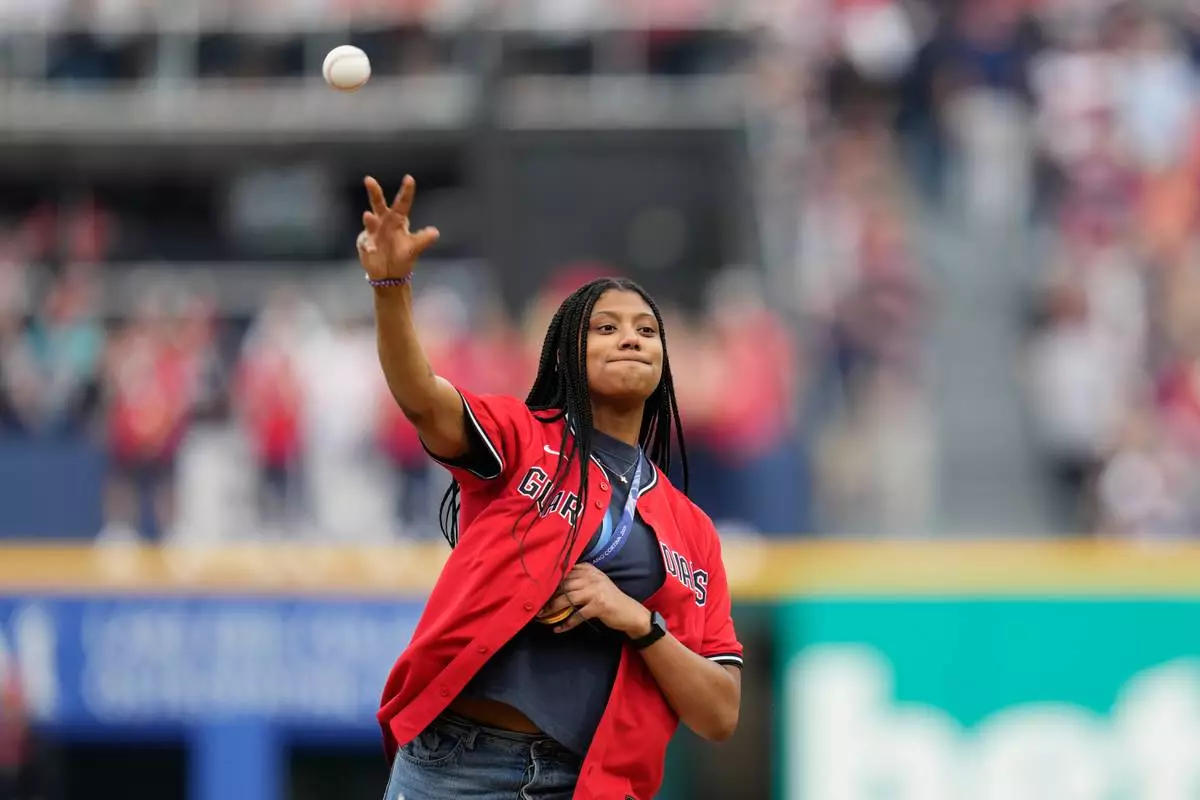
Olympic gold medal hockey player Laila Edwards throws out a ceremonial first pitch before an opening day baseball game between the Chicago Cubs and the Cleveland Guardians in Cleveland, Friday, April 3, 2026. (AP Photo/Sue Ogrocki)

Dallas Stars goaltender Jake Oettinger throws a ceremonial first pitch prior to the Texas Rangers' home-opener baseball game against the Cincinnati Reds, Friday, April 3, 2026, in Arlington, Texas. (AP Photo/Julio Cortez)
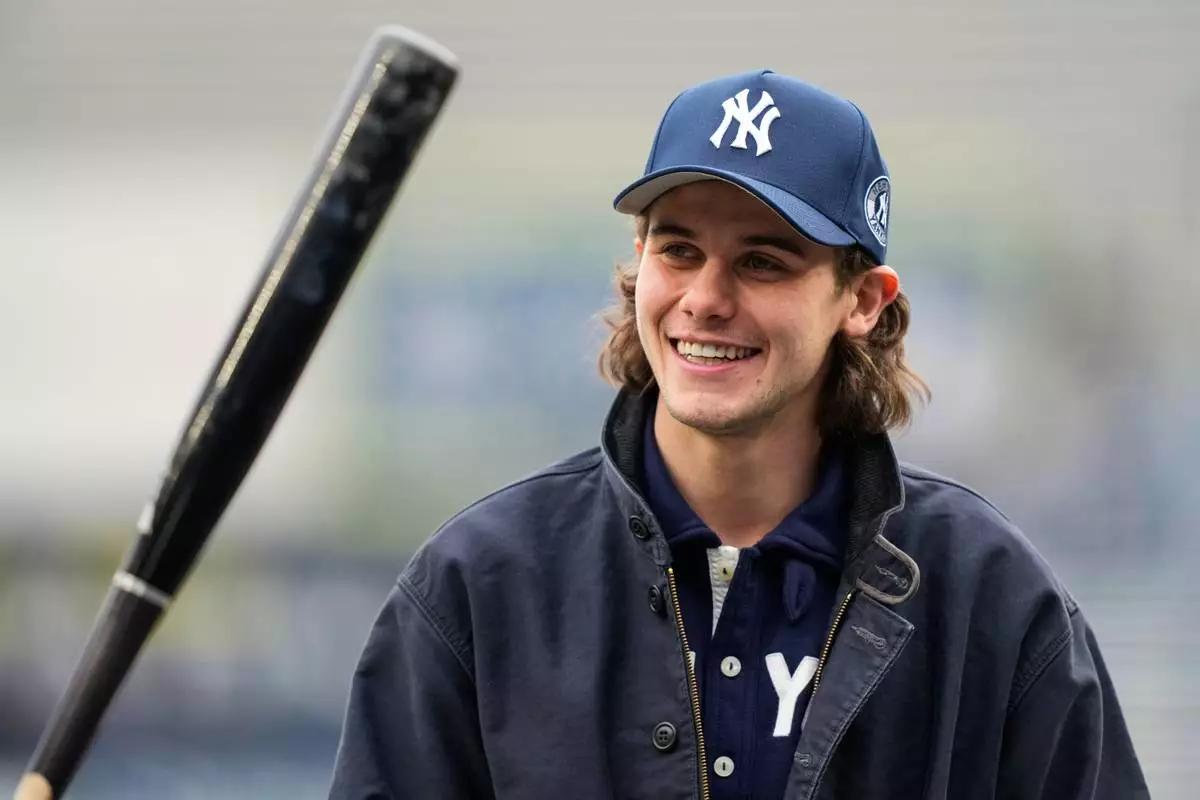
New Jersey Devils' Jack Hughes looks on during batting practice before his ceremonial first pitch for the home-opener baseball game between the New York Yankees and the Miami Marlins, Friday, April 3, 2026, in New York. (AP Photo/Yuki Iwamura)
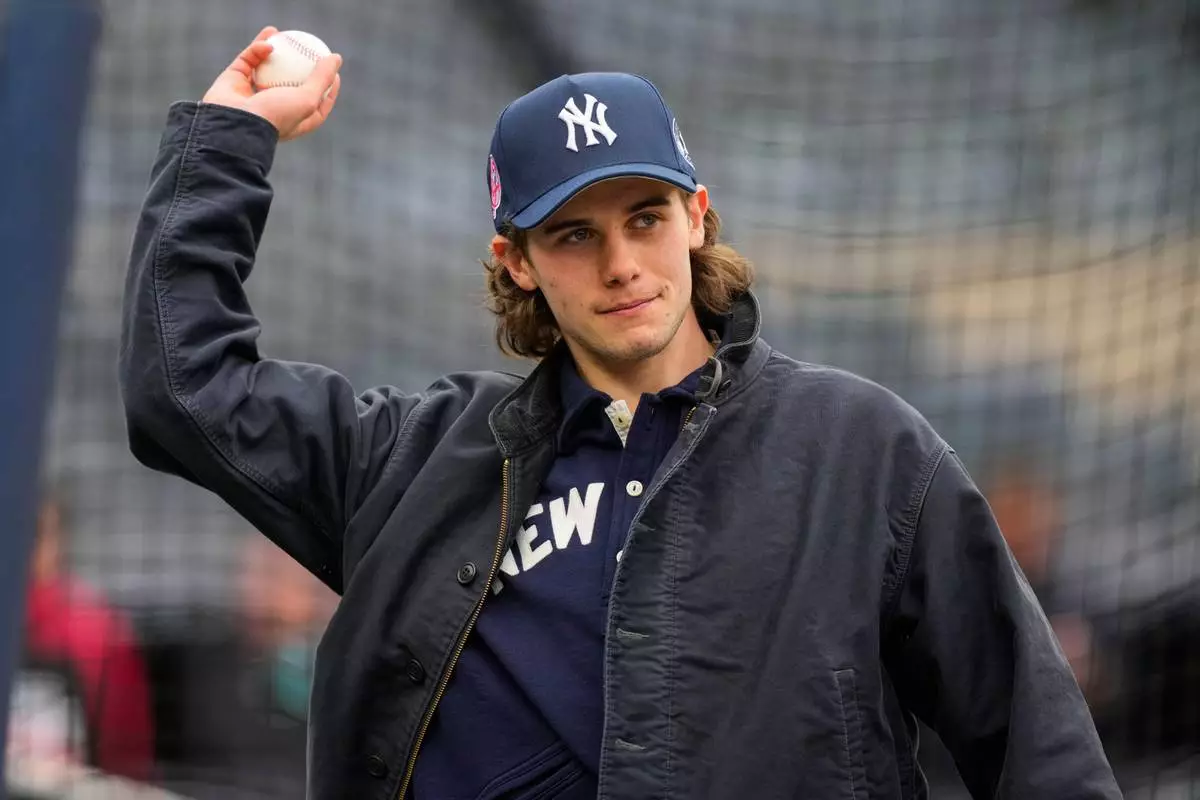
New Jersey Devils' Jack Hughes practices ahead of his first pitch before a home-opener baseball game between the New York Yankees and the Miami Marlins, Friday, April 3, 2026, in New York. (AP Photo/Yuki Iwamura)