PHOENIX (AP) — The seven Western states that depend on the Colorado River missed a deadline for the second time Saturday to agree on a plan addressing record drought and water shortages.
Arizona Gov. Katie Hobbs, California Gov. Gavin Newsom and Nevada Gov. Joe Lombardo released a joint statement calling on Upper Basin states to offer more concessions. Those states include Colorado, New Mexico, Utah and Wyoming.
“The Colorado River is essential to our communities and economies, and our states have conserved large volumes of water in recent years to stabilize the basin’s water supplies for years to come,” the governors said. “Our stance remains firm and fair: all seven basin states must share in the responsibility of conservation.”
Arizona, California and Nevada have offered to decrease Colorado River allocation by 27%, 10% and 17%, respectively, according to those states.
Colorado Sen. John Hickenlooper. who helped negotiate a river contingency plan in 2019 as governor, called the situation in the Colorado Basin “dire," pointing to the state's low snowpack.
"If we don’t address this problem together –- head-on and fast –- our communities, farms, and economies will suffer. The best path forward is the one we take together. Litigation won’t solve the problem of this long-term aridification," Hickenlooper said in a statement.
John Entsminger, the general manager of the Southern Nevada Water Authority, also expressed frustration at the lack of progress.
“The actions we have taken over the past two-plus decades are less about raising Lake Mead’s elevation than they are about protecting ourselves if things go from bad to worse,” Entsminger said in a statement.
The states previously let pass a November deadline set by the U.S. Bureau of Reclamation to devise a strategy to face water shortages after this year, when current guidelines will expire.
Over 40 million people across these states along with Mexico and Native American tribes rely on Colorado River water. The river is crucial to farming as well as water and electricity for millions of homes and businesses. Much of the water starts out as winter mountain snowfall in the Upper Basin, which amasses far more that way than it consumes. Lower Basin states, including agriculture-heavy regions, are bigger consumers.
Major cities including Denver, Salt Lake City, Albuquerque, Las Vegas, Phoenix and Los Angeles, are also big water consumers. Chronic overuse, drought and rising temperatures linked to climate change have lessened water flows.
How the water is allocated — especially in dry spells — and conserved has been the center of agreements among the states for decades. The original 1922 Colorado River Compact was calculated based on water amounts that doesn’t exist today, especially with the long-term drought.
The current round of negotiations among states have been going on over two years.
If no consensus can be reached, the federal government could step in and devise a plan that leaves parties dissatisfied and could even result in litigation.
Scientists recently found snow cover and snow depth in the West are at their lowest in decades. Some areas have seen their warmest December through early February. Normally, snow cover this time of year spans 460,000 square miles — about the size of California, Utah, Idaho and Montana. But, this year it is only California-sized, about 155,000 square miles, according to the National Snow and Ice Data Center.
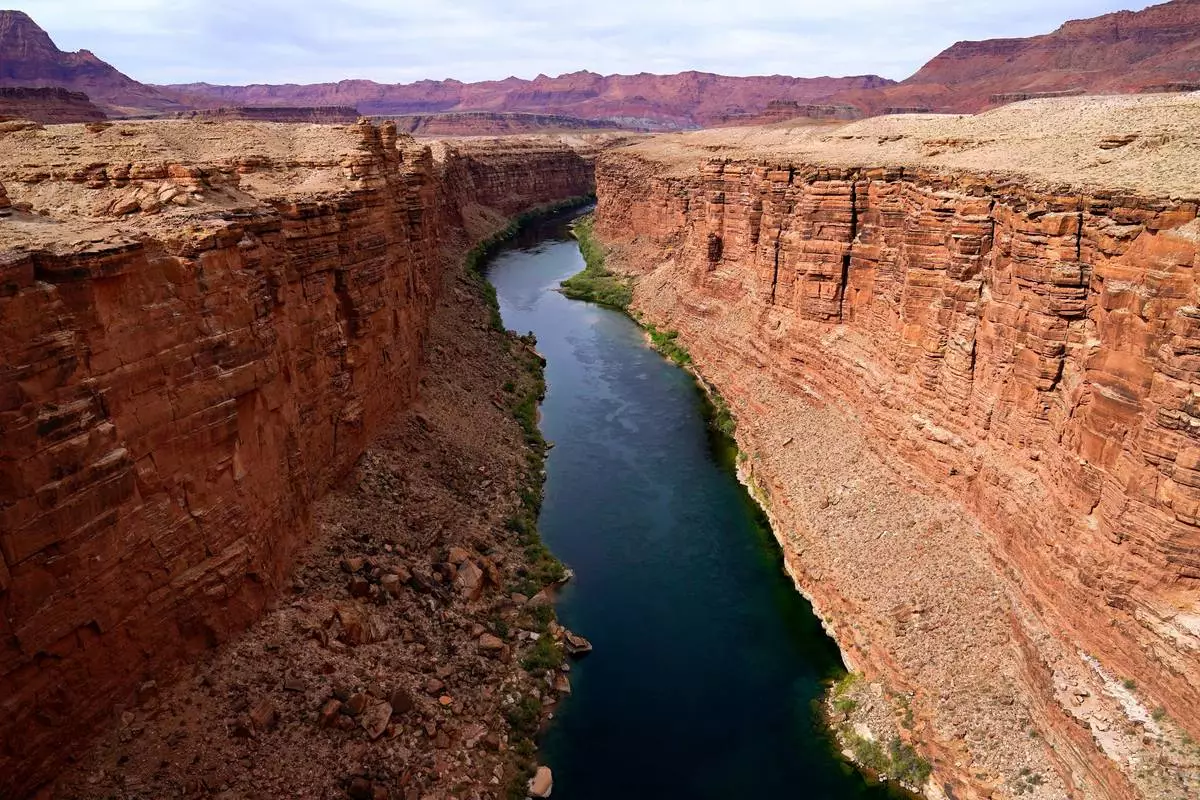
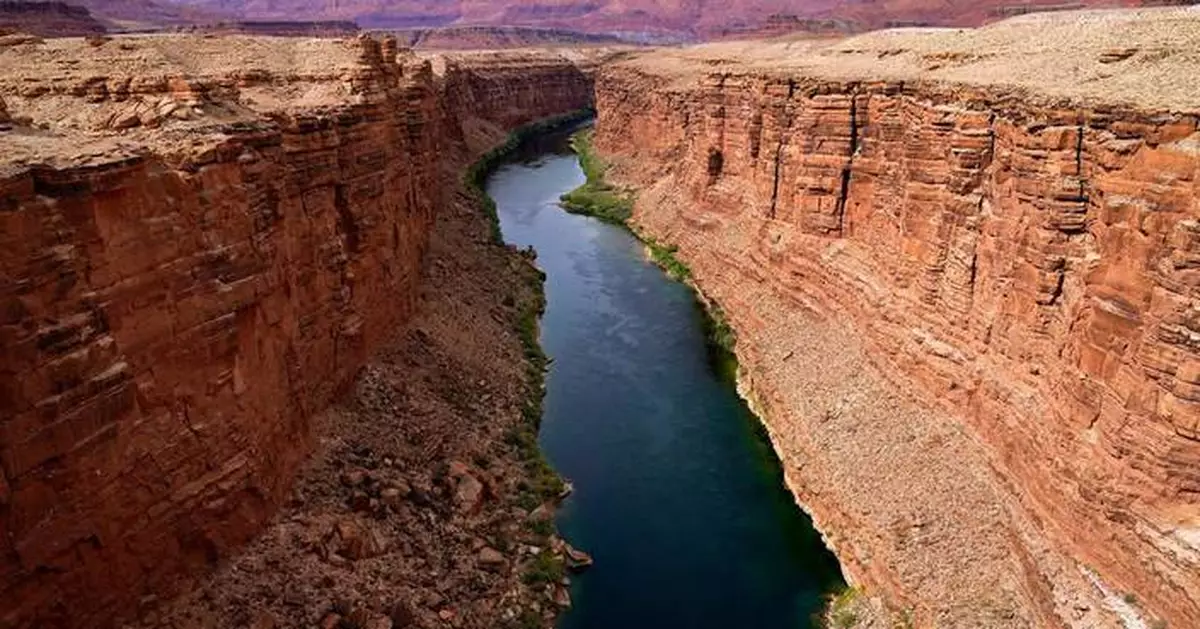
FILE - The Colorado River in the upper River Basin is seen, May 29, 2021, in Lees Ferry, Ariz. (AP Photo/Ross D. Franklin, File)
PHOENIX (AP) — Ta'Niya Latson scored 16 and Agot Makeer added 14 points and South Carolina played stifling defense to beat UConn 62-48 on Friday night, ending the Huskies' 54-game winning streak and advancing to the women's NCAA Tournament championship game.
The Gamecocks will face the winner of Texas and UCLA semifinal on Sunday for the title, capping off another March Madness. South Carolina (36-3) will be looking to win its fourth national championship. Their other three have come in the last decade.
UConn (38-1) entered the Final Four undefeated for the ninth time in school history and for the third straight time left without a title. The Huskies also lost in the 2017 and 2018 national semifinals. This was the fewest points UConn had scored since putting up 49 points in a national championship game loss to the Gamecocks in 2022.
The Huskies and Gamecocks played last season for the title and UConn came away with an 82-59 rout for the school’s 12th national championship. UConn also beat South Carolina handily during the 2024-25 regular season.
With less than a second remaining in the game, UConn coach Geno Auriemma walked across the court to shake hands with Dawn Staley and had an animated conversation with the South Carolina coach while pointing to the floor. Staley yelled back at him as assistants from both teams separated the two.
When the clock ran out finally, Auriemma walked straight to the tunnel and didn’t shake hands. The two teams did shake hands.
The teams came into the game as the second- and third-leading scoring teams in the nation, both averaging over 87 points per game. This was a defensive battle.
Leading 46-44 a few minutes into the third quarter, South Carolina scored five straight points, capped by Agot Makeer’s 3-pointer to extend the advantage to seven.
Sarah Strong hit a 3-pointer to get the Huskies back within 51-47 with 4:39 left. The Huskies didn't score again until Strong hit a free throw with 30.8 seconds left, after South Carolina had scored 11 straight points.
South Carolina clamped down on UConn’s two stars. Strong, who was honored as the AP Player of the Year on Thursday, had 12 points and 12 rebounds, but went 4 for 16 from the field. Azzi Fudd had just eight points for the Huskies, making only 3 of 15 shots.
UConn had its worst shooting night of the season finishing 19 for 61 (31.1%) from the field.
Trailing 26-24 at the half, South Carolina opened the third quarter with a 12-2 run to take the lead. The Gamecocks extended the advantage to 40-30 — the biggest deficit the Huskies’ had faced this season.
UConn, which missed 10 of its first 11 3-point attempts, then started to get hot from the field, hitting three consecutive 3-pointers, the last by Fudd to get within 40-39. The All-America guard had missed seven of her first eight shots as she was blanketed by South Carolina’s defense.
South Carolina’s Tessa Johnson scored the final four points of the quarter to make it 44-39.
Both teams had cruised to the Final Four, each winning in the first four rounds of the tournament easily. The Huskies had been rarely challenged all season long, routing their Big East opponents by record margins.
Facing their first real test in a long time, they had no answer.
The opening 20 minutes was full of missed shots and turnovers. The two teams combined to shoot 22 for 62 from the field (35.4%) and had 14 turnovers. UConn led 26-24 at the half.
There were dozens of former Huskies and Gamecocks players in the crowd including Diana Taurasi, Paige Bueckers and Aliyah Boston. Boston was sitting next to Flavor Flav, who is a huge supporter of women’s sports.
AP March Madness bracket: https://apnews.com/hub/ncaa-womens-bracket and coverage: https://apnews.com/hub/march-madness
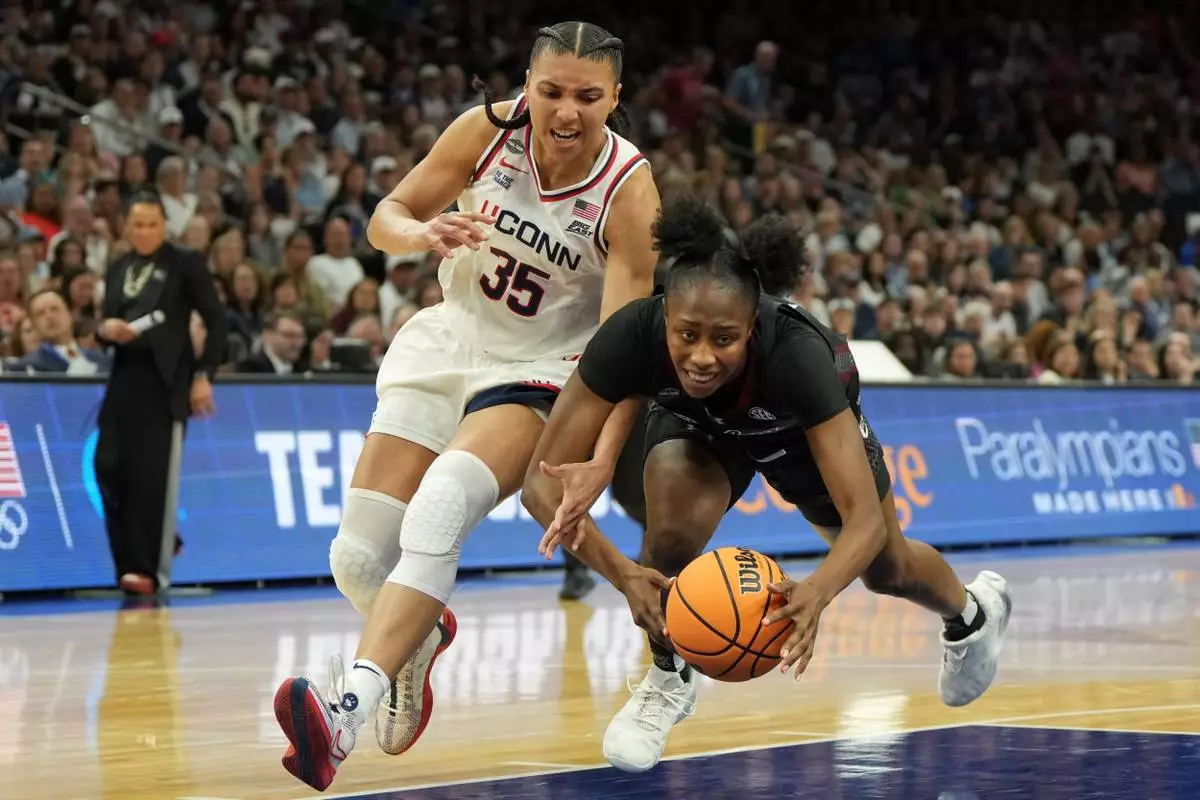
UConn guard Azzi Fudd (35) fouls South Carolina forward Joyce Edwards (8) during the second half of a woman's NCAA college basketball tournament semifinal game at the Final Four, Friday, April 3, 2026, in Phoenix. (AP Photo/Rick Scuteri)
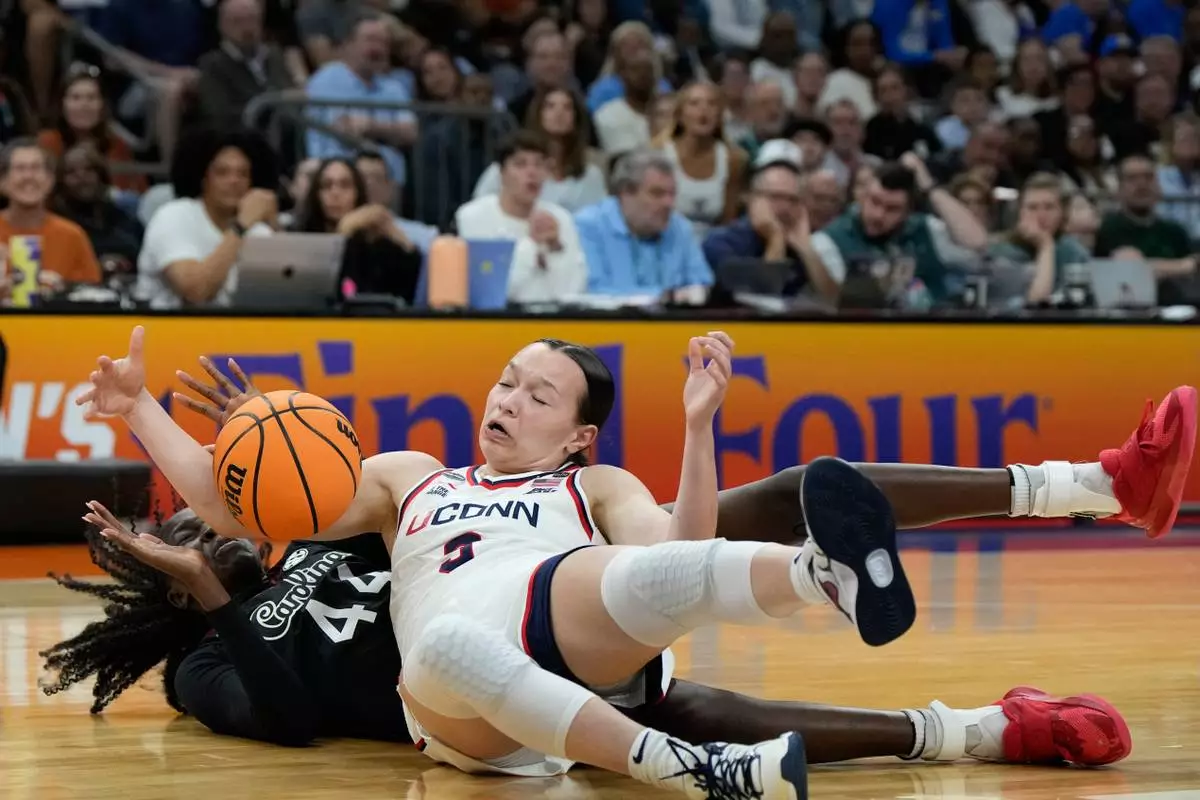
South Carolina guard Agot Makeer (44) and UConn guard Kayleigh Heckel (9) scramble for the ball during the second half of a woman's NCAA college basketball tournament semifinal game at the Final Four, Friday, April 3, 2026, in Phoenix. (AP Photo/Ross D. Franklin)
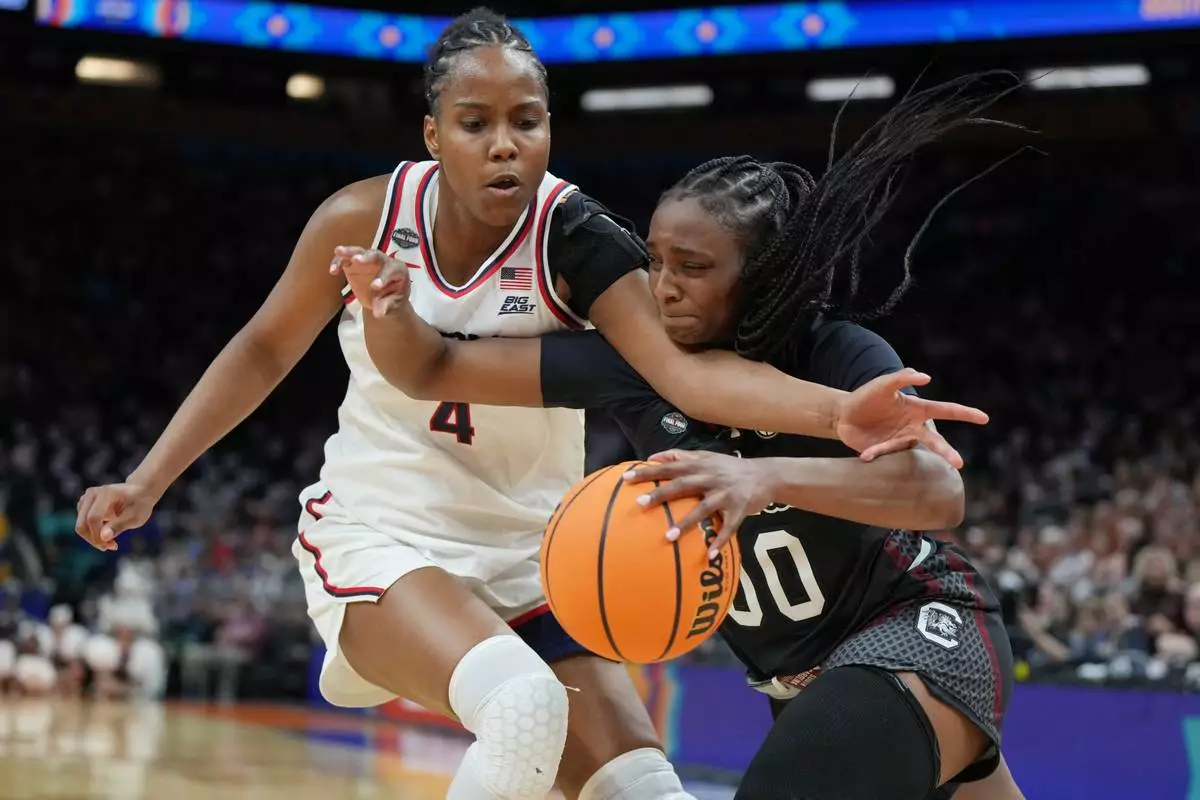
South Carolina guard Ta'Niya Latson (00) drives against UConn guard Blanca Quinonez (4) during the second half of a woman's NCAA college basketball tournament semifinal game at the Final Four, Friday, April 3, 2026, in Phoenix. (AP Photo/Rick Scuteri)
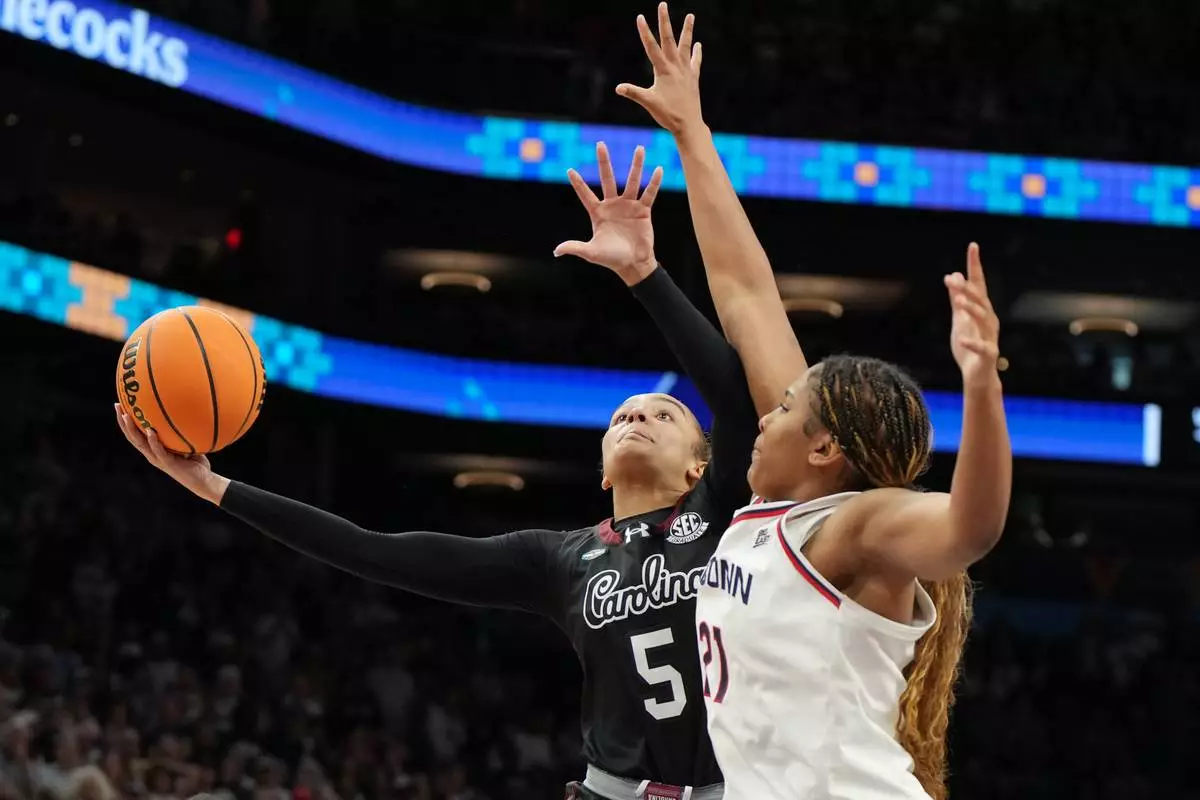
South Carolina guard Tessa Johnson (5) shoots over UConn forward Sarah Strong (21) during the second half of a woman's NCAA college basketball tournament semifinal game at the Final Four, Friday, April 3, 2026, in Phoenix. (AP Photo/Rick Scuteri)
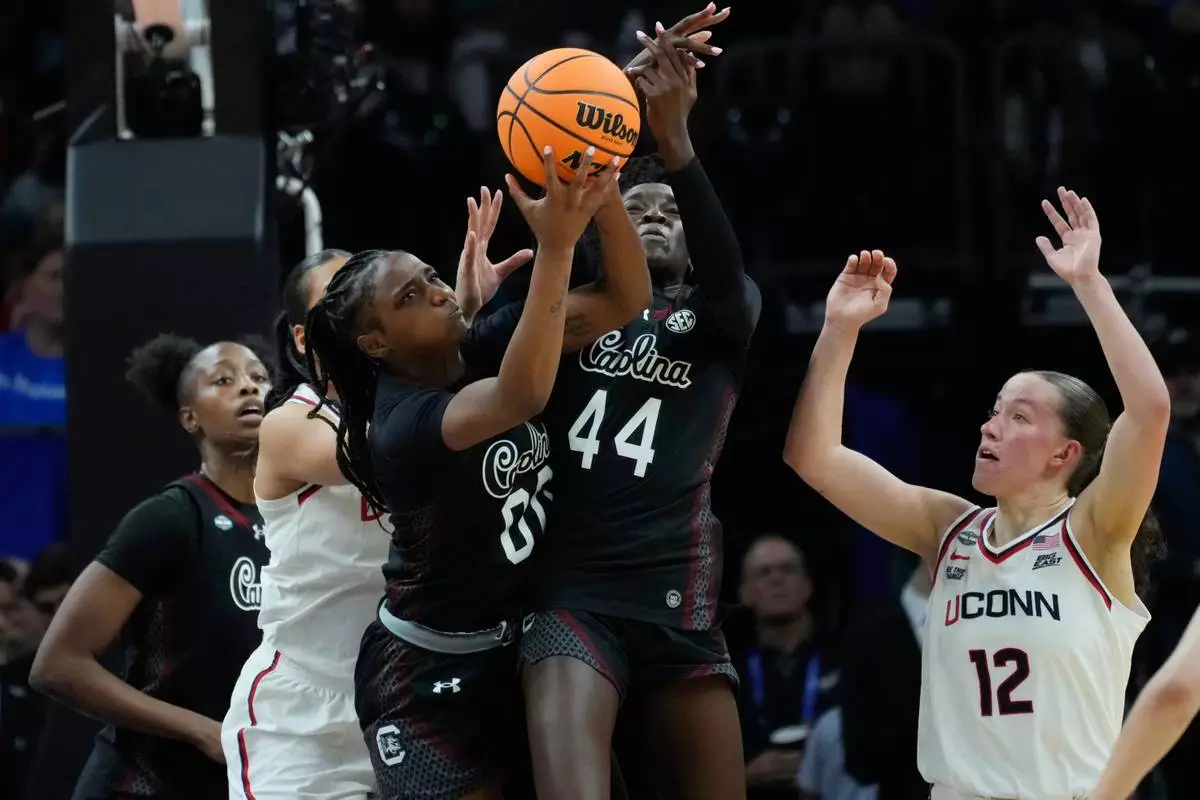
South Carolina guard Ta'Niya Latson (00) and South Carolina guard Agot Makeer (44) go for a rebound against UConn during the first half of a woman's NCAA college basketball tournament semifinal game at the Final Four, Friday, April 3, 2026, in Phoenix. (AP Photo/Ross D. Franklin)