Legal experts have urged the United States to fully unseal millions of pages relating to the case of late U.S. financier and convicted sex offender Jeffery Epstein, condemning redactions that obscure evidence of crimes tied to global political and business elites.
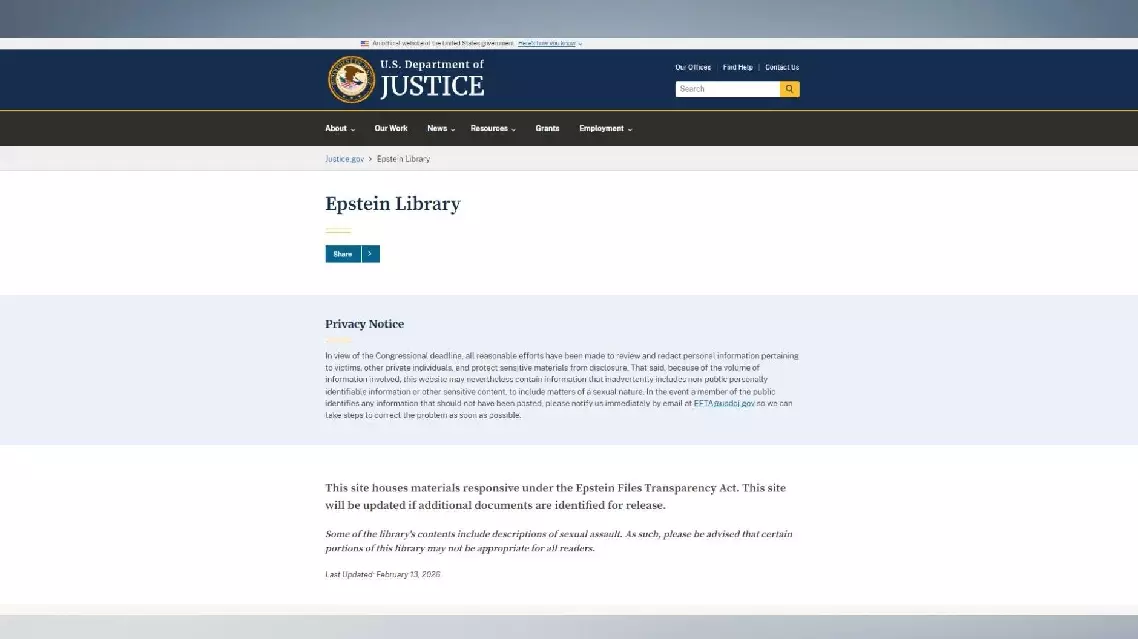
Late last month, the U.S. Department of Justice released the latest batch of the so‑called Epstein files, some three million pages, along with 2,000 video segments and 180,000 images, triggering scrutiny across the Atlantic and beyond. The disclosures have already prompted resignations among political figures over their ties to Epstein, who died under mysterious circumstances in federal custody in 2019.
The release represents only half of the six million pages compiled in the case, leaving vast portions of evidence sealed. Epstein, once a financier, ran a trafficking network that exploited underage girls and offered sexual services to wealthy and powerful figures at his New York mansion, on his private island, and elsewhere.
Among the names appearing in the documents are former U.S. President Bill Clinton, former British Prince Andrew Mountbatten-Windsor, and Microsoft founder Bill Gates, highlighting the global reach of Epstein’s network and intensifying calls for full transparency.
Legal scholars say the scale of Epstein's crimes defies precedent, framing his network as a global assault on human rights.
"Jeffrey Epstein ran a criminal network that spanned decades and amounted to crimes against humanity. It is simply appalling and inconceivable. We simply cannot comprehend such a grave, large-scale, long-running criminal network that involves a wide range of political figures and elites from Europe and the United States," said Zhi Zhenfeng, a researcher with the Institute of Law of the Chinese Academy of Social Sciences (CASS).
Epstein died in a New York prison in 2019, in what authorities ruled a suicide. His case is now being made public under the newly enacted Epstein Files Transparency Act.
Much of the evidence disclosed has been heavily redacted, leaving the public unable to grasp the full scope of events. U.S. authorities say the blacked-out sections are intended to protect personal privacy and national security.
Legal experts, however, argue that such redactions lack legal basis and insist the documents must be released in full.
"I believe all remaining materials must be released in full. What has been uncovered so far has seriously violated the conscience of civilized society, and trampled on the global consensus on human rights protection under the rule of law. Therefore, as global citizens, everyone should call on the United States to disclose the remaining materials and reveal the truth to the world," said Ye Yuantao, researcher with the Institute of Law of the CASS.
Jia Yin, assistant researcher with the Institute of Law of the CASS, stressed that "national security" is being used as a convenient shield against accountability.
"It's very convenient to hide secrets from the public in the name of national security. Because national security is like a catch-all concept, it can hold everything," said Jia.
"I think this case can be a turning point for the whole world to disenchant with American values and its slogans of human rights, protection, freedom and democracy. All of this dream has gone," Jia added.
Despite over a decade of investigations, only Epstein's longtime accomplice Ghislaine Maxwell has been held accountable, leaving a vast network of alleged co-conspirators untouched.
Calls mount for US to unseal Epstein case files as redactions spark outcry