A team of railway maintenance workers is working tirelessly to ensure the smooth and safe operation of a key coal transport line in northwest China’s Xinjiang Uygur Autonomous Region, clearing coal dust and cinders in harsh conditions.
Stretching 1,206 kilometers, the Golmud-Korla Railway is a crucial channel for transporting coal in Xinjiang. Starting in Korla in western Xinjiang, the railway crosses the Tarim River and passes through the Taklamakan Desert and uninhabited areas of the Altun Mountains, heading east all the way to Golmud in Qinghai Province. The line reaches a maximum elevation of 2,510 meters, equivalent to 800 stories high, functioning like a "sky ladder" that links the Tarim Basin with the Qinghai-Xizang Plateau.
As trains travel through tunnels linked by bridges in the Altun Mountains, the piston effect creates strong whirlwinds that blow coal dust and cinders from the gaps between carriages. The dust and cinders accumulate inside the tunnels, where, combined with sand carried in by strong winds, they pose significant safety risks. To address this, maintenance workers conduct routine cleaning operations.
The Yitunbulake workshop, headed by Qiao Qiyuan, along with the nearby Bashikagong workshop, is responsible for the emergency repair and maintenance of a 174-kilometer section of track in the uninhabited Altun Mountains. The stretch includes 107 bridges, 338 culverts and 13 tunnels. Teams from both workshops join forces for each cleaning operation.
As the Spring Festival travel rush gets underway, rising coal transport demand is adding to the workers’ cleaning workload.
A China Media Group (CMG) reporter joined Qiao’s team for a recent cleaning operation in the 13,195-meter Altun Mountain Tunnel, the highest and longest tunnel along the railway line. It took the team two hours to arrive at the work site, traversing the windswept Gobi Desert and the harsh mountain landscape.
The Altun Mountains tunnel complex includes 15 tunnels, most of which are located halfway up the mountain, so workers had to carry all necessary tools and hike up the mountain to reach the work site.
Both cleaning and maintenance tasks must be meticulously timed according to the train schedule. In the recorded cleaning task, the workers were given two and a half hours to clear coal dust and cinders from a 300-meter section of the tunnel.
"[During the window period], no trains pass through, allowing us a safe working environment. It's like being in a battle. Once the window period is given, we'd rush forward," said Qiao.
"We set a warning line here," Qiao explained. "If the dust accumulation approaches or exceeds that line, we must halt all other work and organize workers to clean it up. If the dust accumulation reaches rail level, it could lead to derailments."
The task was conducted three meters inside the tunnel, where there were heavy accumulations of coal dust along the tracks. Clearing this requires manual labor with shovels, generating significant dust with each scoop, which makes the workers' work more difficult. Meanwhile, the workers also have to overcome possible symptoms caused by oxygen deficiency at such a high altitude.
Despite the tight schedule and heavy workload, the workers carried out their tasks in an orderly and efficient manner, coordinating closely with one another. As time passed and the maintenance window drew to a close, Qiao wrapped up the operation and instructed all workers to exit the tunnel 10 minutes before the window period ended, as required.
"Every day we have different tasks to complete. If they remain unfinished, it will create a vicious cycle. Therefore, we have to grit our teeth and finish them all," said Qiao.
After completing an intense operation in the tunnel, Qiao finally took a moment to rest. Shortly afterward, a train approached from a distance, passing through the freshly cleaned tunnel.
"To the east is Golmud, and to the west is my hometown, Kurla," Qiao said with a hint of nostalgia. "The railway leads to my home. My home is over there, and I'm here. Really. Sometimes at night, especially during festivals and holidays, I watch the trains go by and hope that my family is on the train, getting off to see me."
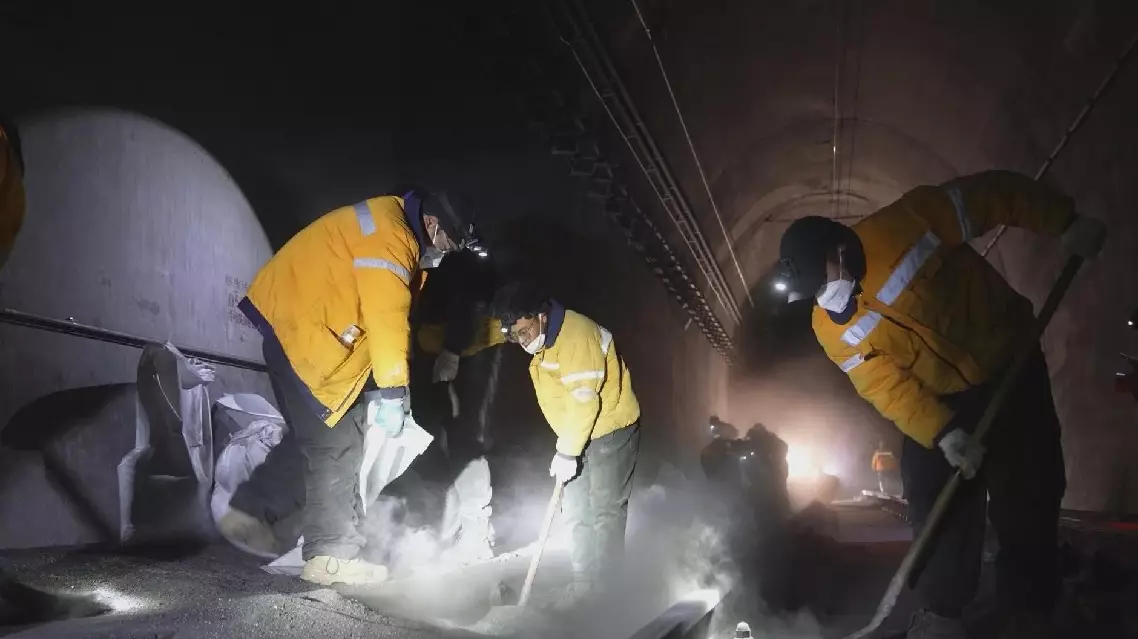
Railway workers brave harsh conditions to keep key Xinjiang coal transport line running smoothly