Skip to Content Facebook Feature Image

Expectations are low for the latest US-brokered talks between Russia and Ukraine

News

Expectations are low for the latest US-brokered talks between Russia and Ukraine
News

News

Expectations are low for the latest US-brokered talks between Russia and Ukraine

2026-02-16 20:06 Last Updated At:20:10

KYIV, Ukraine (AP) — A Ukrainian delegation was heading to Geneva on Monday for another round of U.S.-brokered talks with Russian officials, ahead of next week’s fourth anniversary of Russia’s full-scale invasion of its neighbor.

There was no anticipation of any significant progress on ending the war at the Tuesday-Wednesday meeting in Switzerland as both sides appear to be sticking to their negotiating positions on key issues, despite the United States setting a June deadline to reach a settlement. The future of Ukrainian land that Russia occupies or still covets is a central issue.

Ukrainian defenders remain locked in a war of attrition with Russia’s bigger army along the roughly 1,250-kilometer (750-mile) front line. Ukrainian civilians endure Russian aerial barrages that repeatedly knock out power and smash homes, while Ukraine has developed drones that can fly deep into Russian territory and strike oil refineries and arms depots.

The governor of western Russia’s Bryansk region said Monday that air defenses had shot down 229 Ukrainian drones in the previous 24 hours. No other Russian region has come under as many simultaneous drone attacks in a single day, Gov. Alexander Bogomaz said.

Ukraine’s Air Force, meanwhile, said Russia launched 62 long-range strike drones and six missiles of various types at Ukraine overnight.

Kremlin spokesman Dmitry Peskov said Monday that the talks in Geneva will deal with a “broader range of issues related to the territories and other issues connected to the demands that we have.” He didn’t elaborate on the issues.

A year of peace efforts by U.S. President Donald Trump’s administration has failed to stop the fighting. Western officials and analysts say Russian President Vladimir Putin believes that time is on his side, that Western support for Ukraine will peter out and that Ukraine’s resistance will eventually collapse under pressure.

Gen. Kyrylo Budanov, Ukrainian President Volodymyr Zelenskyy’s chief of staff, posted a photograph on Telegram showing himself standing next to a train with other members of the negotiating team, which is due to be led in Geneva by Rustem Umerov, Ukraine’s National Security and Defense Council chief.

Entering or leaving Ukraine entails a long overland journey, even for VIPs, as the country’s airspace is closed because of the war.

Putin’s adviser Vladimir Medinsky, who headed Moscow’s team of negotiators in the first direct peace talks with Ukraine in Istanbul in March 2022 and who has forcefully pushed Putin’s war goals, is returning to lead Moscow’s delegation. Medinsky has written several history books that focus on exposing purported Western plots against Russia and denigrate Ukraine.

Igor Kostyukov, the head of Russian military intelligence, and Deputy Foreign Minister Mikhail Galuzin, along with other officials, will also be in the delegation, Kremlin spokesman Peskov said.

Putin’s envoy Kirill Dmitriev will also travel to Geneva for separate talks with the U.S. on economic cooperation, according to Peskov. Moscow and Kyiv are keen to offer future business opportunities to Washington.

It was not clear which American officials would be in Geneva. At recent talks in Abu Dhabi, the capital of the United Arab Emirates, the Trump administration was represented by envoys Steve Witkoff and Jared Kushner.

The Russian and Ukrainian delegations were to report back to their leaders before any possible compromises discussed in Geneva could be accepted.

Follow AP’s coverage of the war in Ukraine at https://apnews.com/hub/russia-ukraine

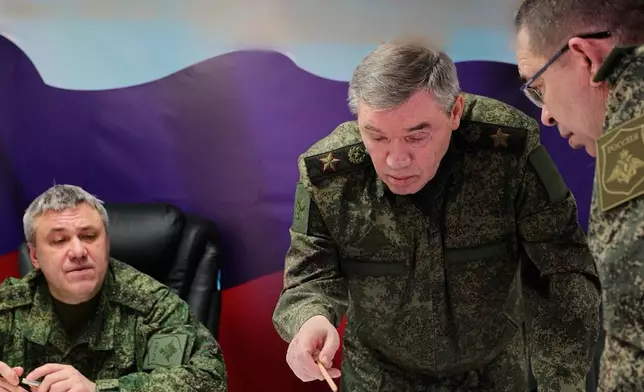
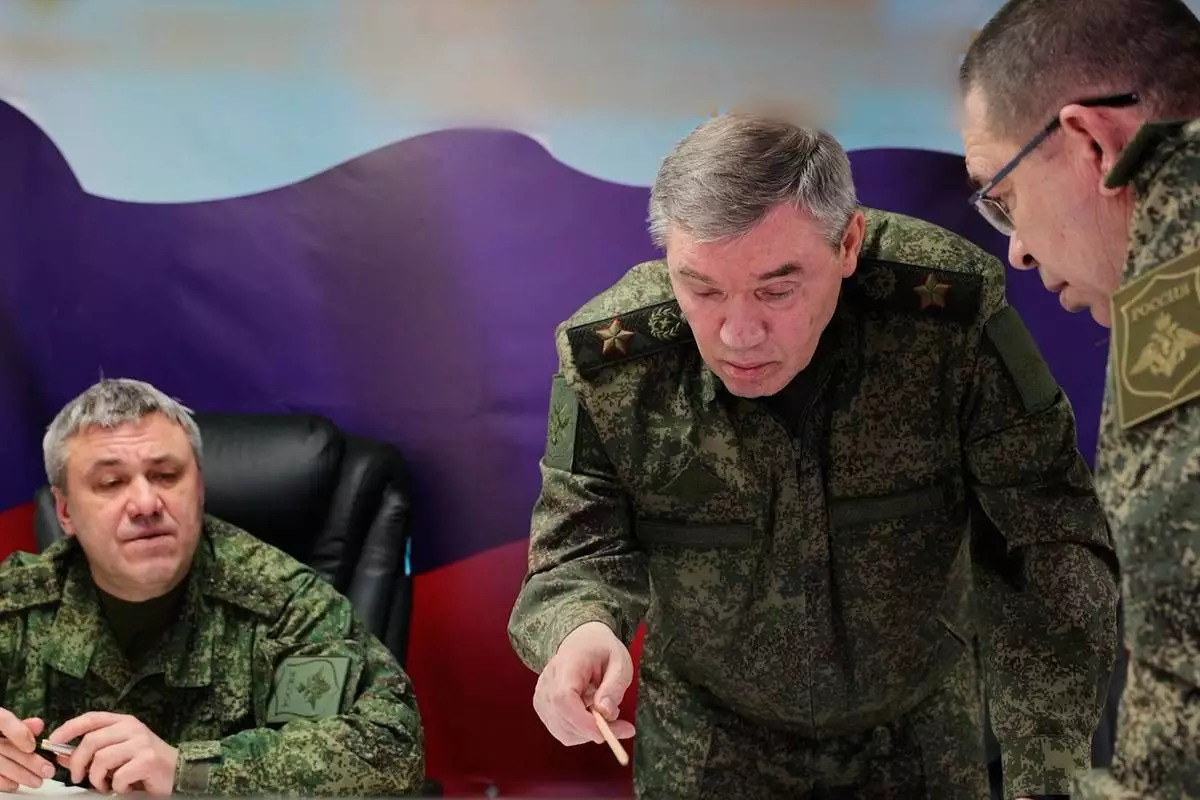
In this image made from video provided by Russian Defense Ministry Press Service on Saturday, Feb. 14, 2026, Russian Chief of General Staff Gen. Valery Gerasimov, second right, speaks while inspecting the troops involved in the fighting in Ukraine. (Russian Defense Ministry Press Service via AP)
In this image made from video provided by Russian Defense Ministry Press Service on Saturday, Feb. 14, 2026, Russian Chief of General Staff Gen. Valery Gerasimov, second right, speaks while inspecting the troops involved in the fighting in Ukraine. (Russian Defense Ministry Press Service via AP)
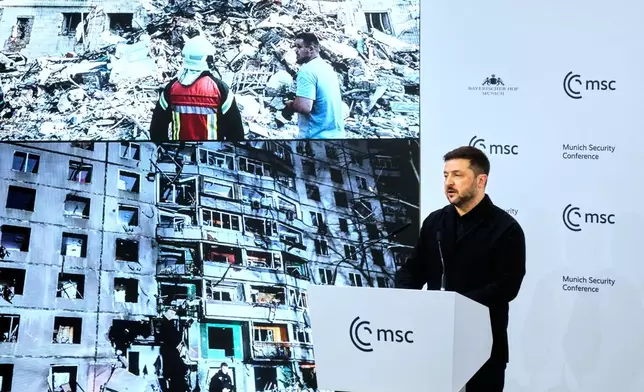
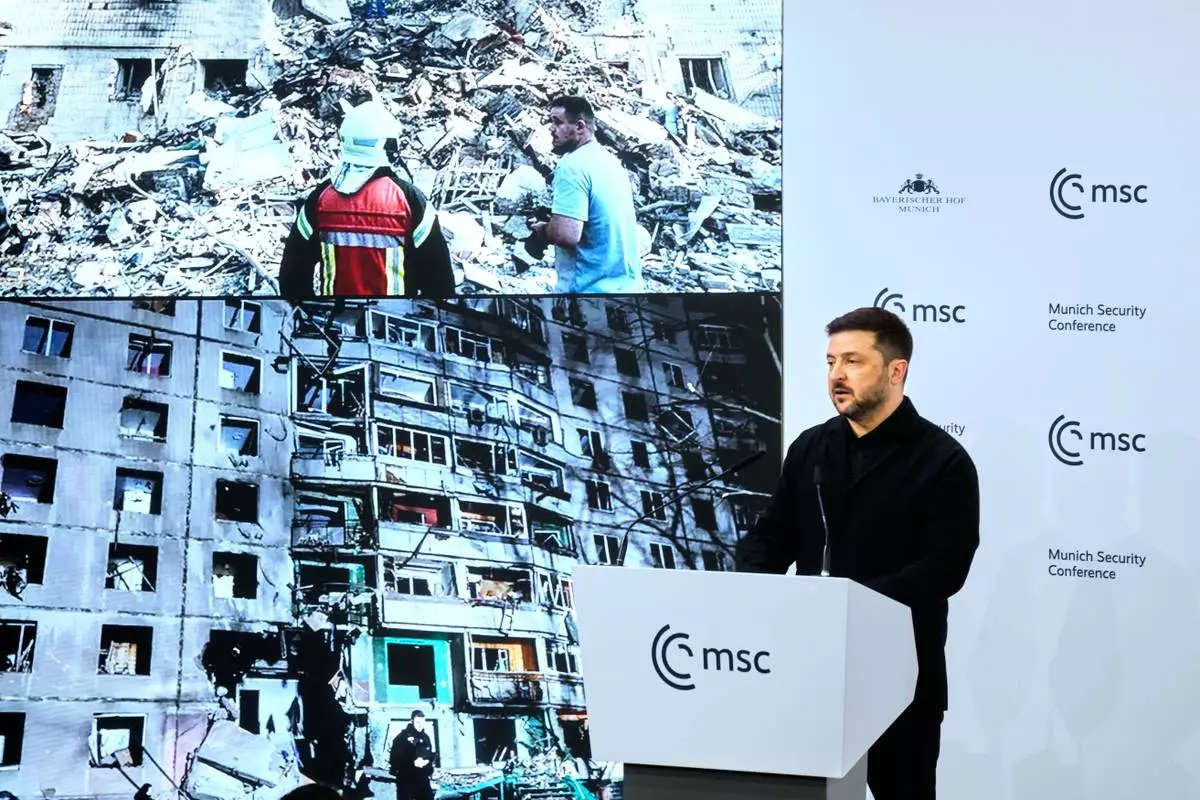
Ukraine's President Volodymyr Zelenskyy addresses the audience during a session at the Munich Security Conference in Munich, Germany, Saturday, Feb. 14, 2026. (AP Photo/Michael Probst)
Ukraine's President Volodymyr Zelenskyy addresses the audience during a session at the Munich Security Conference in Munich, Germany, Saturday, Feb. 14, 2026. (AP Photo/Michael Probst)
GENEVA (AP) — Iran's top diplomat met with the head of the U.N. nuclear watchdog agency on Monday, ahead of a second round of negotiations with the United States over Tehran's nuclear program.

Iranian Foreign Minister Abbas Araghchi met with Rafael Grossi, director-general of the International Atomic Energy Agency, and said he would also meet with Foreign Minister Badr al-Busaidi of Oman, which is hosting the U.S.-Iran talks in Geneva on Tuesday.

“I am in Geneva with real ideas to achieve a fair and equitable deal,” Araghchi wrote on X. “What is not on the table: submission before threats.”

As U.S. President Donald Trump ordered an additional aircraft carrier to the region, Iran on Monday launched a second naval drill in weeks, state TV reported. It said the drill would test Iran’s intelligence and operational capabilities in the Strait of Hormuz, the Persian Gulf and the Gulf of Oman.

Just before the talks, Iran announced its paramilitary Revolutionary Guard started the drill early Monday morning in the waterways that are crucial international trade routes through which 20% of the world’s oil passes.

Separately, EOS Risk Group said sailors passing through the region received by radio a warning that the northern lane of the Strait of Hormuz, in Iranian territorial waters, likely would see a live-fire drill Tuesday. Iranian state TV did not mention the live fire drill.

This is the second time in recent weeks sailors have received warning about an Iranian live fire drill. During the previous exercise, announced at the end of January, the U.S. military’s Central Command issued a strongly worded warning to Iran and the Revolutionary Guard. While acknowledging Iran’s “right to operate professionally in international airspace and waters,” it warned against interfering or threatening American warships or passing commercial vessels.

On Feb. 4, tensions between the Iranian and U.S. navies rose further after a U.S. Navy fighter jet shot down an Iranian drone that was approaching the aircraft carrier USS Abraham Lincoln in the Arabian Sea. Iran also harassed a U.S.-flagged and U.S.-crewed merchant vessel that was sailing in the Strait of Hormuz, the U.S. military reported.

On Sunday, Iran’s Deputy Foreign Minister Majid Takht-Ravanchi signaled that Tehran could be open to compromise on the nuclear issue, but is looking for an easing of international sanctions led by the United States.

“The ball is in America’s court. They have to prove they want to have a deal with us,” Takht-Ravanchi told the BBC. “If we see a sincerity on their part, I am sure that we will be on a road to have an agreement."

"We are ready to discuss this and other issues related to our program provided that they are also ready to talk about the sanctions,” he added.

Oman hosted a first round of indirect talks between the U.S. and Iran on Feb. 6.

Similar talks last year between the U.S. and Iran about Iran’s nuclear program broke down after Israel launched what became a 12-day war on Iran, that included the U.S. bombing Iranian nuclear sites.

The U.S. is also hosting talks between envoys from Russia and Ukraine in Geneva on Tuesday and Wednesday, days ahead of the fourth anniversary of the all-out Russian invasion of its neighbor.

Trump initially threatened to take military action over Iran’s bloody crackdown on nationwide protests last month, but then shifted to a pressure campaign in recent weeks to try to get Tehran to make a deal over its nuclear program.

Secretary of State Marco Rubio, visiting Budapest, reiterated on Monday that the U.S. hopes to achieve a deal with Iran, despite the difficulties. “I’m not going to prejudge these talks,” Rubio said. “The president always prefers peaceful outcomes and negotiated outcomes to things.”

Trump said Friday the USS Gerald R. Ford, the world’s largest aircraft carrier, was being sent from the Caribbean to the Mideast to join other military assets the U.S. has built up in the region. He also said a change in power in Iran “would be the best thing that could happen.”

Iran has said if the U.S. attacks, it will respond with an attack of its own.

The Trump administration has maintained that Iran can have no uranium enrichment under any deal. Tehran says it won’t agree to that.

Iran has insisted its nuclear program is for peaceful purposes. However, its officials increasingly threaten to pursue a nuclear weapon. Before the June war, Iran had been enriching uranium up to 60% purity, a short, technical step away from weapons-grade levels.

The direct meeting with Grossi is a significant step after Iran suspended all cooperation with the IAEA following the June war with Israel. The two also met briefly on the sidelines of the United Nations General Assembly in September. The IAEA said it has been unable to verify the status of Iran’s near weapons-grade uranium stockpile since the war. Iran has allowed IAEA some access to sites that were not damaged, but has not allowed inspectors to visit other sites.

Iran’s stockpile of uranium enriched to 60% could allow Iran to build as many as 10 nuclear bombs, should it decide to weaponize its program, Grossi previously told The Associated Press. He added that it doesn’t mean that Iran has such a weapon.

Israeli Prime Minister Benjamin Netanyahu rushed to Washington last week to urge Trump to ensure that any deal to include steps to neutralize Iran’s ballistic missile program and end its funding for proxy groups such as Hamas and Hezbollah.

Liechtenstein reported from Vienna. Associated Press writers Melanie Lidman in Tel Aviv, Israel, and Matthew Lee in Budapest, Hungary contributed to this report.

The Associated Press receives support for nuclear security coverage from the Carnegie Corporation of New York and Outrider Foundation. The AP is solely responsible for all content.

Additional AP coverage of the nuclear landscape: https://apnews.com/projects/the-new-nuclear-landscape/

In this photo released by the Iranian Foreign Ministry, Iranian Foreign Minister Abbas Araghchi, left, shakes hands with International Atomic Energy Agency (IAEA) Director-General Rafael Grossi during their meeting in Geneva, Switzerland, Monday, Feb. 16, 2026. (Iranian Foreign Ministry via AP)

In this photo released by the Iranian Foreign Ministry, Iranian Foreign Minister Abbas Araghchi, left, shakes hands with International Atomic Energy Agency (IAEA) Director-General Rafael Grossi during their meeting in Geneva, Switzerland, Monday, Feb. 16, 2026. (Iranian Foreign Ministry via AP)

In this photo released by the Iranian Foreign Ministry, Iranian Foreign Minister Abbas Araghchi, right, and International Atomic Energy Agency (IAEA) Director-General Rafael Grossi, left, hold a meeting in Geneva, Switzerland, Monday, Feb. 16, 2026. (Iranian Foreign Ministry via AP)

In this photo released by the Iranian Foreign Ministry, Iranian Foreign Minister Abbas Araghchi, right, and International Atomic Energy Agency (IAEA) Director-General Rafael Grossi, left, hold a meeting in Geneva, Switzerland, Monday, Feb. 16, 2026. (Iranian Foreign Ministry via AP)

FILE - Director General of the International Atomic Energy Agency (IAEA) Rafael Grossi looks on during a meeting with Egyptian Foreign Minister Badr Abdelatty and Iranian Foreign Minister Abbas Araghchi at Tahrir Palace in Cairo, Tuesday, Sept. 9, 2025. (AP Photo/Khaled Elfiqi, File)

FILE - Director General of the International Atomic Energy Agency (IAEA) Rafael Grossi looks on during a meeting with Egyptian Foreign Minister Badr Abdelatty and Iranian Foreign Minister Abbas Araghchi at Tahrir Palace in Cairo, Tuesday, Sept. 9, 2025. (AP Photo/Khaled Elfiqi, File)

FILE - Iranian Foreign Minister Abbas Araghchi looks on during a meeting with Director General of the International Atomic Energy Agency (IAEA) Rafael Grossi, and Egyptian Foreign Minister Badr Abdelatty, at Tahrir Palace in Cairo, Tuesday, Sept. 9, 2025. (AP Photo/Khaled Elfiqi, File)

FILE - Iranian Foreign Minister Abbas Araghchi looks on during a meeting with Director General of the International Atomic Energy Agency (IAEA) Rafael Grossi, and Egyptian Foreign Minister Badr Abdelatty, at Tahrir Palace in Cairo, Tuesday, Sept. 9, 2025. (AP Photo/Khaled Elfiqi, File)

Recommended Articles