THE HAGUE, Netherlands (AP) — Kosovo's former president cast himself Wednesday as a statesman and peacemaker as he urged international judges to acquit him of what he called groundless charges including murder, torture and persecution dating from his nation's struggle for independence.
“Throughout my life, I stood with the people of Kosovo defending freedom, life and dignity. I was always guided by the Western ideals of democracy, equality and justice,” Hashim Thaci told judges at the end of his nearly three-year trial at the Kosovo Specialist Chambers.
Supporters in the court’s public gallery at the beginning of his speech pushed against the glass wall separating them from the courtroom to wave at the former president before being chastised by security guards. One man could be seen wiping away tears as Thaci spoke.
Prosecutors have asked for a maximum 45-year prison sentence for Thaci and the other defendants, Kadri Veseli, Rexhep Selimi and Jakup Krasniqi. Thaci also faces a separate trial on charges of intimidating witnesses that will begin later this month.
Thaci resigned from office in 2020 to defend himself against the 10 charges of crimes against humanity and war crimes allegedly committed during his country’s 1998-99 war for independence from Serbia. He and three other former leaders of the separatist Kosovo Liberation Army (KLA) have been in custody since November 2020 at the court in The Hague, which formally is part of Kosovo’s judicial system. They must now wait — likely for months —- until judges reach verdicts.
In his closing statement to the court, Thaci, who has always insisted he is innocent, said "the only just decision would be my full acquittal.”
He said he returned from studies in Switzerland to help defend his homeland against brutal attacks by neighboring Serbia and ultimately becoming a key KLA representative in Western-brokered peace talks and later president of his home country.
“During all that time, the only power I had was the power of my voice," he said.
“I used my voice to promote a multi-ethnic and tolerant society in my country, in Kosovo,” he added.
On Monday, prosecutor Kimberly West painted a starkly different picture, saying that witnesses provided “overwhelming evidence” that Thaci and his fellow defendants, while commanding the Kosovo Liberation Army, pursued a policy of targeting political opponents and civilians perceived as collaborators and traitors, West told judges.
Thaci also dismissed claims that Kosovo Albanian fighters harvested organs from prisoners during the war as “Russian and Serbian propaganda.”
Wednesday's closing statements came a day after thousands of people marched through Kosovo's capital, Pristina, in support of Thaci and the other former fighters on trial in The Hague as the country marked the anniversary of its independence.
In 2008, Kosovo declared its independence from Serbia, a move that Belgrade refuses to recognize. Ties between Kosovo and Serbia remain tense, despite nine years of negotiations mediated by the European Union and supported by the United States.
Many Kosovars consider the court's proceedings an attempt to rewrite their history, saying it’s trying to equalize Serbia’s crimes to their suffering.
Most of the 13,000 people who died in the war in Kosovo were ethnic Albanians. A 78-day campaign of NATO airstrikes against Serbian forces ended the fighting. About 1 million ethnic Albanian Kosovars were driven from their homes.
Thaci said he returned to Kosovo to help the fight, saying: “I did not return to risk my life for control or for power. I returned to my homeland, risking my life, for freedom and for peace.”
Associated Press Writer Molly Quell in The Hague contributed.

FILE - Former Kosovo president Hashim Thaci, left, appears before the Kosovo Tribunal in the Hague, on April 3, 2023. (Koen van Weel/Pool Photo via AP, File)
WASHINGTON (AP) — Democratic candidates have notched a series of wins in recent special elections — but a new AP-NORC poll finds views of the Democratic Party among rank-and-file Democrats have not bounced back since President Donald Trump’s victory in 2024.
Only about 7 in 10 Democrats have a positive view of the Democratic Party, according to new polling from The Associated Press-NORC Center for Public Affairs Research. While the overwhelming majority of Democrats still feel good about their party, they're much less positive than they've been in the past.
The midterm elections are still many months away, and lackluster favorability doesn't spell electoral doom. Other factors could benefit Democrats this year, including broadly negative views of Trump and other Republicans. Additionally, recent polling has found that independents tend to identify more with the party that’s out of power, which could boost Democrats this year too. Historically, the party not in the White House has picked up seats in Congress in midterm elections.
But the lack of enthusiasm could be a longer-term problem for the party. Democrats' favorability of their party plummeted after the 2024 election, from 85% in September 2024 to 67% in October 2025. And despite overwhelming victories in November’s off-season elections and a string of wins since then, those views haven’t recovered. Other polling indicates that Democrats are deeply frustrated with their party.
At the same time, there's some potential good news for Democrats in the new poll. Although Republicans are slightly more enthusiastic about their own party, Americans in general don't think highly of either party. Health care is on many Americans' minds this year, and it's an issue where Democrats have a large advantage, according to the survey. Meanwhile, Republicans have lost some ground on two of Trump's signature issues, the economy and immigration, although Americans don't necessarily trust Democrats more on those issues as a result.
Other polling suggests that Democrats' post-2024 slump is unusually large.
In Gallup’s measure of favorability, Democrats’ positive views of their own party declined about 12 percentage points in the last year. That marked the lowest measure in that question’s history, which dates back to 2001. Notably, Democrats did not see a similar decline after their first loss to Trump in 2016.
That diminished view of the Democratic Party in the AP-NORC polling is consistent regardless of Democrats' age, race, ideology or educational background — suggesting that appealing to a specific group or two won't fix the problem.
A separate survey from the Pew Research Center last fall found roughly two-thirds of Democrats in September said their own party made them “frustrated” compared to just 4 in 10 Republicans.
Among those frustrated Democrats, about 4 in 10 felt their party was not fighting hard enough against Trump while about 1 in 10 said there was a lack of good leadership or a cohesive agenda.
It's not just Democrats — Americans aren't thrilled with either party right now.
Roughly one-quarter of Americans have a negative view of both the Democratic Party and the Republican Party, according to the AP-NORC data. That double-negativity is especially sharp among independents and Americans under 45.
About half of U.S. adults only view one party positively, and only about 1 in 10 feel good about both parties.
But Democrats' loss of goodwill is more recent. Polling over the last 25 years from Gallup shows that Americans used to feel much more positively toward the Democrats. Around 2010, public sentiment turned against the Democrats. Since then, at least half of Americans have held unfavorable views of the party, according to Gallup.
Negative views of the Democrats now rival the most negative points in time for the Republicans.
With health care at the top of Americans' priority lists as costs and premiums rise, Democrats have a possible advantage going into the midterm year.
About one-third of U.S. adults — 35% — trust the Democrats to do a better job handling health care, compared to 23% for the Republicans. That is broadly in line with the last time the question was asked in October 2025.
At the same time, Republicans have lost some ground on the issues that were key to Trump’s reelection — the economy and immigration. But Democrats haven’t managed to capitalize on it. Only about 3 in 10 U.S. adults, 31%, say Republicans are the party they trust to handle the economy, down slightly from 36% last year. But Democrats haven’t made any gains on this issue; rather, slightly more Americans now say they trust “neither” party to handle the economy.
Neither party has an edge on who is better equipped to manage the cost of living, which was first asked in the most recent poll.
Republicans are also down slightly on handling immigration. Only about one-third of U.S. adults trust them to better handle immigration, an apparent decrease from 39% in October. Democrats didn't appear to benefit from that shift either.
The AP-NORC poll of 1,156 adults was conducted Feb. 5-8 using a sample drawn from NORC’s probability-based AmeriSpeak Panel, which is designed to be representative of the U.S. population. The margin of sampling error for adults overall is plus or minus 3.9 percentage points. The margin of sampling error for Democrats overall is plus or minus 6.0 percentage points.
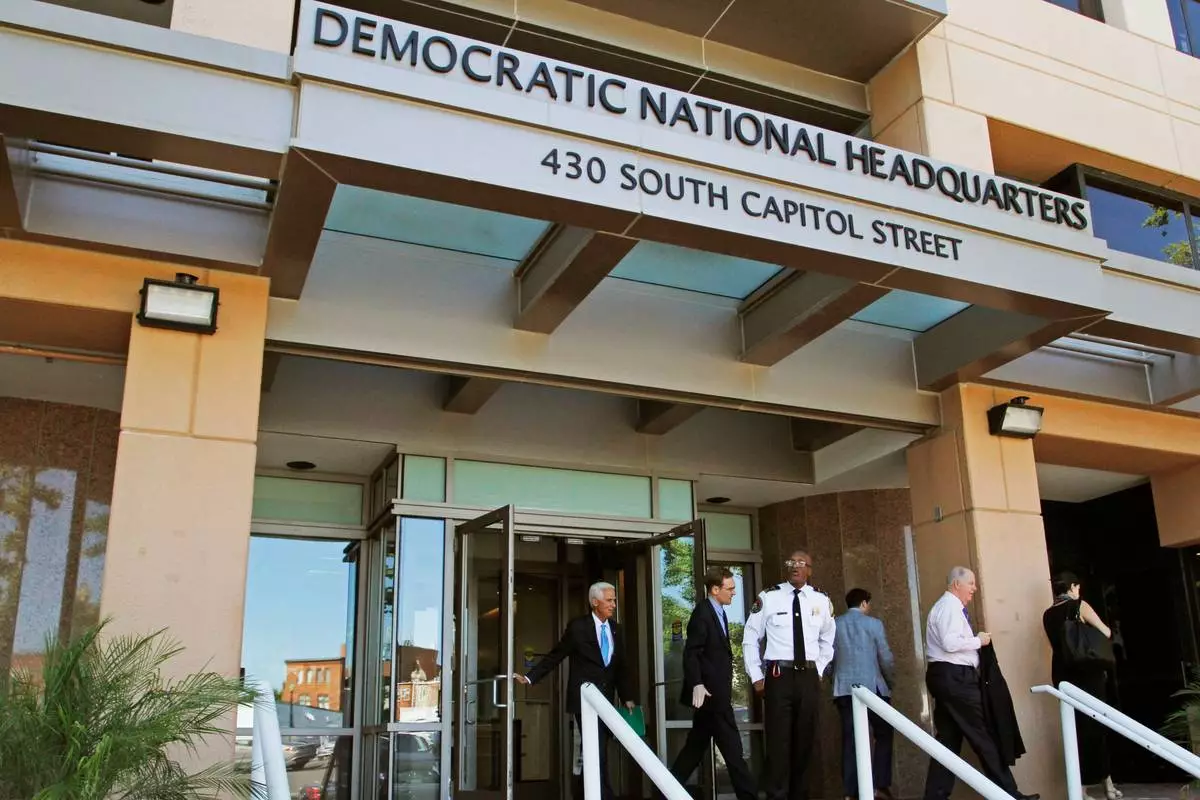
FILE - People stand outside the Democratic National Committee headquarters in Washington, June 14, 2016. (AP Photo/Paul Holston, File)
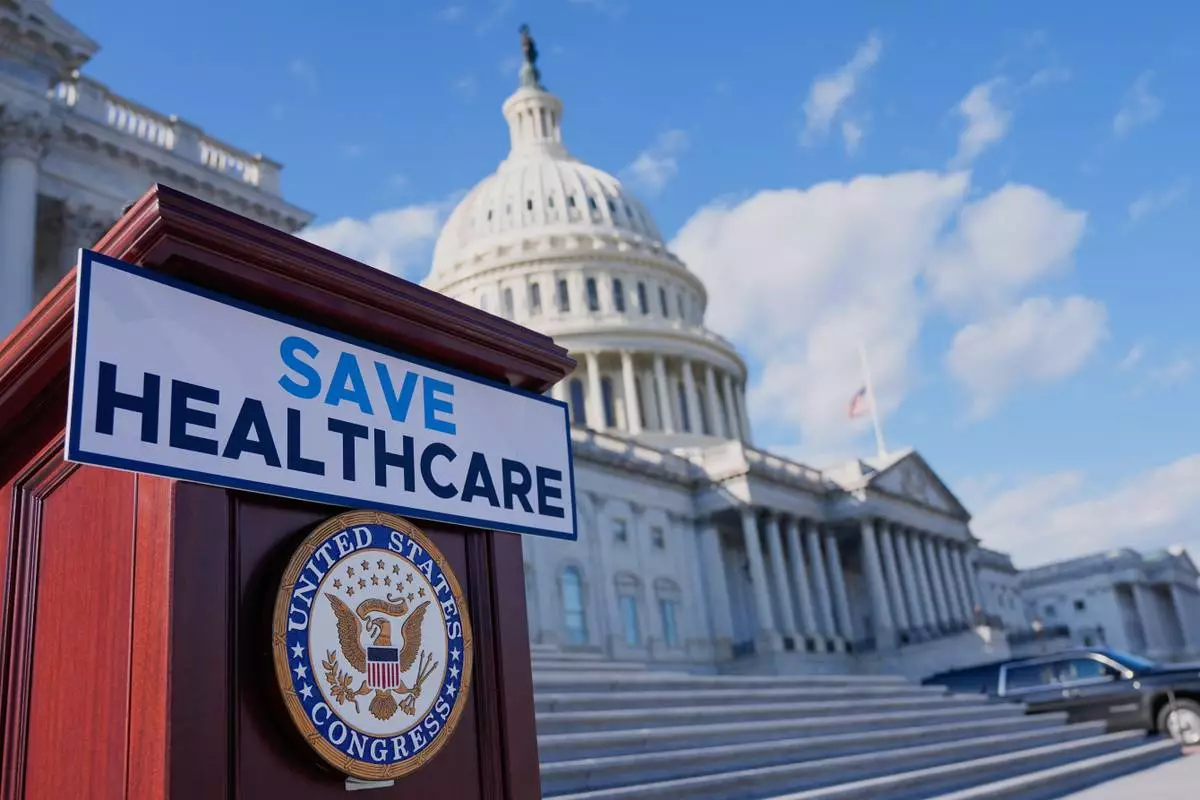
FILE - A podium is prepared before Democrats hold news conference on the health care funding fight on the steps of the House before votes to end the government shutdown on Capitol Hill, Nov. 12, 2025, in Washington. (AP Photo/Mariam Zuhaib, File)

FILE - Part of the stage with the DNC logo is seen at the Democratic National Convention Thursday, Aug. 22, 2024, in Chicago. (AP Photo/Brynn Anderson, File)

FILE - Birds fly near the U.S. Capitol during sunrise, Feb. 13, 2026, in Washington. (AP Photo/Tom Brenner, File)