Skip to Content Facebook Feature Image

Brazil's samba school celebrates cultural fusion with Chinese traditions in carnival parade

China

China

China

Brazil's samba school celebrates cultural fusion with Chinese traditions in carnival parade

2026-02-19 17:12 Last Updated At:19:27

The carnival celebration of a century-old samba school in São João da Barra, Brazil, reached its climax as G.R.E.S Chines staged its vibrant annual parade, blending Brazilian and Chinese cultural elements in a colorful event that drew a large crowd and recent official recognition as a cultural heritage site.

Nearly 93 years ago, a small local carnival group in this quiet coastal town was formed with a unique purpose: to embrace and showcase Chinese culture abroad. Over the decades, it evolved into the full-fledged samba school called G.R.E.S Chines, whose lively parade now stands as a testament to this enduring cross-cultural legacy.

The school's colorful annual carnival parade was recently recognized as cultural heritage by the state government of Rio de Janeiro.

The parade, themed "The Legacy of Our Ancestors," showcased a stunning fusion of traditions. After months of meticulous preparation, thousands of feathers, sequins, and colorful costumes animated the street, culminating in a magnificent procession.

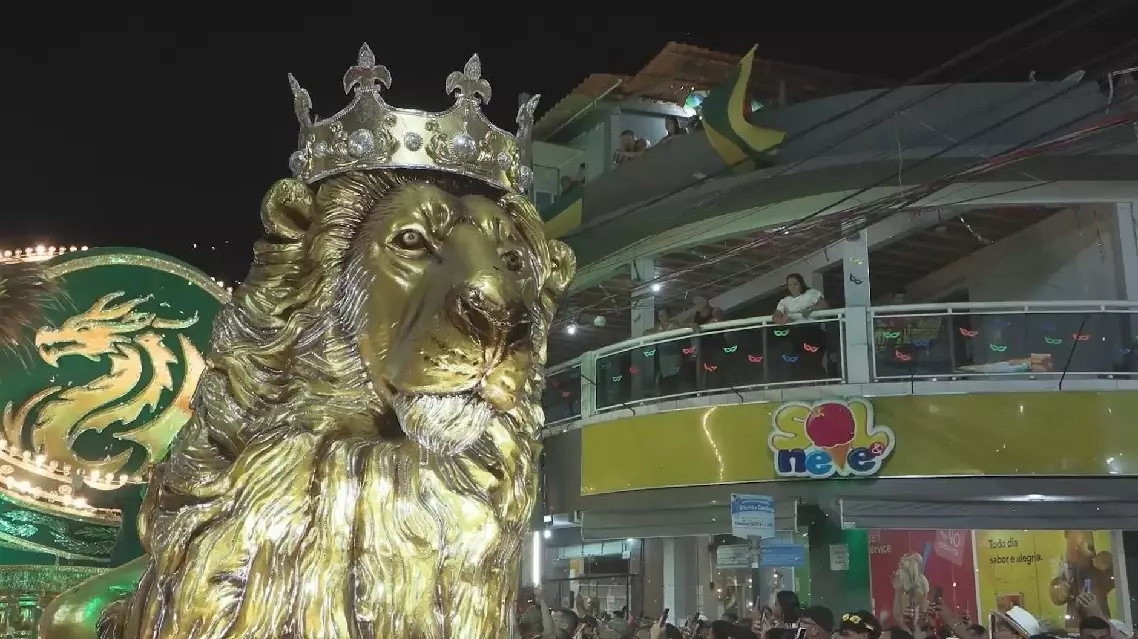
The event kicked off with an elaborate dragon float symbolizing wisdom and renewal, followed by 350 dancers and multiple floats depicting symbolic Chinese figures, all performed with Brazilian carnival flair.

Town historian Fernando Antonio Lobato, parading as a traditional Chinese elder, knows the story well.

"Ninety-three years ago, some local people decided to dress as Chinese figures for Carnival. Over time, it grew into something with rich textures, showing the traditions of ancient China," he said.

The Chines has become such a tradition that the state of Rio de Janeiro declared it cultural and historical heritage in 2019, making it one of only eight samba schools to receive that honor.

School director Luciano Vicente, who designed the costumes and floats, explained the significance of this year’s theme.

"This theme draws on the beauty and richness of Chinese culture, bringing it here to our city. And at the same time, it shares our joy and the vibrant spirit of our country, Brazil," he said.

The parade's grand finale featured a powerful, roaring icon -- symbolizing strength -- before the celebrations spilled into the night, continuing a tradition that celebrates cultural exchange and diversity. With next year's parade already planned around a Chinese theme, G.R.E.S Chines remains a living bridge between two rich and intertwined heritages.
Brazil's samba school celebrates cultural fusion with Chinese traditions in carnival parade


Brazil's samba school celebrates cultural fusion with Chinese traditions in carnival parade
Vienna recently held the first Spring Festival parade, briefly turning the city's largest shopping mall into a festive hub where visitors joined drum performances and martial arts demonstrations.

The parade was welcomed by residents in the Austrian capital.

"Celebrations and parties are very popular, which fits in well with consumer culture. That's why it's so well received here," said Christian, a Vienna resident.

Celebration of the Spring Festival, or the Chinese New Year, also took place at one of Vienna's most prestigious addresses -- the Hotel Imperial, with lion dances performed in its lobby.

"Obviously, the lion dance is something spectacular, and we do this in our lobby, and I think it's important for the whole world to do this. For example, when I lived in Hong Kong, a lot of hotels did Oktoberfest. It brings the world together," said Thomas van Opstal, General Manager at Hotel Imperial.

The hotel manager even prepared red envelopes filled with coins, in line with Chinese New Year tradition. Besides creating an exotic atmosphere for European guests, this marketing campaign is especially tailored for tourists from China.

"We're trying more and more to attract Chinese visitors. It's a fantastic market. Obviously, the Chinese like to travel," said van Opstal.

Hotels and businesses in Vienna are attracting more Chinese visitors beyond the Spring Festival period, as Chinese tourists have become the city's fastest-growing group, with arrivals last autumn nearly doubling from a year earlier, though numbers remain below pre-pandemic levels.

Tourist arrivals also depend on the number of flight connections, which, according to van Opstal should be expanded.

"I was just recently in Asia for a sales trip. And the feedback that I got is that it's difficult to get seats on the aircraft," said van Opstal.

China Eastern Airlines recently announced a new direct flight from the central Chinese city of Xi'an to the Austrian capital, which is set to boost tourism.

Vienna marks Chinese New Year with parade as Chinese tourists grow

Vienna marks Chinese New Year with parade as Chinese tourists grow

Recommended Articles