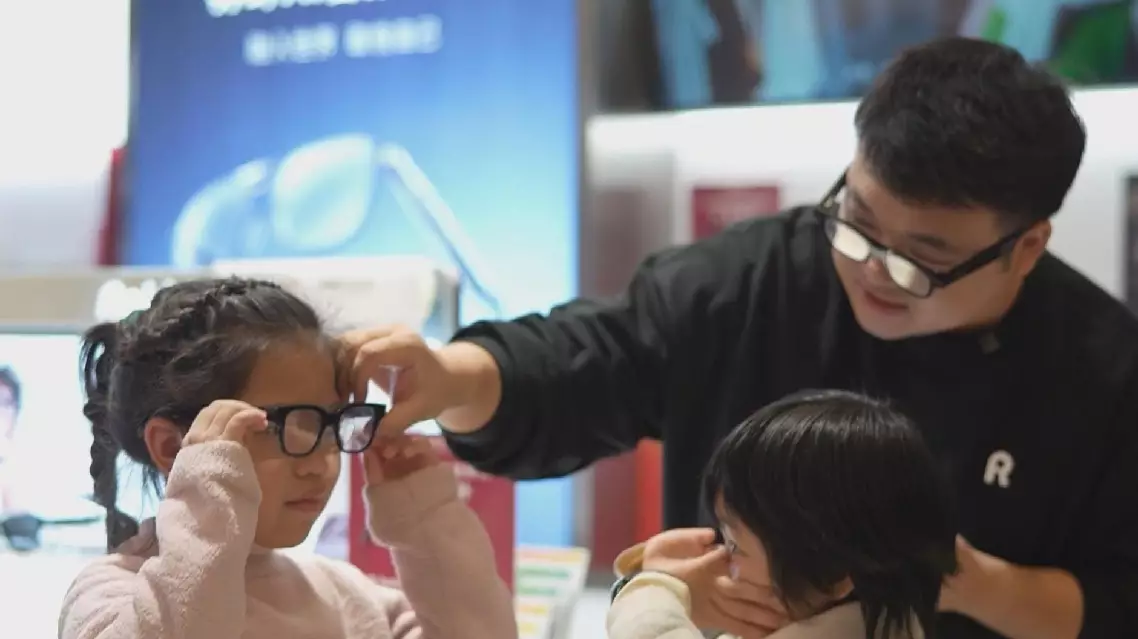
China's emerging smart glasses industry sees growing opportunities in 2026, as the device has been added to the national pro-consumption subsidy catalog for the first time this year. At a smart glasses company based in Hangzhou City, an emerging tech hub in east China's Zhejiang Province, research and development engineer Xu Degang has taken on a new role as an in-store sales assistant. To better understand consumer needs before the busy Spring Festival shopping season, engineers who once focused solely on product development are now stepping directly into the market.
According to the national subsidy program, smart glasses qualify for a government subsidy of 15 percent of the retail price, capped at 500 yuan (about 72 U.S. dollars) apiece. Boosted by the incentive and Xu's professionalism, store sales have risen sharply.
"Since AI glasses were brought under the coverage of the national subsidy program, sales have doubled," said Li Luyao, manager of the retail outlet.
"Online sales have doubled as well," Xu added.
The sales surge has brought a flood of user feedback. To keep up, the team has accelerated its system updates from once a month to once every two weeks.
"The chart presents the latest feedback, totaling 865 records. We have deleted records on the solved ones, counting around two to three thousand," Xu said.
Ahead of the Spring Festival, the Chinese New Year and a peak sales season, the company prepared a major upgrade, adding features such as train ticket synchronization and integrated shopping options. But the simultaneous rollout of multiple functions unexpectedly led to repeated glitches during internal testing.
For the company, delaying an update would cost more than time, but erode user trust. The lesson remains fresh as it had been in a similar situation last year.
"We promised our customers that our products would be ready for delivery by the end of the second quarter, yet the first shipment of our products for delivery was made only by the end of June, and it was not until September that we could start bulk delivery. People on the internet started posting around to mock whether we are merely a hype machine. It is very lucky for us to hang on through 2025 and keep forging ahead," Xu said.
Determined not to repeat that mistake, the Research and Development team set a three-day deadline to launch the holiday upgrade. After intensive testing, the new version went live within two days. During a live-stream explaining the update, the team found skepticism replaced by supportive comments and streams of likes.
"We finally shipped out (the Spring Festival update). That is quite a relief," Xu sighed after the live-stream.
Earlier this year, smart glasses joined smartphones, tablets, and smart wearables as one of four major categories covered by the national subsidy program, bringing new opportunities for companies with a research and development edge.
During the Spring Festival holiday season so far, smart glasses, now seen as trendy "tech gifts," are flying off the shelves. At the company's warehouse, newly arrived products are dispatched almost immediately.
"Once the transportation of finished products back to Hangzhou from our factories, the products would be dispatched almost immediately. There is virtually no time for registration and storage," said Yao Xiusheng, who works at the company's warehouse.
As a high-potential future industry backed by national policy support, the company's team says it is confident about what lies ahead.
"This subsidy program shows strong national support for innovative tech enterprises. Providing national-level policy backing at such an early stage could help the entire industry accelerate its growth," said Zhu Mingming, founder of the company.
China's subsidy program brings opportunities for smart glasses industry