The cosmetics industry in China has reached a milestone, with domestic brands now taking the lead through sustained investment in innovation and focus on consumer-centric efficacy.
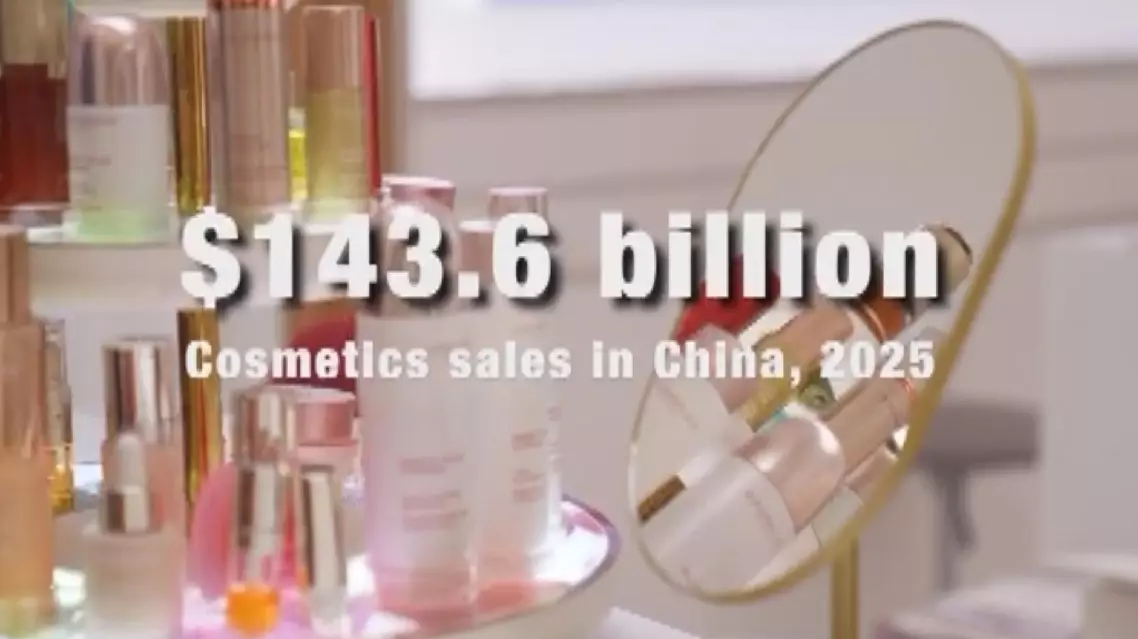
Chinese cosmetics industry's full-channel transaction value in 2025 exceeded 1.1 trillion yuan (143.6 billion U.S. dollars) for the first time, according to the data released by the China Association of Fragrance, Flavour and Cosmetic Industries last month.
That market includes makeup, skincare, perfume, cologne, hair care and other products. But in this lucrative market, local brands are no longer on the sidelines, while global names still hold their shine.
"In the past 10 years, the market share of Chinese [beauty] companies has grown significantly. So you can see that the market share [has been] rising from 43 percent [in 2015] to 57 percent last year," said Cheng Jing, chief scientific officer of Yatsen Group.
Chinese brands took half of the domestic market for the first time in 2022, with their share continuing to grow since, reaching 53 percent in 2023, 55 percent in 2024, and 57 percent last year.
"This growth is primarily driven by continuous advancements in innovation, in brand equity, and product use experience," Cheng added.
Yatsen Group, one of China's biggest local cosmetic groups, has invested about 100 million U.S. dollars in R&D since 2020. While building a multi-brand portfolio to serve diverse consumers' needs from skincare, neuroscience to makeup.
Many local brands are betting on biotech and naturally sourced ingredients. Being "cheap" is no longer their tag.
"Domestic players are leading in R&D, with breakthroughs in core ingredients and bioactive materials that power real product performance," said Lu Ying, manager of Shanghai Beauty Nova Tech Hub.
Meanwhile, local trends are rewriting the playbook for international beauty brands in China.
"Chinese consumers are very efficacy-driven and want to understand the science behind it. So our research covers the whole process, from studying their skincare habits, to validating ingredients on China-specific cell models, and testing the final product on real consumers," said Helen Song, Clarins APAC R&D Director.
To stay competitive, French company Clarins built its only overseas research center in Shanghai, developing foundations for local skin tones, skincare for different climates and textures tailored to Chinese consumers.
In the lab, researchers carry out in vitro cell experiments using Chinese skin samples. The data collected will be sent to France for further evaluation.
Global beauty giants like L'Oréal and Estée Lauder have also established high-level research centers in Shanghai – a sign that China is no longer just a sales market, but an innovation hub.
Domestic brands leading China's cosmetics industry