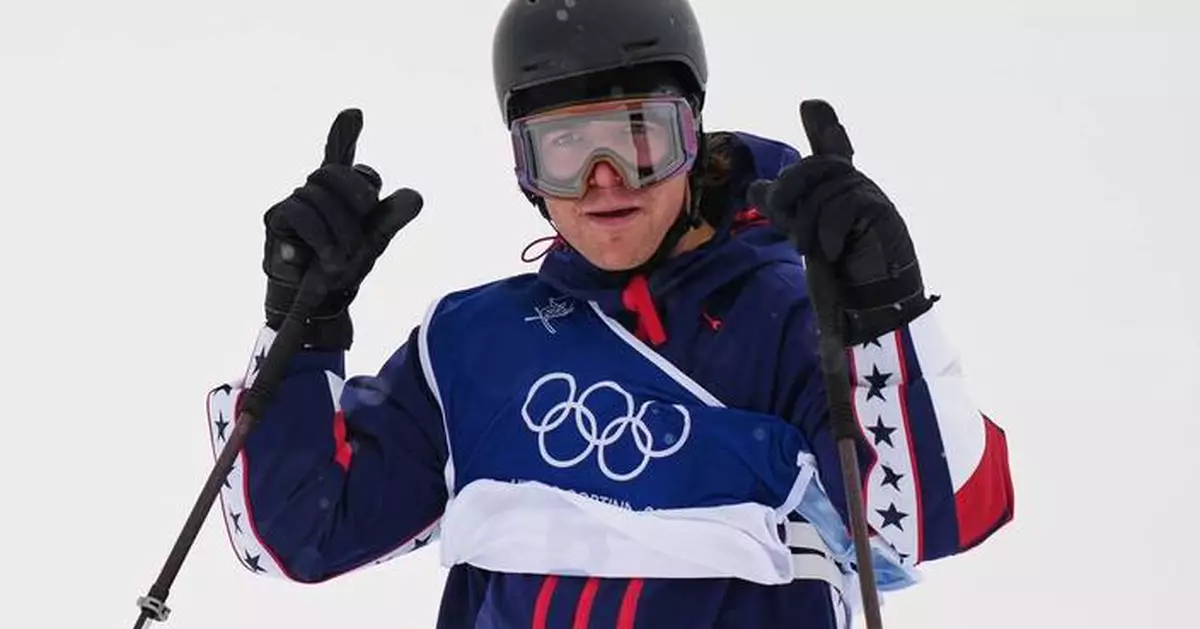
LIVIGNO, Italy (AP) — American freeskier Hunter Hess got to the end of his successful run in Olympic halfpipe qualifying, then leaned into the camera. He bent his left thumb and forefinger into the shape of an “L," lifted it to his forehead and pointed at it with the other hand.
“Apparently,” he explained, “I'm a loser.”
The 27-year-old who received that label from U.S. President Donald Trump at the start of the Olympics — leading to threats to his family and setting off the first major political imbroglio of the Games — finally got in the starting gate Friday. Fired up after nailing his first run, he flashed the “L” sign, then explained he has used the entire episode as motivation.
“I worked so hard to be here. I sacrificed my entire life to make this happen,” Hess said. “I’m not going to let controversy like that get in my way. I love the United States of America. I cannot say that enough. My original statement, I felt like I said that, but apparently people didn’t take it that way. I’m so happy to be here, so happy to represent Team USA.”
Hess was one of four Americans to qualify for the 12-man final, all of whom have a chance to give the U.S. team its first gold medal over nearly two weeks of skiing and snowboarding at the Livigno Snow Park.
During a news conference at the start of the Games, skiers were asked how they felt representing the country during the Trump administration's heightened immigration enforcement actions back home.
Hess' response: "If it aligns with my moral values, I feel like I’m representing it. Just because I’m wearing the flag doesn’t mean I represent everything that’s going on in the U.S.”
That caught Trump's attention.
“Hess, a real Loser, says he doesn’t represent his Country in the current Winter Olympics. If that’s the case, he shouldn’t have tried out for the Team, and it’s too bad he’s on it,” Trump wrote on his Truth Social account.
After a few days, that died down. The freeskiers, placed on the back end of the Olympic schedule, retreated to Laax, Switzerland, for a week of training. Hess conceded it wasn't the easiest time.
“I had a week that was pretty challenging,” he said. “Luckily, my family was there to support me and help me get through it. There was a lot of noise and I've never been subject to that kind of criticism. Skiing has saved my life time and time again and it seems to have done so again."
He said, "There's been a lot of hate out there. All those people are super entitled to their opinion, and I respect it."
Ultimately, though, he said he had no second thoughts about what he said in that fateful Feb. 6 news conference. The message, he insisted, was really a message of support.
“I stand with what I said. I love the United States of America. I cannot reiterate that enough. It means the absolute world to me to be able to represent Team USA here. I worked so, so hard to get here. I stick with what I said.”
AP Winter Olympics: https://apnews.com/hub/milan-cortina-2026-winter-olympics

United States' Hunter Hess reacts during the men's freestyle skiing halfpipe qualifications at the 2026 Winter Olympics, in Livigno, Italy, Friday, Feb. 20, 2026. (AP Photo/Julia Demaree Nikhinson)
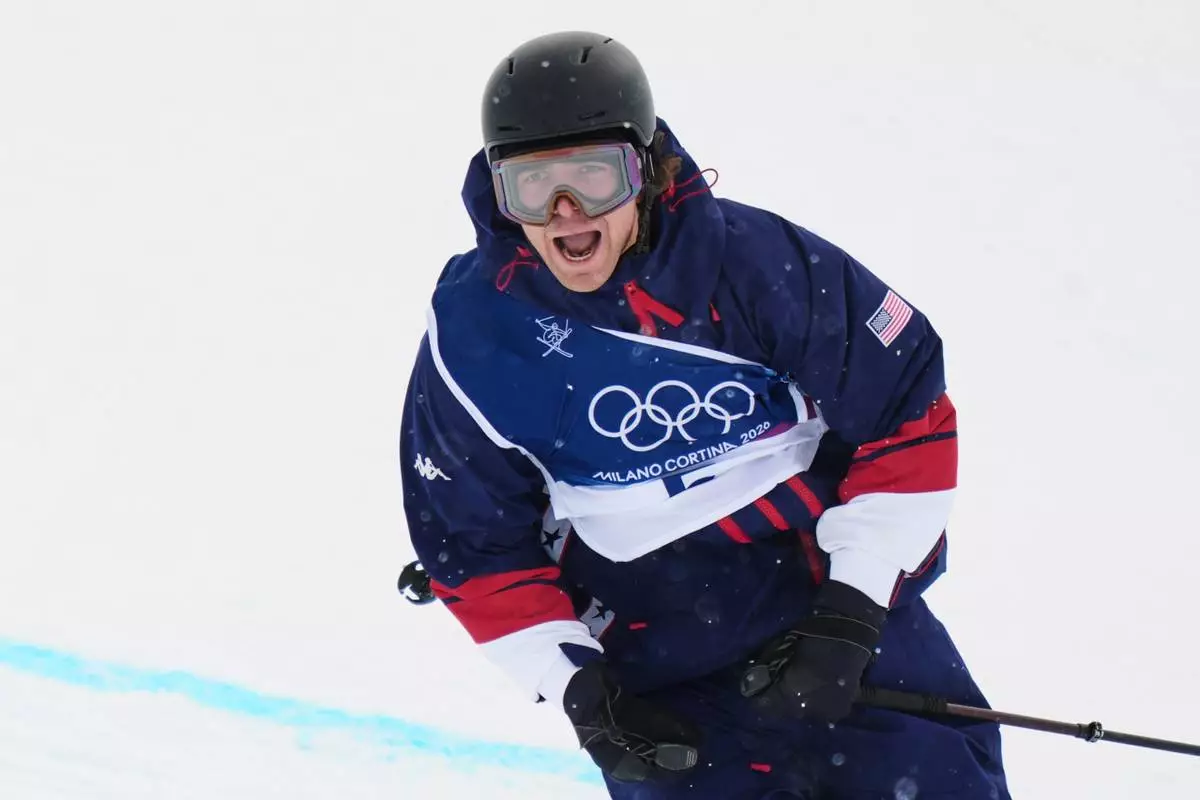
United States' Hunter Hess reacts during the men's freestyle skiing halfpipe qualifications at the 2026 Winter Olympics, in Livigno, Italy, Friday, Feb. 20, 2026. (AP Photo/Julia Demaree Nikhinson)
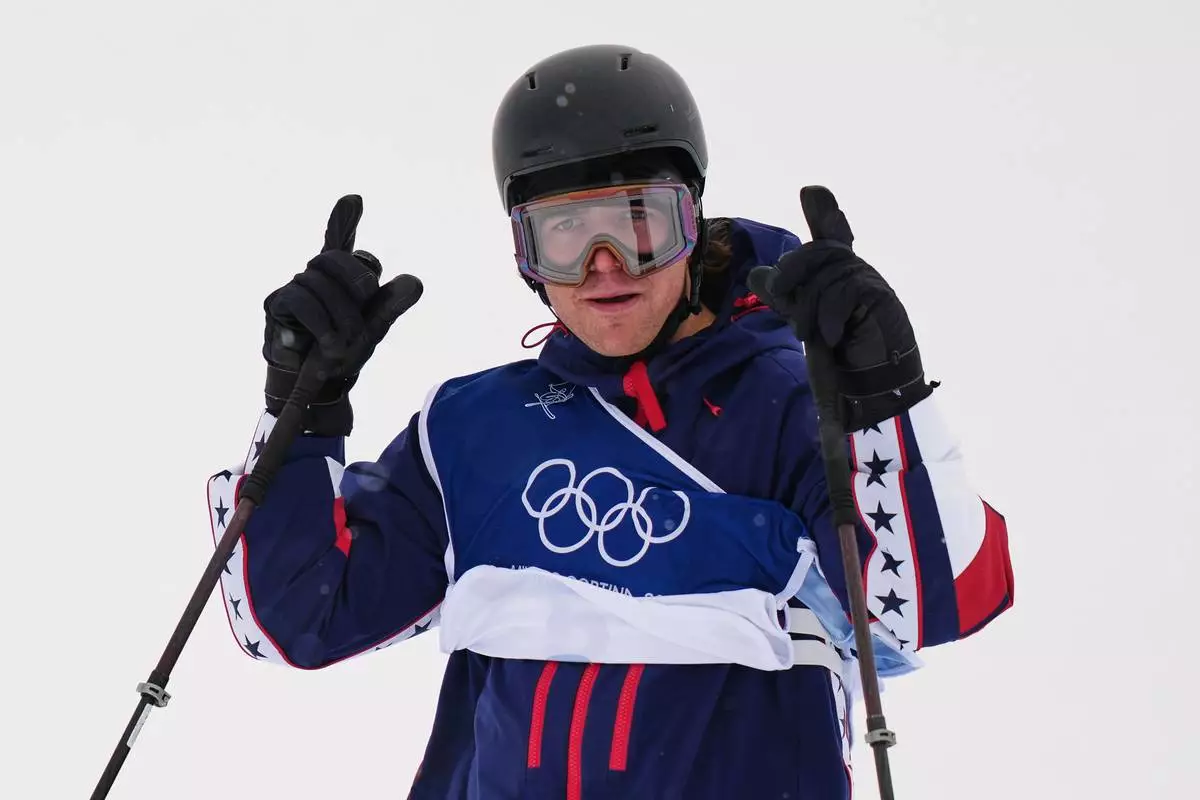
United States' Hunter Hess reacts during the men's freestyle skiing halfpipe qualifications at the 2026 Winter Olympics, in Livigno, Italy, Friday, Feb. 20, 2026. (AP Photo/Julia Demaree Nikhinson)
CORTINA D'AMPEZZO, Italy (AP) — It takes an immense amount of energy to power venues and make snow for the Winter Olympics and, for the 2026 Milan Cortina Games, organizers pledged that virtually all of the electricity would be clean.
The organizing committee said that energy use is where they can make the most meaningful impact, since it has been one of the main drivers of planet-warming emissions at major events. And Italy’s largest electricity company, Enel, guaranteed the supply of entirely certified renewable electricity for event venues.
Here's a look at what that means:
The organizing committee said in its sustainability report from September that its Games-time electrical energy would be 100% green, fed by certified renewable sources. In rare cases where temporary power generation is required, hydrotreated vegetable oil would be substituted for traditional diesel fuels, it said.
“This is also an opportunity to contribute to a broader shift — showing athletes, spectators and future host cities that cleaner energy solutions are increasingly viable for events of this scale,” the committee said Friday in a statement to The Associated Press. “We hope the steps taken for these Games can support ongoing progress across major events.”
Enel said it is supplying 85 gigawatt-hours of power for the Olympic and Paralympic Winter Games. It bought “guarantee of origin” (GO) certificates on the market from renewable energy plants to cover the entire Games’ energy demand.
GO certificates are a European mechanism created in 2001. Each certificate corresponds to 1 megawatt hour of electricity produced using a certified renewable source.
These certificates are traded on the power market, in negotiations between companies or through brokers.
Once used, they are canceled to prevent the same megawatt hour from being claimed twice. This system is meant to support the development of renewable sources, by helping companies meet their green energy targets.
Enel told the AP in a statement that its commitment to cleanly lighting up the events “translates the values of sustainability and inclusion inherent in the Games into concrete terms, combining technological innovation and environmental protection.”
While many say GOs are vital to promote Earth's decarbonization, the system has its detractors. Matteo Villa, who leads the data lab at the Italian Institute for International Political Studies, said it is a “great way to promote your event,” but it's not making Italy cleaner or more renewable.
The Games can only be as clean, or as sustainable, as the whole of Italy, Villa added.
Nearly three-quarters of the electricity Enel produced in Italy in 2025 was carbon-free, according to its preliminary full-year operational data. About 50% came from hydropower, followed by 17% geothermal and less than 10% from wind, solar and other renewables. The remainder was mostly from gas-fired power plants.
Many power plants that use water to produce electricity are in northern Italy, where mountains and rivers make for highly productive facilities. But Italy's national grid is still largely reliant on fossil fuels, according country-specific data from the International Energy Agency.
Enel built new primary substations in Livigno and Arabba, so electricity could be distributed throughout the territory. It also built and upgraded distribution infrastructure in the Livigno, Bormio and Cortina areas, which will benefit residents after the Games end.
Enel has a spot in the fan village in Cortina, where events are livestreamed.
Sustainability has been a major focus for the Games, as both the organizers and the International Olympic Committee seek to model how to cut carbon pollution while running a major event. Researchers say the list of locales that could reliably host a Winter Games will shrink substantially in the coming years.
“Every Games we strive to push innovation in sustainability, reduce the overall impact and the carbon footprint,” Julie Duffus, the IOC’s head of sustainability, told the AP Friday. She highlighted the use of clean power, upgrades to the energy system and the way these Games were designed so that most venues would be existing or temporary.
Matteo Di Castelnuovo, a professor of energy economics at the SDA Bocconi School of Management in Milan, said he expects the Olympics will stay committed to clean energy, and that “the challenge lies somewhere else to make them greener.” The thornier issue for Olympic organizers, and for any business, is figuring out how to reduce the emissions they do not have direct control over, notably those stemming from transportation, he added.
The amount of greenhouse gases estimated to be released into the atmosphere as a result of the Games is similar to the emissions of 4 million average-sized, gasoline-fueled cars driving from Paris to Rome, the organizing committee said in its greenhouse gas management strategy. The largest share of the carbon footprint are activities indirectly related to the Games, such as accommodations and spectator travel. Air travel is a significant contributor because burning jet fuel releases carbon dioxide.
Karl Stoss, who chairs the Games’ Future Host Commission, has said they may need to eventually reduce the number of sports, athletes and spectators who attend.
Many skiers, including Team USA members Lindsey Vonn and Mikaela Shiffrin, expressed concern during the Games about climate change accelerating melt of the world’s glaciers.
Associated Press writer Colleen Barry and video journalist Brittany Peterson in Milan contributed to this report.
AP Winter Olympics coverage: https://apnews.com/hub/milan-cortina-2026-winter-olympics
The Associated Press’ climate and environmental coverage receives financial support from multiple private foundations. AP is solely responsible for all content. Find AP’s standards for working with philanthropies, a list of supporters and funded coverage areas at AP.org.
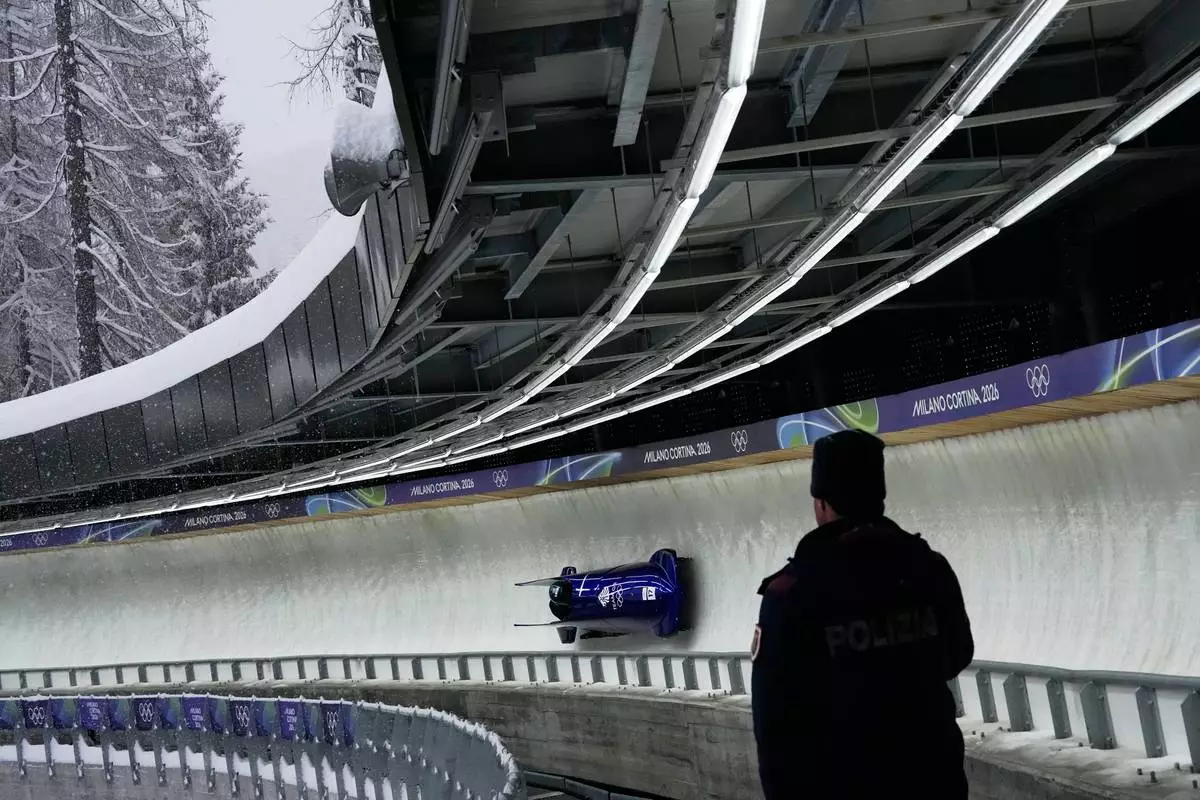
Great Britain's Adele Nicoll, right, slides down the track during a two women bobsled training session at the 2026 Winter Olympics, in Cortina d'Ampezzo, Italy, Thursday, Feb. 19, 2026. (AP Photo/Alessandra Tarantino)
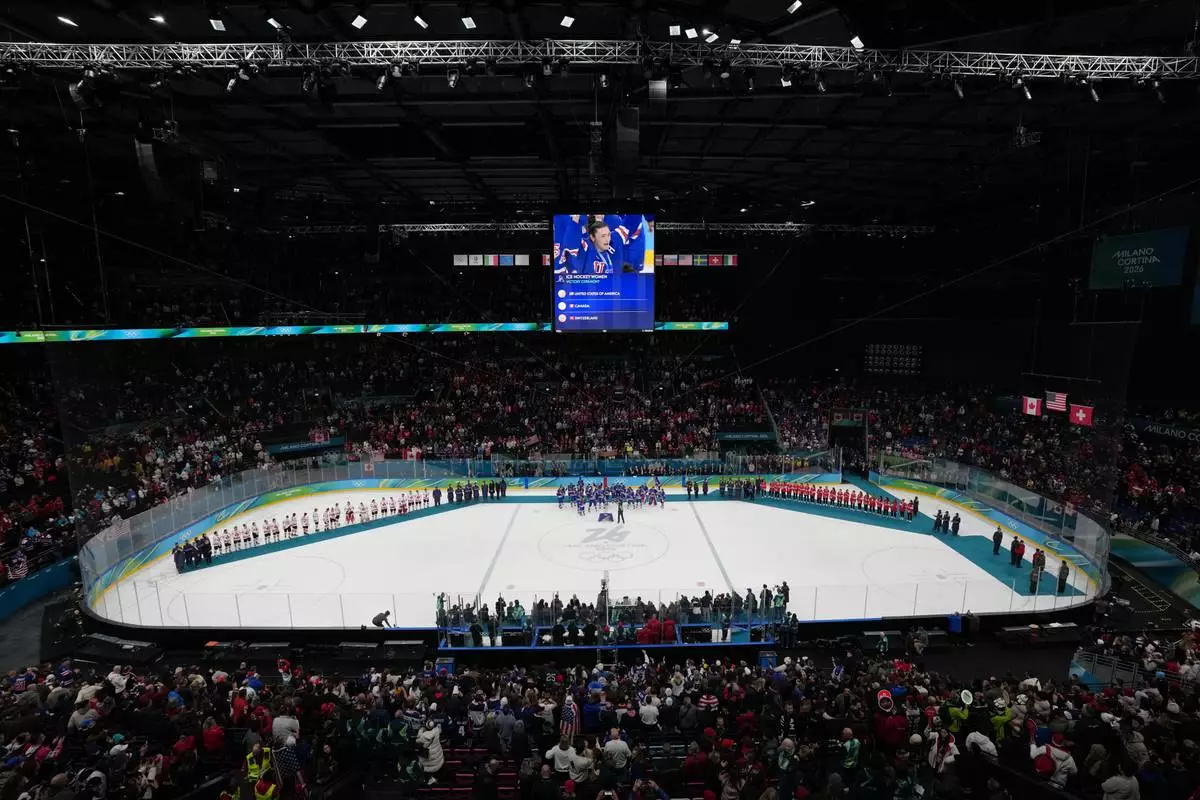
Teams from the United States, Canada and Switzerland receive their medals following the women's ice hockey gold medal game at the 2026 Winter Olympics, in Milan, Italy, Thursday, Feb. 19, 2026. (AP Photo/Carolyn Kaster)