PORTLAND, Ore. (AP) — PacifiCorp has agreed to pay $575 million to resolve the federal government's claims for damages stemming from six wildfires in Oregon and California in 2020 and 2022, federal officials announced Friday, in the utility's latest multimillion-dollar payout related to the deadly blazes.
The settlement resolves the federal government's claims that PacifiCorp's electrical lines negligently started four fires in Oregon in 2020 and two fires in California in 2020 and 2022, the Justice Department said. The money will help restore some of the 290,000 acres (117,359 hectares) of public land that burned. It will also help repay the government for the cost of fighting the fires, which the department said was “critical because the U.S. Forest Service now spends more than half of its budget on wildfire suppression annually."
“This settlement served the Department’s longstanding policy of holding individuals and corporations responsible for damages caused by wildfires. Every fire impacting federal lands, no matter the size, is a priority,” U.S. Attorney Eric Grant of the Eastern District of California said in a statement.
PacifiCorp said the settlement demonstrates its ongoing commitment to resolve claims related to the fires. It has so far settled claims totaling over $2 billion, according to its statement.
The utility has faced a series of lawsuits over the 2020 blazes in Oregon. In other cases that have gone to trial in the state, juries in multiple verdicts have ordered PacifiCorp to pay hundreds of millions of dollars to victims.
In 2023, an Oregon jury found PacifiCorp liable for negligently failing to cut power to its 600,000 customers despite warnings from top fire officials. The jury determined it acted negligently and willfully and should have to pay punitive and other damages — a decision that applied to a class of property owners. More than a thousand class members have cases set for trial in 2026 and 2027.
PacifiCorp’s appeal of the case is still making its way through state court.
The 2020 Labor Day weekend fires were among the worst natural disasters in Oregon’s history. They killed 11 people, burned more than a million acres (404,686 hectares) and destroyed thousands of homes.
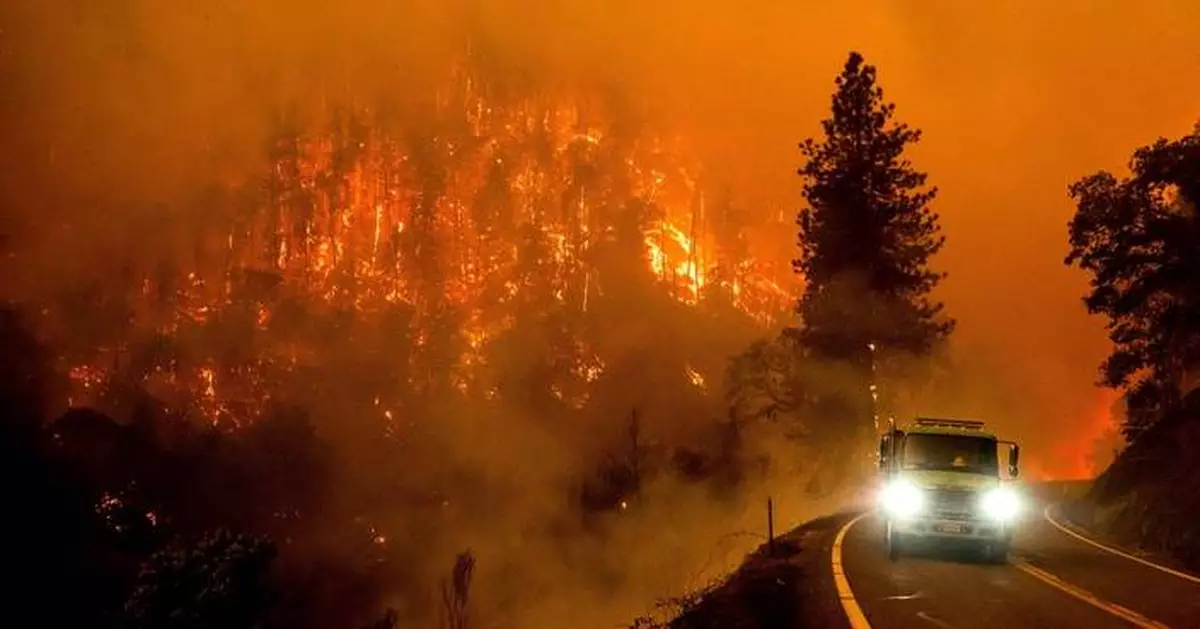
In California, the 2020 Slater Fire and 2022 McKinney Fire also claimed several lives.
Earlier this week, PacifiCorp announced that it will sell its wind, natural gas generation and distribution assets and infrastructure in the state of Washington to Portland General Electric Company for $1.9 billion to help stabilize its finances. Even though it is appealing wildfire judgments against it, PacifiCorp has had to post bonds with the court, which has put a crunch on its cash flow.
Darin Carroll, PacifiCorp’s CEO, said Tuesday the move would “improve the company’s financial stability while simplifying our operations” and help ensure reliable service for customers in Washington.
The utility’s parent company, Warren Buffett’s Berkshire Hathaway, is sitting on more than $382 billion cash, but the conglomerate expects PacifiCorp to take care if its own obligations. The executive who led Berkshire’s utility unit for years, Greg Abel, is now Berkshire’s CEO.
__
Associated Press writer Josh Funk contributed from Omaha, Nebraska.
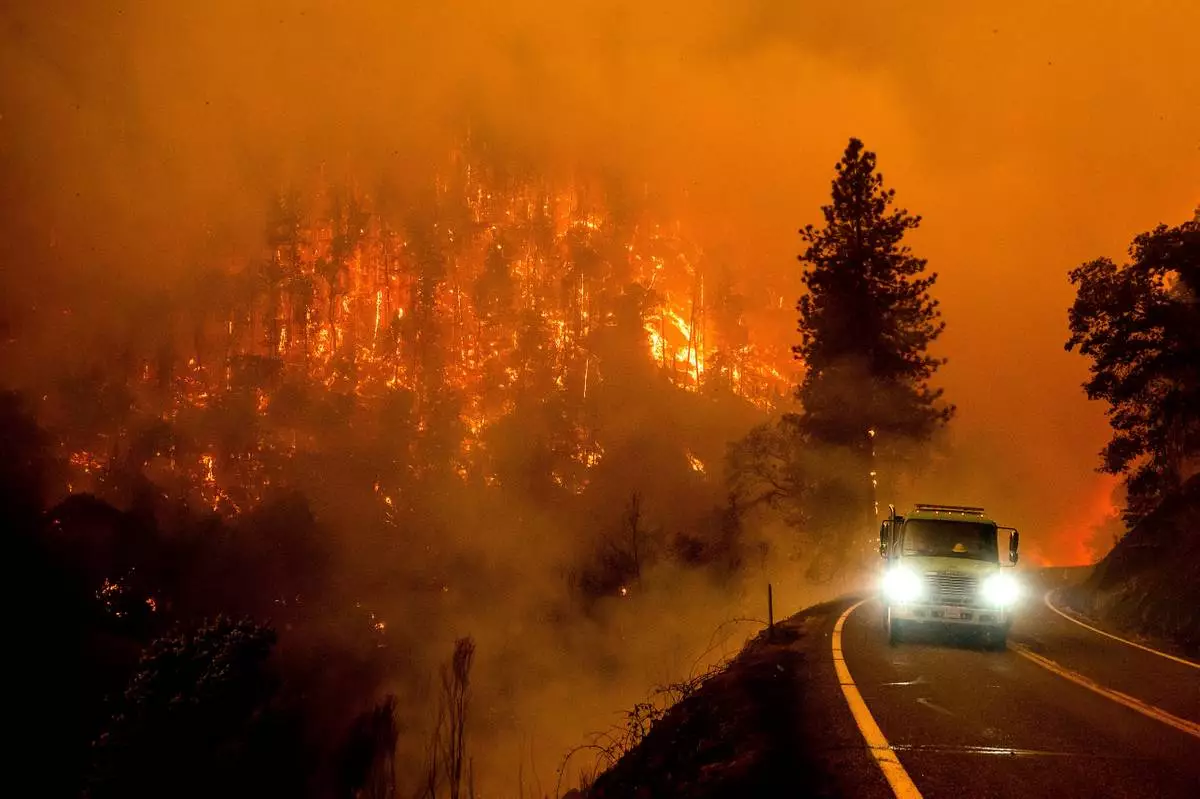
FILE - A firetruck drives along California Highway 96 as the McKinney Fire burns in Klamath National Forest, Calif., on July 30, 2022. (AP Photo/Noah Berger, File)
SAO PAULO (AP) — While Bad Bunny has dominated global charts, the superstar has not had quite the same success in Brazil, a country notoriously hard for foreign stars to win over due to a devotion to national artists.
But a shift that began with his Grammy-winning album “Debí Tirar Más Fotos” may accelerate further after his first-ever gigs in Brazil on Friday and Saturday in Sao Paulo.
Bad Bunny has come to Brazil at the peak of his career so far, following the phenomenal hype around his performance at the Super Bowl halftime show.
“It’s the best time to try and unlock a country like Brazil, at a time when he’s managed to dominate practically the entire world,” said Felipe Maia, an ethnomusicologist who is pursuing a doctoral degree on popular music and digital technologies at Paris Nanterre University.
For years, the Puerto Rican artist born Benito Antonio Martínez Ocasio has been one of the most-streamed artists on the planet.
But neither the singer, nor his album, nor his songs were among the most played last year in Brazil, according to Spotify. The most streamed artists in the country on the platform in 2025 were all Brazilian.
In the land of samba, funk, bossa nova, choro, sertanejo, forro and pagode, among other Brazilian music genres, 75% of streaming consumption in Brazil focuses on national artists, according to the 2025 midyear music report of Luminate, a company specializing in entertainment industry data. Brazil is the country that most listens to its own music, it said.
Still, particularly since “Debí Tirar Más Fotos," the fever around Bad Bunny has made headway in Brazil. Only one performance was initially scheduled at the Allianz Parque arena, but it sold out so quickly the artist added an extra date, which also sold out.
By mid-afternoon on Friday, long queues had formed. Brazilian fans mixed with people from El Salvador, Colombia and Venezuela. Many came wearing straw hats — used by Bad Bunny and traditionally worn by jíbaros, rural Puerto Rican farmers.
Tickets on Ticketmaster, the official vendor, ranged from $50 to $210, but resellers on Friday were selling tickets for that same night for more than $830 — more than 2.5 times the minimum monthly wage in Brazil.
Flávia Durante, a Sao Paulo -based DJ who specializes in Latin American music, said that some Brazilians have a tendency to see Spanish-language music as corny due to the association with Mexican telenovelas, but that Bad Bunny pierced a bubble with his latest album.
“Nowadays everyone knows all the songs, they sing along and really get into it. I normally play him at the peak of the night. People request him, even at rock or 80s pop themed parties,” Durante said.
Since the half-time Super Bowl show, that popularity has grown. Bad Bunny’s average streams grew by 426% on Spotify in Brazil in the following week compared with the previous one. Many songs experienced massive streaming surges, with “Yo Perreo Sola” leading the growth with a 2,536% increase.
During Brazil’s Carnival celebrations, Bad Bunny themed costumes were a fixture in Rio’s raucous, dazzling street parties.
Nicole Froio, a Colombian Brazilian writer specializing in Latin American cultural issues, went kitted out in a straw hat and plastic, tropical plants that echo the background of his latest album. It was the third Carnival in which Froio — who has two Bad Bunny tattoos and a third one planned — wore attire that evoked the Puerto Rican artist.
For a long time, Froio was the sole person among her Brazilian friendship group who liked Bad Bunny. She believes that Brazilians in general have trouble identifying themselves as Latino.
“There’s a lot of prejudice around Hispanic music and there were preconceptions against him because of his Puerto Rican accent, because people don’t understand him,” she said.
Brazil’s Latino identity exists but it is diffuse and difficult to seize due to the variety within the continent-sized country, said Maia. But Bad Bunny succeeds in giving it emphasis, particularly in cosmopolitan cities such as Sao Paulo and Rio de Janeiro, he said.
Brazil, like other countries in the Americas, was listed by Bad Bunny in the Super Bowl halftime show, when he reminded the world that while “America” is used as a synonym for the U.S. in the U.S., it is the name used across two continents.
Bad Bunny’s global success, including in Brazil, “reinforces that we’re part of this — that we belong,” said 22-year-old Diogo da Luz, a longtime fan of the Puerto Rican ahead of Friday's concert. “He reinforces that we are one people and that we’re very united.”
For Froio, who has been waiting to see him live for six years and will see him on Saturday, Bad Bunny “represents a Latino resistance.”
She pointed to the fact that other Latin American superstars, including Anitta, Shakira, and Ricky Martin, have recorded full songs in other languages, while Bad Bunny has kept his music almost entirely in Spanish.
“For me, there’s a great authenticity in his sound that inspires me to be who I am and let everyone else deal with it,” Froio said.
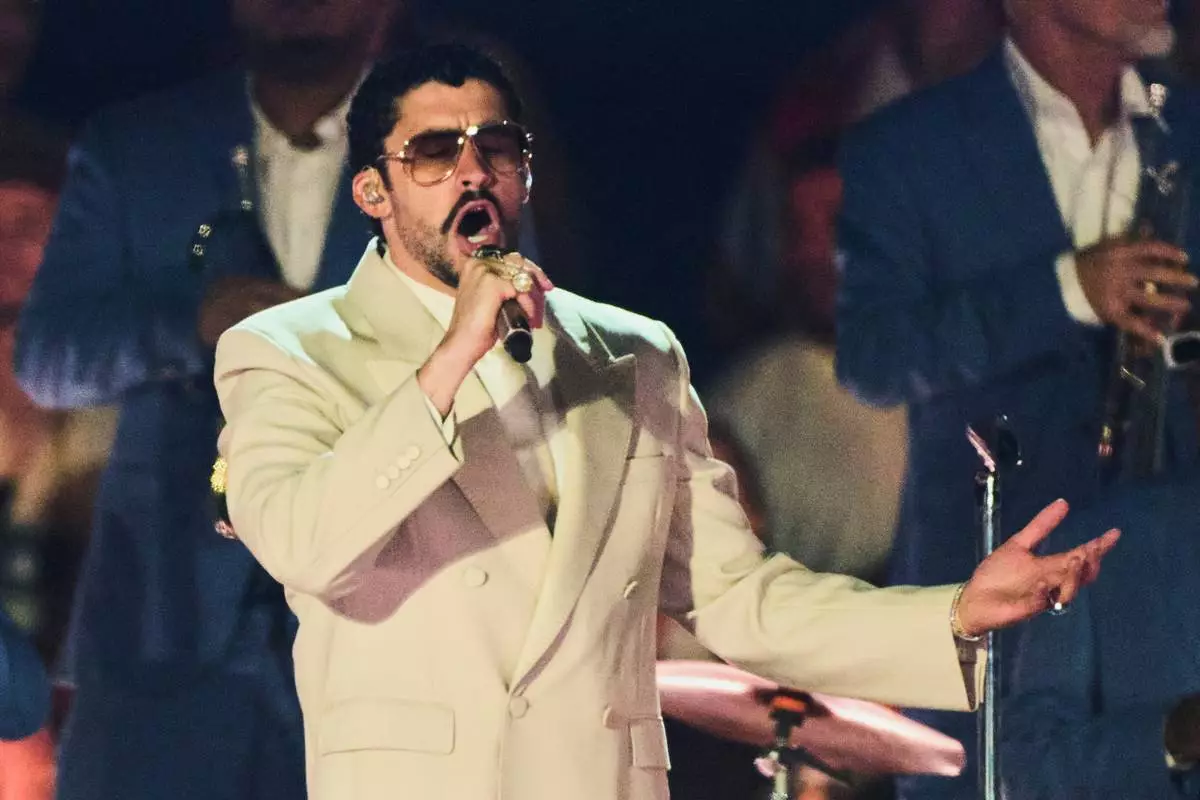
Bad Bunny performs in concert at the Monumental stadium in Buenos Aires, Argentina, Friday, Feb. 13, 2026. (AP Photo/Rodrigo Abd)