TOPEKA, Kan. (AP) — Kansas is set to invalidate about 1,700 driver’s licenses held by transgender residents and roughly as many birth certificates under a new law that goes beyond Republican-imposed restrictions in other states on listing gender identities in government documents.
The new law takes effect Thursday. Democratic Gov. Laura Kelly vetoed the measure but the Legislature's GOP supermajorities overrode it last week as Republican state lawmakers across the U.S. have pursued another round of measures to roll back transgender rights.
Click to Gallery
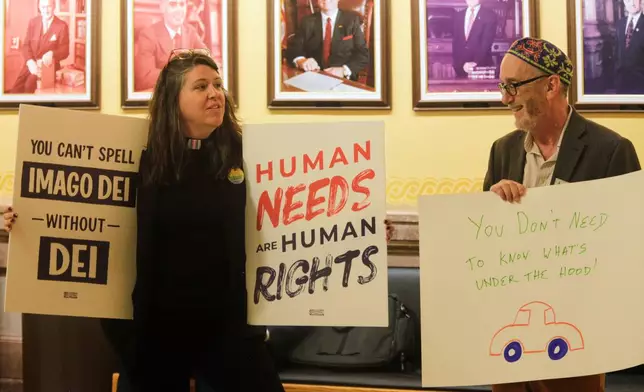
The Rev. Dr. Mandy Todd, left, pastor of Messiah Lutheran Church in Lindsborg, Kan., and Rabbi Moti Rieber, right, executive director of Kansas Interfaith Action, protest a new Kansas law that will invalidate hundreds of driver's licenses and birth certificates for transgender people that reflect their gender identities, Monday, Feb. 16, 2026, outside the Kansas Senate chamber in the Statehouse in Topeka, Kan. (AP Photo/John Hanna)
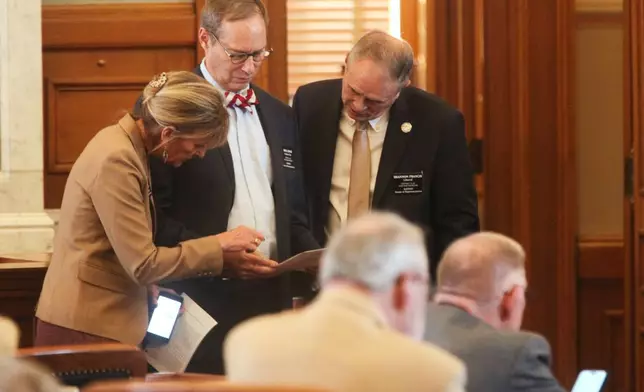
Kansas State Reps. Susan Humphries, left, R-Wichita; Bob Lewis, center, R-Garden City, and Shannon Francis, right, R-Liberal, confer during a House debate on a measure to prevent transgender people from changing their driver's licenses and birth certificates to reflect their gender identities and invalidate any past changes made for them, Wednesday, Jan. 28, 2026, at the Statehouse in Topeka, Kan. (AP Photo/John Hanna)
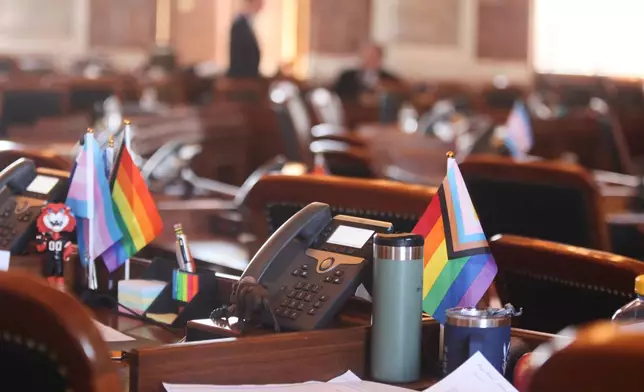
Small transgender and LGBTQ rights flags sit on the desks of Kansas state Reps. Tobias Schlingensiepen, right, D-Topeka, and Kirk Haskins, left, also D-Topeka, in the Kansas House chamber, protesting a new law that will prevent transgender people from changing their driver's licenses and birth certificates to reflect their gender identities and nullify past changes, Thursday, Feb. 19, 2026, at the Statehouse in Topeka, Kansas. (AP Photo/John Hanna)
The Rev. Dr. Mandy Todd, left, pastor of Messiah Lutheran Church in Lindsborg, Kan., and Rabbi Moti Rieber, right, executive director of Kansas Interfaith Action, protest a new Kansas law that will invalidate hundreds of driver's licenses and birth certificates for transgender people that reflect their gender identities, Monday, Feb. 16, 2026, outside the Kansas Senate chamber in the Statehouse in Topeka, Kan. (AP Photo/John Hanna)
Kansas State Reps. Susan Humphries, left, R-Wichita; Bob Lewis, center, R-Garden City, and Shannon Francis, right, R-Liberal, confer during a House debate on a measure to prevent transgender people from changing their driver's licenses and birth certificates to reflect their gender identities and invalidate any past changes made for them, Wednesday, Jan. 28, 2026, at the Statehouse in Topeka, Kan. (AP Photo/John Hanna)
Small transgender and LGBTQ rights flags sit on the desks of Kansas state Reps. Tobias Schlingensiepen, right, D-Topeka, and Kirk Haskins, left, also D-Topeka, in the Kansas House chamber, protesting a new law that will prevent transgender people from changing their driver's licenses and birth certificates to reflect their gender identities and nullify past changes, Thursday, Feb. 19, 2026, at the Statehouse in Topeka, Kansas. (AP Photo/John Hanna)
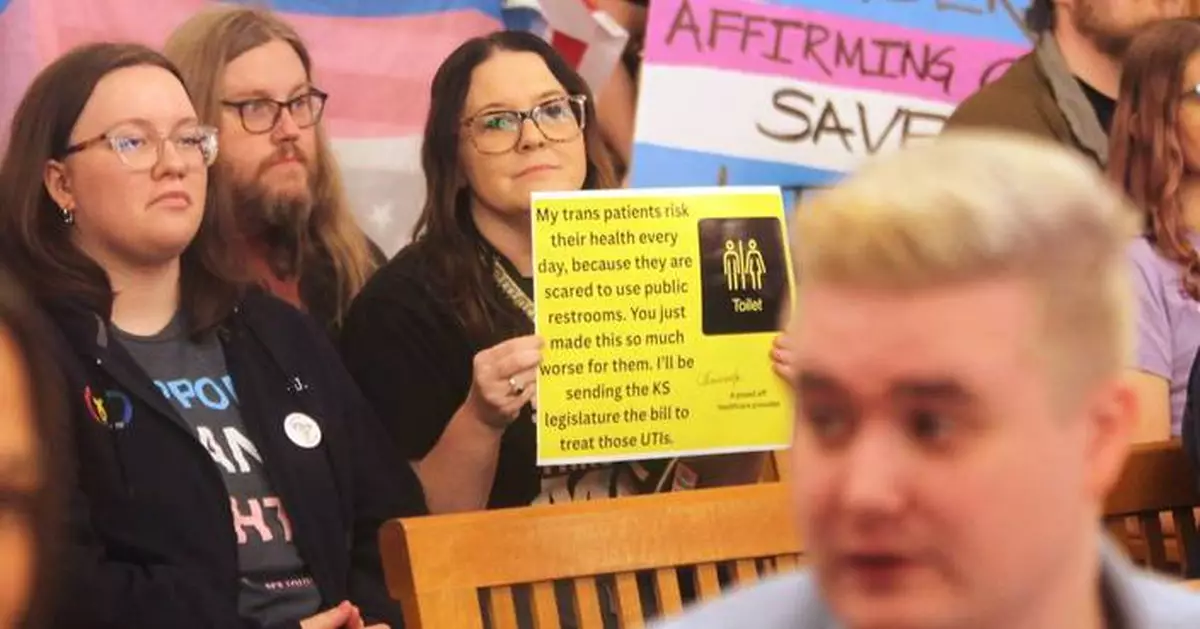
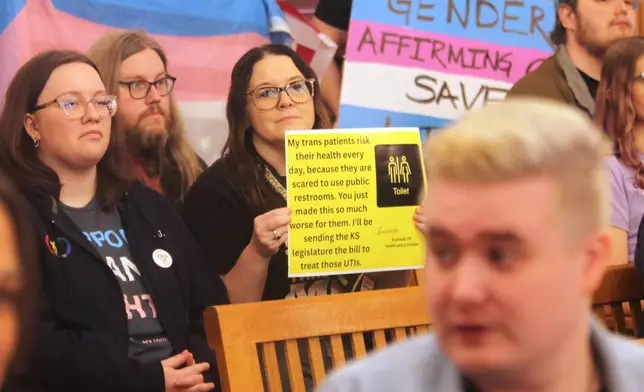
Amanda Mogoi, an advance practice registered nurse who provides care for transgender patients in Wichita, Kan., participates in a protest against a new Kansas law that prevents transgender people from changing their birth certificates and driver's licenses to reflect their gender identities and imposes new, tough enforcement provisions in state restrictions on their bathroom use with a sit-in during a legislative committee hearing, Friday, Feb. 6, 2026, at the Statehouse in Topeka, Kan. (AP Photo/John Hanna)
The bill prohibits documents from listing any sex other than the one assigned birth and invalidates any that reflect a conflicting gender identity. Florida, Tennessee and Texas also don't allow driver's licenses to reflect a trans person's gender identity, and at least eight states besides Kansas have policies that bar trans residents from changing their birth certificates.
But only Kansas' law requires reversing changes previously made for trans residents. Kansas officials expect to cancel about 1,700 driver's licenses and issue new birth certificates for up to 1,800 people.
“It tells me that Kansas Republicans are interested in being on the vanguard of the culture war and in a race to the bottom,” said Democratic state Rep. Abi Boatman, a transgender Air Force veteran appointed in January to fill a vacant Wichita seat.
Kansas' new law enjoyed nearly unanimous GOP support. It is the latest success in what has become an annual effort to further roll back transgender rights by Republicans in statehouses across the U.S., bolstered by policies and rhetoric from President Donald Trump's administration.
Trump and other Republicans attack research-backed conclusions that gender can change or be fluid as radical “gender ideology." GOP lawmakers in Kansas regularly describe transgender girls and women as male and as they say they're protecting women.
Like fellow Republicans, Kansas Senate Majority Leader Chase Blaisi said Trump’s reelection and other GOP victories in 2024 show that voters want “to return to common sense" on gender.
"When I go home, people believe there are just two sexes, male and female,” Blasi said. “It’s basic biology I learned in high school.”
Kelly supports transgender rights, but GOP lawmakers have overridden her vetoes three of the past four years. Kansas bans gender-affirming care for minors and bars transgender women and girls from female sports teams, kindergarten through college.
Transgender people can't use public restrooms, locker rooms or other single-sex facilities associated with their gender identities, though there was no enforcement mechanism until this year's law added tough new provisions.
Transgender people have said carrying IDs that misgender them opens them to intrusive questions, harassment and even violence when they show it to police, merchants, and others.
In 2023, Republicans halted changes in Kansas birth certificates and driver's licenses by enacting a measure ending the state's legal recognition of trans residents' gender identities. Though the law didn't mention either document, it legally defined male and female by a person's “biological reproductive system” at birth.
However, a lawsuit led to state court decisions that last year permitted driver's license changes to resume.
Legislators in at least seven other states are considering bills to prevent transgender people from changing one or both documents, according to a search using the bill-tracking software Plural.
But none would reverse past changes.
The extra step by Kansas legislators reinforces a message “that trans people aren’t welcome,” said Anthony Alvarez, a transgender University of Kansas student who works for a pro-LGBTQ rights group.
Kansas is likely to notify transgender residents by mail that their driver's licenses are no longer valid and they need to go to a local licensing office to get a new one, said Zachary Denney, spokesperson for the agency that issues them.
The Legislature hasn't earmarked funds to cover the cost, so each person will pay it — $26 for a standard license.
Alvarez already has had four IDs in four years as he's changed his name, changed his gender marker and turned 21.
He's always planned to stay in his native Kansas after getting his history degree this spring.
But, he said, “They’re just making it harder and harder for me to live in the state that I love.”
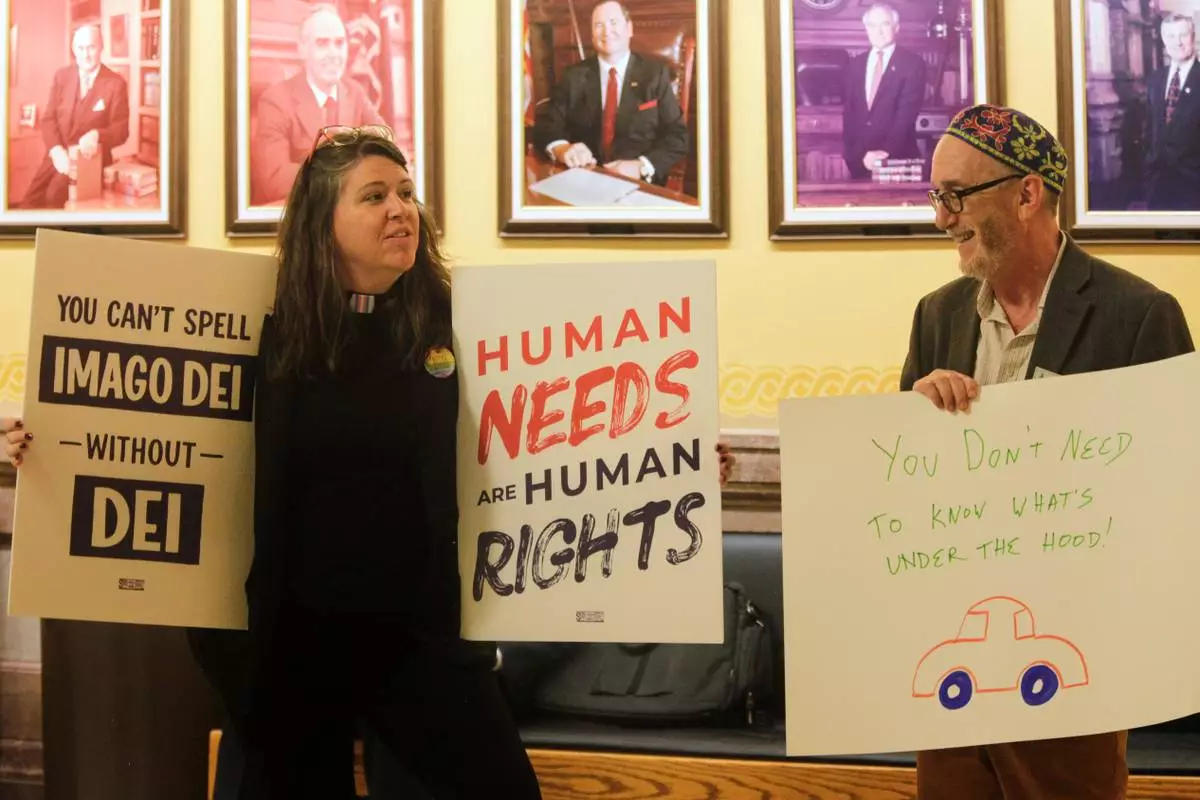
The Rev. Dr. Mandy Todd, left, pastor of Messiah Lutheran Church in Lindsborg, Kan., and Rabbi Moti Rieber, right, executive director of Kansas Interfaith Action, protest a new Kansas law that will invalidate hundreds of driver's licenses and birth certificates for transgender people that reflect their gender identities, Monday, Feb. 16, 2026, outside the Kansas Senate chamber in the Statehouse in Topeka, Kan. (AP Photo/John Hanna)
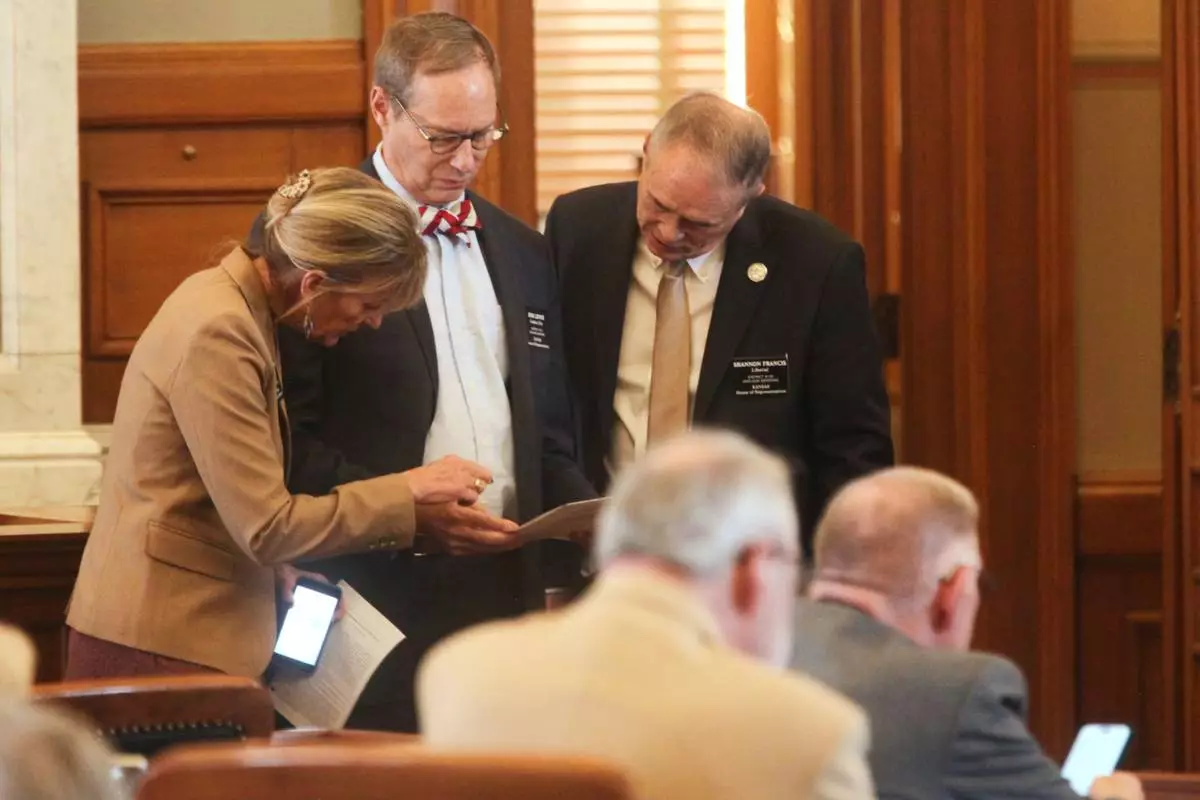
Kansas State Reps. Susan Humphries, left, R-Wichita; Bob Lewis, center, R-Garden City, and Shannon Francis, right, R-Liberal, confer during a House debate on a measure to prevent transgender people from changing their driver's licenses and birth certificates to reflect their gender identities and invalidate any past changes made for them, Wednesday, Jan. 28, 2026, at the Statehouse in Topeka, Kan. (AP Photo/John Hanna)
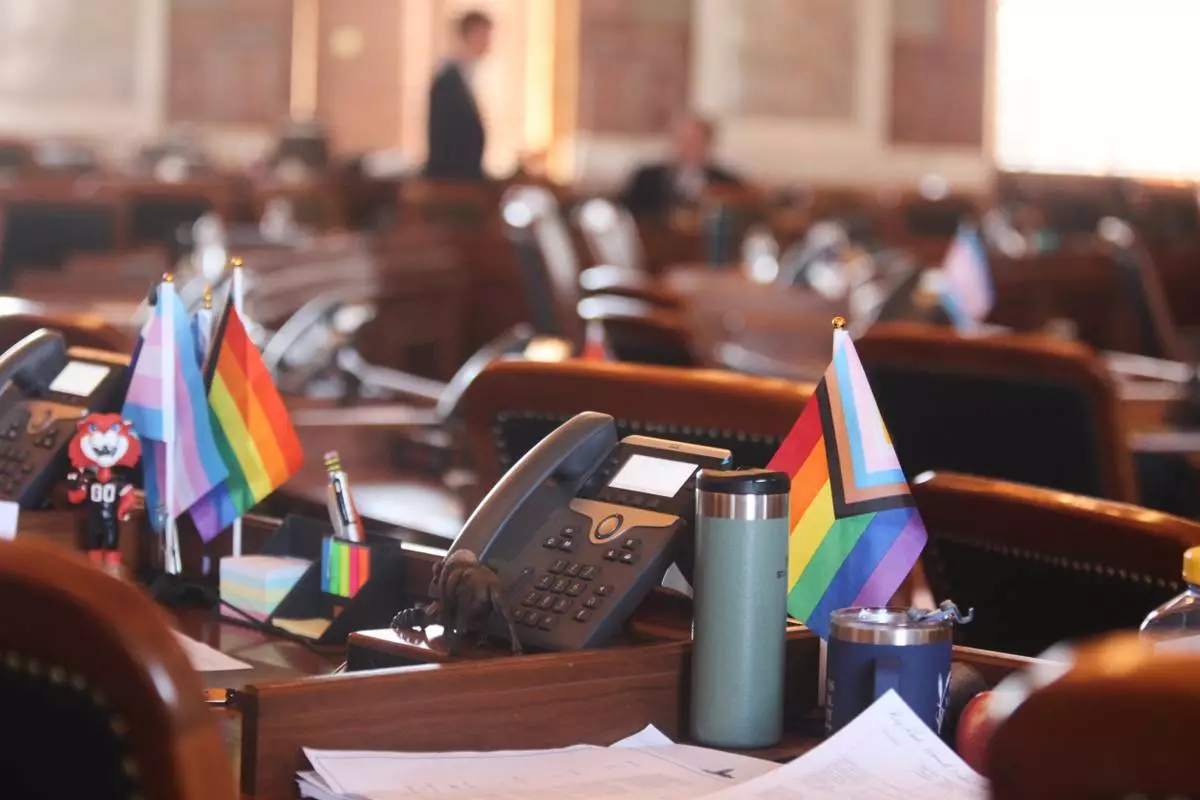
Small transgender and LGBTQ rights flags sit on the desks of Kansas state Reps. Tobias Schlingensiepen, right, D-Topeka, and Kirk Haskins, left, also D-Topeka, in the Kansas House chamber, protesting a new law that will prevent transgender people from changing their driver's licenses and birth certificates to reflect their gender identities and nullify past changes, Thursday, Feb. 19, 2026, at the Statehouse in Topeka, Kansas. (AP Photo/John Hanna)
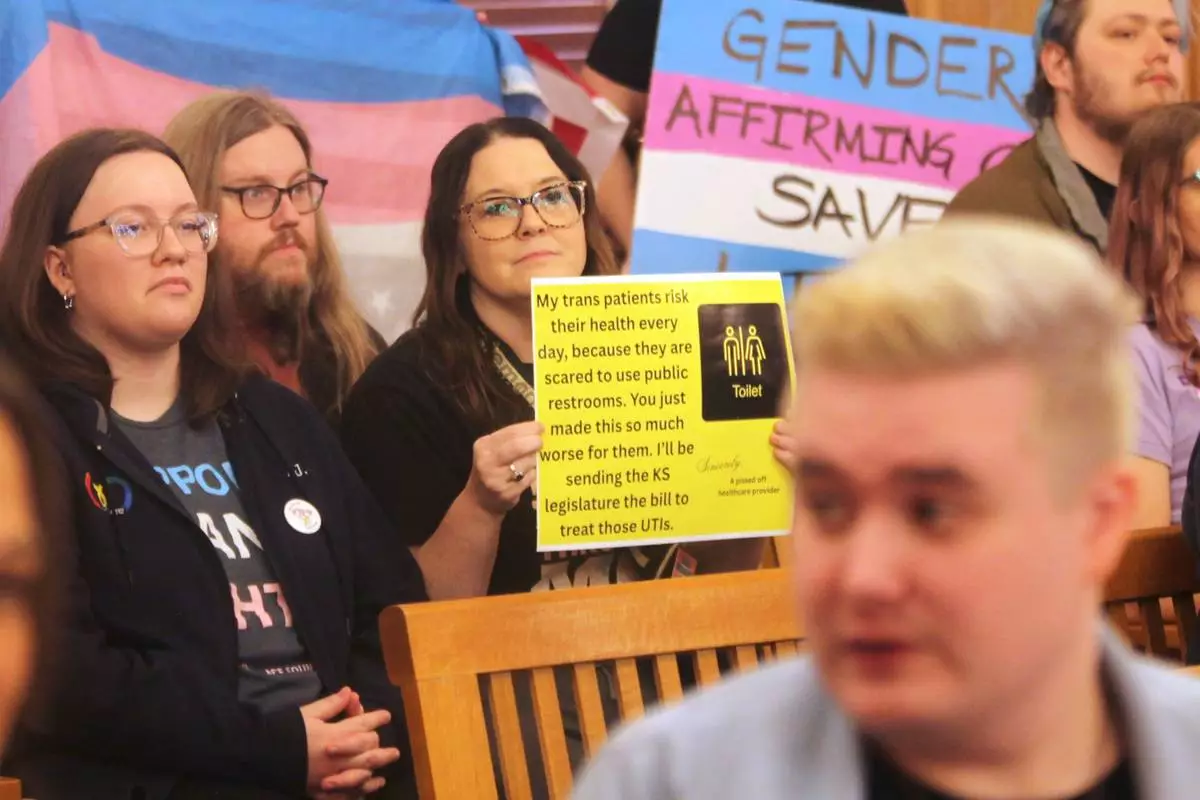
Amanda Mogoi, an advance practice registered nurse who provides care for transgender patients in Wichita, Kan., participates in a protest against a new Kansas law that prevents transgender people from changing their birth certificates and driver's licenses to reflect their gender identities and imposes new, tough enforcement provisions in state restrictions on their bathroom use with a sit-in during a legislative committee hearing, Friday, Feb. 6, 2026, at the Statehouse in Topeka, Kan. (AP Photo/John Hanna)
DAKAR, Senegal (AP) — Being gay in Morocco is illegal and punishable by up to three years in prison. But it was the violence from her family that forced Farah, a 21-year-old gay woman, to flee the country.
After a long journey to the United States and a third-country deportation by the Trump administration, however, Farah said she is now back in Morocco and in hiding.
“It is hard to live and work with the fear of being tracked once again by my family,” she told The Associated Press, in a rare testimony from a person deported via a third country despite having protection orders from a U.S. immigration judge. “But there is nothing I can do. I have to work.”
She asked to be identified by her first name only for fear of persecution. The AP saw her protection order and lawyers verified parts of her account.
Farah said that before she fled, she was beaten by her family and the family of her partner when they found out about their relationship. She was kicked out of the family home and fled with her partner to another city. She said her family found her and tried to kill her.
Through a friend, she and her partner heard about the opportunity to get visas for Brazil and fly there with the aim of reaching the United States, where they had friends. From Brazil, she trekked through six countries for weeks to reach the U.S. border, where they asked for asylum.
“You get put in situations that are truly horrible," she recalled. "When we arrived (at the U.S. border), it felt like it was worth the trouble and that we got to our goal."
They arrived in early 2025. But instead of finding the freedom to be herself, Farah said she was detained for almost a year, first in Arizona, then in Louisiana.
“It was very cold,” she said of detention. “And we only had very thin blankets.” Medical care was inadequate, she said.
She was denied asylum, but in August she received a protection order from an U.S. immigration judge, who ruled she cannot be deported to Morocco because that would endanger her life. Her partner, denied asylum and a protection order, was deported.
Farah said she was three days from a hearing on her release when she was handcuffed by Immigration and Customs Enforcement and put on a plane to an African country she had never visited, and one where homosexuality is illegal: Cameroon. She was put in a detention facility.
“They asked me if I wanted to stay in Cameroon, and I told them that I can’t stay in Cameroon and risk my life in a place where I would still be endangered,” she said. She was flown to Morocco.
She is one of dozens of people confirmed to be deported from the U.S. by the Trump administration to third countries despite having legal protection from U.S. immigration judges. The real number is unknown.
The administration has used third-country deportations to pressure migrants who are in the U.S. illegally to leave on their own, saying they could end up “in any number of third countries."
The detention facility in Cameroon's capital of Yaounde, where Farah was held, currently has 15 deportees from various African countries who arrived on two flights, and none is Cameroonian, according to lawyer Joseph Awah Fru, who represents them.
Eight of the deportees on the first flight in January, including Farah, had received a judge's protection orders, said Alma David, an immigration lawyer with the U.S.-based Novo Legal Group who has helped deportees and verified Farah’s case. The AP spoke to a woman from Ghana and a woman from Congo, who both said they had protection orders, speaking on condition of anonymity for fear of retaliation.
Another flight on Monday brought eight more people. Three freelance journalists reporting on the deportations to Cameroon for the AP were briefly detained there.
Deporting people to a third country where they could be sent home was effectively a legal “loophole,” said David.
“By deporting them to Cameroon, and giving them no opportunity to contest being sent to a country whose government hoped to quietly send them back to the very countries where they face grave danger, the U.S. not only violated their due process rights but our own immigration laws, our obligations under international treaties and even DHS’ own procedures," David said.
The U.S. Department of Homeland Security earlier confirmed there were deportations to Cameroon in January.
“We are applying the law as written. If a judge finds an illegal alien has no right to be in this country, we are going to remove them. Period,” it said, and asserted that the third-country agreements “ensure due process under the U.S. Constitution.”
Asked about the deportations to Cameroon, the U.S. State Department on Friday told the AP it had “no comment on the details of our diplomatic communications with other governments." It did not reply to further questions.
Cameroon’s Foreign Ministry didn’t respond to a request for comment.
Farah was one of two women from the first group of deportees to return to Morocco.
“They were given two impossible choices,” David said, and asserted that claiming asylum was not clearly presented as one of them. “This was before the lawyer had access to them."
She said International Organization for Migration staff in the facility did not give them any indication that there was a viable option other than going back to their home countries.
Fru said he has not been granted access to the deportees. He said the assistant to the country director for the IOM, a U.N.-affiliated organization, told him he must apply to speak to them. Fru plans to do that Monday.
The IOM told the AP it was “aware of the removal of migrants from the United States of America to some African countries” and added that it “works with people facing difficult decisions about whether to return to their country of origin." It said its role is providing accurate information about options and ensuring that "anyone who chooses to return does so voluntarily.”
The IOM said the facility in Yaounde was managed by the authorities in Cameroon. It did not respond to further questions.
Cameroon is one of at least seven African nations to receive deported third-country nationals in a deal with the U.S. Others include South Sudan, Rwanda, Uganda, Eswatini, Ghana and Equatorial Guinea.
Some have received millions of dollars in return, according to documents released by the State Department. Details of other agreements, including the one with Cameroon, have not been released.
The Trump administration has spent at least $40 million to deport about 300 migrants to countries other than their own, according to a report released last week by the Democratic staff of the Senate Foreign Relations Committee.
According to internal administration documents reviewed by the AP, 47 third-country agreements are in various stages of negotiation.
In Morocco, Farah said it was hard to hear U.S. officials refer to people like her as a threat.
“The USA is built on immigration and by immigrant labor, so we’re clearly not all threats,” she said. “What was done to me was unfair. A normal deportation would have been fair, but to go through so much and lose so much, only to be deported in such a way, is cruel.”
This story has been corrected to state that the two women who spoke to the AP had been on the first flight in January, not on last week’s flight. It also corrects that eight of the initial deportees had protection orders while the ninth was stateless.
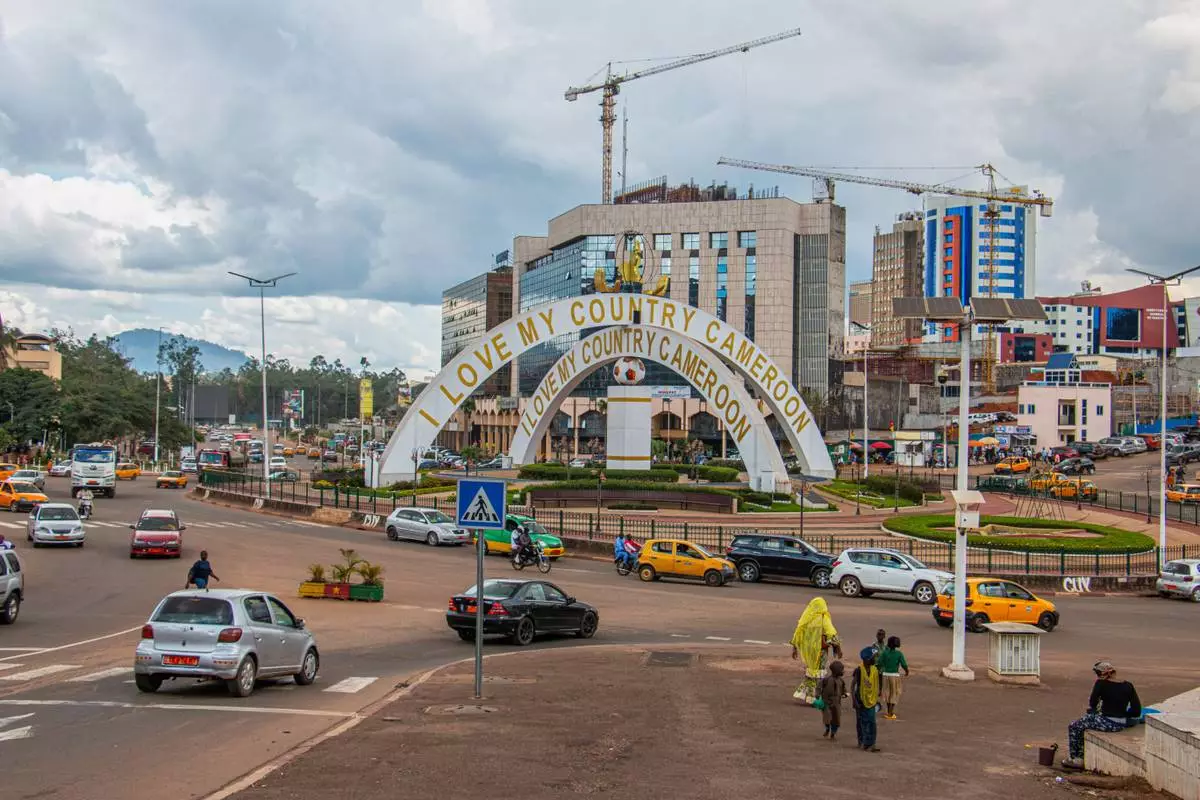
FILE - Cars drive through an intersection near a monument in Yaoundé, Cameroon, Sept. 12, 2025. (AP Photo / Welba Yamo Pascal, file)
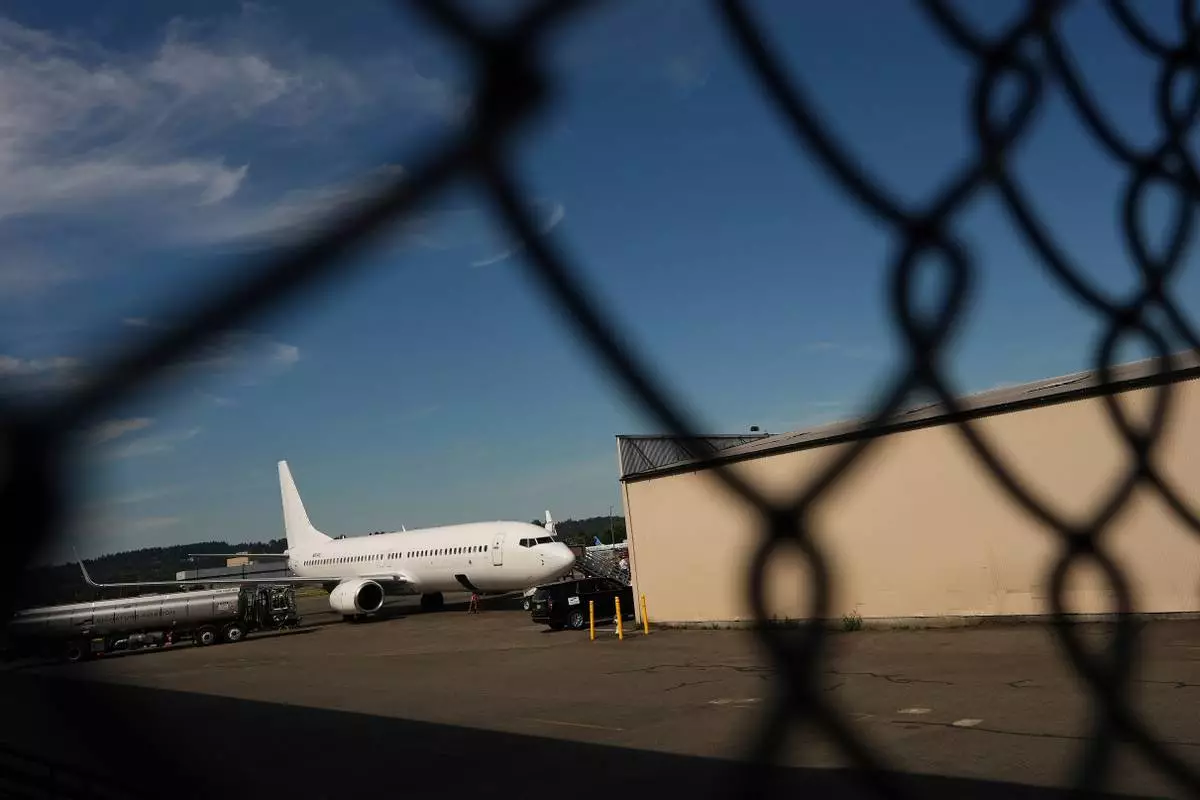
FILE - A U.S. Immigration and Customs Enforcement flight operates out of King County International Airport-Boeing Field, Aug. 23, 2025, in Seattle. (AP Photo/Lindsey Wasson, File)