KYIV, Ukraine (AP) — More than a dozen senior European officials were in the Ukrainian capital on Tuesday in a show of support on the fourth anniversary of Russia’s all-out invasion of Ukraine — a grim milestone in a war that has killed tens of thousands of people and put European leaders on edge about the scale of Moscow’s ambitions on the continent.
Ukrainian President Volodymyr Zelenskyy was defiant despite the devastating toll — insisting that Russia has not “broken Ukrainians” nor triumphed in the war.
Zelenskyy said his country has withstood the onslaught by Russia’s bigger and better equipped army, which over the past year of fighting captured just 0.79% of Ukraine’s territory, according to the Institute for the Study of War, a Washington-based think tank.
“Looking back at the beginning of the invasion and reflecting on today, we have every right to say: we have defended our independence, we have not lost our statehood,” Zelenskyy said on social media, adding that Russian President Vladimir Putin has “not achieved his goals.”
“He has not broken Ukrainians; he has not won this war,” Zelenskyy said.
However, as the corrosive war of attrition enters its fifth year, a U.S.-led diplomatic push to end Europe’s biggest armed conflict since World War II appears no closer to finding compromises that might make a peace deal possible.
Negotiations are stuck on what happens to the Donbas, eastern Ukraine’s industrial heartland which Russian forces mostly occupy but have failed to seize completely, and the terms of a postwar security arrangement that Kyiv is demanding to deter any future Russian invasion.
In a speech at a makeshift memorial in Kyiv’s central square, where thousands of small flags and portraits show photos of fallen soldiers, Zelenskyy said he wanted U.S. President Donald Trump to visit and witness for himself Ukrainian suffering.
“Only then can one truly understand what this war is really about,” Zelenskyy said.
Trump, who says he wants the fighting to stop, has repeatedly changed his tone toward Putin and Zelenskyy over the past year.
The number of soldiers killed, injured or missing on both sides could reach 2 million by spring, with Russia sustaining the largest number of troop deaths for any major power in any conflict since World War II, a report last month from the Center for Strategic and International Studies estimated.
European leaders see their countries’ own security at stake in Ukraine amid concerns about Putin’s wider goals and has demanded its leaders be consulted in the ongoing U.S.-brokered talks.
German Chancellor Friedrich Merz wrote on X that “for four years, every day and every night has been a nightmare for the Ukrainians — and not just for them, but for us all. Because war is back in Europe.”
“We will only end it by being strong together, because the fate of Ukraine is our fate,” he added.
Putin believes that time is on the side of his bigger army, Western officials and analysts say — and that Western support will trail off and that Ukraine’s military resistance will eventually crumble.
But French President Emmanuel Macron described the war was “a triple failure for Russia: military, economic, and strategic.”
The war “has strengthened NATO—the very expansion Russia sought to prevent—galvanized Europeans it hoped to weaken, and laid bare the fragility of an imperialism from another age,” Macron said on X.
The war has brought widespread hardship for Ukrainian civilians. Russia's aerial attacks have devastated families and denied civilians power and running water.
It has drawn in countries far beyond Ukraine, giving the conflict a global dimension, and threatened to worsen shortages, hunger and political instability in developing countries.
While NATO countries have come to Ukraine’s aid, Russia has been helped by North Korea, which has sent thousands of troops and artillery shells; Iran, which has provided drone technology; and China, which the United States and analysts say has provided machine tools and chips.
Among the European officials visiting Kyiv on Tuesday were the President of the European Council, Antonio Costa, the President of the European Commission Ursula von der Leyen and Finnish President Alexander Stubb, as well as seven prime ministers and four foreign ministers.
The only American listed among the official guests in Kyiv ceremonies was Lt. Gen. Curtis Buzzard, a U.S. officer who represents NATO in Ukraine.
With Ukraine unable to sustain its fight against Russia without foreign help, NATO countries are now providing military help, purchasing American weapons after the Trump administration broke with earlier Washington policy and stopped giving arms to Kyiv.
The European Union has also sent financial aid, but has sometimes met with reluctance from members Hungary and Slovakia.
British Armed Forces Minister Al Carns said Russia's war on Ukraine was “the most defining conflict” in decades.
“I don’t think anyone of us would be able to guess (when the war started) the scale and size of what has taken place,” he said.
The war has brought a “revolution in military affairs,” especially through the rapid development of drone technology by both sides, according to Carns. Drones now account for the vast majority of battlefield casualties, he said.
The United Kingdom on Tuesday announced a new package of military and humanitarian support for Ukraine, including sending teams of British military medics conducting medical mentoring inside Ukraine, drawing on battlefield experience from Iraq and Afghanistan.
The cost of rebuilding war-battered Ukraine would amount to almost $588 billion over the next decade, according to World Bank, the European Commission, the United Nations and the Ukrainian government.
That is nearly three times the estimated nominal GDP of Ukraine for last year, they said in a report Monday.
Associated Press reporters across Europe contributed to this story.
Follow AP’s coverage of the war in Ukraine at https://apnews.com/hub/russia-ukraine
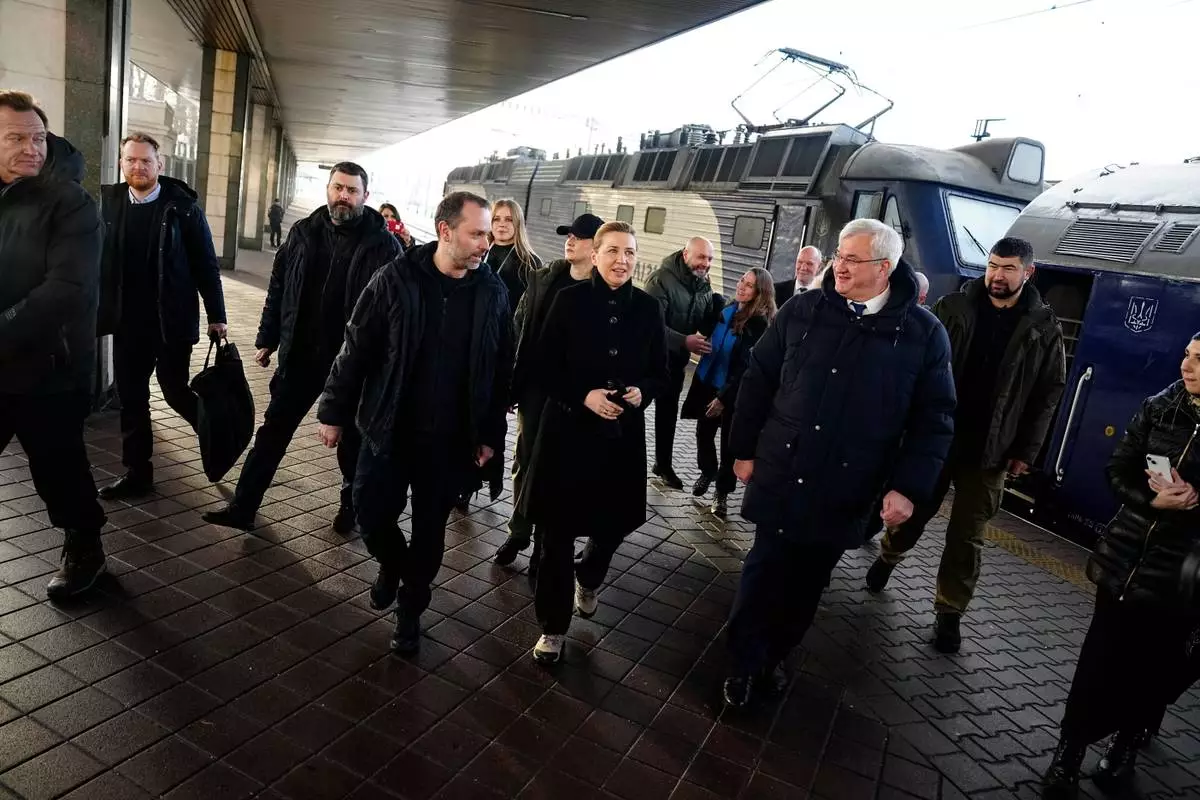
Denmark's Prime Minister Mette Frederiksen, centre, is welcomed by Ukraine's Foreign Minister Andrii Sybiha, centre right, as she arrives in Kyiv, Ukraine, Tuesday, Feb. 24, 2026. (Mads Claus Rasmussen/Ritzau Scanpix via AP)
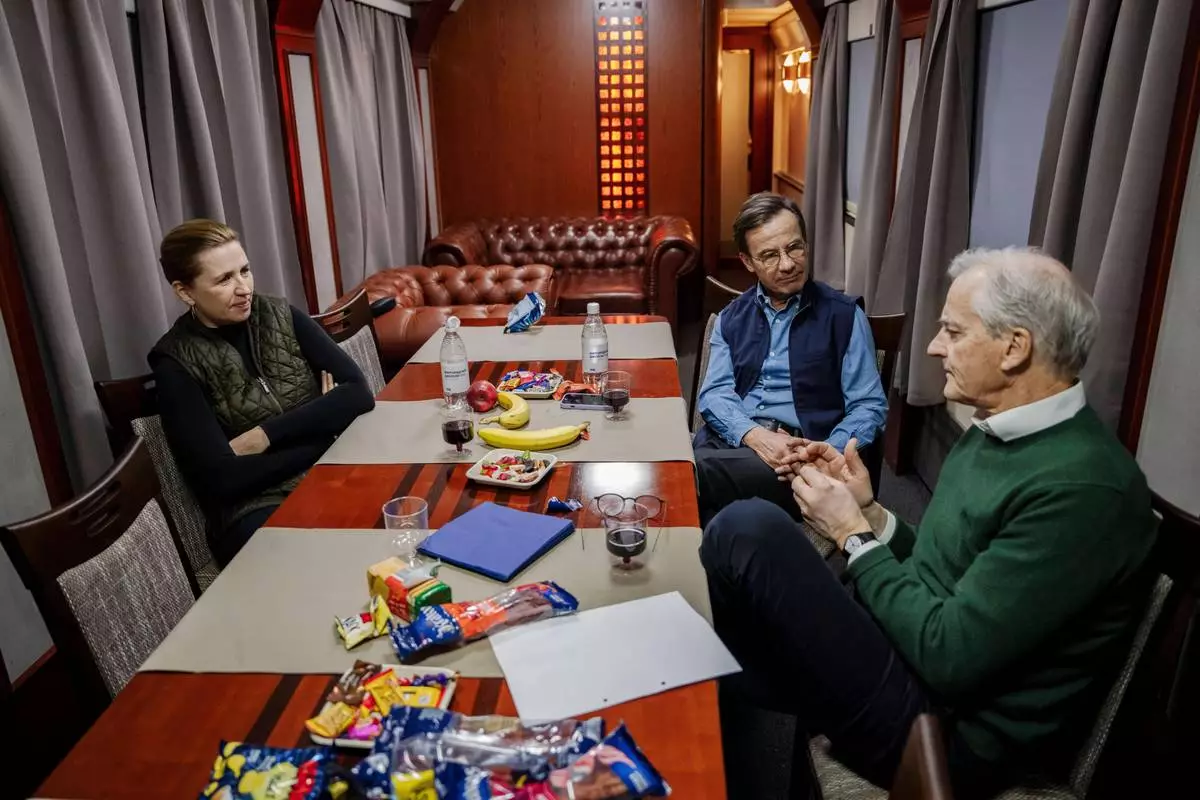
From left: Denmark's Prime Minister Mette Frederiksen, Sweden's Prime Minister Ulf Kristersson and Norway's Prime Minister Jonas Gahr Stoere talk in the train during their journey from Poland's Medyka to Kyiv, Ukraine, Tuesday, Feb. 24, 2026. (Mads Claus Rasmussen/Ritzau Scanpix via AP)
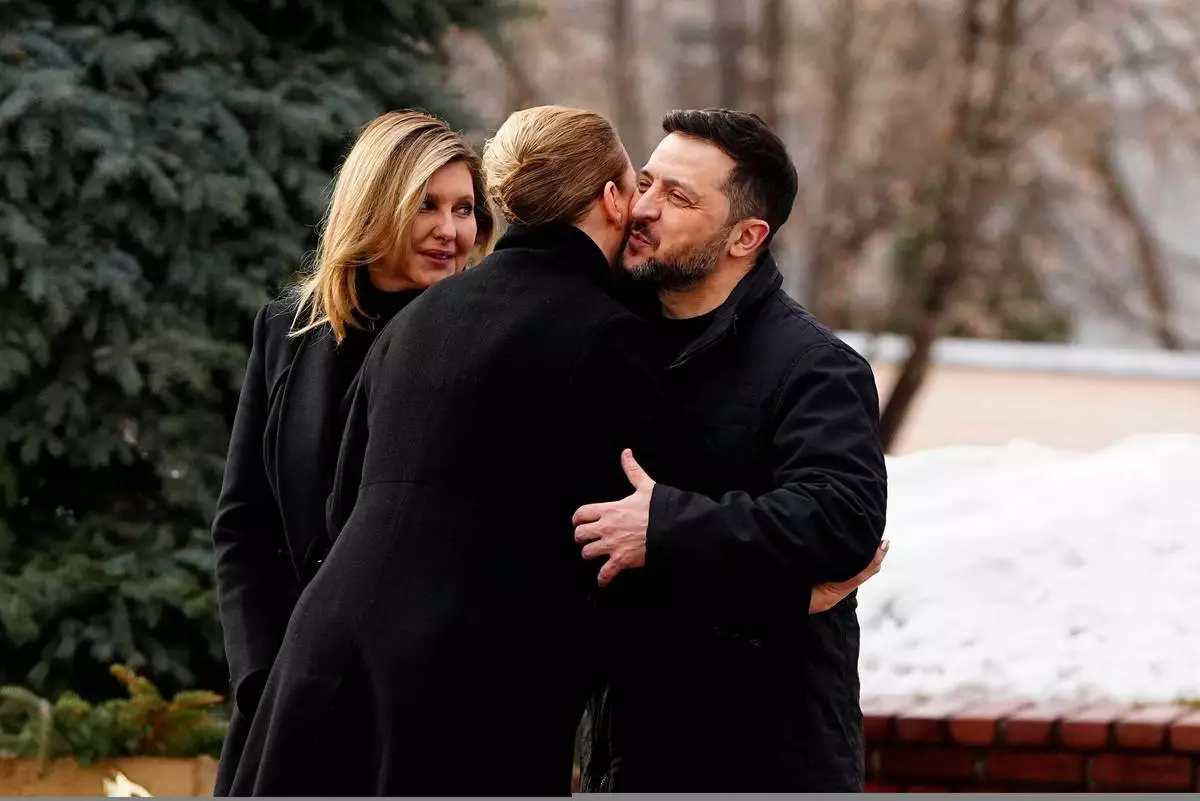
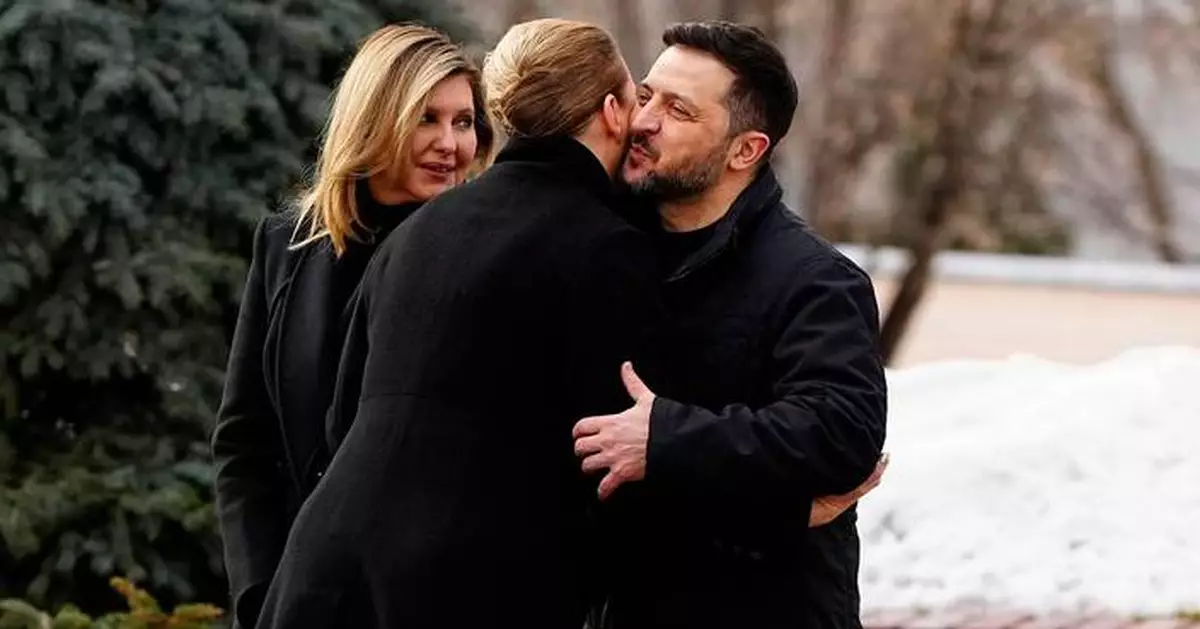
Denmark's Prime Minister Mette Frederiksen, centre, is welcomed by Ukraine's President Volodymyr Zelenskyy and his wife Olena Zelenska, left, before a service at St. Sophia Cathedral in Kyiv, Ukraine, on Tuesday, Feb. 24, 2026. (Mads Claus Rasmussen/Ritzau Scanpix via AP)
It has been exactly four years since Russia launched its large-scale invasion of Ukraine, attacking the country from multiple directions. On Feb. 24, 2022, Russian President Vladimir Putin announced a “special operation," a campaign that many expected to be brief and to end with Kyiv's capitulation.
Instead, European officials are traveling to the Ukrainian capital on Tuesday to show their support for President Volodymyr Zelenskyy and the Ukrainian people, who are fighting on.
While Putin did not get the quick and overwhelming victory he had hoped for, the cost has been high on both sides. And as Europe’s biggest conflict enters its fifth year, there is no sign of any peace deal despite U.S. diplomatic efforts over the past year.
Here’s the latest:
More than a dozen senior European officials arrived in Kyiv on Tuesday in a show of support. But they also come without two new deals they had hoped to present to Kyiv — a new package of sanctions on Russia and a 90 billion euro loan to fund Ukraine's defense for the next two years.
Hungary, seen as most pro-Russian country in the European Union, blocked them both. It's a sign of how difficult it has been sometimes to maintain solidarity as the war drags on.
Zelenskyy said his country has withstood the onslaught by Russia’s bigger and better equipped army, which over the past year of fighting captured just 0.79% of Ukraine’s territory, according to the Institute for the Study of War, a Washington-based think tank.
“Looking back at the beginning of the invasion and reflecting on today, we have every right to say: we have defended our independence, we have not lost our statehood; Putin has not achieved his goals,” Zelenskyy said on social media.
“He has not broken Ukrainians; he has not won this war,” Zelenskyy said.
French President Emmanuel Macron said in a post on the social platform X that “this war is a triple failure for Russia: military, economic, and strategic.”
“It has strengthened NATO — the very expansion Russia sought to prevent — galvanized Europeans it hoped to weaken, and laid bare the fragility of an imperialism from another age," Macron said.
Macron also urged the EU to issue the 90 billion euro ($106 billion) loan to Ukraine, a plan that requires the unanimity of the 27 member states.
“There is no justification for calling this into question. We must now deliver on it,” he wrote.
Macron and British Prime Minister Keir Starmer were to join a meeting of Western leaders supporting Ukraine, the so-called Coalition of the Willing, via videoconference on Tuesday.
Britain’s Armed Forces Minister Al Carns says the war has been “the most defining conflict” in decades due to the way it has revolutionized warfare and upended Europe’s security.
“I would never have guessed in my lifetime I would see North Korean troops fighting on the border of Europe,” Carns told reporters on Monday. “Which I think is a significant warning signal to all of us.”
Carns said the conflict had brought a “revolution in military affairs,” especially through the rapid development of drone technology. Drones now account for the vast majority of battlefield casualties in the war.
Western officials say that in the last three months, Russia has lost more casualties than the number of troops it recruits, a potential tipping point.
“The cost on Russia has been almost unimaginable,” Carns said, calling a Western estimate of 1.25 million Russian personnel killed and wounded since 2022 likely an underestimate.
European leaders visiting Kyiv hailed the Ukrainian struggle.
Danish Prime Minister Mette Frederiksen said the Ukrainians are “standing up for the freedom of us all. Their courage and strength shine in the fight against Putin’s darkness. And they give hope to those of us who want a Europe at peace.”
Swedish Prime Minister Ulf Kristersson, said: “We don’t yet know when the war will end, but how it ends will affect Sweden’s security for at least a generation to come. And that’s why our continued support is so crucial.”
Poland’s Foreign Minister Radosław Sikorski vowed from Kyiv that his country would remain “steadfast in its support for the Ukrainian people and in its pursuit of a just and lasting peace.”
“A victory parade was supposed to take place here after a few days,” Sikorski said in an address from Kyiv referring to Russia’s initial plans of a quick takeover of Ukraine. “Instead, four years later, Kyiv is still defending itself.”
NATO Secretary-General Mark Rutte said Ukraine’s allies will continue to militarily support the war-ravaged nation to end the war and ensure a lasting peace.
“Ukraine needs ammunition today and every day, until the bloodshed stops. Ukraine continues to blunt Russia’s aggression, and despite Putin’s posturing, Russia has failed to meet their ambitions on the battlefield,” he said during a ceremony at NATO headquarters in Brussels.
“There cannot be true peace in Europe without real peace in Ukraine. When the fighting eventually stops, the peace has to hold with strong Ukrainian forces ready to deter and defend and effective security guarantees from Ukraine’s partners: Europe, Canada, and the United States.”
A Chinese government spokesperson noted that the door to dialogue had recently opened in what she called the Ukraine crisis, avoiding describing the conflict as a war.
“We hope all parties will seize the opportunity to reach a comprehensive, lasting and binding peace agreement,” Foreign Ministry spokesperson Mao Ning said when asked about the fourth anniversary of the outbreak of the war.
China has been accused of not doing enough to pressure Russia to end the fighting. It has maintained ties and trade with Russia, relieving some of the pressure of economic sanctions. China says its position is impartial and objective.
“China never fans the flames or seeks to profit from the situation, and of course we do not accept any attempts to shift blame onto China,” Mao said.
Matthias Schmale, the U.N. humanitarian coordinator in Ukraine, noted that the costs for the country’s recovery from the war are now estimated at $590 billion over a decade — three times Ukraine’s GDP last year.
Schmale said by video link to a U.N. briefing in Geneva on Tuesday that over 10.8 million people, roughly a quarter of Ukraine’s population, remain in need of humanitarian assistance – including up to 1 million in Russian-occupied territory.
He also noted that that Ukraine is one of the world’s most-mined countries, with almost a quarter of its territory “potentially contaminated.”
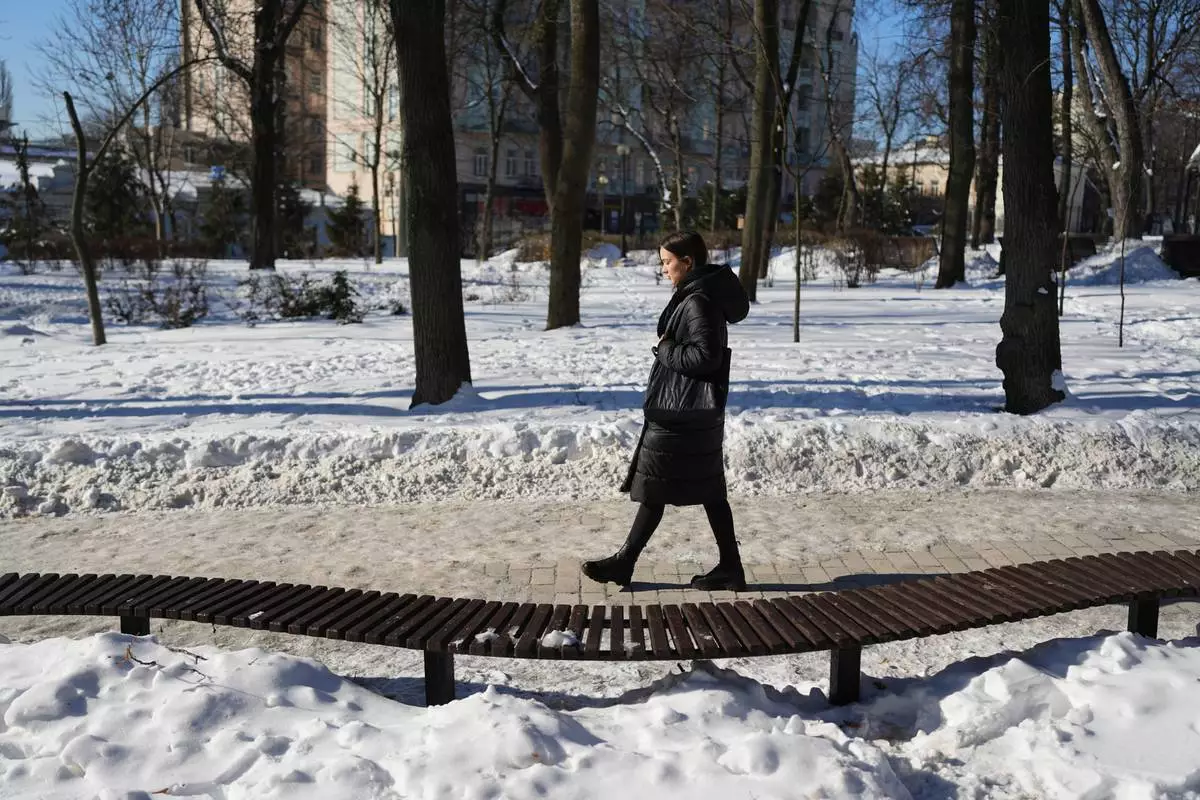
Liliia, 30, whose boyfriend is a prisoner of war, walks through a city park in Kyiv, Ukraine, Saturday, Feb. 21, 2026. (AP Photo/Sergei Grits)
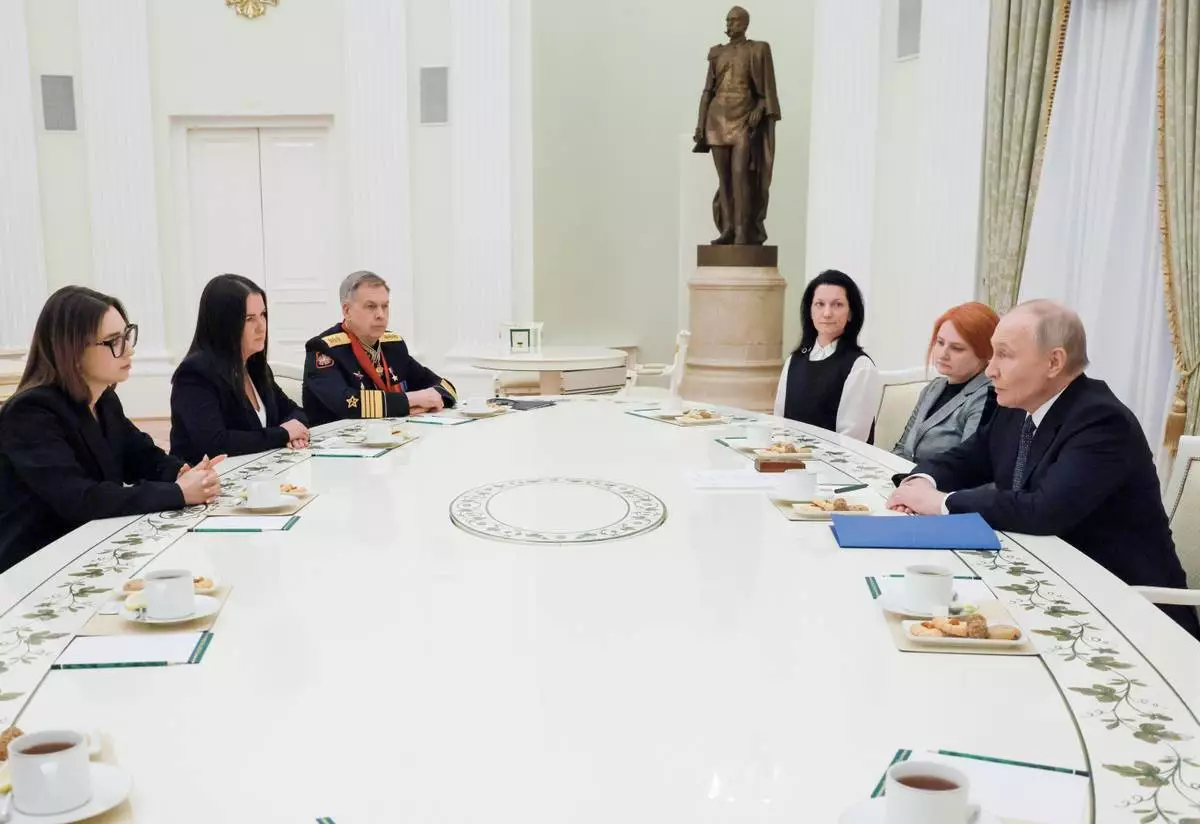
Russian President Vladimir Putin speaks to widows of Russian fallen servicemen during a military action in Ukraine, as Admiral Igor Kostyukov, head of Russian military intelligence (GRU), third left, attends a meeting at the Kremlin in Moscow, on Monday, Feb. 23, 2026. (Mikhail Metzel, Sputnik, Kremlin Pool Photo via AP)
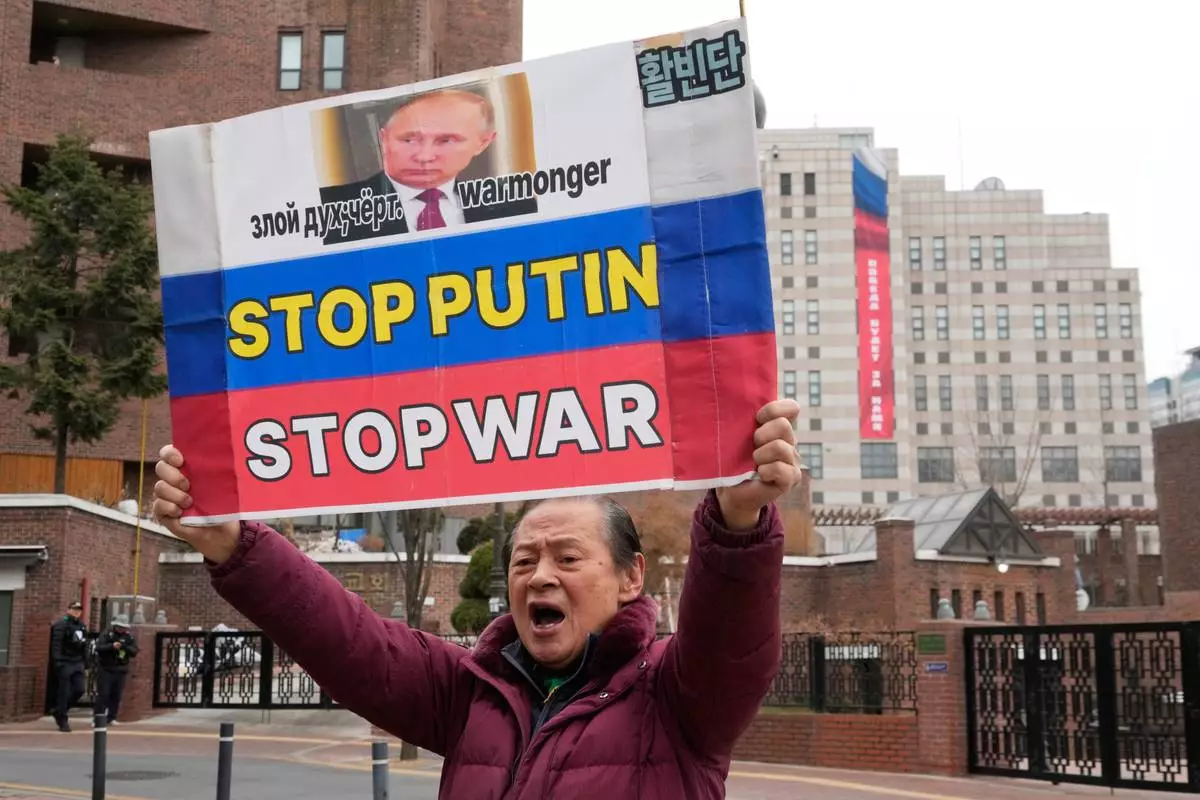
A South Korean protester holds a banner to denounce Russia's invasion of Ukraine on the fourth anniversary of the Russia-Ukraine war, near the Russian Embassy in Seoul, South Korea, Tuesday, Feb. 24, 2026. A banner reads "Victory will be ours." (AP Photo/Ahn Young-joon)