DCS chairs 11th meeting of Task Force on District Governance
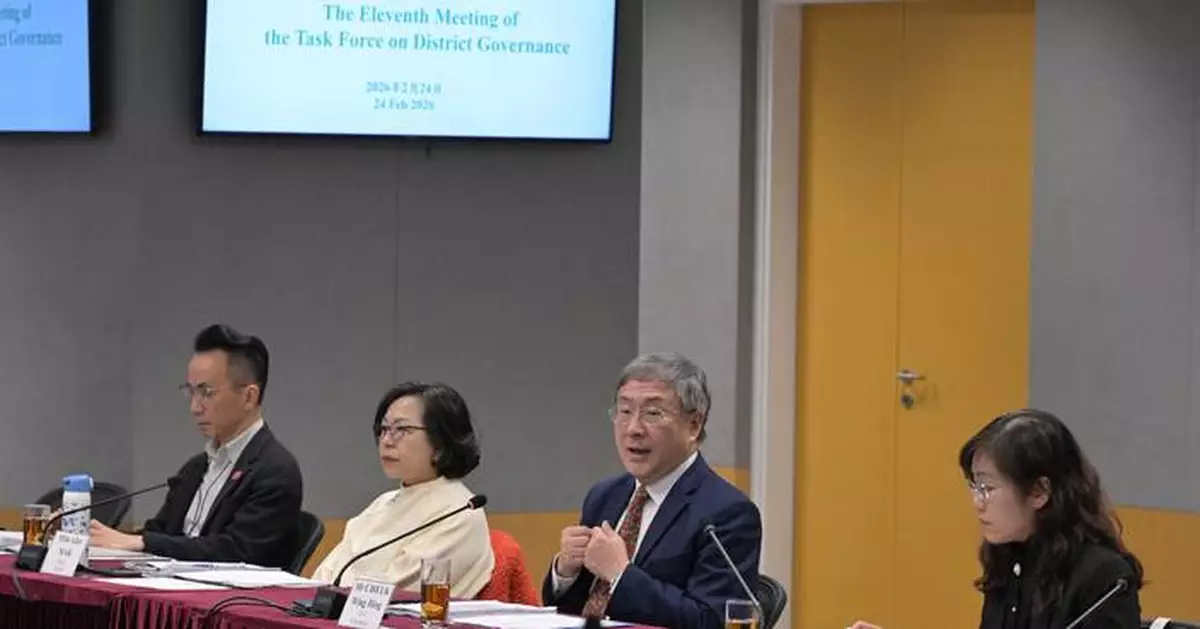
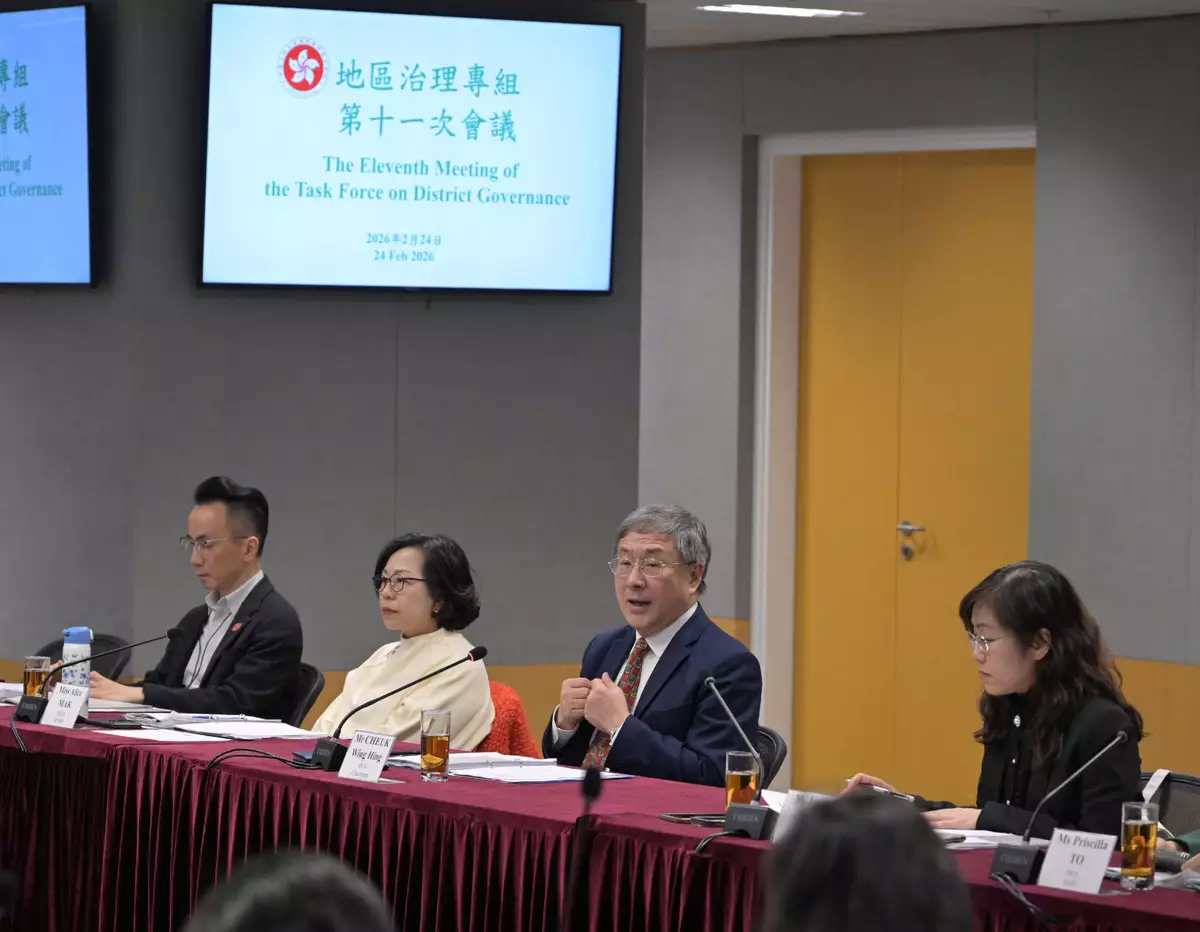
The Deputy Chief Secretary for Administration, Mr Cheuk Wing-hing, chaired the 11th meeting of the Task Force on District Governance today (February 24) to follow up on the initiatives in accordance with the work assigned by the Steering Committee on District Governance. The meeting co-ordinated various departments in formulating specific implementation measures on issues of local concern and continuously reviewed the work progress and performance.
Mr Cheuk said, "The Task Force has continuously steered departments in implementing the strategies formulated by the Steering Committee, introducing various policies and measures targeting district issues of key public concern and achieving fruitful results. The Task Force will continue to lead departments in addressing people's livelihood concerns through concrete actions, comprehensively enhancing district governance and building a better community. The Task Force will also strengthen the promotion of work achievements to enhance citizens' sense of happiness and fulfillment."
The Steering Committee chaired by the Chief Secretary for Administration has formulated strategies for 12 district issues (Note), including various measures to strengthen community support and enhance district facilities, thereby creating a higher-quality living environment for the public. At the meeting, the Task Force followed up on the implementation progress and outcomes of relevant initiatives.
The meeting discussed the achievements of the Care Teams, which completed their first-term services in October 2025. Over the two-year period, Care Teams made around 610000 visits to elderly households and other households in need, provided around 100000 instances of basic home or other support services, and organised around 50000 district-level activities. Their achievements are evident to all. Moreover, Care Teams assisted in emergency and incident responses. In the event of emergencies and incidents in the districts (such as during the Wang Fuk Court Fire in Tai Po, the discovery of wartime bombs in Quarry Bay, Super Typhoon Ragasa, and successive heavy rainstorms affecting Hong Kong), Care Teams swiftly mobilised their members and volunteers to attend to the needs of affected individuals and provide them with adequate assistance. In particular, during the aftermath support for the Wang Fuk Court Fire, more than 1 900 Care Team members and volunteers from all 18 districts across Hong Kong responded promptly to the Government's call and actively participated in emergency assistance. In terms of resources, the Government provided the Care Teams with part of the funding they need, while the operating organisations supported the Care Teams' services through sponsorships, donations, or internal resources of the organisations. The total expenditure for the overall service plan of the first-term Care Teams was $444 million, of which $411 million was covered by Government funding disbursed according to the funding agreements (i.e., 92 per cent), while the remaining expenditure (i.e., 8 per cent) was met by community resources gathered by the Care Teams. Notably, the Government allocated $452 million as funding for the first-term Care Teams, but only 91 per cent of this amount was ultimately utilised, despite services exceeding the key performance indicator requirements that were delivered. This reflects the Care Teams' prudent use of public funds in accordance with guidelines and their effective mobilisation of community resources. To enable the public to better understand the work of the Care Teams' services, the Work Reports of the first-term Care Teams have been released today. Members of the public can visit the Care Teams website (www.had.gov.hk/tc/public_services/district_services_community_care_teams/index.htm) to view the Work Reports of the individual teams.
The meeting also followed up on the progress of 12 district initiatives. In terms of care for the elderly, as at end-January 2026, the Care Teams in all districts had visited or reached out to over 91 000 singleton and doubleton elderly households, carers of elderly persons and persons with disabilities. More than 2 900 households (involving over 3 470 elderly persons or persons with disabilities) were referred by the Care Teams to receive subsidies for installation of emergency alarm systems.
As regards enhancing district facilities, the Food and Environmental Hygiene Department is expediting the renovation of public markets and cooked food markets. The stall enhancement works in the Ap Lei Chau Market Cooked Food Centre and the Luen Wo Hui Market Cooked Food Centre will be completed by April and July this year respectively, while the stall enhancement works in the Yue Wan Market Cooked Food Centre are expected to commence in March this year. The Highways Department has selected 14 suitable footpath locations for surface material replacement works, under which the existing paving slabs will be replaced with concrete pavement to enhance durability by minimising problems such as loosening or breakage of paving slabs resulting from load-bearing, compression or heavy usage; the Housing Department has also been carrying out minor improvement works at public housing estates to enhance the environment, and has so far completed external wall repainting works at five estates.
In respect of enhancing the environment, relevant departments plan to complete six beautification projects in 2026, including thematic planting in various park projects and housing development schemes. The Leisure and Cultural Services Department has already completed the planting of flowering trees, such as pink trumpet trees and silk floss trees, along the main pedestrian pathways at Sha Tin Park and Che Kung Miu Road Playground in January this year, bringing vibrant colours to the community.
Mr Cheuk thanked all departments for their dedicated efforts in advancing the above work and achieving notable results. He encouraged all departments to continue their efforts in the new year and to respond to public expectations through more solid and effective work, tangibly enhancing the quality of life and well-being of the public.
Note: The 12 key issues are: (1) expanding after-school care and enhancing support for parents; (2) caring for the elderly and enhancing community support; (3) fostering clean markets and mobilising the community to participate in anti-rodent work; (4) enhancing public order and combating crimes on all fronts; (5) improving pedestrian facilities and ensuring road safety; (6) enhancing the community environment and strengthening local characteristics; (7) improving the environment of public housing estates and creating comfortable homes; (8) caring for the elderly and promoting digital inclusion; (9) improving the waiting environment at public transport interchanges to enhance the travel experience; (10) combating air-conditioner water dripping to improve community environment; (11) cleaning pedestrian walkways to improve city streets; and (12) strengthening thematic planting.
DCS chairs 11th meeting of Task Force on District Governance Source: HKSAR Government Press Releases
Visitor arrivals to Hong Kong surge during Chinese New Year holidays
The interdepartmental working group on festival arrangements, led by the Chief Secretary for Administration, Mr Chan Kwok-ki, today (February 24) announced that the nine-day Chinese New Year Golden Week of the Mainland (February 15 to 23) concluded smoothly yesterday. According to the Immigration Department (ImmD), around 1.77 million visitors arrived in Hong Kong over the Golden Week, representing an increase of 14 per cent over the same period last year. Mainland inbound visitors accounted for around 1.5 million, representing an increase of 14 per cent. The number of non-Mainland inbound visitors was around 270 000, also representing an increase of 14 per cent.
Mr Chan said, "During this Chinese New Year Golden Week, Hong Kong was filled with a festive atmosphere, with residents and visitors alike participating in a wide array of celebratory activities, including the Cathay International Chinese New Year Night Parade on the first day of the Chinese New Year, the fireworks display on the second day, the Chinese New Year Raceday on the third day, and the Chinese New Year Cup football match on the fifth day. These diverse and enriching events were well received by both residents and visitors, not only creating a joyous atmosphere throughout the city but also effectively attracting crowds, stimulating consumption, and bringing opportunities to various industries such as retail, catering and tourism, showcasing Hong Kong's vibrant and welcoming metropolitan charm."
Visitor flow, situation at control points, and traffic and public transport arrangements
During the nine-day Chinese New Year Golden Week, the daily average of Mainland visitors was around 170 000. The arrival of Mainland visitors peaked on February 18 (the second day of Chinese New Year) with around 210 000 Mainland visitors arriving in Hong Kong. During the Golden Week, the Express Rail Link West Kowloon Control Point received the highest number of Mainland visitors, followed by the Lok Ma Chau Spur Line Control Point.
To cope with the increased passenger flow during the Chinese New Year Golden Week, relevant departments deployed additional manpower and operated additional counters and channels to facilitate passenger and vehicular flows. The Security Bureau activated the Emergency Monitoring and Support Centre during the holidays to closely monitor and co-ordinate public order across various districts, including various boundary control points (BCPs). The overall operation of the control points and traffic were smooth and orderly.
Overall traffic conditions were generally smooth during the Golden Week. The Emergency Transport Co-ordination Centre of the Transport Department (TD) operates round the clock to holistically monitor traffic conditions and public transport services across the territory, including BCPs, major stations and various tourist hotspots. The TD steered local and cross-boundary public transport operators (PTOs) to enhance their carrying capacity by increasing the frequency of bus services connecting land-based BCPs and strengthening cross-boundary coach services to meet passenger demand. PTOs also deployed additional staff to maintain order and reserved sufficient vehicles and manpower to further enhance services when necessary.
Mega events and major tourist attractions
The Cathay International Chinese New Year Night Parade on the first day of the Chinese New Year drew many residents and visitors, while the Chinese New Year Fireworks Display over Victoria Harbour on the second day of the Chinese New Year attracted over 360 000 residents and visitors. The race day on the third day of Chinese New Year also attracted over 20 000 visitors to experience the unique atmosphere of horse racing tourism of Hong Kong.
Visitors went to different parts of Hong Kong during the Chinese New Year Golden Week, with high visitor flows observed at major tourist attractions including the West Kowloon Cultural District, Ocean Park, Hong Kong Disneyland, the Peak Tram and Ngong Ping 360. Smooth and effective crowd management measures were implemented.
Regarding popular attractions in the Sai Kung East Country Park, various departments managed the increased number of visitors during the Chinese New Year Golden Week according to the measures devised beforehand. In the area of the East Dam of the High Island Reservoir in Sai Kung, the Police implemented traffic control measures as needed; the TD co-ordinated with the minibus operator to increase the service frequency of Route 9A (Pak Tam Chung - East Dam of High Island Reservoir); the Agriculture, Fisheries and Conservation Department (AFCD) published visitor flow information of the East Dam via its "Enjoy Hiking" website and strengthened cleaning services. The AFCD has also erected additional barriers and warning signs at the Po Pin Chau Viewing Platform, and deployed patrol staff during the Chinese New Year Golden Week holiday as planned, to urge visitors to pay attention to safety.
As for the campsites at Ham Tin Wan, Sai Wan and Long Ke Wan, the AFCD implemented a management plan formulated before the Chinese New Year Golden Week holiday. This included providing additional large waste collection bins during the period, arranging daily campsite cleaning and bin clearances, deploying staff as planned for patrols and reminding campers of camping etiquette and regulations. The Food and Environmental Hygiene Department arranged toilet attendants to be on duty daily at the Ham Tin public toilet. The AFCD also strengthened enforcement against illegal activities. During the Golden Week, there were a total of 32 enforcement cases along Sections 1 and 2 of the MacLehose Trail and at designated campsites nearby, including campsites at Ham Tin Wan, Sai Wan and Long Ke Wan. These cases involved offences such as littering and illegal use of fire outside designated barbecue areas or campsites. There were no instances of severe damage occurring at the aforementioned popular attractions and campsites within the Sai Kung East Country Park during the Golden Week. Traffic in the East Dam area was also generally smooth. The AFCD will review its long-term management strategies in light of the Golden Week experience, including the introduction of reservation and fee-charging mechanisms to better manage visitor flows.
Inbound tour groups and hotel occupancy rates
In terms of Mainland inbound tour groups, around 2 400 Mainland inbound tour groups brought nearly 84 000 visitors to Hong Kong during the nine-day Chinese New Year Golden Week, with around 74 per cent engaged in overnight itineraries. The number of tour groups exceeded the record of last year's eight-day Chinese New Year Golden Week by 9 per cent. The tour groups were generally orderly. The overall hotel occupancy rate reached 90 per cent in general.
Mr Chan expressed gratitude to all relevant government departments, organisations, and industry partners for their collaborative efforts and close co-ordination in receiving visitors, providing citizens and visitors with a festive atmosphere, along with a warm, welcoming experience in Hong Kong, while celebrating the joyous, harmonious and vibrant Chinese New Year holidays.
Source: AI-found images