DUBAI, United Arab Emirates (AP) — As the United States assembles its greatest military firepower in decades in the Middle East, Iranians are warily awaiting the next round of talks with the U.S. in Geneva this week — negotiations that many see as a last chance for their ruling theocracy to strike a deal with U.S. President Donald Trump.
Some say the situation feels hopeless. Battered by decades of sanctions, heightened by Trump's 2018 decision to withdraw from Tehran's nuclear deal with world powers, Iranians also just suffered through the bloodiest crackdown on dissent in the country's modern history as security forces in January killed thousands of people and detained tens of thousands more.
Click to Gallery
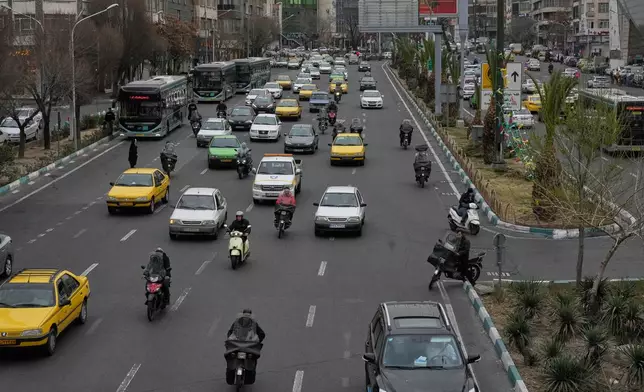
Vehicles drive in downtown Tehran, Iran, Tuesday, Feb. 24, 2026. (AP Photo/Vahid Salemi)
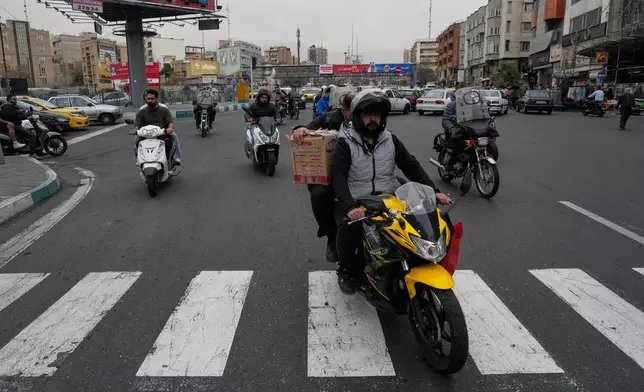
People drive their motorbikes in a square in downtown Tehran, Iran, Tuesday, Feb. 24, 2026. (AP Photo/Vahid Salemi)
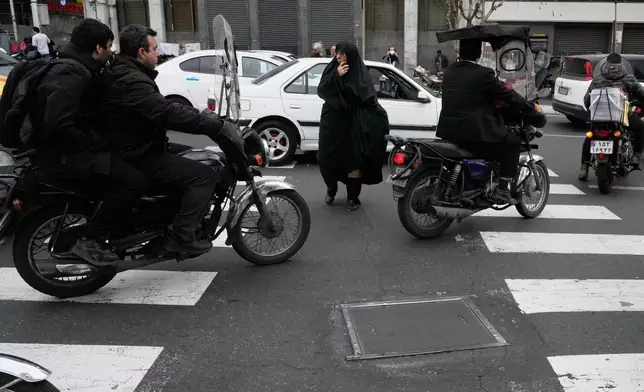
A woman crosses a square as motorbikes ride past in downtown Tehran, Iran, Tuesday, Feb. 24, 2026. (AP Photo/Vahid Salemi)
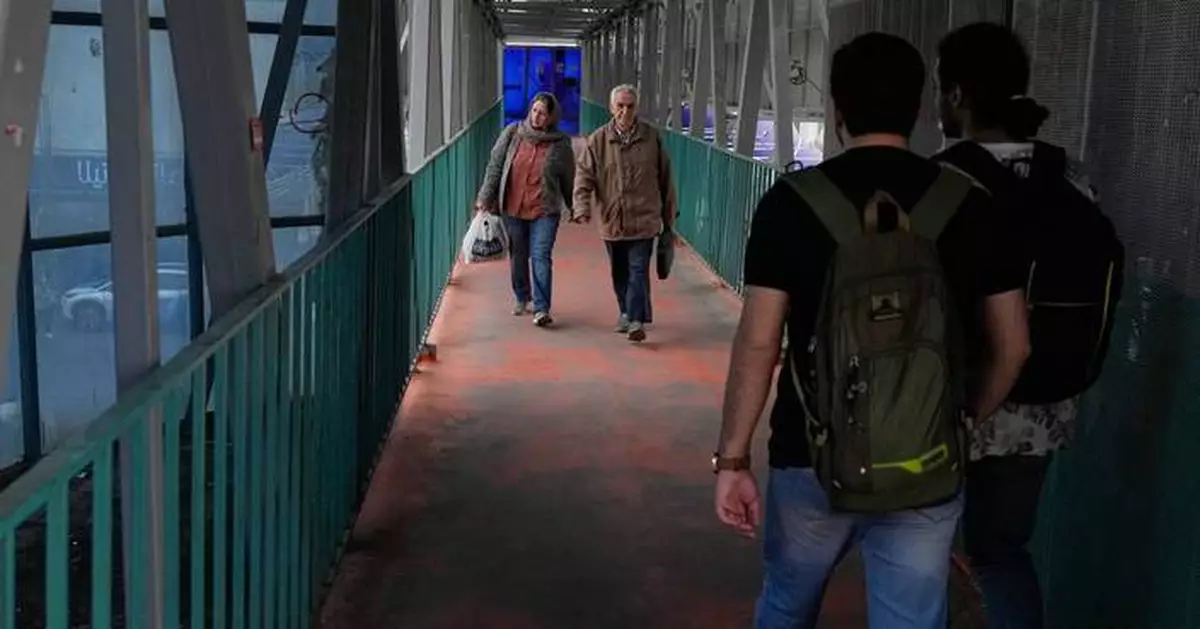
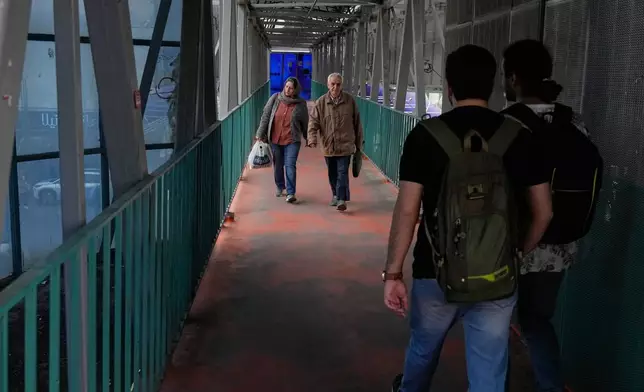
People walk across an overpass in downtown Tehran, Iran, Tuesday, Feb. 24, 2026. (AP Photo/Vahid Salemi)
Still, Iran is going into the Thursday talks “with a determination to achieve a fair and equitable deal—in the shortest possible time,” Foreign Minister Abbas Araghchi posted Tuesday on X.
As Iranians await the outcome of the Geneva negotiations, many fear the outbreak of a war that could surpass Iran's bloody 1980s conflict with Iraq.
But while that conflict sparked a patriotic response from Iranian volunteers, the prospects of a war with the U.S. have riven a population that still includes hardline supporters of the country's theocracy as well as those who feel Iran is splitting at the seams.
“Every morning when I get up, my brain is full of chaos,” said Sepideh Bafarani, a 29-year-old woman who works in a woman's clothing store. “It's a possible war ... and an ongoing bad economic situation.”
Rasool Razzaghi, a 54-year-old resident in Tehran, the Iranian capital, summed up the approaching talks with similar concern.
“I predict that if both sides really mean what they are saying, a war will start," he said.
For weeks, Trump has talked about an “armada” now largely in place off the coast of Iran, including the aircraft carrier USS Abraham Lincoln. He has also sent the USS Gerald R. Ford, the world’s largest aircraft carrier, from the Caribbean toward the Mideast.
Overall, there are at least 16 U.S. Navy ships assembled, according to an analysis by the Washington-based Center for Strategic and International Studies.
That’s comparable to Operation Desert Fox in 1998, when American and British forces bombed Iraq for four days over Saddam Hussein ’s refusal to comply with U.N. Security Council resolutions about weapons inspections. Between the carriers and aircraft on the ground in Jordan, there are also stealth F-35 fighters and other warplanes capable of launching a major attack on Iran.
Meanwhile, the CIA published instructions in Farsi online on how Iranians can securely contact the spy agency.
Iranians have been watching the buildup with growing concern, either by surreptitiously getting around internet restrictions or watching satellite news channels. Iranian state television has kept showing the country's military running drills and its leaders threatening massive retaliation against any American assault.
Iranian state TV on Tuesday said the country's Revolutionary Guard held a drill that included launching missiles, flying drones and firing guns at targets along its coast, without elaborating on the exact time or place of the exercise.
“I don’t know. I’m not so optimistic," a passer-by told The Associated Press on Tuesday in Tehran, declining to give his name for fear of reprisals. "It’s not an equal situation. One side has entered the talks with a lot of power, it has lot of equipment. On the other hand, Iran is in a weak position. They want total surrender, but I think that’s not viable.”
Steve Witkoff, the billionaire friend of Trump now serving as his special Mideast envoy, has said the president didn’t understand why Iran “hadn’t capitulated” given the forces arrayed against it in the region and beyond in Europe. Iranian Foreign Minister spokesman Esmail Baghaei dismissed Witkoff’s comments on Monday, saying “the word ‘capitulation’ does not exist in the Iranians’ dictionary.”
In a series of posts on X Tuesday, Araghchi reiterated that Iran had no intention of ever developing an nuclear weapon, but said it would also not forgo the “right to harness the dividends of peaceful nuclear technology for our people.”
The Geneva talks, he said, are “a historic opportunity to strike an unprecedented agreement that addresses mutual concerns and achieves mutual interests. A deal is within reach, but only if diplomacy is given priority.” Iran, he added, would “stop at nothing to guard our sovereignty with courage.”
Even looking beyond the public statements, it remains unclear just what Iran could offer Trump. Tehran has insisted it wants to continue enriching uranium, something Trump has repeatedly said must stop. It also has refused to discuss its ballistic missile arsenal or its support of regional proxy forces, another Trump demand.
It remains difficult to speak to people in Iran as the internet and telephone lines remain disrupted following last month's nationwide protests. On the streets of Tehran, many people remain suspicious of talking to journalists, assuming reporters all work for the government. Iran's theocracy controls all radio and TV stations in the country.
Those who did talk with the AP kept mentioning the 1980s war with Iraq, a cataclysmic event in the mind of those old enough to remember it.
“I remember many bad situations but even during Iran-Iraq war in 1980s it was not like this," said Hassan Mirzaei, a 68-year-old taxi driver. “I am in shock without any hope — especially when there is word about war.”
He added: “I have two orphaned grandchildren, and I need to work to feed.”
“Everybody is worried because (of) the consequences of war with a country like America," said the Tehran passer-by. “We once fought Iraq for eight years, but it was a country at the same level with us. Going to war with America, Israel and NATO will have very horrible and unpredictable consequences. "
“What can we do,” he added. "We can’t leave our country. We have no choice but to adapt.”
However, not everyone is opposed to Iran's government. Ami Mianji, a 33-year-old who runs an auto repair shop, described Iranians as a brave people who are not afraid of war.
“I do not care about threats by Trump and others, eventually Iranians will push back any warmonger,” Mianji said.
But for many young people, the crackdown on the demonstrations have broken whatever trust they had for the government.
“Iran is refusing to back down from its positions for sure, because if it does, it would have officially given up its 40-year-old ideology,” said one student who spoke to the AP on condition of anonymity also fearing reprisals.
“I have no hope,” he added. "The leaders of both countries speak often and none of them is willing to concede to reach a deal. So the likelihood for war is high.”
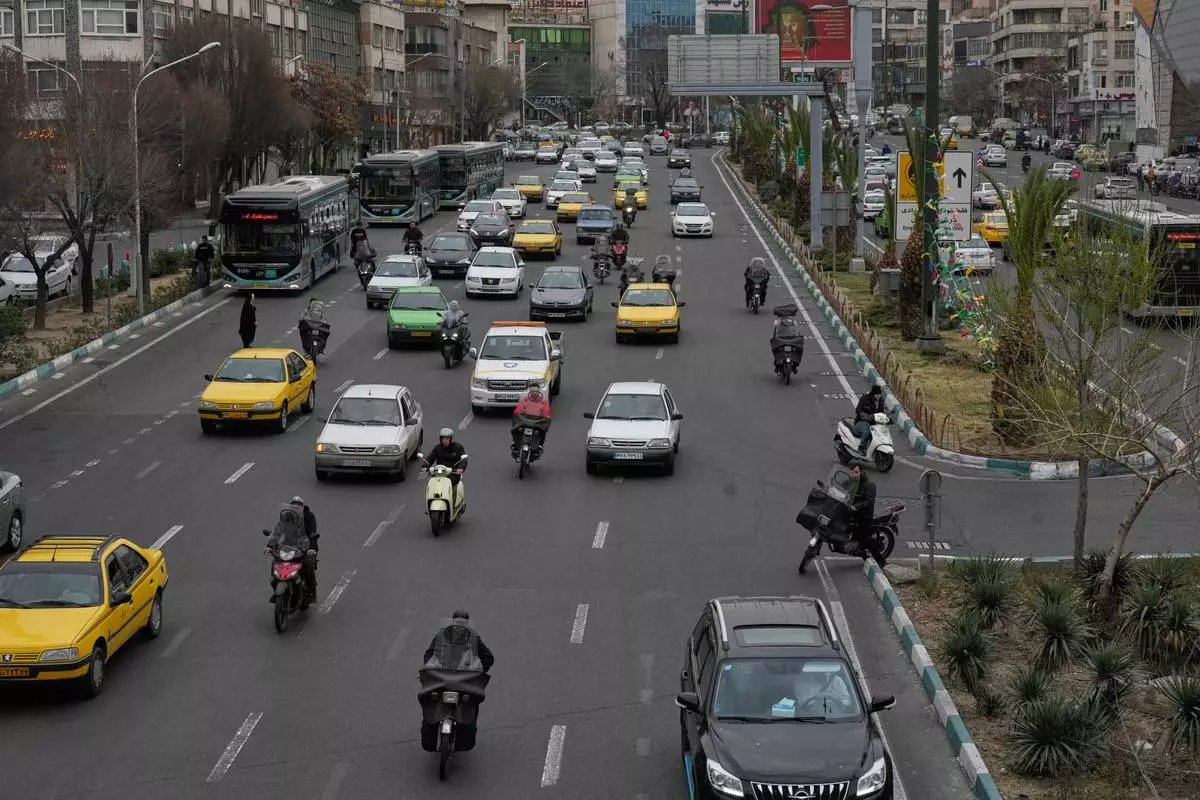
Vehicles drive in downtown Tehran, Iran, Tuesday, Feb. 24, 2026. (AP Photo/Vahid Salemi)
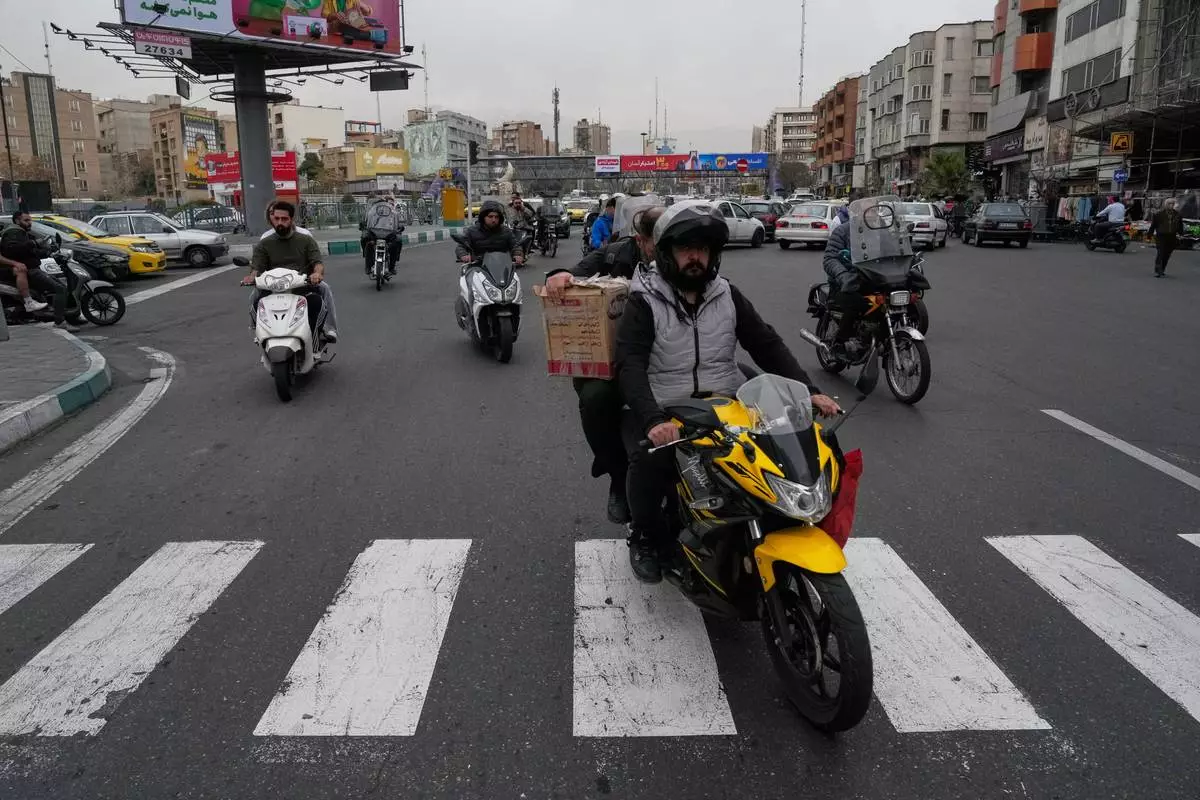
People drive their motorbikes in a square in downtown Tehran, Iran, Tuesday, Feb. 24, 2026. (AP Photo/Vahid Salemi)
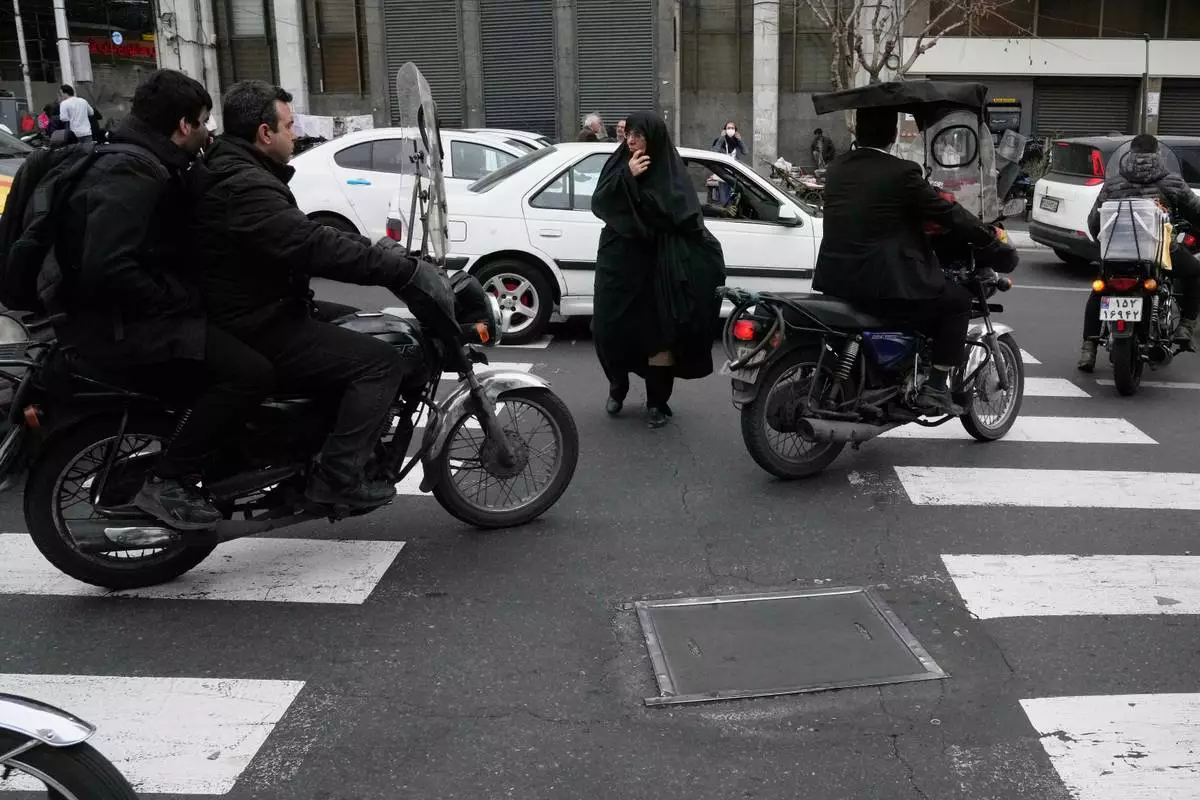
A woman crosses a square as motorbikes ride past in downtown Tehran, Iran, Tuesday, Feb. 24, 2026. (AP Photo/Vahid Salemi)
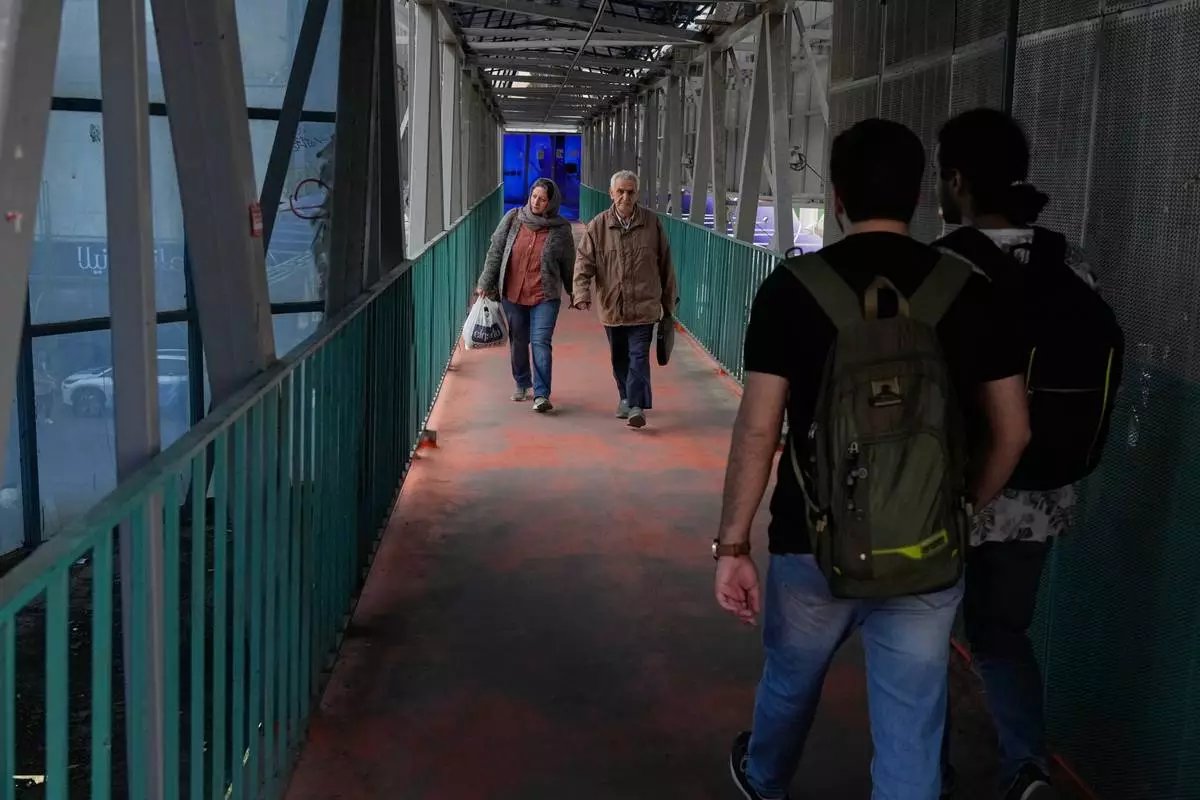
People walk across an overpass in downtown Tehran, Iran, Tuesday, Feb. 24, 2026. (AP Photo/Vahid Salemi)
Neighbors, government workers and a powerful railroad snow-clearing machine nicknamed “Darth Vader” scrambled to dig out from a brutal and — in some areas — record-breaking storm that blanketed the northeastern United States with snow, causing thousands of flights to be cancelled.
Even as the snow moved north Tuesday, giving way to sunshine in parts of the region, National Weather Service forecasters warned another storm originating in the Great Lakes was right around the corner.
Monday’s storm, which meteorologists are calling the strongest in a decade, dumped more than 2 feet (60 centimeters) of snow in parts of the metropolitan Northeast.
By Tuesday, roads were beginning to reopen, mass transportation was coming back online in some cities and power had returned for some of the hundreds of thousands that had lost electricity in Massachusetts, New Jersey, Delaware and Rhode Island.
The Latest:
In recent days, hundreds of New Yorkers have appeared at sanitation garages across the city to register for $30-per-hour shifts clearing snow across public streets and bus stops.
But several applicants reported being turned away after being told – despite Mayor Zohran Mamdani’s claim otherwise – that they needed to show a physical copy of their Social Security card and two Passport-sized photographs.
As of Tuesday, the city had dropped both of those requirements, according to Sanitation Department spokesperson Joshua Goodman. “The goal is to make this as simple as possible,” he told the AP.
Javier Lojan, acting commissioner of the Sanitation Department, said the city had tripled the size of the program in the last week, with at least 3,500 people now signed up as emergency shovelers.
Rhode Island Gov. Dan McKee announced Tuesday that the state’s travel ban was no longer in effect but still urged the public to stay off the roads if possible.
The governor’s office says they’ve requested help from other states, particularly with resources like heavy-duty plows, backhoes and other equipment to speed up snow removal.
In snowbound Providence, Rhode Island, snow is being transported to five locations, according to Josh Estrella, communications director for the city government.
The challenge is so great that additional dumping grounds may be added, Estrella said.
Providence has more than 60 of its own plows and at least 30 vendor plows on the job, he said, with main roads, hospital routes and overpasses getting priority attention.
State Rep. David Morales has criticized the city for hauling snow to a vacant lot slated for redevelopment in South Providence.
Two work crew members carry a snowblower up the steps of the Rhode Island State Capital, Tuesday, Feb. 24, 2026, in Providence, R.I. (AP Photo/Mark Stockwell)
Morales called that part of Providence “the most polluted part of the city” and home to a dense population of people of color.
“My frustration is the fact that the most polluted community in Providence has to once again become the dumping ground of polluted contaminants – in this case, dirty snow,” Morales said. He is running in the September Democratic primary against incumbent Mayor Brett Smiley.
But Estrella said the five dumping locations are scattered around Providence.
“One, for equity,” Estrella said. “Two, we have snow haulers go where it’s closer to them.” He said the South Providence lot is the largest and easiest to push snow into.
In Massachusetts nearly a quarter-million customers remained without electricity Tuesday, with outages concentrated along coastal communities.
Officials said it may take days for power to return to some areas of the state.
In Boston, many sidewalks remained coated in packed snow or reduced to narrow, icy trenches carved out by foot traffic. While property owners are responsible for clearing sidewalks in front of their homes, compliance appeared uneven.
For people using wheelchairs or pushing strollers, some stretches were impassable. Residents dug out cars buried under snow — and in some cases boxed in by plow piles — brushing off license plates just to identify which vehicle was whose.
Lerone Davis, who works nights as a first responder, said it would’ve been safer for children to have an extra day at home because the streets are still piled high with snow.
“Finally I was thinking, ‘OK I’ll park the car and relax for a little bit,’ but then I had to jump right back into it,” he said, standing with another father outside his kid’s Brooklyn day care, which follows the city’s decision to reopen Tuesday.
Both dads said they weren’t thrilled.
“Not having to worry about getting to school, battling with snow and everything, I think makes a little bit more sense,” Davis said. “Plus, they have snow days built into the school year.”
Around 94,500 children are enrolled in New York City’s publicly funded pre-K and 3-K programs, according to a city report at the start of the school year. Expanding free child care to include 2-year-olds was one of Mamdani’s signature campaign promises.
In addition to the thousands of canceled flights due to the storm, more than 1,500 of Tuesday’s flights within, into or out of the United States were delayed, according to flightaware.com.
Even after a storm passes, it takes time for airlines to get their planes and flight crews back where they need to be to restore full schedules, according to Michael McCormick, an associate professor of air traffic management at Embry‑Riddle Aeronautical University.
“This storm is so wide-ranging, it’s impacted major hubs along the Northeast. And those airports are the most vulnerable airports in terms of getting aircraft and air crews positioned to be able to fly their schedule,” McCormick said. As a result, there will continue to be cancellations that “gradually decrease daily,” he said.
The travel disruptions threatened further delays at the trial of Alon, Oren and Tal Alexander in Manhattan federal court.
A juror was “trapped in Miami” and wasn’t scheduled for a return flight until Friday, Judge Valerie Caproni said Tuesday. And it was unlikely the juror could make it back sooner: “She’s flying Spirit. That tells you everything,” Caproni said.
The judge eventually dismissed the stranded juror, leaving just one alternate. The trial already wasn’t held last week to accommodate jurors whose children were on a school break.
“I am loath to lose another juror, but I am also loath to lose another week of trial,” Caproni said.
A storm descending from Canada is forecast to bring snow to the Great Lakes starting Tuesday and could drop up to 2 inches in places of the Northeast still digging out from blizzard-like conditions.
The National Weather Service said a quick moving storm is set to hit the upper Great Lakes on Tuesday, bringing up to several inches of snow before moving southeast overnight. Buffalo, New York, could see up to 5 inches of accumulation. The weather service said New York could get less than half an inch, but other places, including Hartford, Connecticut, could see up to 2 inches.
Choosing the protest slogan with a double meaning proved a potent way for voters to jab at President Donald Trump after he sent Immigration and Customs Enforcement officers into the city and its suburbs in a major immigration crackdown. “Operation Midway Blitz” resulted in more than 4,000 arrests, a fatal shooting and a sour taste among many Chicago residents.
Chicago maintains 300 trucks, and is naming just six this year. After 39,000 final votes were cast, the other top winners were:
In a statement, Mayor Brandon Johnson thanked Chicago voters “for their unmatched creativity, sense of humor, and civic pride.”
The agency said early Tuesday that Rhode Island gets top honors for 37.9 inches, a preliminary state record, at the airport in Providence. And as of 3 a.m., snow totals weren’t complete for Connecticut, Maine, Massachusetts, New Hampshire and Rhode Island, where the storm’s remnants were passing through. Other top state accumulations so far:
White House press secretary Karoline Leavitt says the Federal Emergency Management Agency is “on the ground” working with state and local authorities to restore power, even though the agency is operating without a budget.
More than 350,000 customers in the Northeast were without electricity Tuesday morning, according to Poweroutage.com, which tracks outages nationwide.
“The Trump administration is on it,” Leavitt said, when asked for the administration’s message to those getting by without electricity.
A fight in Congress over federal immigration officers has led to a lapse in funding for the Department of Homeland Security, which houses FEMA.
Roughly 2,200 flights in and out of the United States were canceled Tuesday, according to the flight tracking website FlightAware.
Most of the cancellations involved Boston and the New York City area’s three major airports, affecting about half of all departing flights. About 14 percent of departing flights were canceled at Reagan National Airport in Washington, D.C.
Rhode Island’s T.F. Green International Airport’s operational pause remained in effect Tuesday as authorities assessed conditions. The airport paused all flights Monday as it dealt with nearly 38 inches (97 centimeters) of snow, according to the Weather Service, breaking a record of 28.6 inches (72.6 centimeters) set in 1978. The airport is in Warwick, six miles south of Providence, the state capital.
The nor’easter may have moved on, but there are still a lot of power outages.
More than 350,000 customers in the Northeast were without electricity Tuesday morning, according to Poweroutage.com, which tracks outages across the country. Outages reached over 600,000 during the peak of the storm Monday. Most are in Massachusetts.
Cape Cod, Martha’s Vineyard and other coastal communities experienced the worst of the storm and suffered the most severe damage, Eversource said. Power restoration was expected to take multiple days, the utility said.
About 20% of Massachusetts households depend on electricity for heating. Most heat their homes with natural gas, and another 20% use fuel oil or kerosene, according to Census estimates.
This is just a regular school day in New York City for more than 900,000 students in the nation’s largest public school system — the mayor said so, and invited kids to pelt him with snowballs over his decision.
Many students and their caregivers seemed open to taking Mamdani up on that snowball idea as they scrambled over mountainous snow banks and dodged salt spreaders during the Tuesday morning drop-off.
“We’re walking on thin ice here. One more day would’ve been fine,” said Danielle Obloj, the parent of a Brooklyn 5th grader. “They should never have let these kids come back to school.”
Others, meanwhile, hailed the city’s efforts at snow-clearing.
“It was much better than last time — an easy commute, no problems whatsoever,” said Raul Garcia, as he exited a cab with his three school-age children. “We thought it was going to be really bad walking, but looking at the streets, they’re so clean.”
A massive snowball fight erupted Monday in New York City’s Washington Square Park as the blizzard wound down, but it wasn’t all fun and games.
A viral video showed two very outnumbered police officers being pelted by snowballs — and shoving some of the people throwing them — in frustration as they tried to get away.
City police commissioner Jessica Tisch posted that the NYPD is aware of the video, calling the behavior “disgraceful” and “criminal.”
Mayor Zohran Mamdani announced that schools would be back in person on Tuesday, drawing questions about how feasible that is with snow still piled along sidewalks.
Staten Island Borough President Vito Fossella said schools should remain closed, while Michael Mulgrew, president of the United Federation of Teachers, described the situation as “a big mess.”
“There’s going to be low attendance of students, you’re going to have low attendance of staff because people don’t know if they can travel, if they can get to schools,” he said.
Mamdani's schools chief, Chancellor Kamar Samuels, said in a post on X, “We are confident in our decision to reopen.”
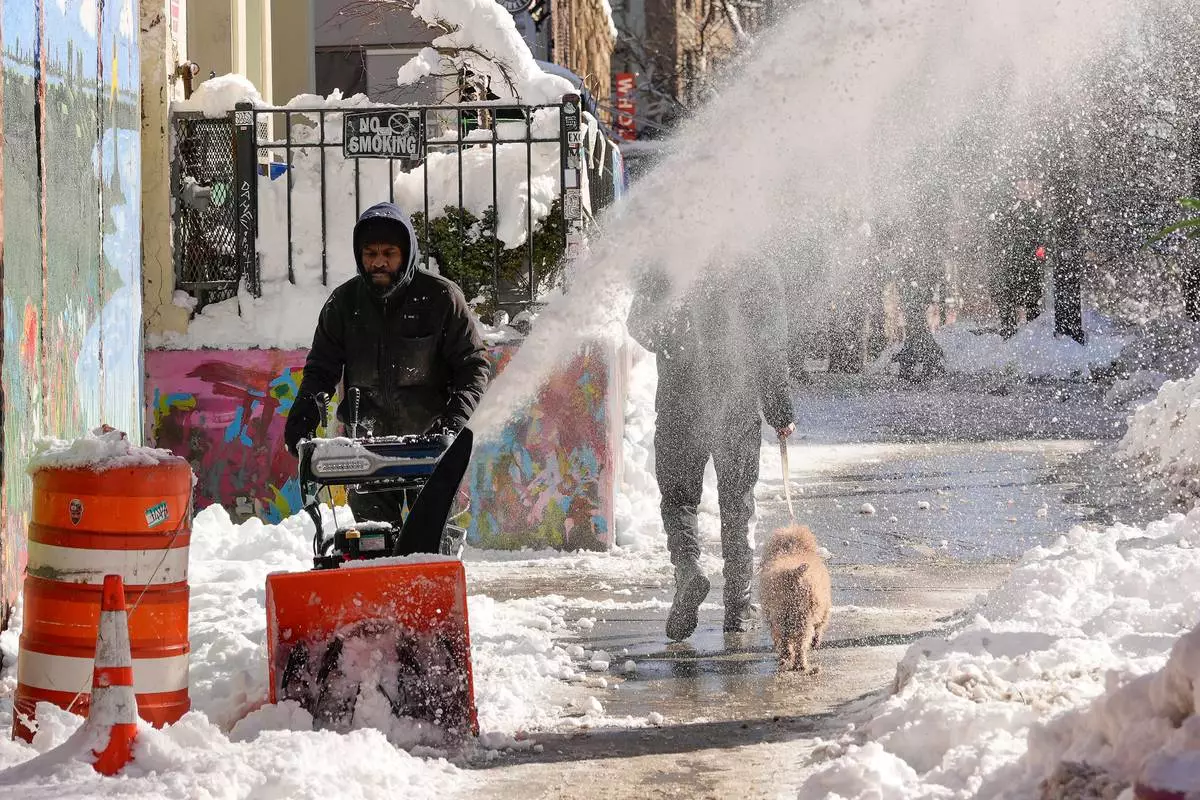
A worker uses a snow blower to clear snow from a sidewalk in front of retail shops, Tuesday, Feb. 24, 2026, in the Brooklyn borough of New York. (AP Photo/Yuki Iwamura)
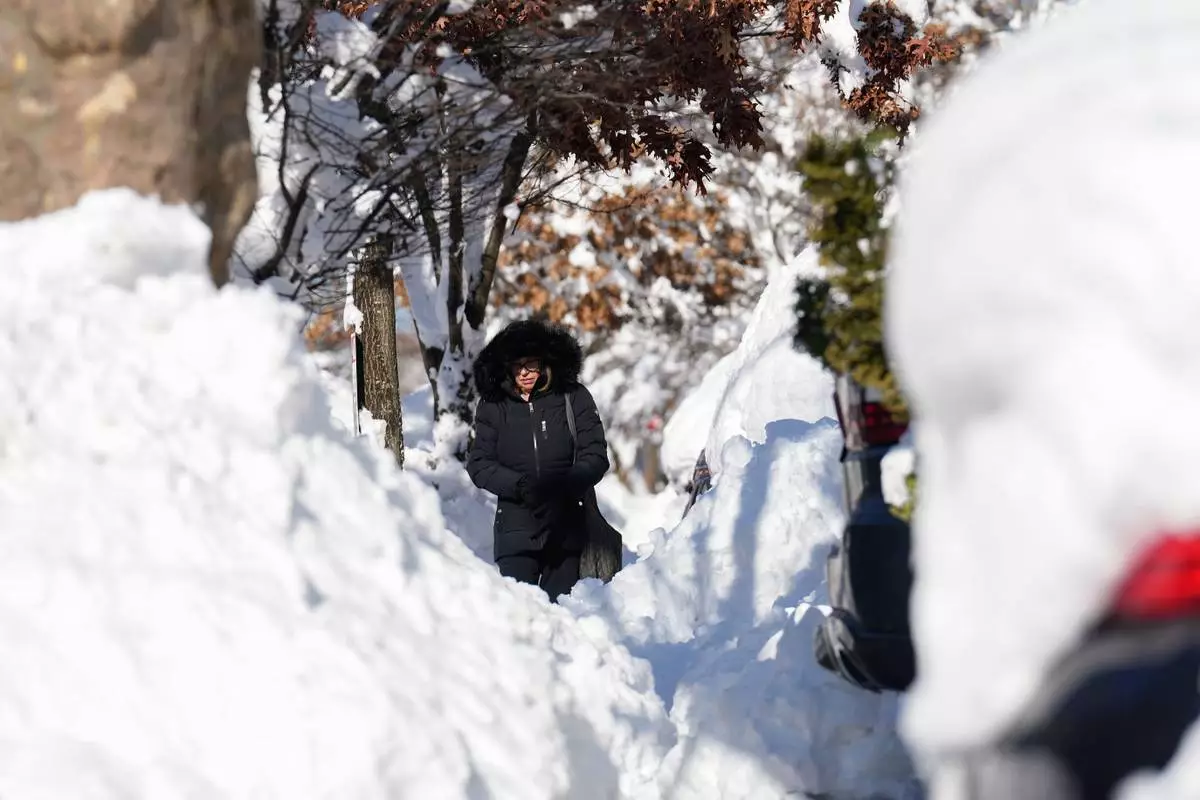
A woman navigates around piles of shoveled snow as she makes her way down a sidewalk, Tuesday, Feb. 24, 2026, in Weekhawken, N.J. (AP Photo/Seth Wenig)
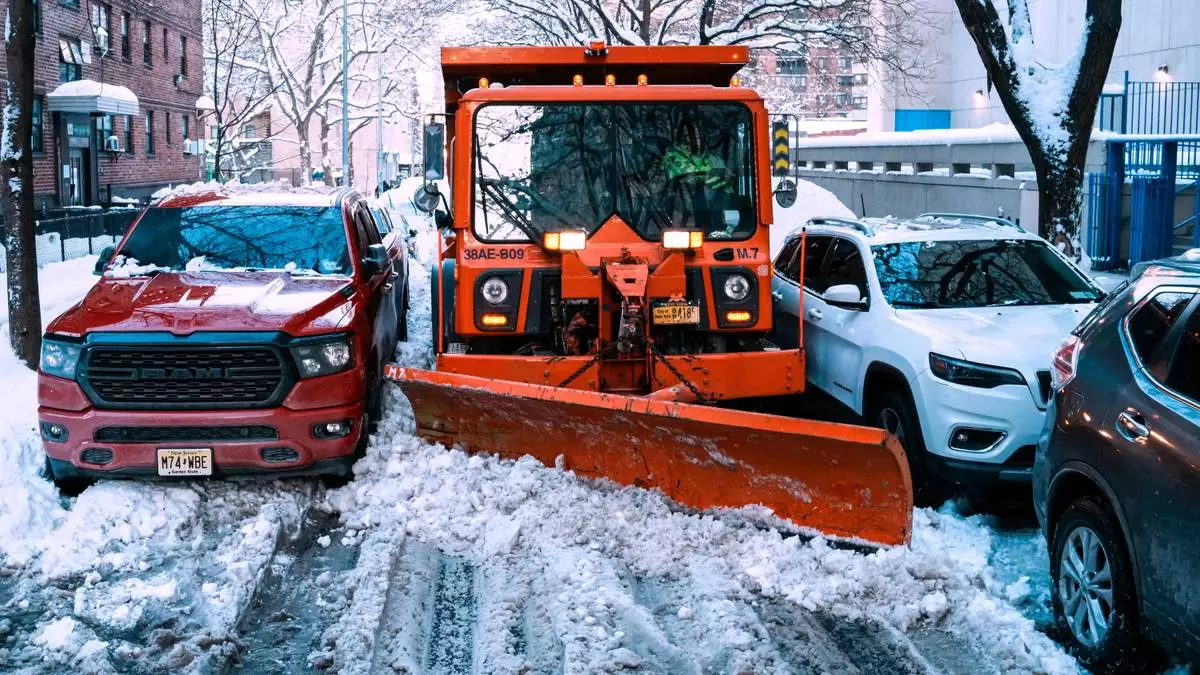
A truck removes snow for them street a day after a winter storm on Tuesday, Feb. 24, 2026, in New York. (AP Photo/Eduardo Munoz Alvarez)
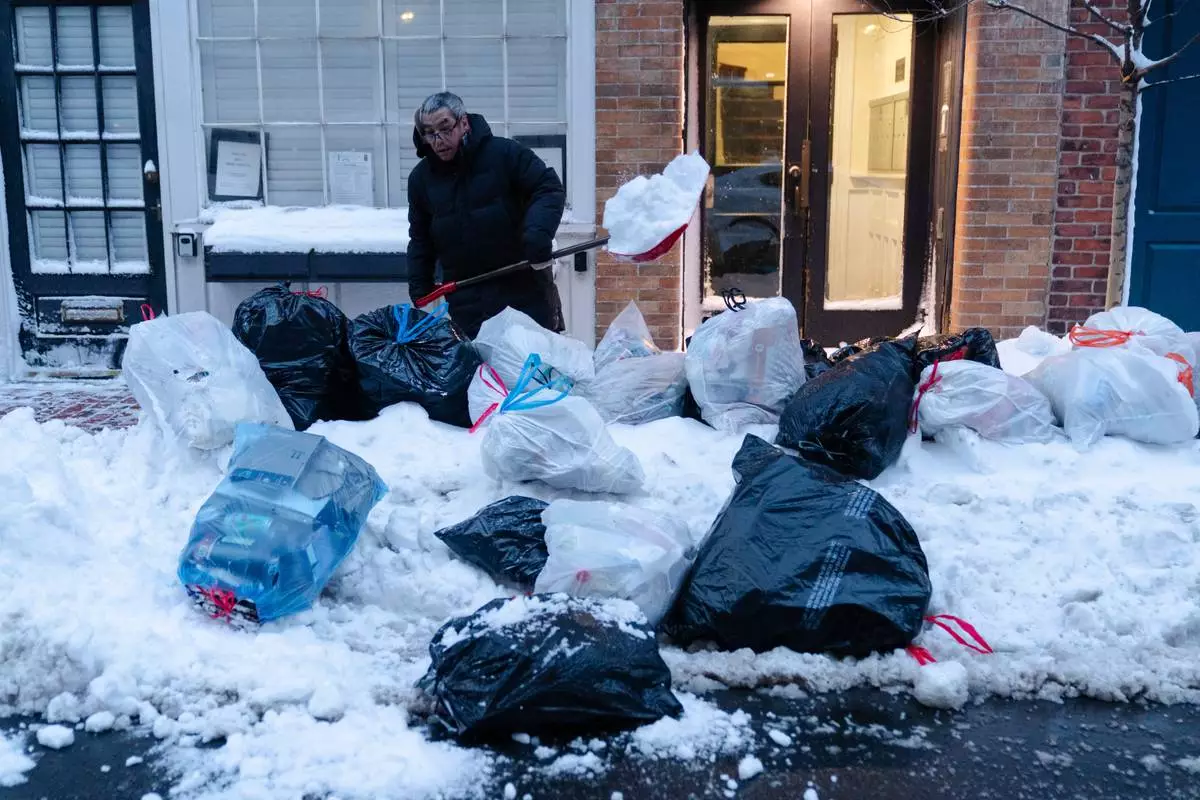
Key Lim, 55, of Quincy, removes snow from a sidewalk lined with trash bags in front of the laundromat that he manages on Tuesday, Feb. 24, 2026, in Boston. (AP Photo/Sophie Park)
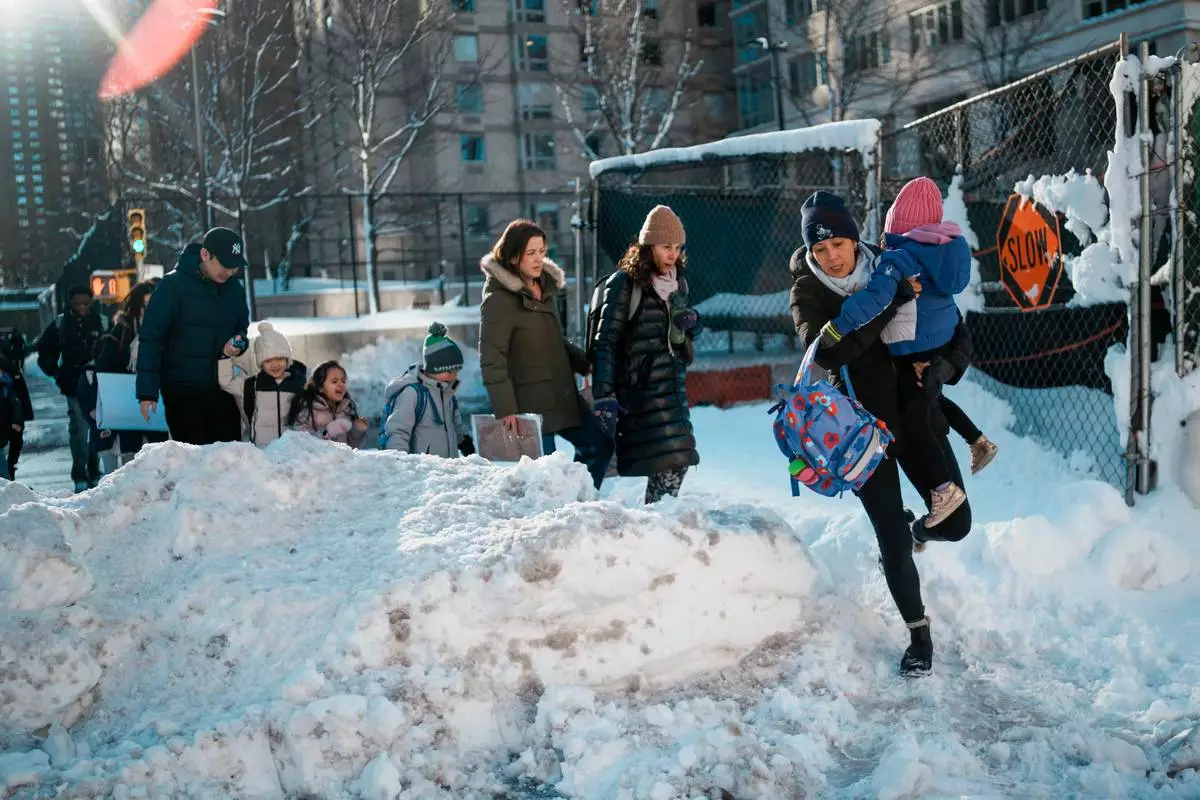
A woman carries a child over piles of plowed snow as she walks a girl to school, Tuesday, Feb. 24, 2026, in New York. (AP Photo/Eduardo Munoz Alvarez)
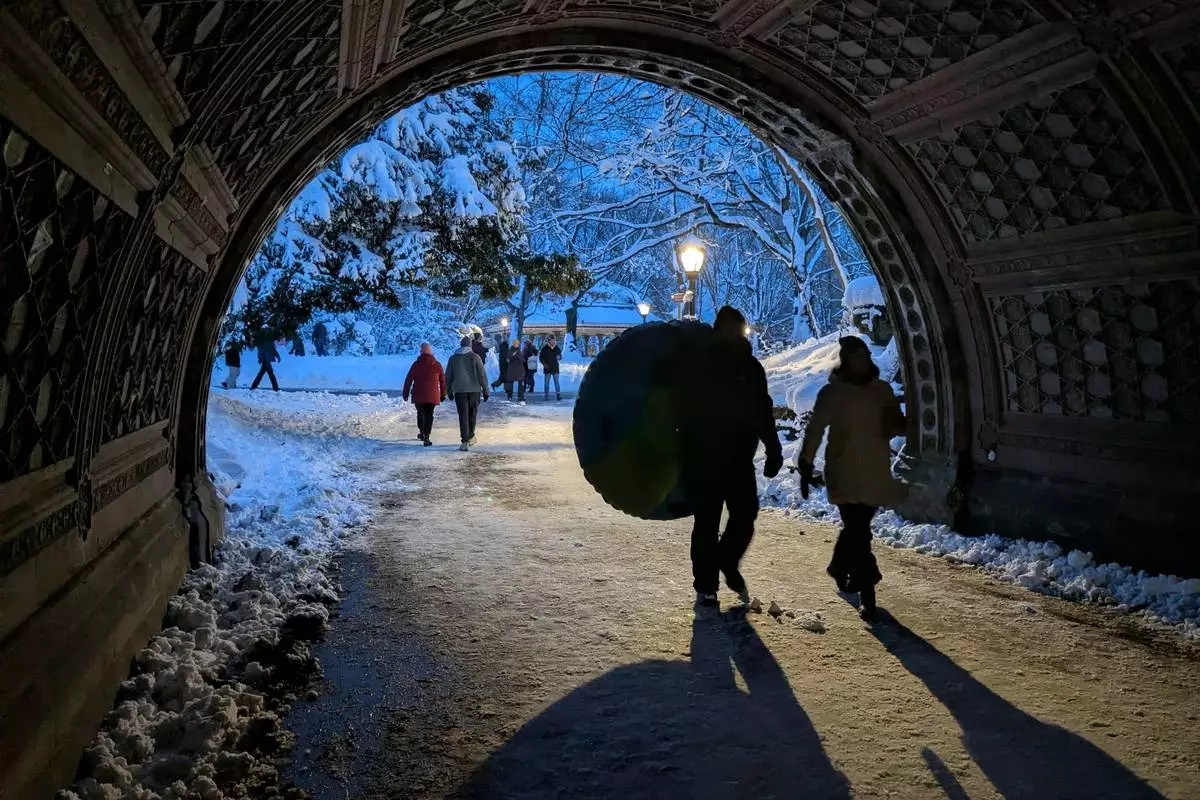
A man carries an inflatable inner-tube for snow sledding in Prospect Park in the borough of Brooklyn, New York, on Monday, Feb. 23, 2026. (AP Photo/Drew Callister)
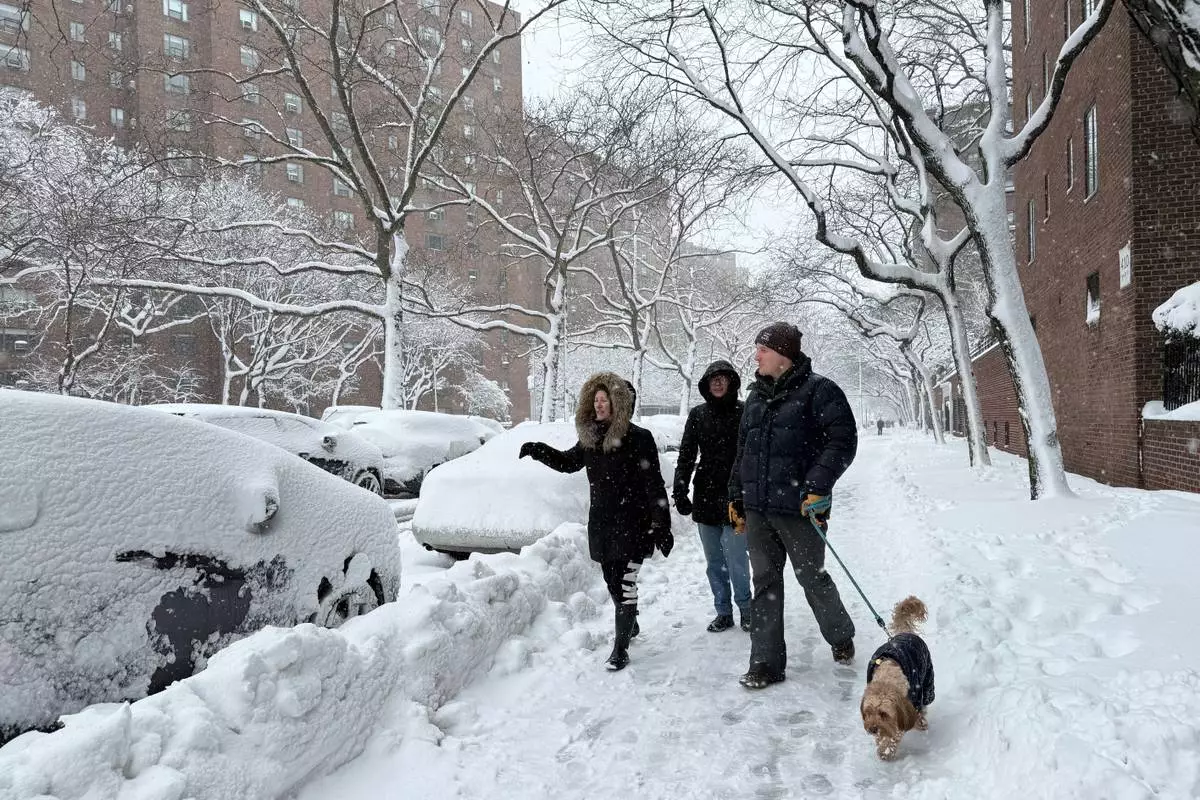
People walk with a dog alongside snow laden parked cars in a snowstorm, Monday, Feb. 23, 2026, in New York. (AP Photo/Pamela Hassell)
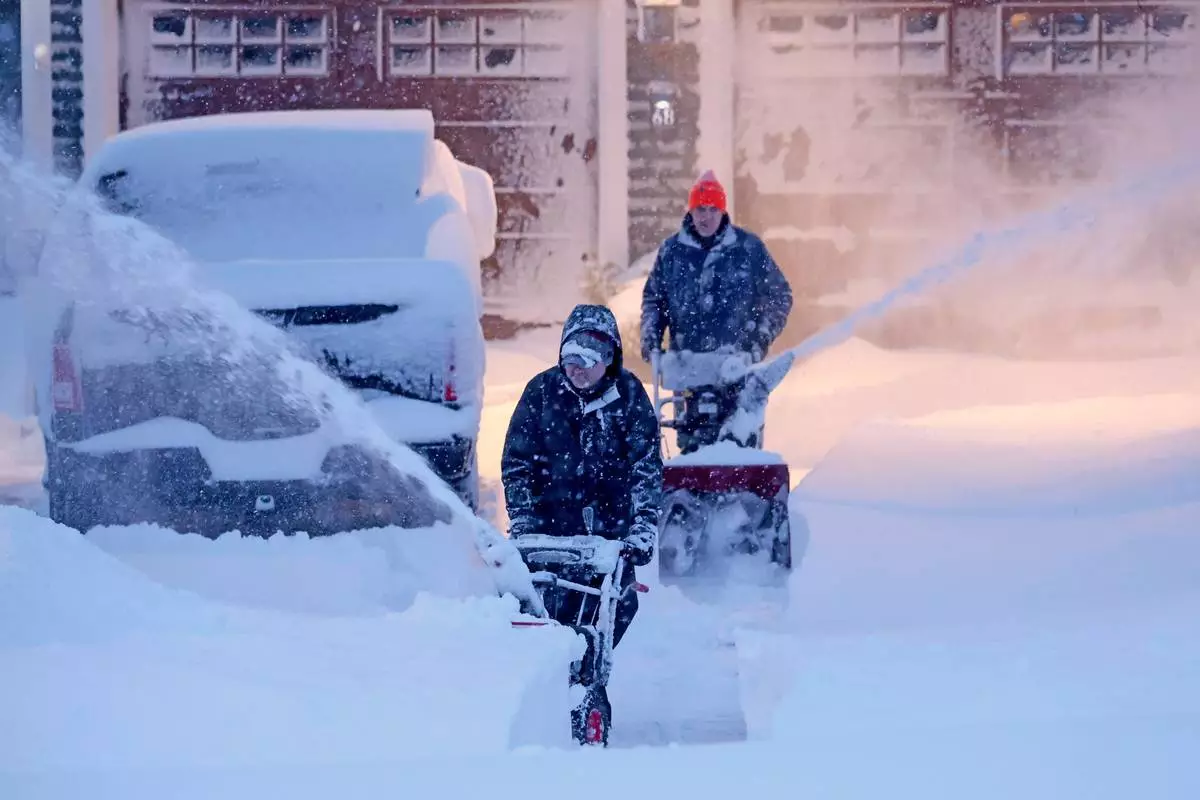
Neighbors team up to clear a driveway, Monday, Feb. 23, 2026, in North Attleborough, Mass. Over two feet of snow fell on the area after a blizzard passed through. (AP Photo/Mark Stockwell)
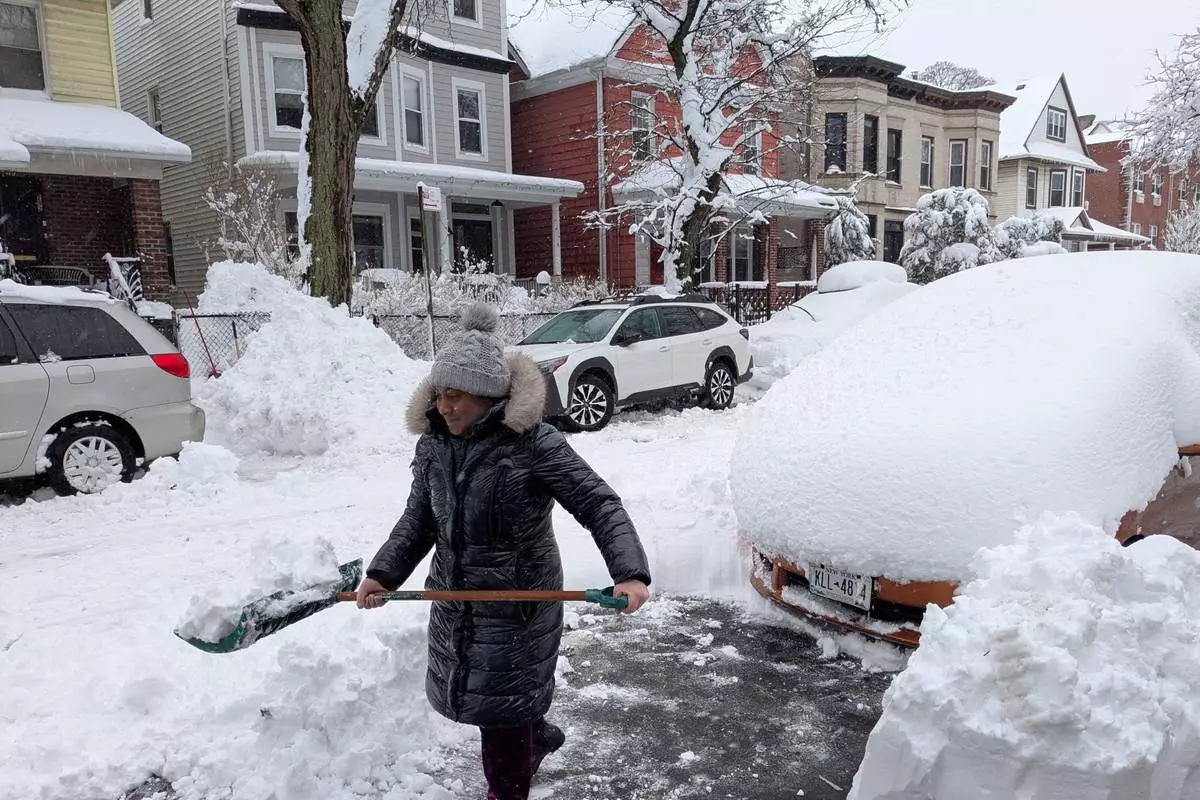
Christa Prince shovels snow during a blizzard in the borough of Brooklyn, New York, on Monday, Feb. 23, 2026. (AP Photo/Drew Callister)
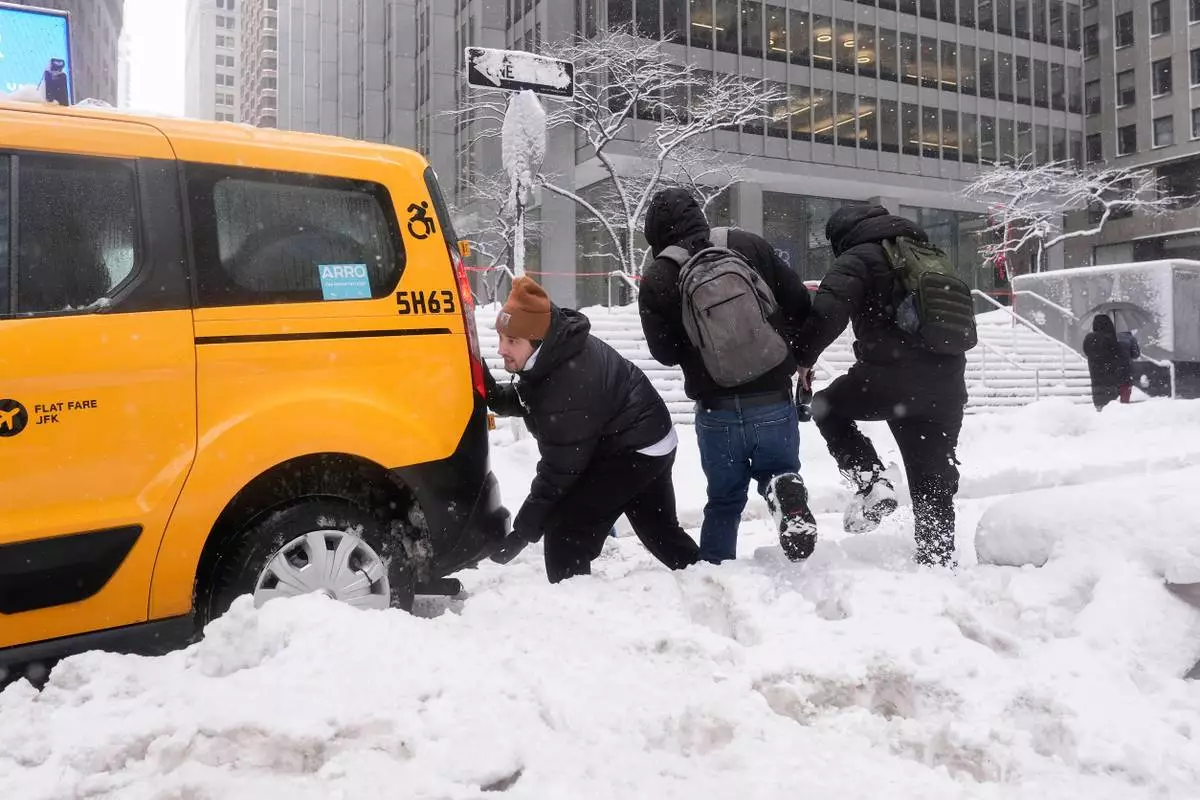
Cameron Betz helps push a taxi stuck in the snow during a snow storm, Monday, Feb. 23, 2026, in New York. (AP Photo/Seth Wenig)