Throughout the official nine-day Spring Festival holiday running until Monday, a scientific expedition team remained on the front line aboard an icebreaker in the ice-covered waters of the Liaodong Bay in northeast China's Bohai Sea, collecting critical research data at the peak of the ice season to strengthen the country's marine disaster prevention and mitigation capabilities.
The Liaodong Bay, the northernmost bay in China, transforms into a frozen landscape every winter. With sea ice blanketing nearly 40 percent of its surface in excess of 10,000 square kilometers, shipping routes, oil platforms and island residents all face weeks of disruption.
Ice typically begins forming in late December, and right now, the Liaodong Bay is in the grip of its harshest ice season. In some areas, ice floes have piled up to more than half a meter thick.
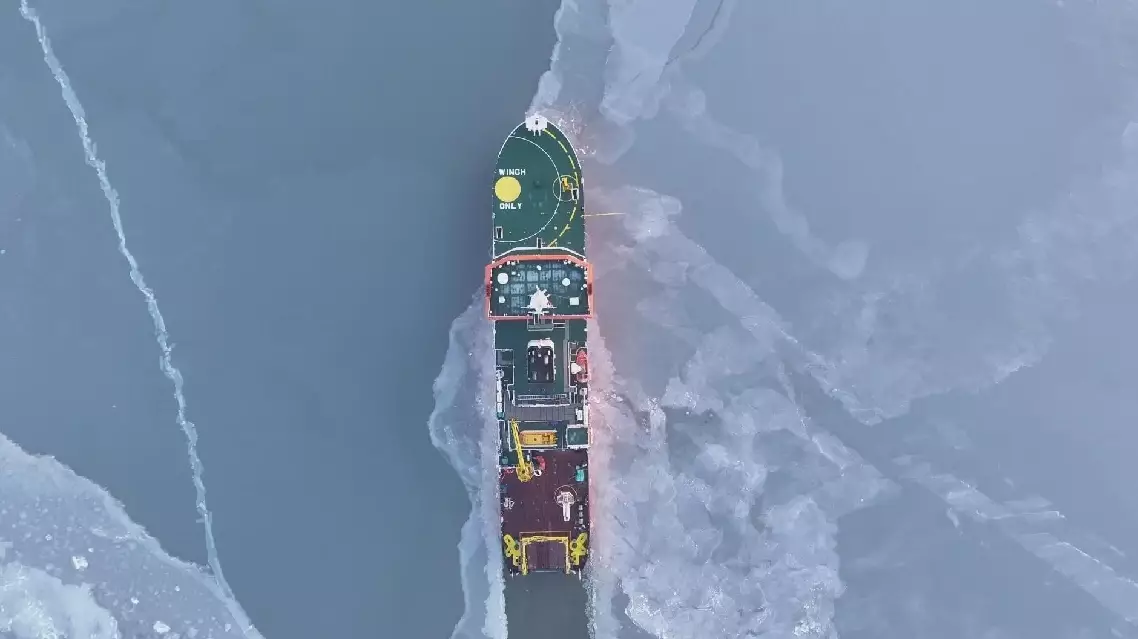
But as temperatures plummet, a team of researchers is pushing deeper into the frozen waters. Onboard the Jidi, China's independently designed and built icebreaker research vessel, scientists are racing to collect data and ice samples.
The routine at each stop is the same: to launch the drone -- equipped with a multispectral camera -- into the biting wind, to scan the ice from above. It's painstaking work -- and the cold makes it even harder.
Wang Ye is one of the youngest members of the 2026 Winter Bohai-Yellow Sea Sea Ice Survey Team, a seasoned drone operators. But in this cold, even routine flights can go sideways.
"I've never been so nervous. The cold was so intense. We didn't instruct it to fly back within the safe battery range, so when the power supply was insufficient, it triggered the auto-return function. But since our ship was moving, the auto-return couldn't locate the landing point accurately -- and it ended up going off the ship, out over the water," said Wang Ye.
Li Ge, who leads the 20-person expedition team, said the cold is a constant adversary. "Temperatures regularly drop to below minus 20 degrees Celsius. You can wear all the layers you want -- your face still feels like it's being sliced open, and your feet sting with every step," he said.
The team has been living aboard the icebreaker since mid-January, working their way through 26 sampling sites across more than 10,000 square kilometers of ice. Each day, they have to inspect four to six locations, battling the negative impacts to gather scientific data.
Cao Xiaowei heads the ice collection unit -- the most labor-intensive group on the expedition. "The inner gloves keep the water out, while the outer ones keep the heat in," he introduced. "After working for hours outside, the gloves can't keep up. By the time our work is done, our hands would be swollen and red. Sometimes we can barely hold our chopsticks when have a meal," he added.
Once Cao's team hauls the ice and water onboard, the clock starts ticking. Samples must be cut, processed, and refrigerated immediately -- before any physical changes occur. Only then can the rest of the research team begin to be busy with their analysis.
"We need to concentrate 100 liters of water down to just a cupful. Then we use filter paper to separate out different types of microorganisms," said Sun Shujuan, one of the members of the survey team. During the day, sunlight interferes with some of their experiments, skewing the results. So when night falls, the researchers will keep working, tackling the tasks that require darkness.
After dark, the crew will lower the anchor chain, sending a hooked iron anchor down to grip the seabed and hold the vessel steady. But in ice-choked waters, nothing stays put for long. Ice floes constantly push against the hull, tugging at the anchor chain.
The risk of dragging anchor is far higher here than in ice-free waters. Under the combined force of ice, wind and current, the ship slowly begins to drift -- dragging the anchor across the seafloor.
The ship's captain Zhang Wei said it often takes multiple attempts to get the anchor to hold.
"We have to pull up the anchor and try a different spot, steering clear of the heavy ice floes. We're near a shipping lane right now. If the anchor keeps dragging, we could collide with another vessel -- or even worse, hit a subsea pipeline. That's a risk we can't take," Zhang said.
Every winter, at the peak of the ice season, the China National Offshore Oil Corporation's Jinzhou 9-3 oilfield -- deep in the heart of the Liaodong Bay -- gets completely surrounded by thick sea ice.
The ice exerts tremendous pressure on the platform's legs, gradually wearing them down. One of the key missions for the survey team is to collect data in these waters, helping engineers figure out how to make the platform more resilient against ice.
"When sea ice presses against platform legs, it cuts and compresses -- constantly wearing away at the structure. By sampling the ice and making measurements here, we're gathering data that can feed directly into better engineering designs. The goal is to help these platforms stand up stronger against the ice," said Li Ge.
The research vessel Jidi has come a long way since it first set out on scientific missions in 1986. Over four decades, it's been through two generations of upgrades. The first Jidi was essentially an ice-strengthened transport ship with basic research capabilities. Today's new-generation Jidi can continuously break through one-meter-thick first-year ice and is equipped with cutting-edge technology for studying the atmosphere, sea ice, and geophysical processes -- many of its systems are internationally leading.
Alongside the ship's evolution, there's also a human story -- of two generations of researchers who've dedicated their lives to marine research. Li Nan, chief officer of the new Jidi, is following in his father's footsteps. The elder Li was a researcher on the original Jidi back in the day.
"You could say I'm carrying on the family tradition. My father worked on the old Jidi. He spent his whole career on research vessels -- literally sailed around the world on them. He really likes this new, fully modernized Jidi. Back in the 1980s, when he was working, China couldn't build its own icebreakers. We had to buy them from other countries. Now, seeing that we can build one ourselves -- it moves him. He's proud of how far our country has come," said Li Nan.
The ship may have changed -- smarter, stronger. But the name endures. And so does the spirit of the researchers who brave the ice and cold, year after year, expanding China's footprint in marine science.
Chinese scientists leave mark on marine research in icebound bay