NEW YORK (AP) — The World Trade Center's final office tower will start construction as soon as this spring and become American Express ' new headquarters, Gov. Kathy Hochul and the company said Wednesday, marking a milestone nearly 25 years after the Sept. 11 attacks destroyed the site.
The 2 World Trade Center building will round out the long, tortuous redevelopment of the original 16-acre trade center property. There remains no construction date for a neighboring apartment building to replace another 9/11-damaged skyscraper.
But the 2 World Trade Center announcement represents a big step, physically and symbolically, in fulfilling a pledge of renewal at ground zero. Hochul and other officials also trumpeted the project as a sign of New York's continued vitality as a business hub. It comes as Florida and other states have been working to woo companies away, and President Donald Trump, a Republican, has repeatedly contended that Democrat-led New York's appeal is waning.
“Building 2 World Trade Center will bring another iconic skyscraper to Lower Manhattan, create thousands of good-paying union jobs and provide billions in economic benefits to New Yorkers," Hochul, a Democrat, said in a statement.
American Express CEO Stephen Squeri called the skyscraper “an investment in our company’s future, our colleagues and the Lower Manhattan community,” where the credit card giant has been based for nearly 200 years. Its current headquarters is just west of the trade center.
The trade center was decimated when al-Qaida hijackers crashed jets into its twin towers, part of a coordinated attack that also sent planes into the Pentagon and a field near Shanksville, Pennsylvania. Nearly 3,000 people were killed, mainly at the trade center.
Fraught with engineering, financial and political complexities and public debate over what to build, redevelopment unfolded gradually and hit numerous roadblocks.
But over time, the signature 1 World Trade Center skyscraper, other towers, the Sept. 11 memorial and museum, a transit hub -cum-shopping center and a performing arts center were built on the property, owned by the Port Authority of New York and New Jersey. A damaged Greek Orthodox church was rebuilt in a spot overlooking the plaza.
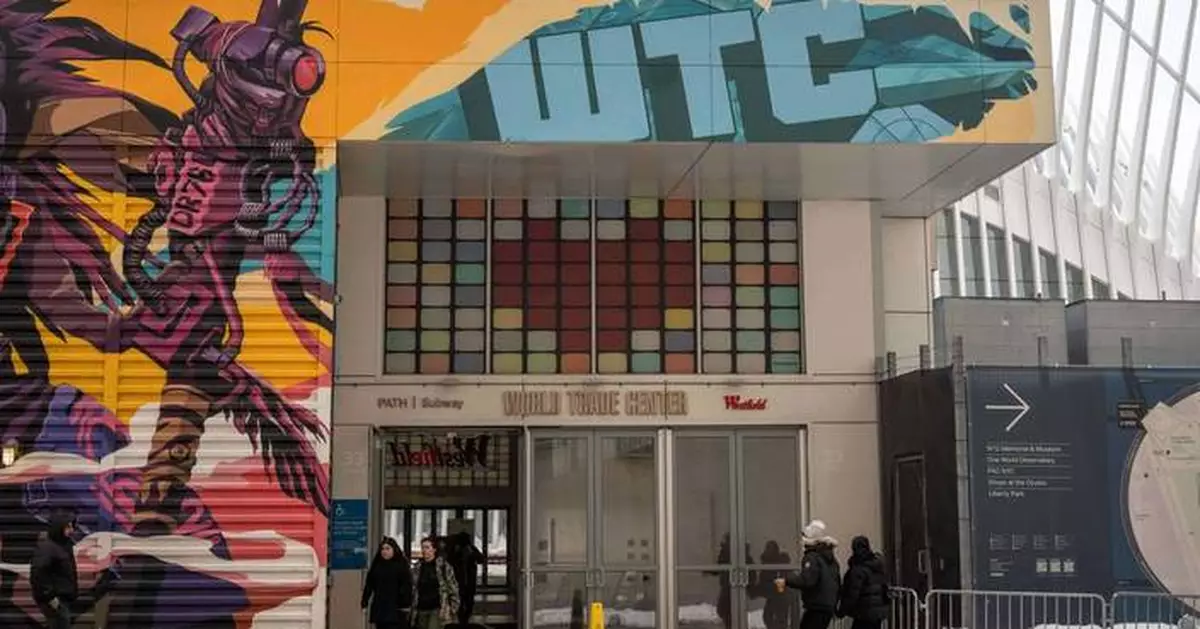
The 55-story, roughly two-million-square-foot (186,000-square-meter) 2 World Trade Center building is planned at the site's northeastern corner. The spot is currently occupied by a low placeholder building, covered with colorful graffiti-style murals, and a beer garden.
American Express declined to discuss the cost of the new building, which the company will own, leasing the underlying land. The tower isn't getting state, city or Port Authority financing or incentives, said Port Authority spokesperson Tom Topousis, who referred questions about the cost to American Express.
Plans once envisioned a skyscraper soaring as high as 80 stories, and News Corp. and the former 21st Century Fox were among companies that at points eyed leasing space there. Like some other trade center components, the project labored for years to secure financing and an anchor tenant. The task grew tougher when the coronavirus pandemic emptied offices in 2020 and raised questions about companies' future space needs.
Developer Larry Silverstein always insisted the project would happen, however.
Silverstein Properties CEO Lisa Silverstein, who is the 94-year-old developer's daughter, hailed American Express as "an iconic institution embodying the strength, resilience, and global significance of the project.”
The company plans to occupy the entire Norman Foster -designed building, a sleek structure of glassy sections interspersed with landscaped terraces and gardens. It's expected to accommodate up to 10,000 workers; American Express declined to say how that compares to its current headquarters.
Completion is expected in 2031.

A person walks past 2 World Trade Center where American Express will build new global headquarters, Wednesday, Feb. 25, 2026, in New York. (AP Photo/Yuki Iwamura)

A person walks past 2 World Trade Center where American Express will build new global headquarters, Wednesday, Feb. 25, 2026, in New York. (AP Photo/Yuki Iwamura)

People walk past 2 World Trade Center where American Express will build new global headquarters, Wednesday, Feb. 25, 2026, in New York. (AP Photo/Yuki Iwamura)
DUBAI, United Arab Emirates (AP) — Iran has sent its response to the latest U.S. ceasefire proposal via Pakistani mediators and wants negotiations to focus on permanently ending the war, Iran’s state-run media said Sunday. Pakistan confirmed receiving it.
Iran seeks to end the war on all fronts, including in Lebanon, where Israel fights the Iranian-backed Hezbollah militant group, and to ensure the security of shipping, its state TV said. Washington’s latest proposal addressed a deal to end the war, reopen the Strait of Hormuz and roll back Iran’s nuclear program, an issue that Tehran would rather discuss later.
The White House had no immediate comment about Iran’s reply. President Donald Trump is giving diplomacy “every chance we possibly can before going back to hostilities,” the U.S. ambassador to the United Nations, Mike Waltz, told ABC.
Iran's new supreme leader, Mojtaba Khamenei, who has not been seen or heard publicly since the war began, “issued new and decisive directives for the continuation of operations and the powerful confrontation with the enemies” while meeting with the head of the joint military command, the state broadcaster reported, with no details.
Meanwhile, the fragile ceasefire was tested when a drone ignited a small fire on a ship off Qatar and the United Arab Emirates and Kuwait reported drones entering their airspace. The UAE blamed Iran. No casualties were reported, and no one immediately claimed responsibility.
Qatar's Foreign Ministry called it a “dangerous and unacceptable escalation that threatens the security and safety of maritime trade routes and vital supplies in the region."
Iran and armed allied groups like Hezbollah in Lebanon have used drones to carry out hundreds of strikes since the war began with U.S. and Israeli attacks on Feb. 28.
Trump has reiterated threats to resume full-scale bombing if Iran does not accept an agreement to reopen the strait and roll back its nuclear program. Iran has largely blocked the strategic waterway that's key to the global flow of oil, natural gas and fertilizer since the war began, rattling world markets.
The U.S. in turn has blockaded Iranian ports and on Friday struck two Iranian oil tankers it said were trying to breach the blockade. Iran’s Revolutionary Guard navy says any attack on Iranian oil tankers or commercial vessels would be met with a “heavy assault” on one of the U.S. bases in the region and enemy ships.
The American military said Sunday that it has turned back 61 commercial vessels and disabled four since the blockade began April 13.
Another sticking point in negotiations is Iran’s highly enriched uranium. The U.N. nuclear agency says Iran has more than 440 kilograms (970 pounds) of uranium that is enriched up to 60% purity, a short, technical step from weapons-grade levels.
In an interview with state media posted late Saturday, an Iranian military spokesperson said its forces were on “full readiness” to protect nuclear sites where uranium is stored.
“We considered it possible that they might intend to steal it through infiltration operations or heli-borne operations,” Brig. Gen. Akrami Nia told the IRNA news agency.
Israeli Prime Minister Benjamin Netanyahu in an excerpt of an interview with CBS scheduled to air later Sunday said the war isn't over because the enriched uranium needs to be taken out of Iran. “Trump has said to me, ‘I want to go in there,’ and I think it can be done physically,” he said.
Russian President Vladimir Putin said Saturday that Moscow’s proposal to take enriched uranium from Iran to help negotiate a settlement remains on the table.
The majority of Iran’s highly enriched uranium is likely at its Isfahan nuclear complex, the International Atomic Energy Agency director-general told The Associated Press last month. The facility was bombarded by U.S.-Israeli airstrikes in the 12-day war last year and faced less intense attacks this year.
Pakistan oversaw face-to-face talks between the U.S. and Iran last month and continues to pursue mediation. In rare public comments, army chief Field Marshal Asim Munir said Islamabad remains committed to helping end the conflict. Prime Minister Shehbaz Sharif spoke by phone with his Qatari counterpart.
The UAE's Defense Ministry said it shot down two drones and blamed Iran.
In Kuwait, Defense Ministry spokesperson Brig. Gen. Saud Abdulaziz Al Otaibi said hostile drones entered Kuwait’s airspace and forces responded “in accordance with established procedures.” The ministry did not say where the drones came from.
Qatar's Defense Ministry said a drone targeted a commercial ship coming from Abu Dhabi, setting a small fire that was extinguished. The United Kingdom Maritime Trade Operations Center said the attack happened 23 nautical miles (43 kilometers) northeast of the capital, Doha. It gave no details about the ship’s owner or origin, and there was no claim of responsibility.
Several attacks against ships in the Persian Gulf have occurred over the past week, and a U.S. effort to “guide” ships through the strait was soon paused.
South Korea announced initial findings from a investigation that said two unidentified airborne objects struck the South Korean-operated vessel HMM NAMU about one minute apart while it was anchored in the Strait of Hormuz last week, causing an explosion and fire. A foreign ministry spokesperson said officials have yet to determine who was responsible.
Magdy reported from Cairo. Associated Press writers Munir Ahmed in Islamabad; Melanie Lidman in Tel Aviv, Israel; Tong-hyung Kim in Seoul; Julia Frankel in Jerusalem; and Josh Boak in Washington contributed to this report.
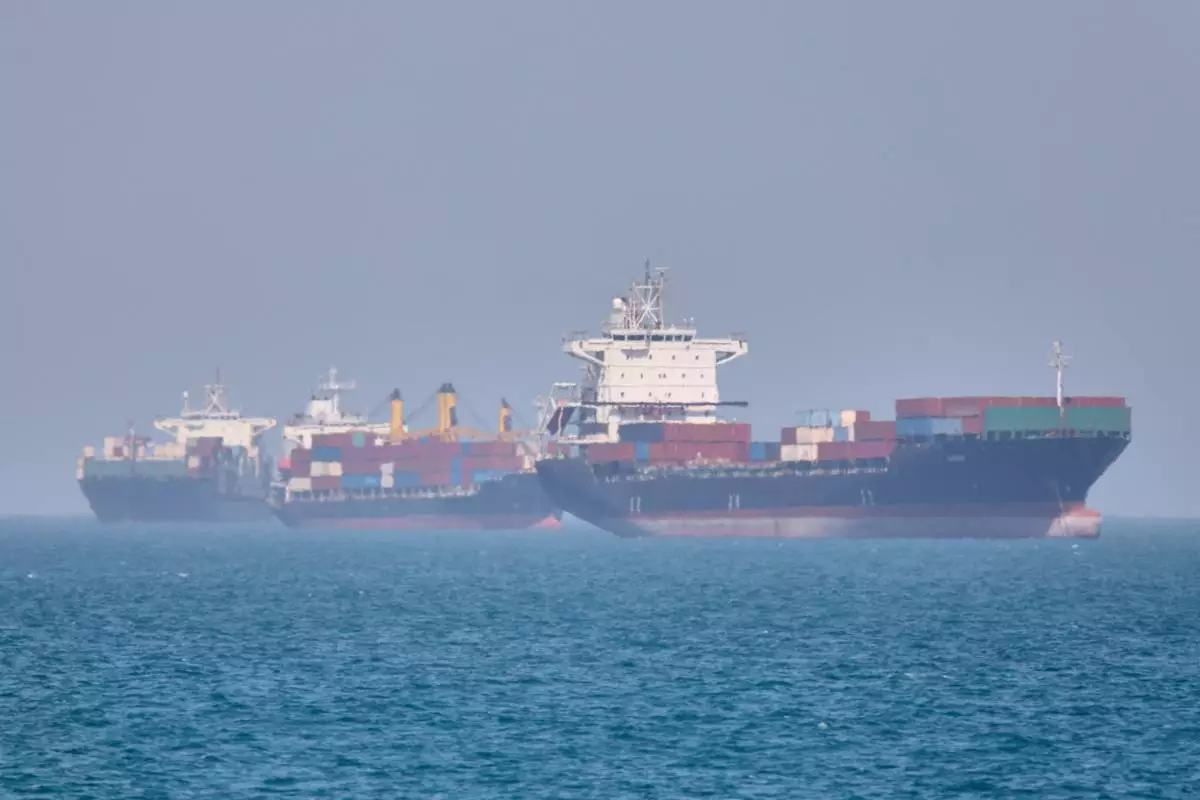
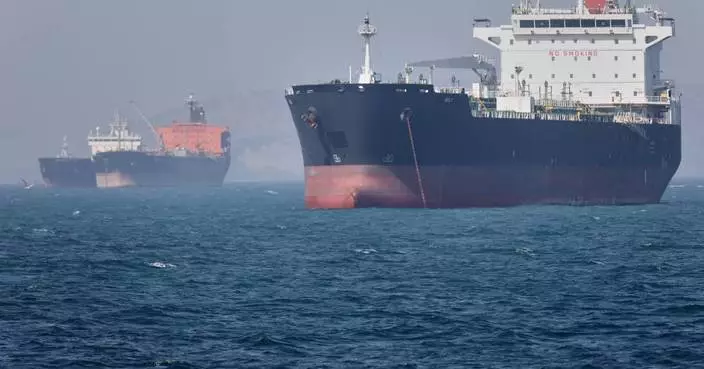
Container ships sit at anchor in the Strait of Hormuz off Bandar Abbas, Iran, Saturday, May 2, 2026.(Amirhosein Khorgooi/ISNA via AP)