NEW YORK (AP) — The trial began this week of a Pakistani man who U.S. prosecutors say had ties to the Iranian government and traveled to New York to meet with men he thought he was recruiting to carry out political assassinations on American soil, including potentially of President Donald Trump.
Asif Merchant, 47, faces a life sentence if he's convicted of terrorism charges. His trial got underway Wednesday in a federal court in Brooklyn.
Prosecutors said in court filings that a man who Merchant initially met when he arrived in New York in April 2024 later notified authorities about the plot and became a confidential informant, The New York Times reported. Merchant later paid a $5,000 advance to two would-be assassins who were actually undercover FBI agents, prosecutors said.
At the time, Merchant did not specify who the target would be, but court filings show the potential targets included high-level officials such as Trump.
Merchant, who has maintained his innocence, is a deeply religious man who frequently traveled to Iran and Pakistan, where he has separate families, which his lawyers noted is legal in both countries he calls home. They told jurors Wednesday that there was simply not enough evidence to show their client was involved in some type of plot.
Prosecutors told jurors that Merchant sketched out his plans by putting objects on a hotel napkin to represent people and places in a potential assassination plot, including the target, crowd and buildings. The killing would have occurred during the run-up to the 2024 presidential election.
The FBI has foiled several alleged attacks through sting operations in which agents posed as terror supporters, supplying advice or equipment. Critics say the strategy can amount to entrapment of mentally vulnerable people who wouldn’t have the wherewithal to act alone.
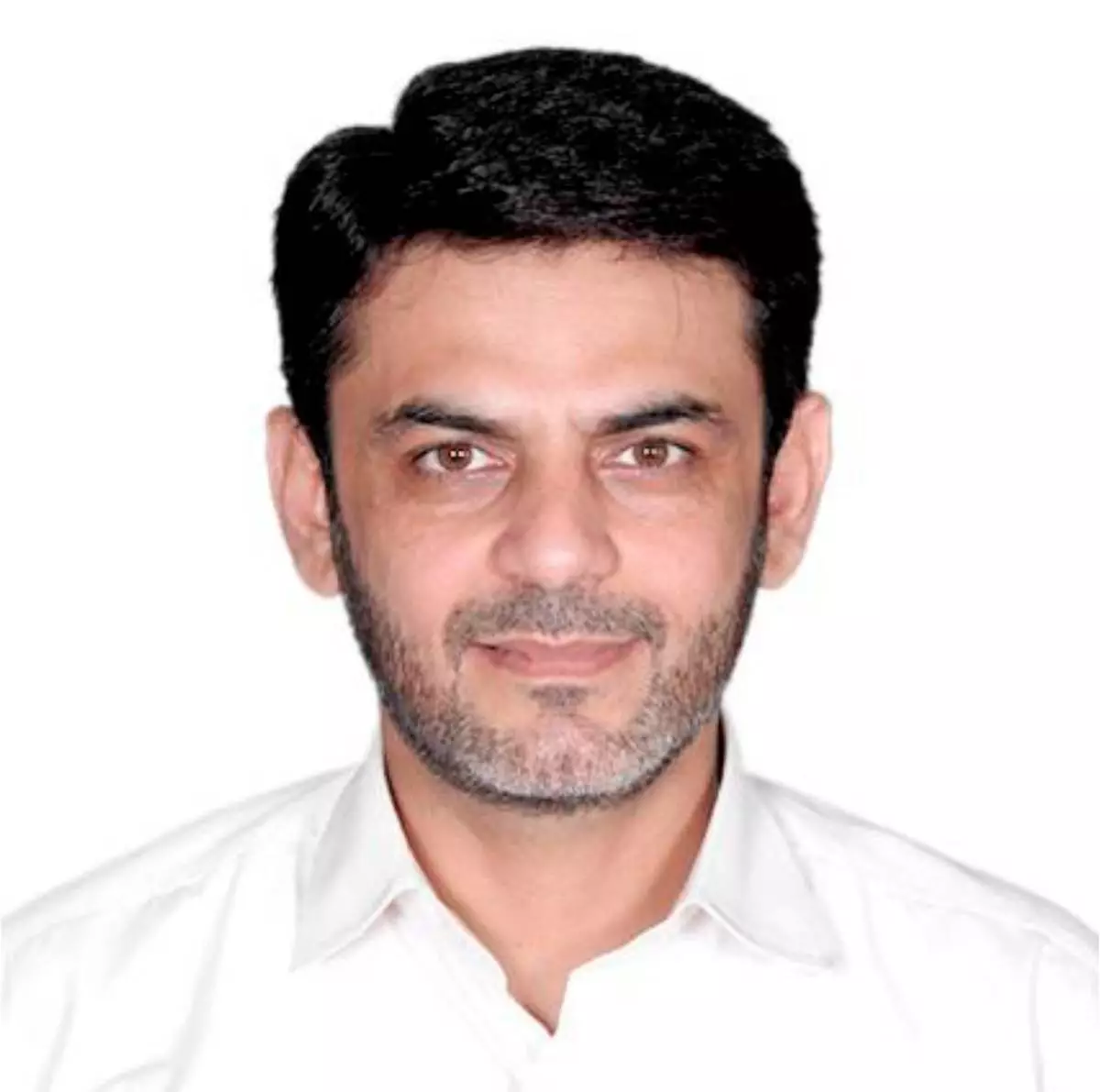
FILE - This image provided by the Justice Department, contained in the complaint supporting the arrest warrant, shows Asif Merchant. (Justice Department via AP, File)
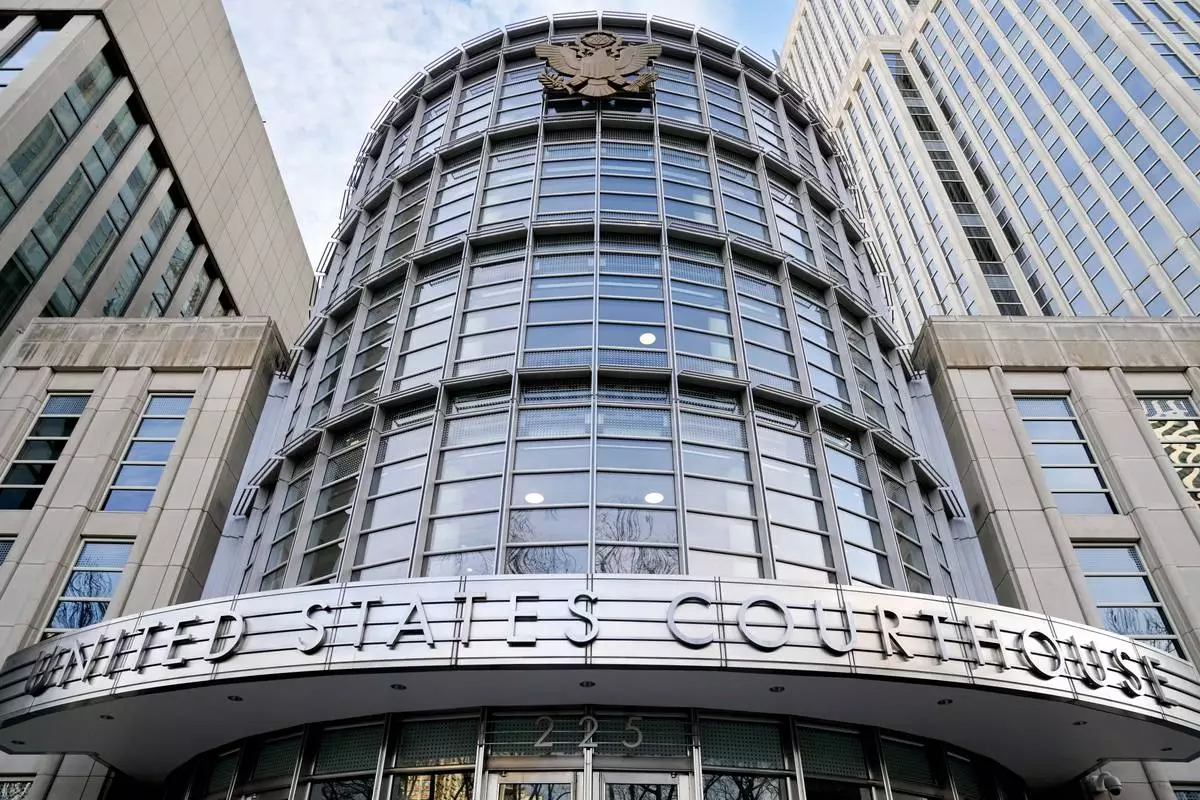
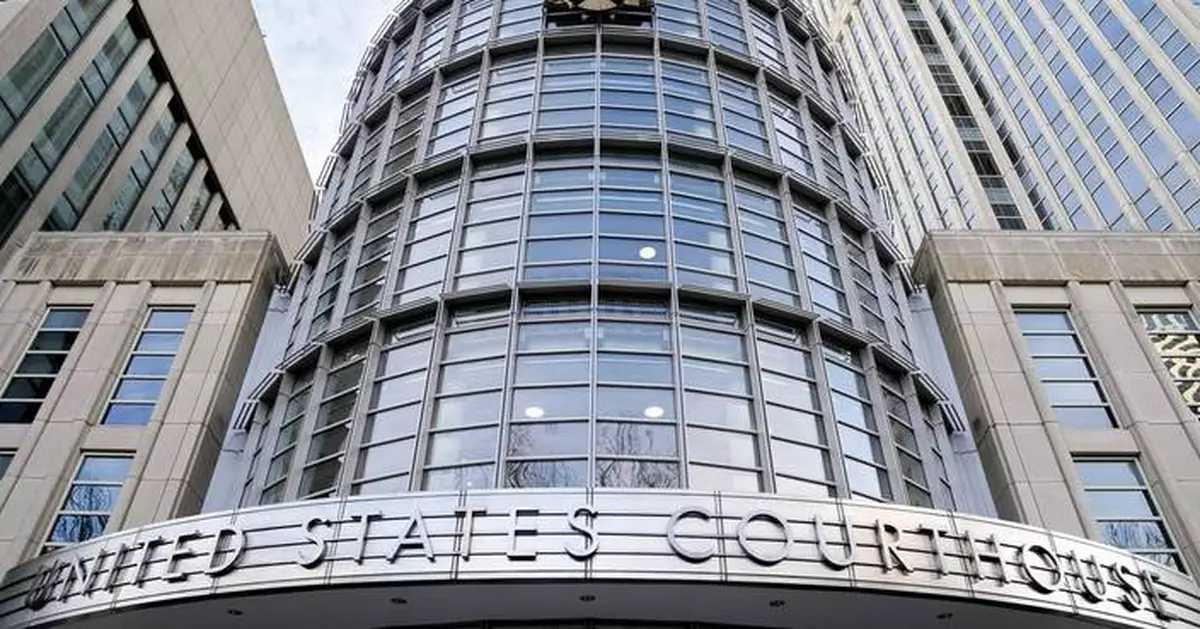
FILE - The seal of the United States is displayed on the facade of Federal court in Brooklyn, Jan. 17, 2023, in New York. (AP Photo/John Minchillo, File)
AKOBO, South Sudan (AP) — Kool Gatyen Pajock was in a South Sudan hospital while a physiotherapist wrapped bandages around the 18-month-old’s legs under the watchful eye of his grandmother, Nyayual Chuol.
Government forces put a bullet in the baby’s leg and killed his parents, according to Chuol, who carried him to the hospital in Akobo, South Sudan’s northeastern region near Ethiopia, from their village 130 kilometers (80 miles) to the west.
They were among the 280,000 people who have been displaced in the past two months by a renewed conflict in Jonglei state between the government army, known as the South Sudan People’s Defense Forces, and the Sudan People’s Liberation Movement In Opposition.
“I have nothing in my hand now to take care of this baby,” Chuol said. “I’m worried about my four children who ran in different directions when the attack took place. I don’t know where they are now.”
The fighting further threatens a fragile peace reached in 2018 after a five-year civil war.
Opposition leader Riek Machar was named first vice president alongside President Salva Kiir following that agreement. But Kiir placed Machar under house arrest following new outbreaks of violence in March. Machar was charged in September with treason along with seven opposition members linked to an attack on government forces. Machar's supporters say the charges are politically motivated.
The conflict escalated in December when opposition forces seized government outposts in Jonglei. The government has conducted a counteroffensive since January with aerial bombardments and ground assaults, despite an official commitment to the peace agreement.
The U.S. on Thursday urged talks between Kiir and Machar.
To maintain Washington's support, South Sudan's government “must undertake urgent action to uphold peace and mitigate the risk of civil war through an immediate return to dialogue among the parties to the 2018 peace agreement,” the State Department's Bureau of African Affairs said in a statement.
In addition to being forced from their homes, civilians have suffered significant casualties.
“People are still fearing that the government army may come and attack here,” Chuol said. “This is what is worrying me right now.”
Nyankhiay Gatluak Jock, 28, escaped from her village of Walgak after a government attack in early February.
“They bombed us from the gunship helicopter, and after that the soldiers came with their cars and started shooting,” said Jock, who was among 42,000 displaced people sheltering in Akobo under the protection of the United Nations Mission in South Sudan.
“We want to ask the president to tell his army to differentiate between the combatants and the civilians,” Jock said while breastfeeding two children in a church alongside other displaced women and youth.
After government forces bombed a hospital operated by humanitarian group Doctors Without Borders on Feb. 3, Nyaphan Nyang Lual headed for Akobo with her husband, daughter and 1-month-old granddaughter. On the road, her husband was shot and her daughter was abducted by armed youths.
Lual reached Akobo with her granddaughter, Bhan Tut Mut, but could not find food assistance and worried for the infant who has developed diarrhea.
“We took her to the clinic but there is no medicine there, and I cannot afford to buy from the pharmacy,” Lual said.
Humanitarian services have not been spared. The U.N. Office for the Coordination of Humanitarian Affairs said 13 health facilities in Jonglei were “looted or partially destroyed.” Reports of widespread sexual violence also have emerged.
Funding cuts and government-imposed restrictions on humanitarian organizations have resulted in a lack of resources and supplies, according to humanitarian workers who said they were frustrated by an inability to offer the necessary level of assistance.
“We have nothing … no feeding, no medication,” said Susan Tab, a reproductive health officer in Akobo with Nile Hope, a South Sudanese organization. “The only thing we can provide to help these displaced people is psychosocial support.”
U.N. humanitarian chief Tom Fletcher visited Akobo on Feb. 21 during a tour of South Sudan's areas impacted by the fighting.
During nearly three years of civil war in Sudan to the north and conflicts in nearby countries in the Horn of Africa, Fletcher said South Sudan has become “one of the most neglected crises in the world right now.”
“I want to make this crisis more visible to the public. And I want them to demand change. To demand funding. To demand political engagement to end this war,” Fletcher said.
He was greeted in Akobo by thousands of displaced women and children who remained unsure of their safety and future. Some held posters with handwritten messages, including one with the blunt report, “They killed everyone."
“Help is coming,” Fletcher told the survivors.
Associated Press reporter Deng Machol contributed from Juba, South Sudan.
For more on Africa and development: https://apnews.com/hub/africa-pulse
The Associated Press receives financial support for global health and development coverage in Africa from the Gates Foundation. The AP is solely responsible for all content. Find the AP’s standards for working with philanthropies, a list of supporters and funded coverage areas at AP.org.
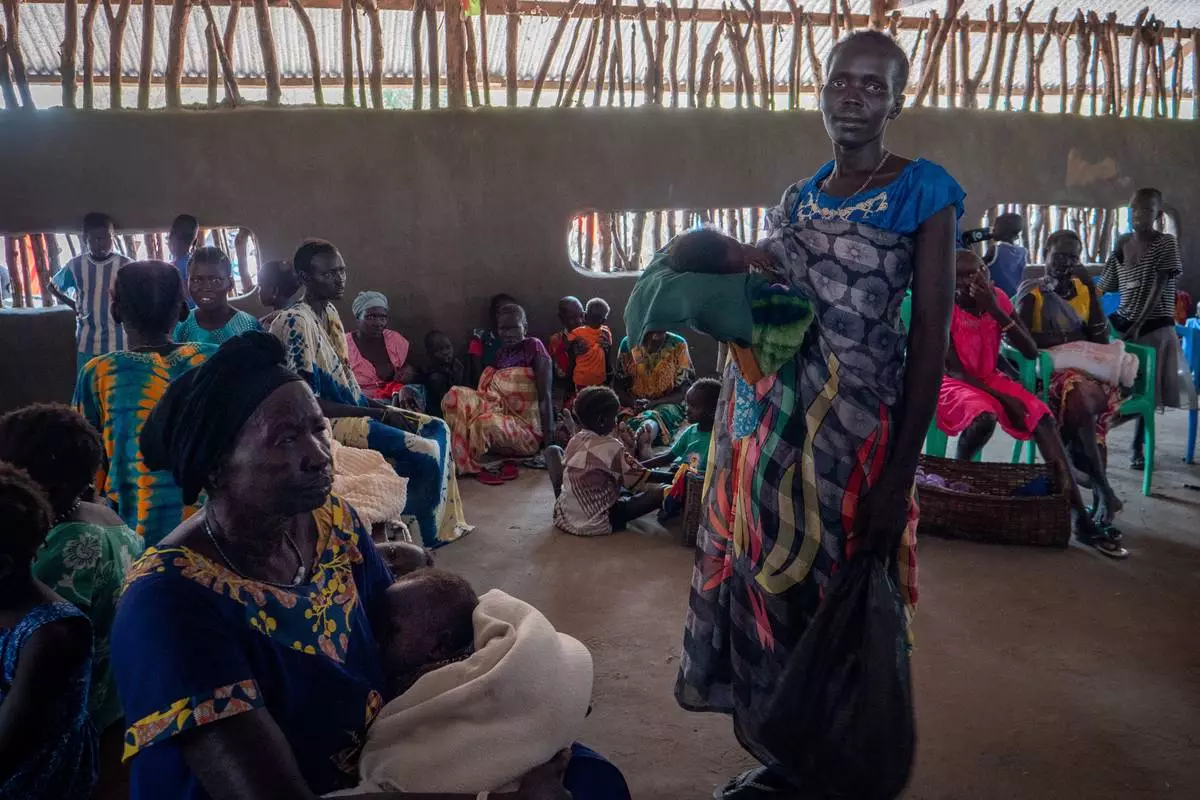
Nyaphan Nyang Lual, 36 years old, an internally displaced person, shelters at a church compound in Akobo, South Sudan, Saturday, Feb. 21, 2026. (AP Photo/Florence Miettaux)
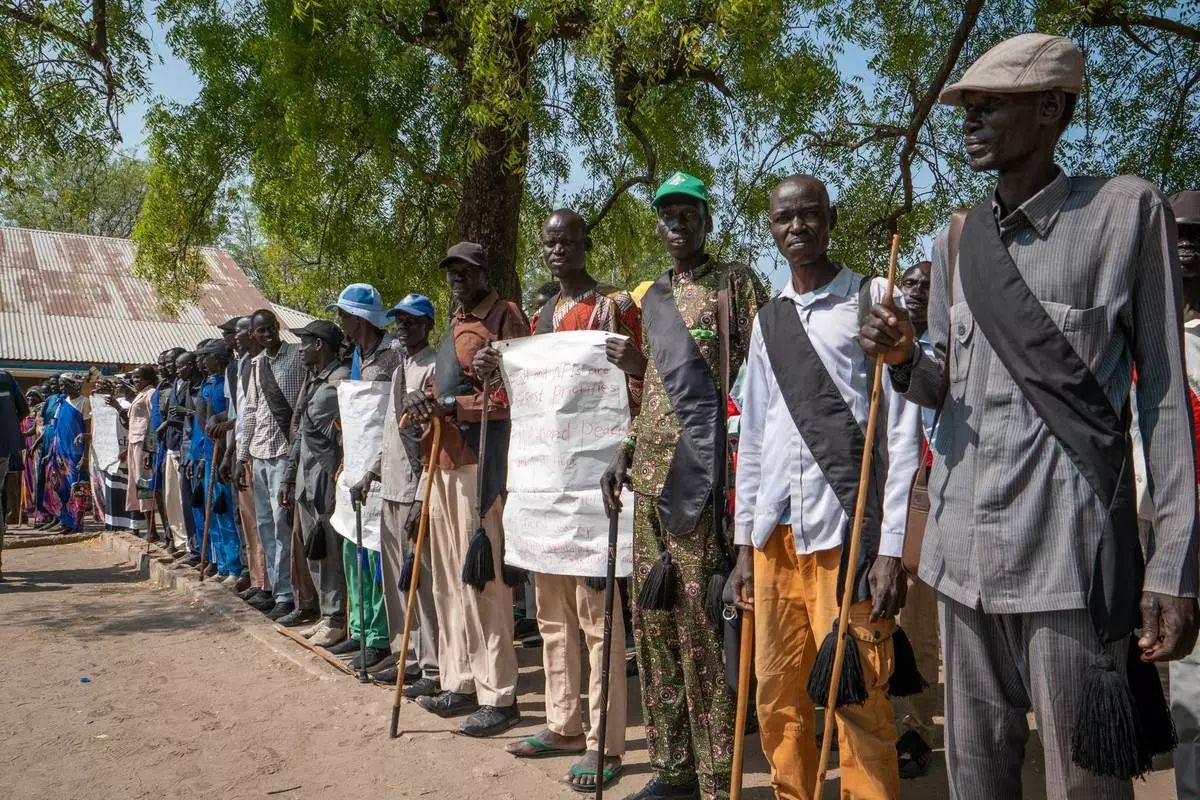
Traditional leaders line up to receive Tom Fletcher, the U.N. under-secretary-general for humanitarian affairs and head of OCHA, in Akobo, Jonglei state, South Sudan, Saturday, Feb. 21, 2026. (AP Photo/Florence Miettaux)
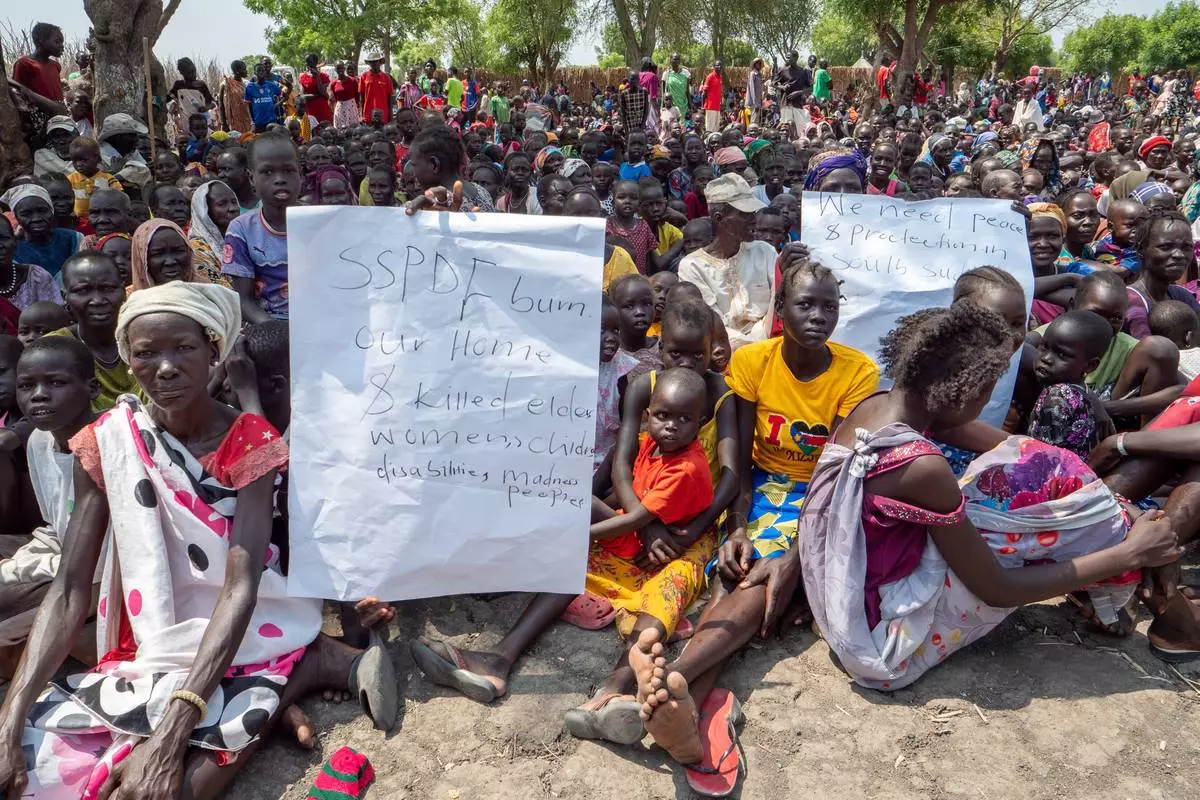
Internally displaced people gather at a church compound in Akobo, Jonglei state, South Sudan, Saturday, Feb. 21, 2026. (AP Photo/Florence Miettaux)
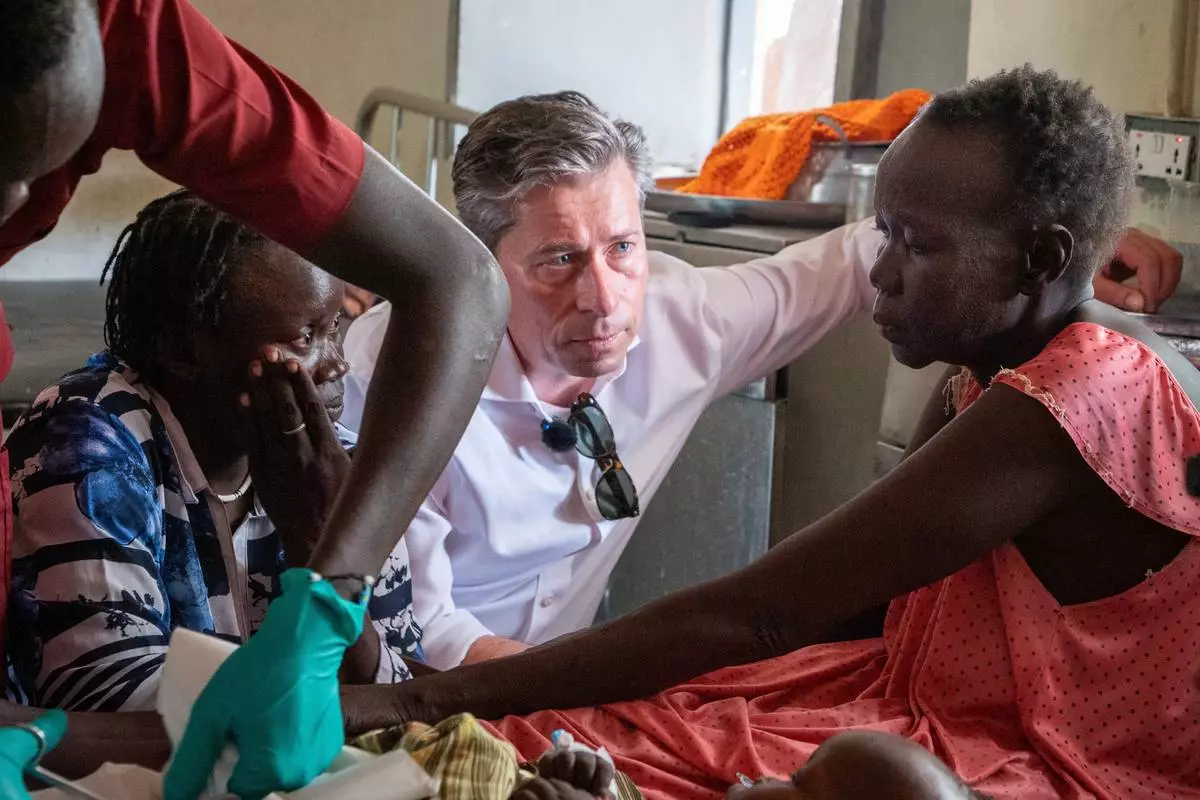
Tom Fletcher, the U.N. under-secretary-general for humanitarian affairs and head of OCHA, center, talks with patients at Akobo County Hospital in South Sudan, Saturday, Feb. 21, 2026. (AP Photo/Florence Miettaux)
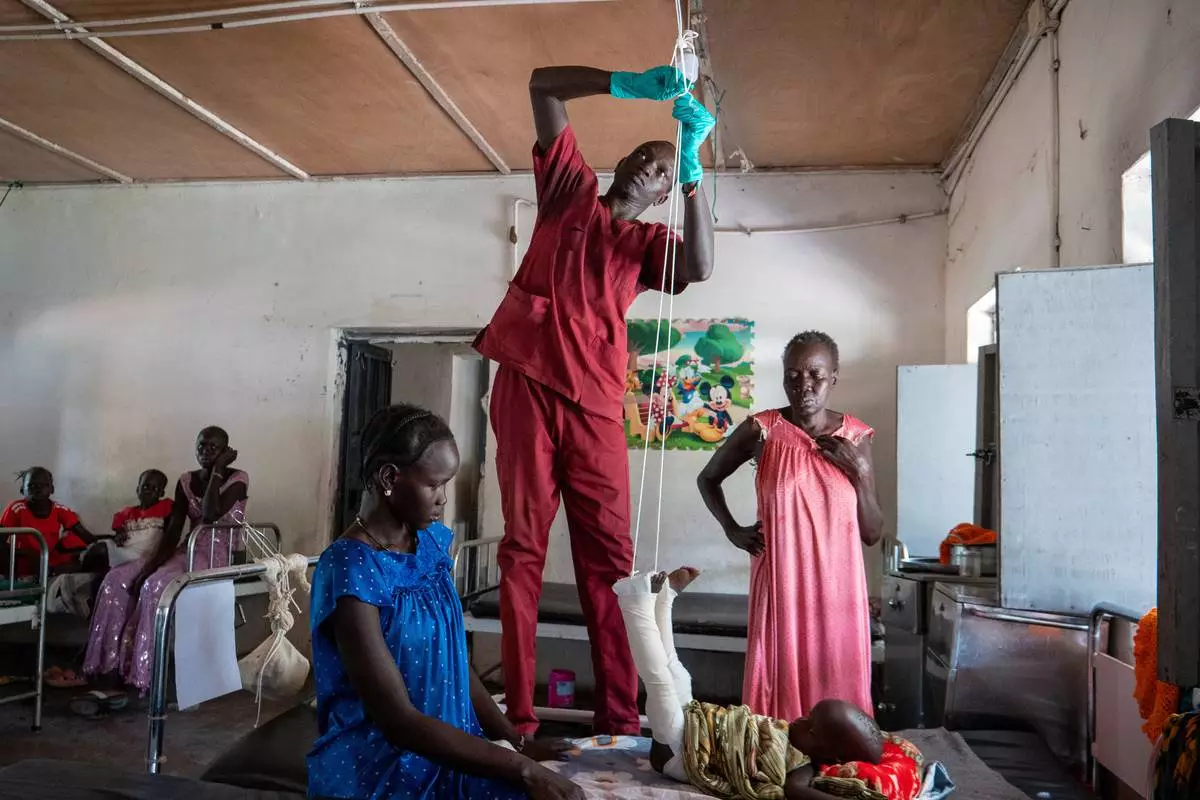
Nyayual Chuol, right, watches her 18-month-old grandson Kool Gatyen Pajock, who was shot during the conflict-hit state, receive treatment at the Akobo County Hospital in South Sudan, Saturday, Feb. 21, 2026. (AP Photo/Florence Miettaux)