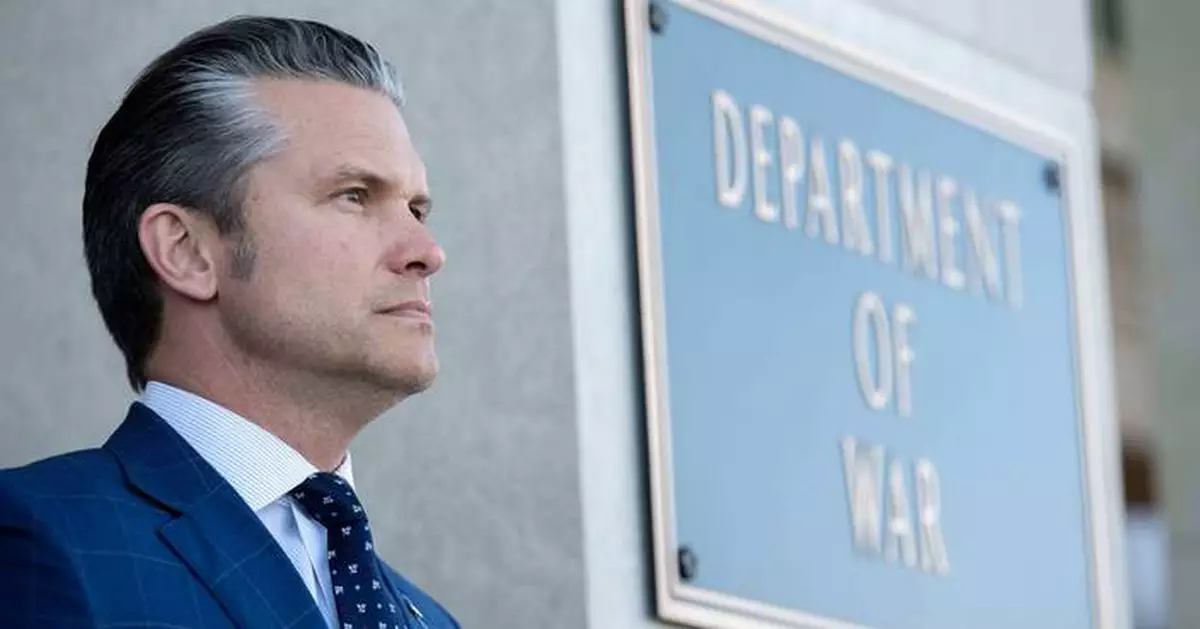
NEW YORK (AP) — Defense Secretary Pete Hegseth gave Anthropic an ultimatum this week: Open its artificial intelligence technology for unrestricted military use by Friday, or risk losing its government contract.
Defense officials in the Trump administration also warned they could designate Anthropic, which makes the AI chatbot Claude, as a supply chain risk — or invoke a Cold War-era law called the Defense Production Act to give the military more sweeping authority to use its products, even if the company doesn’t approve.
Some experts say that using the law this way would be unprecedented, and could bring future legal challenges. The government's efforts to essentially force Anthropic's hand also underscore a wider, contentious debate over AI’s role in national security.
Here's what we know.
The Defense Production Act gives the federal government broad authority to direct private companies to meet the needs of national defense.
The act was signed by President Harry S. Truman in 1950 amid supply concerns during the Korean War. But over its now decades-long history, the law's powers have been invoked not only in times of war but also for domestic emergency preparedness, as well as recovery from terrorist attacks and natural disasters.
One of the act's provisions allows the president to require companies to prioritize government contracts and orders deemed necessary for national defense, with the goal of ensuring the private sector is producing enough goods needed during war or other emergencies. Other provisions give the president the ability to use loans and additional incentives to increase production of critical goods, and authorize the government to establish voluntary agreements with private industry.
The DPA is “one of the government’s most powerful and adaptable industrial policy tools,” said Joel Dodge, an attorney and the director of industrial policy and economic security at the Vanderbilt Policy Accelerator.
Anthropic is the last of its AI peers to not supply its technology to a new U.S. military internal network. CEO Dario Amodei repeatedly has made clear his ethical concerns about unchecked government use of AI, including the dangers of fully autonomous armed drones and of AI-assisted mass surveillance that could track dissent.
The Pentagon has maintained that it has no interest in using AI for mass surveillance or to develop autonomous weapons to operate without human involvement.
If the Defense Department does invoke the DPA to give the military more authority to use Anthropic's products without its approval, that could mean forcing the company to adapt its model to the Pentagon’s needs without built-in safety limits, or remove certain ethical restrictions from the company’s contract language.
Experts like Dodge say both would be “without precedent under the history of the DPA.”
“It’s a powerful law,” he said. ”(But) it has never been used to compel a company to produce a product that it’s deemed unsafe, or to dictate its terms of service.”
Trump in his first term and former President Joe Biden invoked the DPA to boost supplies to combat the COVID-19 pandemic. And during 2022's nationwide baby formula shortage, Biden used the law to speed production of formula and authorize flights to import supply from overseas.
Biden also invoked the DPA in a 2023 executive order on AI, notably in efforts to require that companies share safety test results and other information with the government. Trump repealed the order at the start of his second term.
Decades ago, the administrations of both President Bill Clinton and George W. Bush used the DPA to ensure that electricity and natural gas shippers continued supplying California utilities amid an energy crisis. And the law was used after Hurricane Maria struck Puerto Rico in 2017 to prioritize contracts for food, bottled water, manufactured housing units and the restoration of electrical systems.
The DPA requires periodic reauthorization to remain in effect, which can expand or refine the scope of the law. According to congressional documents, its next expiration date is slated for Sept. 30 of this year. Depending on how the Defense Department's reported demands unfold, Anthropic could be at the top of lawmakers' minds.
If the Defense Department uses the DPA provision aimed at prioritizing government contracts and ordering production of certain goods — which the Anthropic case suggests it would — a company can push back if the requested product isn't something it already produces, Dodge and others say, or if it deems the terms to be unreasonable. But the government may try and overrule that, notes Charlie Bullock, senior research fellow at the Institute for Law & AI.
“If neither side backs down, it seems realistic that there would be litigation between Anthropic and the government,” Bullock said.
Some have also noted tension between the Pentagon's warning that it could designate Anthropic as a supply chain risk while also indicating its products are so important to national defense that it needs to invoke the DPA — two assertions that seem at odds with each other.
Defense officials appeared to be backing away from the DPA option on Thursday, when Chief Pentagon spokesperson Sean Parnell wrote on social media that if Anthropic didn't agree to cooperate by 5:01 p.m. ET on Friday, "we will terminate our partnership with Anthropic and deem them a supply chain risk.”
“We will not let ANY company dictate the terms regarding how we make operational decisions,” Parnell added.
Dodge thinks the administration is counting on “a lot of forces” as it aims to get Anthropic to bend on Friday.
If Anthropic agrees to new terms in the face of such threats, that could open up “a Pandora’s box of what the government could do to assert power and control over private companies," Dodge said.
Associated Press Writers Matt O’Brien in Providence, Rhode Island and Konstantin Toropin and David Klepper in Washington contributed to this report.

Pages from the Anthropic website and the company's logos are displayed on a computer screen in New York on Thursday, Feb. 26, 2026. (AP Photo/Patrick Sison)
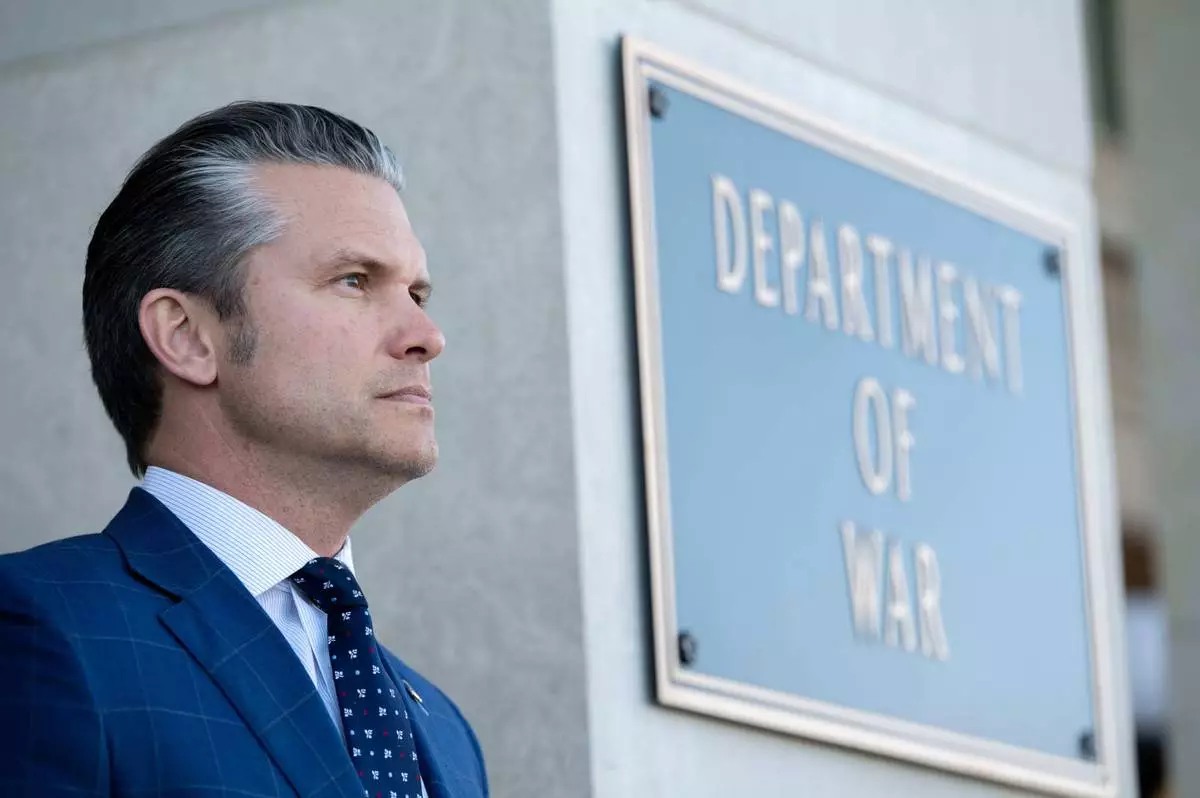
FILE - Defense Secretary Pete Hegseth stands outside the Pentagon during a welcome ceremony for the Japanese defense minister at the Pentagon in Washington, Jan. 15, 2026. (AP Photo/Kevin Wolf, File)

GENEVA (AP) — Iran and the United States held hours of indirect negotiations Thursday over Tehran's nuclear program but walked away without a deal, leaving the danger of another Mideast war on the table as the U.S. has gathered a massive fleet of aircraft and warships in the region.
Oman's Foreign Minister Badr al-Busaidi, who mediated the talks in Geneva, said there had been “significant progress in the negotiation” without elaborating.
But just before the talks ended, Iranian state television reported that Tehran was determined to continue enriching uranium, rejected proposals to transfer it abroad and sought the lifting of international sanctions, indicating it was not prepared to meet U.S. President Donald Trump's demands.
Trump wants a deal to constrain Iran’s nuclear program, and he sees an opportunity while the country is struggling at home with growing dissent following nationwide protests. Iran also hopes to avert war, but maintains it has the right to enrich uranium and does not want to discuss other issues, like its long-range missile program or support for armed groups like Hamas and Hezbollah.
Al-Busaidi said technical-level talks would continue next week in Vienna, the home of the International Atomic Energy Agency. The United Nations' atomic watchdog likely would be critical in any deal.
In an interview with Iranian state television, Iran’s foreign minister said the talks with the U.S. were some of the country’s “most intense and longest rounds of negotiations.”
Abbas Araghchi offered no specifics but said “what needs to happen has been clearly spelled out from our side.”
The White House did not immediately respond to a request for comment.
The stakes could hardly be higher.
If America attacks, Iran has said U.S. military bases in the region would be considered legitimate targets, putting at risk tens of thousands of American service members. Iran has also threatened to attack Israel, meaning a regional war again could erupt across the Middle East.
“There would be no victory for anybody — it would be a devastating war,” Iranian Foreign Minister Abbas Araghchi told India Today in an interview filmed Wednesday just before he flew to Geneva.
“Since the Americans' bases are scattered through different places in the region, then unfortunately perhaps the whole region would be engaged and be involved, so it is a very terrible scenario.”
Ali Vaez, an Iran expert with the International Crisis Group, said it was a good sign that the Americans did not walk away immediately when Iran presented its latest proposal on Thursday.
“There might still not be a breakthrough at the end of this day, but the very fact that the U.S. team is returning shows that there is enough common ground between the two sides," he said.
The two sides held multiple rounds of talks last year that collapsed when Israel launched a 12-day war against Iran in June and the U.S. carried out heavy strikes on its nuclear sites, leaving much of Iran's nuclear program in ruins even as the full extent of the damage remains unclear.
Araghchi represented Iran at the talks. Steve Witkoff, a billionaire real estate developer and friend of Trump who serves as a special Mideast envoy, headed up the U.S. delegation with Trump's son-in-law Jared Kushner. The talks again were mediated by Oman, an Arab Gulf country that's long served as an interlocutor between Iran and the West.
The two sides adjourned after around three hours of talks and resumed the discussions later.
During the break, Iranian Foreign Ministry spokesperson Esmail Baghaei said diplomats held “very intensive” negotiations. He said the Iranians felt there were “constructive proposals” offered on both nuclear issues and sanctions relief.
Trump wants Iran to completely halt its enrichment of uranium and roll back both its long-range missile program and its support for regional armed groups. Iran says it will only discuss nuclear issues, and maintains its atomic program is for entirely peaceful purposes.
U.S. Secretary of State Marco Rubio told reporters Wednesday that Iran is “always trying to rebuild elements” of its nuclear program. He said that Tehran is not enriching uranium right now, “but they’re trying to get to the point where they ultimately can.”
Iran has said it hasn't enriched since June, but it has blocked IAEA inspectors from visiting the sites America bombed. Satellite photos analyzed by The Associated Press have shown activity at two of those sites, suggesting Iran is trying to assess and potentially recover material there.
The West and the IAEA say Iran had a nuclear weapons program until 2003. After Trump scrapped the 2015 nuclear agreement, Iran ramped up its enrichment of uranium to 60% purity — a short, technical step away from weapons-grade levels of 90%.
U.S. intelligence agencies assess that Iran has yet to restart a weapons program, but has “undertaken activities that better position it to produce a nuclear device, if it chooses to do so.” Some Iranian officials have spoken openly about the country's readiness to produce a bomb if that decision is taken.
If the talks fail, uncertainty hangs over the timing of any possible U.S. attack.
If the aim of potential military action is to pressure Iran to make concessions in nuclear negotiations, it’s not clear whether limited strikes would work. If the goal is to remove Iran’s leaders, that will likely commit the U.S. to a larger, longer military campaign. There has been no public sign of planning for what would come next, including the potential for chaos in Iran.
There is also uncertainty about what any military action could mean for the wider region. Tehran could retaliate against the American-allied nations of the Persian Gulf or Israel. Oil prices have risen in recent days in part due to those concerns, with benchmark Brent crude now around $70 a barrel. Iran in the last round of talks said it briefly halted traffic in the Strait of Hormuz, the narrow mouth of the Persian Gulf through which a fifth of all traded oil passes.
Satellite photos shot Tuesday and Wednesday by Planet Labs PBC and analyzed by the AP appeared to show that American vessels typically docked in Bahrain, the home of the U.S. Navy’s 5th Fleet, were all out at sea. The 5th Fleet referred questions to the U.S. military’s Central Command, which declined to comment. Before Iran’s attack on a U.S. base in Qatar during the closing days of the war last June, the 5th Fleet similarly scattered its ships at sea to protect against a potential attack.
Gambrell reported from Dubai, United Arab Emirates, and Melanie Lidman from Jerusalem. Associated Press reporters Will Weissert in Washington and Jamey Keaten in Geneva contributed to this report.
Oman's Minister of Foreign Affairs Sayyid Badr bin Hamad Al Busaidi, right, holds a meeting with White House special envoy Steve Witkoff, centre, and Jared Kushner, as part of the ongoing Iranian-American negotiations, in Geneva, Switzerland, Thursday Feb. 26, 2026. (Foreign Ministry of Oman via AP)
The U.S. delegation arrives at the Oman ambassador's residency, where the indirect nuclear talks between the United States and Iran are taking place in Geneva, Switzerland, Thursday, Feb. 26, 2026. (Martial Trezzini/Keystone via AP)
Vehicles drive past the Saint Sarkis church and a painting of the late Iranian revolutionary founder Ayatollah Khomeini in downtown Tehran, Iran, Wednesday, Feb. 25, 2026. (AP Photo/Vahid Salemi)
A woman walks past a painting on the wall of a girls school at Enqelab-e-Eslami, or Islamic Revolution, street in downtown Tehran, Iran, Wednesday, Feb. 25, 2026. (AP Photo/Vahid Salemi)
Commuters drive past Saint Sarkis church and a mural of the late Iranian revolutionary founder Ayatollah Khomeini in downtown Tehran, Iran, Wednesday, Feb. 25, 2026. (AP Photo/Vahid Salemi)