ST. PAUL, Minn. (AP) — The chief federal judge for Minnesota issued a stern warning Thursday to the chief federal prosecutor for the state, as well as to Immigration and Customs Enforcement officials, warning them that they must comply with court orders or they risk criminal contempt charges.
Chief Judge Patrick Schiltz, who was appointed to the bench by President George W. Bush and is seen as a conservative, took issue with an email he received Feb. 9 from U.S. Attorney Daniel Rosen, in which the prosecutor accused the judge of overstating the extent of ICE's noncompliance with court orders arising from the Trump administration's immigration enforcement crackdown in Minnesota.
His order filed Thursday was just the latest in a series of critical and sometimes scathing statements and rulings by federal judges in Minnesota and elsewhere across the country against how the Trump administration has attempted to conduct mass deportations of immigrants, often citing violations of due process and standards for humane treatment.
In a filing by a different judge Thursday, Rosen, the head of his civil division and ICE representatives were ordered to appear for a contempt hearing Tuesday over failures to comply with court orders for the return of detainees' property.
Schiltz had previously described ICE as a serial violator of court orders related to the enforcement surge. In a Jan. 28 order, he expressed “grave concerns” after federal judges in Minnesota identified 96 orders that ICE had violated in 74 cases. In Thursday's order, Schiltz said the government's response “was not to do a better job complying with court orders, but instead to attack the Court.”
Rosen told Schiltz his office's own review of a “statistically strong sample” of 12 of those 74 cases found a high compliance rate, and complained that the tally by the judges “was far beyond the pale of accuracy for an order that would be wielded so publicly and so sharply. The lawyers in my civil division didn’t deserve it.”
Schiltz wrote in a new order that he filed Thursday that he then asked his judges and law clerks to review the numbers. While he said they discovered some mistakes, which cut both ways, they concluded that ICE violated 97 orders in 66 of the cases referred to in his earlier order.
“Increasingly, this Court has had to resort to using the threat of civil contempt to force ICE to comply with orders," he wrote. "The Court is not aware of another occasion in the history of the United States in which a federal court has had to threaten contempt — again and again and again — to force the United States government to comply with court orders.”
The chief judge also attached a list that documented 113 additional order violations in 77 additional cases, mostly since the original tally.
“The judges of this District have been extraordinarily patient with the government attorneys, recognizing that they have been put in an impossible position by Rosen and his superiors in the Department of Justice," Schiltz wrote, noting the wave of resignations that has left Rosen's office shorthanded. "What those attorneys ‘didn’t deserve’ was the Administration sending 3000 ICE agents to Minnesota to detain people without making any provision for handling the hundreds of lawsuits that were sure to follow.”
Neither Rosen nor ICE officials immediately responded to a request for comment.
Rosen acknowledged at a news conference Wednesday — his first since taking office in October — that his staff of prosecutors has fallen dramatically. He bristled when it was pointed out that at least two criminal cases have been dropped in recent days due in part to the losses. Rosen said the office had 64 assistant U.S. attorneys on the last day of his predecessor's term; 47 as of Rosen's first day; and was now down to 36. But he also insisted he was hiring new prosecutors at a “good clip” and that his office still has the capacity to prosecute major crimes.
The chief judge ended with a blunt warning:
“This Court will continue to do whatever is required to protect the rule of law, including, if necessary, moving to the use of criminal contempt," he wrote. "One way or another, ICE will comply with this Court’s orders.”
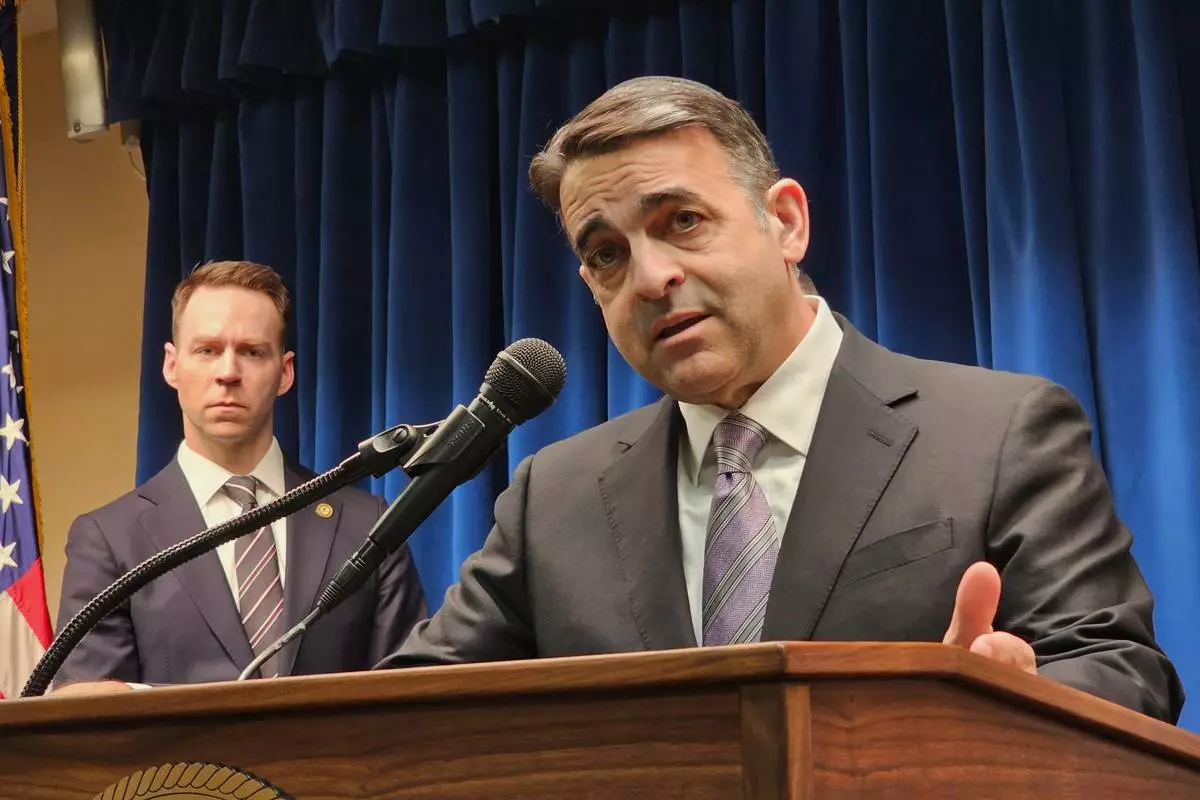
The U.S. attorney for Minnesota, Daniel Rosen, speaks with reporters during a news conference at the federal courthouse in Minneapolis, Wednesday, Feb. 25, 2026. (AP Photo/Steve Karnowski)
DUBAI, United Arab Emirates (AP) — Iran has sent its response to the latest U.S. ceasefire proposal to Pakistani mediators and wants negotiations to focus on permanently ending the war, Iran’s state-run media said Sunday.
State TV said Iran seeks to end the war on all fronts, including in Lebanon, and ensure the security of shipping. Washington’s latest proposal had addressed a deal to end the war, reopen the Strait of Hormuz and roll back Iran’s nuclear program, an issue that Tehran would rather discuss later.
There was no immediate comment from the White House about Iran’s reply.
President Donald Trump is giving diplomacy “every chance we possibly can before going back to hostilities,” the U.S. ambassador to the United Nations, Mike Waltz, told ABC.
Meanwhile, the fragile ceasefire was tested Sunday when a drone ignited a small fire on a ship off Qatar, while the United Arab Emirates and Kuwait reported drones entering their airspace. The UAE blamed Iran for its attack. No casualties were reported, and no one immediately claimed responsibility.
The Qatari Foreign Ministry called it a “dangerous and unacceptable escalation that threatens the security and safety of maritime trade routes and vital supplies in the region."
Iran and armed allied groups have used drones to carry out hundreds of strikes since the war began with U.S. and Israeli attacks on Feb. 28.
Trump has reiterated threats to resume full-scale bombing if Iran does not accept an agreement to reopen the strait and roll back its nuclear program. Iran has mostly blocked the strategic waterway key to the global flow of oil since the war began, rattling world markets.
The U.S. in turn has imposed a blockade of Iranian ports. On Friday, the U.S. struck two Iranian oil tankers that it said were trying to breach the blockade. Iran’s Revolutionary Guard navy has reiterated its warning that any attack on Iranian oil tankers or commercial vessels would be met with a “heavy assault” on one of the U.S. bases in the region and enemy ships.
Another sticking point in negotiations is the fate of Iran’s highly enriched uranium. The U.N. nuclear agency says Iran has more than 440 kilograms (970 pounds) of uranium that is enriched up to 60% purity, a short, technical step from weapons-grade levels.
In an interview with state media posted late Saturday, a spokesman for Iran's military said its forces were on “full readiness” to protect nuclear sites where uranium is stored.
“We considered it possible that they might intend to steal it through infiltration operations or heliborne operations,” Brig. Gen. Akrami Nia told the IRNA news agency.
The majority of Iran’s highly enriched uranium is likely at its Isfahan nuclear complex, International Atomic Energy Agency Director-General Rafael Mariano Grossi told The Associated Press last month. The facility was bombarded by U.S.-Israeli airstrikes in the 12-day war last year and faced less intense attacks this year.
Pakistan, which oversaw face-to-face talks between the U.S. and Iran last month, continues to pursue mediation. In rare public comments, Pakistani army chief Field Marshal Asim Munir said Islamabad remains committed to helping end the conflict. And Pakistani Prime Minister Shehbaz Sharif spoke by phone with Qatari counterpart Sheikh Mohammed bin Abdulrahman Al Thani.
The UAE's Defense Ministry said it shot down two drones and blamed the attack on Iran.
In Kuwait, Defense Ministry spokesman Brig. Gen. Saud Abdulaziz Al Otaibi said hostile drones entered Kuwait’s airspace early Sunday and forces responded “in accordance with established procedures.” The ministry did not say where the drones came from.
The Qatari Defense Ministry said a drone targeted a commercial ship coming from Abu Dhabi into a southern port, setting a small fire that was extinguished. The United Kingdom Maritime Trade Operations Center said the attack happened 23 nautical miles (43 kilometers) northeast of Qatar’s capital, Doha. It provided no details about the ship’s owner or origin, and there was no claim of responsibility.
There have been several attacks against ships in the Persian Gulf over the past week.
South Korea announced initial findings from a investigation that said two unidentified airborne objects struck the stern of the South Korean-operated vessel HMM NAMU about one minute apart while it was anchored in the Strait of Hormuz last week, causing an explosion and fire. A foreign ministry spokesperson said officials have yet to determine who was responsible.
Magdy reported from Cairo. Associated Press writers Munir Ahmed in Islamabad; Melanie Lidman in Tel Aviv, Israel; Tong-hyung Kim in Seoul; Julia Frankel in Jerusalem; and Josh Boak in Washington contributed to this report.
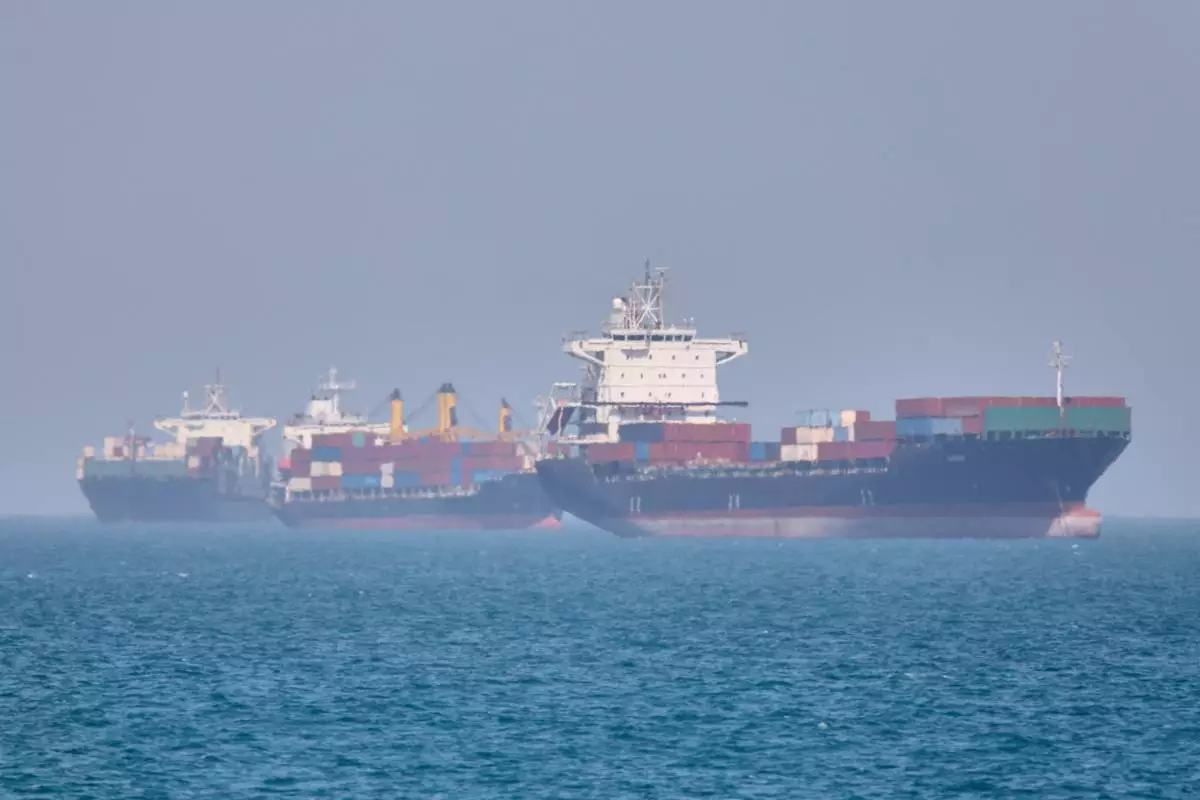
Container ships sit at anchor in the Strait of Hormuz off Bandar Abbas, Iran, Saturday, May 2, 2026.(Amirhosein Khorgooi/ISNA via AP)