PHNOM PENH, Cambodia (AP) — Cambodian officials on Friday welcomed back more than six dozen centuries-old artifacts described as part of the country’s cultural heritage that had been looted during decades of war and instability.
At a ceremony attended by Deputy Prime Minister Hun Many, the 74 items were unveiled at the National Museum in Phnom Penh after their repatriation from the United Kingdom. The artifacts were returned under a 2020 agreement between the Ministry of Culture and Fine Arts and the family of the late Douglas Latchford, an art collector and dealer who is blamed for having had the items smuggled out of Cambodia.
“This substantial restitution represents one of the most important returns of Khmer cultural heritage in recent years, following major repatriations in 2021 and 2023 from the same collection,” said a statement from the Culture Ministry. “It marks a significant step forward in Cambodia’s continued efforts to recover, preserve, and restore its ancestral legacy for future generations.”
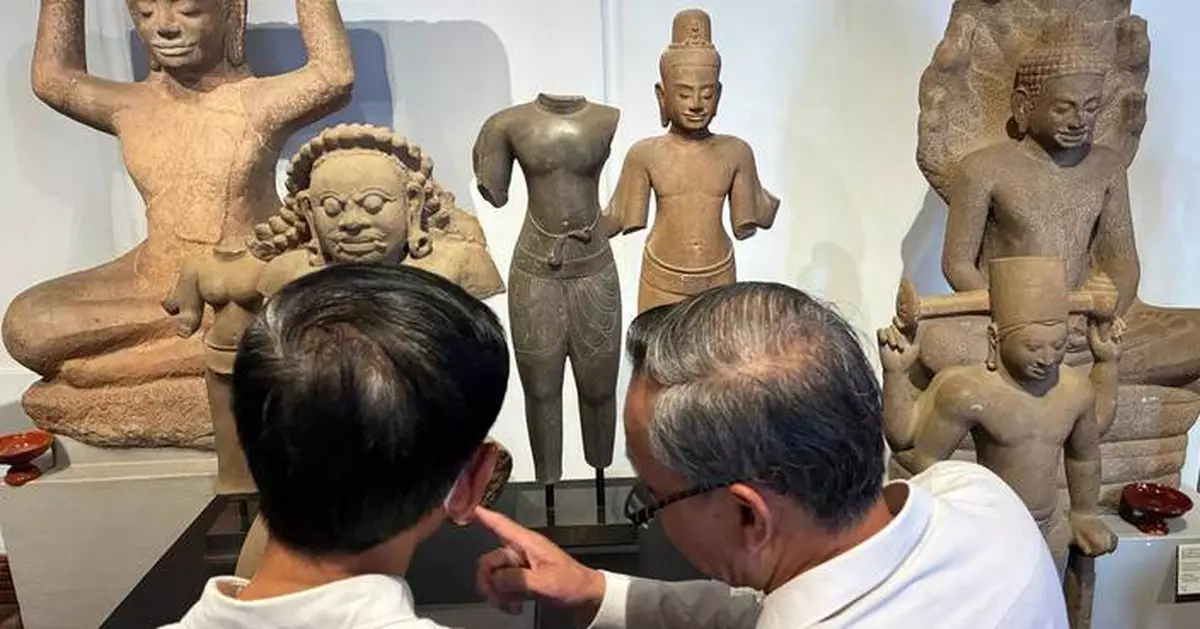
The artifacts were described as dating from the pre-Angkorian period through the height of the Angkor Empire, including “monumental sandstone sculptures, refined bronze works, and significant ritual objects.” The Angkor Empire, which extended from the ninth to the 15th century, is best known for the Angkor Wat archaeological site, the nation’s biggest tourist attraction.
Latchford was a prominent antiquities dealer who allegedly orchestrated a long-running scheme to sell looted Cambodian sculptures on the international market.
From 1970 to the 1980s, during Cambodia’s civil wars and the communist Khmer Rouge ’s brutal reign, organized looting networks sent artifacts to Latchford, who then sold them to Western collectors, dealers, and institutions. These pieces were often physically damaged, having been pried off temple walls or other structures by looters.
In 2019, Latchford was indicted in a New York federal court on charges including wire fraud and conspiracy, though he died in 2020 at age 88 before he could be extradited to face charges.
Cambodia, like neighboring Thailand, has benefited from a trend in recent decades involving the repatriation of art and archaeological treasures taken from their homelands. These include ancient Asian artworks as well as pieces lost or stolen during turmoil in places such as Syria, Iraq and Nazi-occupied Europe. New York’s Metropolitan Museum of Art is one of the prominent institutions that has been returning illegally smuggled art, including to Cambodia.
“The ancient artifacts created and preserved by our ancestors are now being returned to Cambodia, bringing warmth and joy, following the country’s return to peace,” said Hun Many, who is the younger brother of Prime Minister Hun Manet.

Khmer cultural artifacts that were returned to Cambodia on display at the National Museum, in Phnom Penh, Friday, Feb. 27, 2026. (AP Photo/Sopheng Cheang)
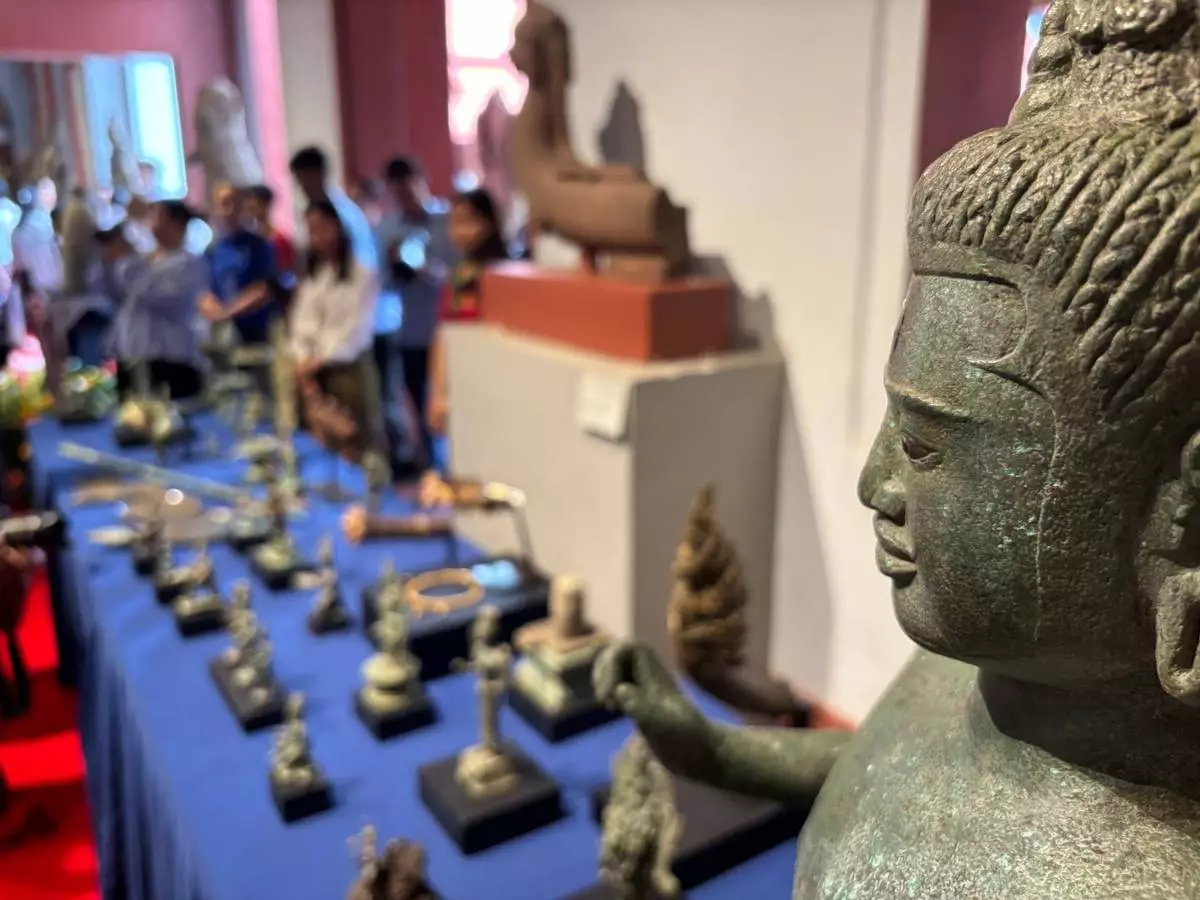
Khmer cultural artifacts that were returned to Cambodia on display at the National Museum, in Phnom Penh, Friday, Feb. 27, 2026. (AP Photo/Sopheng Cheang)
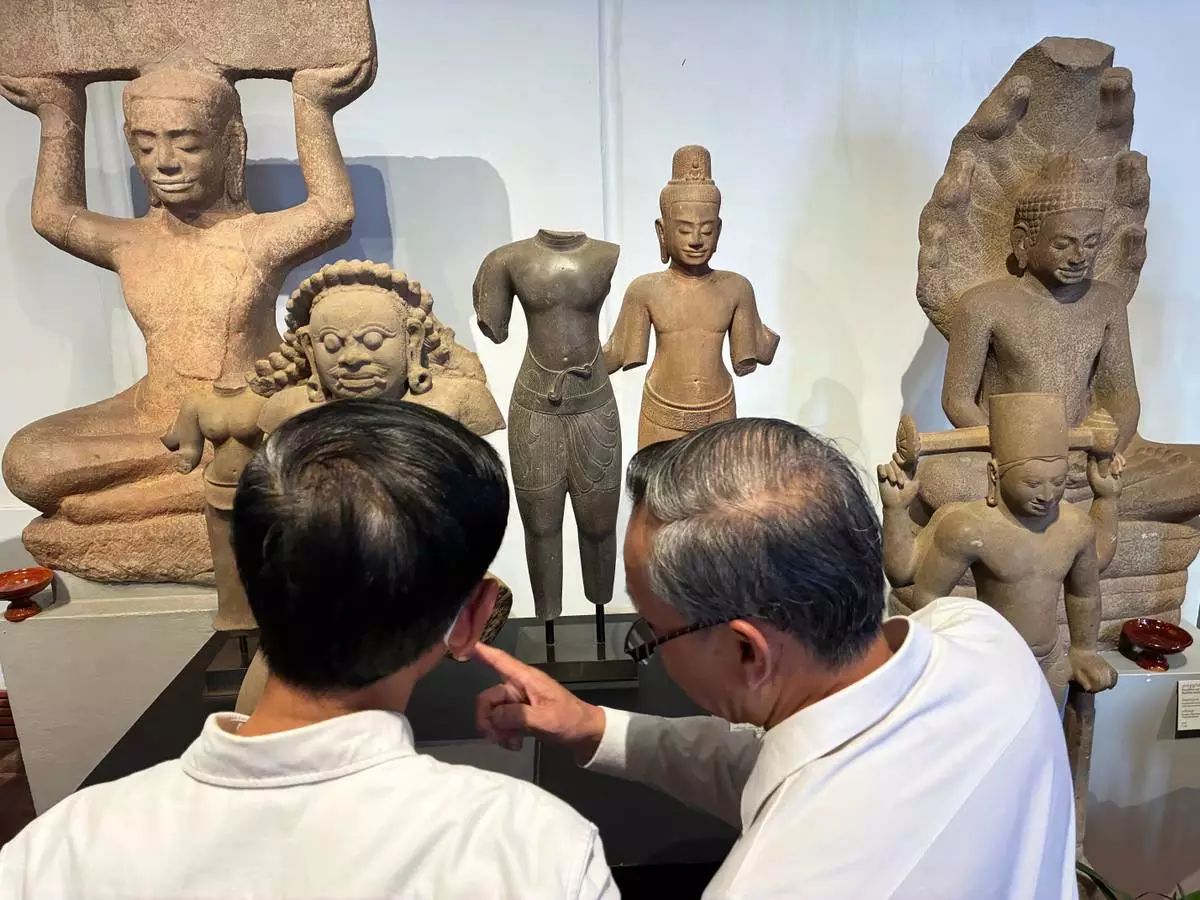
Cambodian officials look at Khmer cultural artifacts that were returned to the country, at the National Museum, in Phnom Penh, Friday, Feb. 27, 2026. (AP Photo/Sopheng Cheang)
WASHINGTON (AP) — Republican Rep. Kevin Kiley has seen the political ground shift beneath him this past year, the boundaries of his California district upended by the nation’s partisan redistricting war.
But Kiley has made clear he’s not going away quietly. Or to hear him put it: “I’m not going away at all.”
It’s the kind of defiance that has defined Kiley’s recent tenure in Washington. Some days, he's blasting Democrats and continuing his longstanding antagonism toward California Gov. Gavin Newsom and political pursuits in his home state, including the effort to build high-speed rail. Other days, he's bucking President Donald Trump on his tariffs and criticizing House Speaker Mike Johnson's leadership.
The double-barreled approach to reelection comes as the former state legislator tries to navigate his way to a third term in the House after watching his current district split into six pieces, leaving him with few paths to remain in office. He plans to announce a decision on his reelection plans on Monday.
Kiley's predicament is an example of how the redistricting war that began in Texas, at Trump's urging, and drew a swift counter response from Democrats in California has left some incumbents scrambling to salvage their political careers.
Kiley has said on social media he's narrowed his reelection options to two. One would be to take on fellow Republican Tom McClintock in a primary and possibly again in the fall. California uses a system in which the top two vote-getters in a primary regardless of party move on to the general election. His other option would be to run in a Democratic-leaning district and hope he can prevail despite the midterm headwinds facing Republicans.
“He's in real jeopardy of not coming back to Congress,” Republican strategist Rob Stutzman said. “Having said that, I think he's got a better shot than most would under this circumstance. He's a shrewd politician. He works hard.”
After Texas redrew its maps to generate five more districts friendlier to Republicans, California responded in kind. Voters approved new congressional district boundaries that give Democrats a better shot at winning up to five additional seats.
Kiley is not the only California Republican facing a tougher road to reelection. Republican Reps. Ken Calvert and Young Kim will face off in a new district. Rep. Darrell Issa is expected to seek a 13th term in his current district, but it now tilts toward Democrats. Rep. David Valadao's district in the Central Valley has become even more Democratic-leaning.
Kiley has been outspoken about their plight. He authored a bill to prohibit states from carrying out more than one congressional redistricting after each decennial census. But the bill has languished, with just one co-sponsor. He has taken to the floor to criticize Johnson for not doing more to head off a redistricting war that has spread to Missouri, North Carolina, Ohio and Virginia, among others.
“Why is the leader of this institution simply watching as the institution crumbles?” he said in one floor speech.
Johnson said that Kiley's criticism is “misinformed" and that he brought in some $13 million to fight California's redistricting effort at the ballot box.
“Last cycle, I practically lived in California,” Johnson said. “I spent so many days campaigning in California, I thought Gavin Newsom was going to send me a tax bill. I'll be out there again because California is equally important to us now as it always has been.”
Kiley said on social media that he would be choosing between the reliably-Republican district that McClintock serves and an open Sacramento County-focused district where Democrat Kamala Harris would have won the 2024 presidential election by about 8 percentage points.
“Over the coming weeks leading up to the March 4 filing deadline, I will be talking with constituents and folks throughout the state about the best path forward, and I would love to hear from you,” he wrote. “... Thank you for all of the encouragement in working through a set of a challenges we never expected."
His willingness to butt heads with GOP leadership and Trump could appeal to the independent voters he will need to have success in the Democratic-leaning Sacramento district.
Kiley was one of six Republicans who earlier this month voted to rescind tariffs Trump imposed on Canada. Before that, he voted to override two Trump vetoes. He also weighed in with a bill to temporarily extend health care subsidies in the Affordable Care Act marketplace, though he ultimately voted against the clean, three-year extension sought by Democrats.
“He's positioning himself to basically run as a Republican that is independent of the speaker and the leadership, and independent from the White House,” said Stutzman, the Republican strategist.
Stutzman added that some of Kiley's actions also stem from a genuine unhappiness with Republican leaders on the redistricting war.
“They started a fight and then left these guys bleeding on the battlefield," Stutzman said.
Stutzman said the Sacramento-area district is an interesting setup for Kiley because part of his political brand is being a Newsom antagonist, and Newsom hasn't fared as well there as he has overall in the state.
“He's going to put up a good fight in this seat — if that's what he does,” Stutzman said.
Democratic strategist Paul Mitchell said he doubts the seat is winnable for Republicans in an election likely to be a referendum on Trump.
“It is a more swingy seat than a seat in Santa Monica or San Francisco, but it's not a seat that I think a Republican wins, especially not in a blue wave election,” said Mitchell, a political data expert.
Mitchell sees Kiley's best chance of returning to Congress as unseating McClintock, who has served nine terms in the House. And before that, 22 years as a California legislator. He may be the most conservative member of the California delegation.
McClintock said of a possible Kiley challenge: “Desperate people do desperate things, but it's a free country and he's free to run where he wishes.”
The Club for Growth Political Action Committee, a powerhouse in GOP primaries that often puts its vast resources behind the most fiscally conservative Republican candidate, endorsed McClintock last week. Trump also gave McClintock his “Complete and Total Endorsement.”
Such endorsements will be key for McClintock. He came into this year at a distinct financial disadvantage compared with Kiley. Federal Election Commission records show McClintock with less than $100,000 in cash on hand at the end of December; Kiley had more than $2 million.
Kiley's campaign put some of those resources to work earlier this month with more than $175,000 spent on a political ad that shows him as a foil to Newsom. “That's why President Trump said no one has fought Gavin Newsom harder than Kevin,” a narrator says.
Ad-Impact, which tracks political ad spending, said most of the funds were directed to the Fresno and Visalia media market. Mitchell says the lack of spending in Sacramento could be a sign of Kiley's thinking.
“I should expect to see him at things in this part of the district or Republicans all excited about Kiley in this part of the districts. It's like crickets," Mitchell said.
Kiley said the ads did not necessarily mean a decision had been made. He said he's talking to current constituents as well as those he might serve in the future, “seeing which is the best fit.”
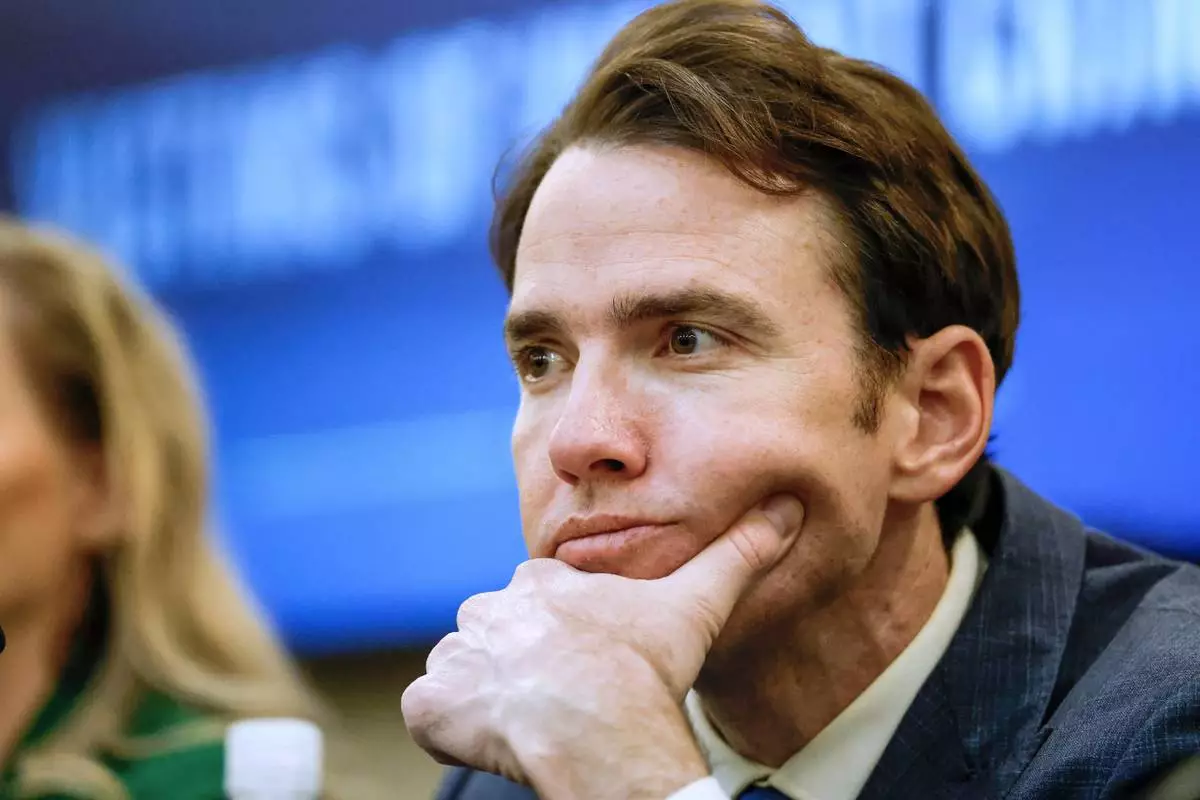
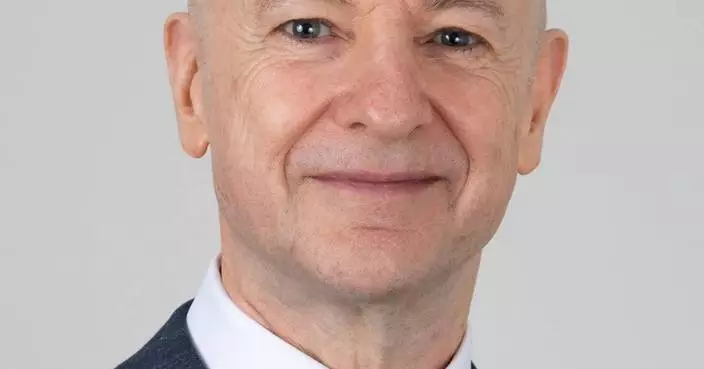
FILE - Rep. Kevin Kiley, R-Calif., listens to testimony as the House Judiciary Subcommittee on Oversight holds a field hearing on violent crime in Charlotte, N.C., Sept. 29, 2025. (AP Photo/Nell Redmond, File)