Hungarian Prime Minister Viktor Orban announced on Friday that he and his Slovak counterpart Robert Fico have agreed to establish a joint Hungarian-Slovak investigative committee to assess the conditions of the Druzhba pipeline.
On the same day, Fico announced on social media that he had proposed the creation of a joint investigation team, comprising representatives from Slovakia, Hungary, and the European Union, and the team's objective would be to conduct an on-site assessment to determine the extent of the technological damage to the pipeline.
The Druzhba pipeline, which translates as the 'friendship' pipeline, serves as a major network for transporting Russian crude oil to Central and Eastern Europe via Ukraine.
According to Ukrainian officials, oil shipments to the countries including Hungary and Slovakia were suspended on Jan 27 due to damage caused by Russian attacks.
However, Hungary and Slovakia have dismissed these claims, asserting that Ukraine has deliberately cut off the supply from Russia.
The two countries on Monday took what they described as "reciprocal" countermeasures against Ukraine following disruptions to oil deliveries through the Druzhba pipeline, escalating tensions over energy security and prompting Hungary to block new European Union (EU) sanctions on Russia.

Hungary, Slovakia agree to set up joint committee to assess conditions of Druzhba pipeline

Hungary, Slovakia agree to set up joint committee to assess conditions of Druzhba pipeline
China posted steady economic growth in 2025 driven by fast-growing innovation strength and progress in green transition, according to a communique released by the National Bureau of Statistics (NBS) on Saturday.
Primary calculation indicated that China's gross domestic product (GDP) in 2025 increased by five percent year on year to reach a record of 140.1879 trillion yuan (about 20.44 trillion U.S. dollars), hitting the annual target, said the communique.
In breakdown, the value added of the primary, secondary and tertiary industries grew by 3.9 percent, 4.5 percent and 5.4 percent year on year, respectively.
Overall labor productivity stood at 184,413 yuan per capita, marking an increase of 6.1 percent over the previous year.
The country's new quality productive forces grew steadily in 2025, with the value added of high-tech manufacturing above designated size increasing by 9.4 percent year on year.
Specifically, the output of high-tech products such as service robots, memory chips and 3D printing equipment grew by 16.1 percent, 22.8 percent and 52.5 percent, respectively.
The country also made notable progress in the green and low-carbon transition, according to the communique.
Preliminary calculations showed that China's carbon dioxide emissions per 10,000 yuan of GDP decreased by 5.0 percent year on year in 2025.
The power generation from clean energy sources such as hydropower, nuclear power, wind power and solar power reached 4.2481 trillion kilowatt-hours, up 14.4 percent from the previous year.
China's overall employment remained stable in 2025, according to the communique. The average surveyed urban unemployment rate stood at 5.2 percent, lower than the target of around 5.5 percent, and 12.67 million new urban jobs were created.
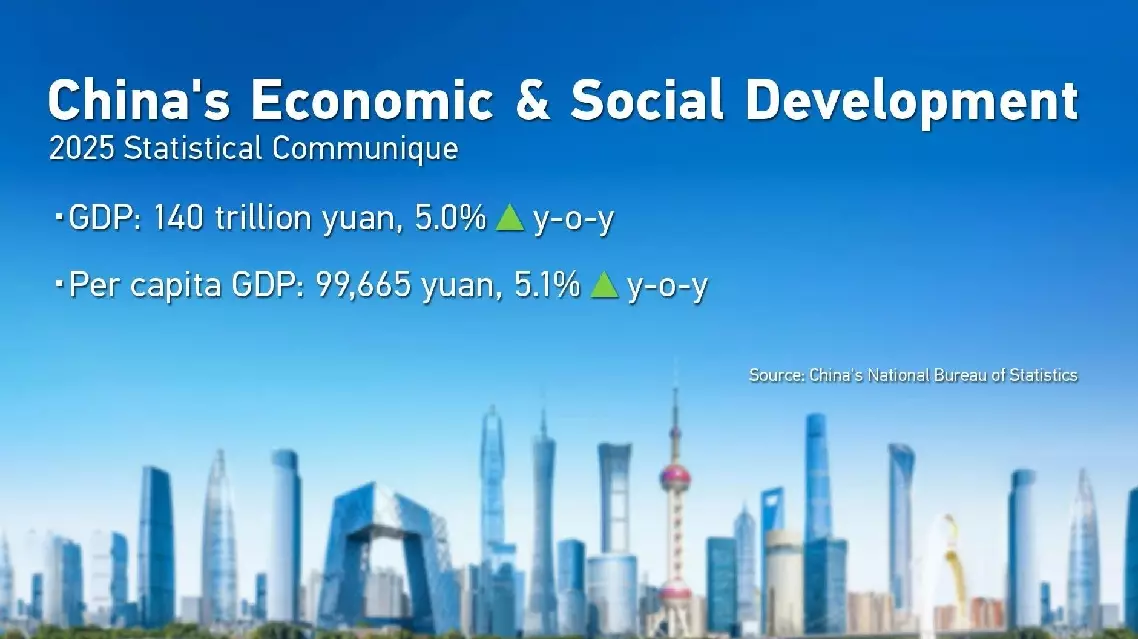
Innovation, green transition highlights China's economic growth in 2025