CARDIFF, Wales (AP) — FIFA president Gianni Infantino has raised the prospect of red cards being shown to players who cover their mouths when confronting opponents.
The issue has been highlighted in recent weeks after Real Madrid player Vinicius Junior said he was racially insulted by Benfica's Gianluca Prestianni during a Champions League match.
Prestianni, who denies the allegations, had approached Vinicius while covering his mouth with his jersey during Madrid's 1-0 win in the first leg of the playoff match. He was provisionally suspended for the second leg while an investigation was being carried out.
The issue of players covering their mouths was discussed on Saturday at a meeting of the International Football Association Board (IFAB).
Measures could come into force at this summer’s World Cup.
“If a player covers his mouth and says something, and this has a racist consequence, then he has to be sent off, obviously,” Infantino told Sky News. “There must be a presumption that he has said something he shouldn’t have said, otherwise he wouldn’t have had to cover his mouth.
“I simply do not understand - if you don’t have something to hide, you don’t hide your mouth when you say something.
“That’s it, as simple as that. And these are actions that we can take and we have to take in order to be serious about our fight against racism.”
AP soccer: https://apnews.com/hub/soccer

Real Madrid's Vinicius Junior argues with referee François Letexier after scoring the opening goal during a Champions League playoff soccer match between SL Benfica and Real Madrid in Lisbon, Portugal, Tuesday, Feb. 17, 2026. (AP Photo/Pedro Rocha)

Real Madrid's Vinicius Junior argues after scoring the opening goal during a Champions League playoff soccer match between SL Benfica and Real Madrid in Lisbon, Portugal, Tuesday, Feb. 17, 2026. (AP Photo/Pedro Rocha)

Real Madrid's Vinicius Junior argues with referee François Letexier after scoring the opening goal during a Champions League playoff soccer match between SL Benfica and Real Madrid in Lisbon, Portugal, Tuesday, Feb. 17, 2026. (AP Photo/Pedro Rocha)
NEW YORK (AP) — Oil prices rose sharply Monday as U.S. and Israeli attacks on Iran and retaliatory strikes against Israel and U.S. military installations around the Gulf sent disruptions through the global energy supply chain.
Traders were betting the supply of oil from Iran and elsewhere in the Middle East would slow or grind to a halt. Attacks throughout the region, including on two vessels traveling through the Strait of Hormuz, the narrow mouth of the Persian Gulf, have restricted countries’ ability to export oil to the rest of the world. Prolonged attacks would likely result in higher prices for crude oil and gasoline, according to energy experts.
West Texas Intermediate, the light, sweet crude oil produced in the United States, was selling for about $72 a barrel early Monday, up around 7.3% from its trading price of about $67 on Friday, according to data from CME group.
A barrel of Brent crude, the international standard, was trading at $78.55 per barrel early Monday, according to FactSet, up 7.8% from its trading price of $72.87 on Friday, which had been a seven-month high at the time.
Higher global energy prices could lead to consumers paying more for gasoline at the pump and shelling out more for groceries and other goods, at a time when many are already feeling the impacts of elevated inflation.
Roughly 15 million barrels of crude oil per day — about 20% of the world’s oil — are shipped through the Strait of Hormuz, making it the world’s most critical oil chokepoint, according to Rystad Energy. Tankers traveling through the strait, which is bordered in the north by Iran, carry oil and gas from Saudi Arabia, Kuwait, Iraq, Qatar, Bahrain, the UAE and Iran.
Iran had temporarily shut down parts of the strait in mid-February for what it said was a military drill, which led oil prices to jump about 6% higher in the days that followed.
Against that backdrop, eight countries that are part of the OPEC+ oil cartel announced they would boost production of crude Sunday. The Organization of Petroleum Exporting Countries, in a meeting planned before the war began, said it would increase production by 206,000 barrels per day in April, which was more than analysts had been expecting. The countries boosting output include Saudi Arabia, Russia, Iraq, the United Arab Emirates, Kuwait, Kazakhstan, Algeria and Oman.
“Roughly one-fifth of global oil supply passes through the Strait of Hormuz, a vital artery for world trade, meaning markets are more concerned with whether barrels can move than with spare capacity on paper,” said Jorge León, Rystad's senior vice president and head of geopolitical analysis, in an email. "If flows through the Gulf are constrained, additional production will provide limited immediate relief, making access to export routes far more important than headline output targets.”
Iran exports roughly 1.6 million barrels of oil a day, mostly to China, which may need to look elsewhere for supply if Iran’s exports are disrupted, another factor that could increase energy prices.
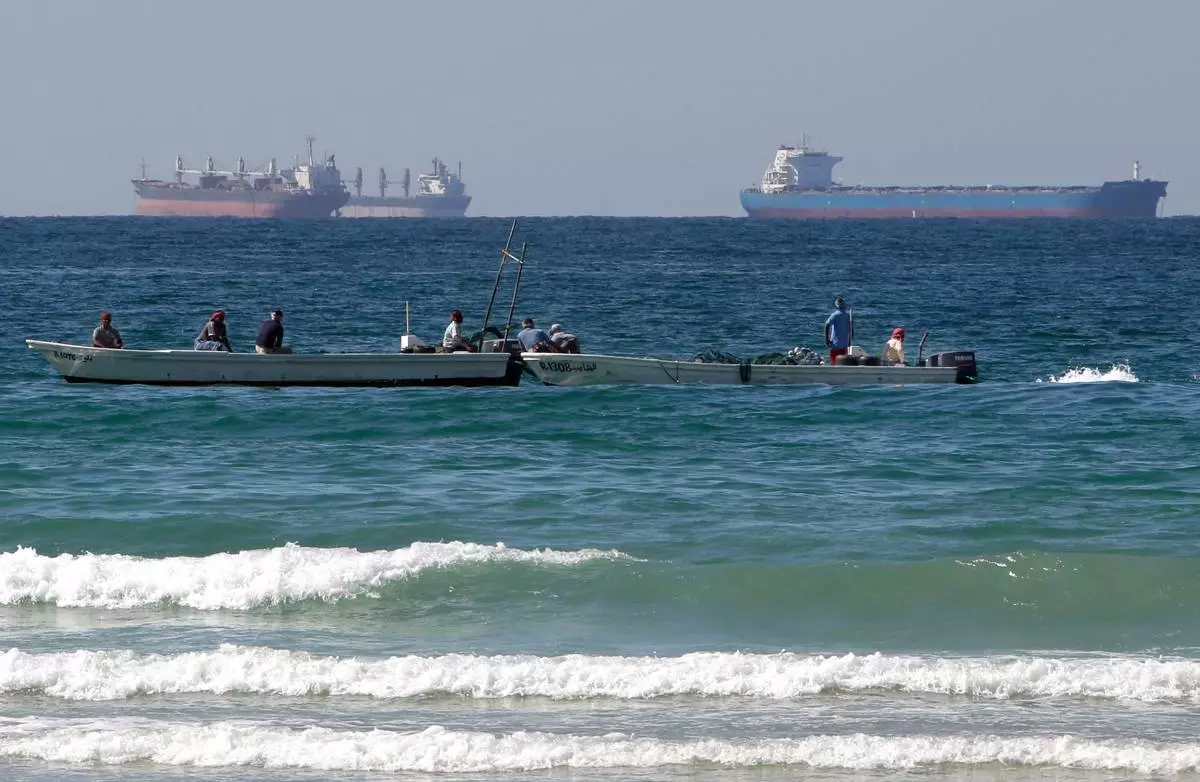
FILE - Fishermen work in front of oil tankers south of the Strait of Hormuz Jan. 19, 2012, offshore the town of Ras Al Khaimah in United Arab Emirates. (AP Photo/Kamran Jebreili, File)