Skip to Content Facebook Feature Image

Spain's government denies cooperating with US operations in Mideast, contradicting White House

News

Spain's government denies cooperating with US operations in Mideast, contradicting White House
News

News

Spain's government denies cooperating with US operations in Mideast, contradicting White House

2026-03-05 04:25 Last Updated At:04:31

MADRID (AP) — A diplomatic tussle between the United States and Spain over the war in Iran intensified on Wednesday when the governments exchanged contradictory statements over the possible use of Spanish military bases by American armed forces for operations in the Middle East.

Moments after a White House spokesperson said the Spanish government in Madrid had agreed to help the U.S., Spanish Foreign Minister José Manuel Albares came out and flatly denied that the European government had changed its position.

“I can refute (the White House spokesperson),” Albares told Spanish radio station Cadena Ser. “The position of the Spanish government regarding the war in the Middle East, the bombing of Iran and the use of our bases has not changed one iota.”

The disagreement broke out on Tuesday when Trump said that he was going to “ cut off all trade with Spain,” a day after Albares said that his government wouldn’t allow the U.S. to use jointly operated bases in southern Spain in any strikes not covered by the U.N. charter. Spanish Prime Minister Pedro Sánchez said that his government wouldn’t “be complicit in something that is bad for the world.”

Albares denied that his government had reconsidered its posture on the use of the bases on Wednesday evening in Madrid shortly after White House press secretary Karoline Leavitt had said “with respect to Spain, I think they heard the president’s message yesterday loud and clear.

“And it’s my understanding over the past several hours, they’ve agreed to cooperate with the U.S. military," Leavitt had said. "And so I know that the U.S. military is coordinating with their counterparts in Spain.”

Sánchez, widely regarded as Europe’s last major progressive leader, has called the U.S. and Israeli attacks on Iran an “unjustifiable” and “dangerous” military intervention.

Sánchez again criticized the U.S. and Israel's military actions in Iran early on Wednesday when he made a nationally televised address. While not mentioning Trump by name, Sánchez stood firm against trade threats from Washington and warning that the war in the Middle East risked “playing Russian roulette” with millions of lives.

“We are not going to be complicit in something that is bad for the world and is also contrary to our values ​​and interests, just out of fear of reprisals from someone,” Sánchez said.

Sánchez expressed concern that the attacks on Iran could lead to another costly military quagmire in the Middle East, similar to the past American interventions in Iraq and Afghanistan.

“In short, the position of the government of Spain can be summarized in four words,” Sánchez said. “No to the war.”

After Spain denied U.S. use of its bases, Trump on Tuesday said “we could use their base if we want,” referencing the Rota and Morón installations in southern Spain that the U.S. and Spain share, but which remain under Spanish command.

“We could just fly in and use it,” Trump said. “Nobody’s going to tell us not to use it, but we don’t have to.”

It wasn't clear how Trump would have cut off trade with Spain, which is a member of the European Union. The EU negotiates trade on behalf of all its 27 member states.

When asked in an interview with CNBC whether a trade embargo with Spain would be possible, U.S. Treasury Secretary Scott Bessent said that Wednesday “it would be a combination effort." He didn't explain further, but said Spain's refusal to allow the U.S. to use its bases in the weekend attack on Iran endangered American lives.

“Anything that slows down our ability to engage and prosecute this war in the fastest, most effective manner puts American lives at risk,” Bessent said. “The Spanish put American lives at risk.”

The EU said that it would protect its interests and work to stabilize its trade relationship with the U.S, with which it struck a trade deal last year after months of economic uncertainty over Trump’s tariff blitz.

Tuesday's threats from Washington were just the latest instance of the U.S. president wielding the threat of tariffs or trade embargoes as punishment. Last month, the U.S. Supreme Court struck down Trump’s far-reaching global tariffs, saying emergency powers don't allow the president to unilaterally impose sweeping tariffs.

However, Trump maintains that the court allows him to instead impose full-scale embargoes on other nations of his choosing.

Spain's main business groups expressed concerns over the trade threat, calling the U.S. a “key partner from an economic and political standpoint.”

“We trust that our trade relations will ultimately not be affected in any way,” the Spanish business chambers CEOE, CEPYME and ATA said Tuesday.

Last year, Spain's central bank issued a report that concluded Europe's fourth-largest economy was relatively cushioned compared with the EU average when it came to exposure to tariffs by Trump.

Spain’s exports and imports with the U.S. accounted for 4.4% of gross domestic product, the Bank of Spain said, while trade with the U.S. for the EU as a whole was 10.1%.

Exports of Spanish goods to the U.S. accounted for 1% of Spain's GDP, or 16 billion euros ($18.6 billion), the bank said, making it Spain’s sixth largest export market for goods. Pharmaceutical products, olive oil, refined gas and electrical transformers are among Spain's main exports to the U.S., according to the Observatory of Economic Complexity.

Spain’s position on the Iran conflict is the latest flare-up in its relationship with the Trump administration.

Sánchez was an outspoken critic of the Israel-Hamas war in Gaza and attracted Trump's ire last year when Spain backed out of NATO’s pledge to increase defense spending by members to 5% of GDP.

Joseph Wilson reported from Barcelona, Spain, and Aamer Madhani from Washington. Sam McNeil contributed to this report from Brussels.
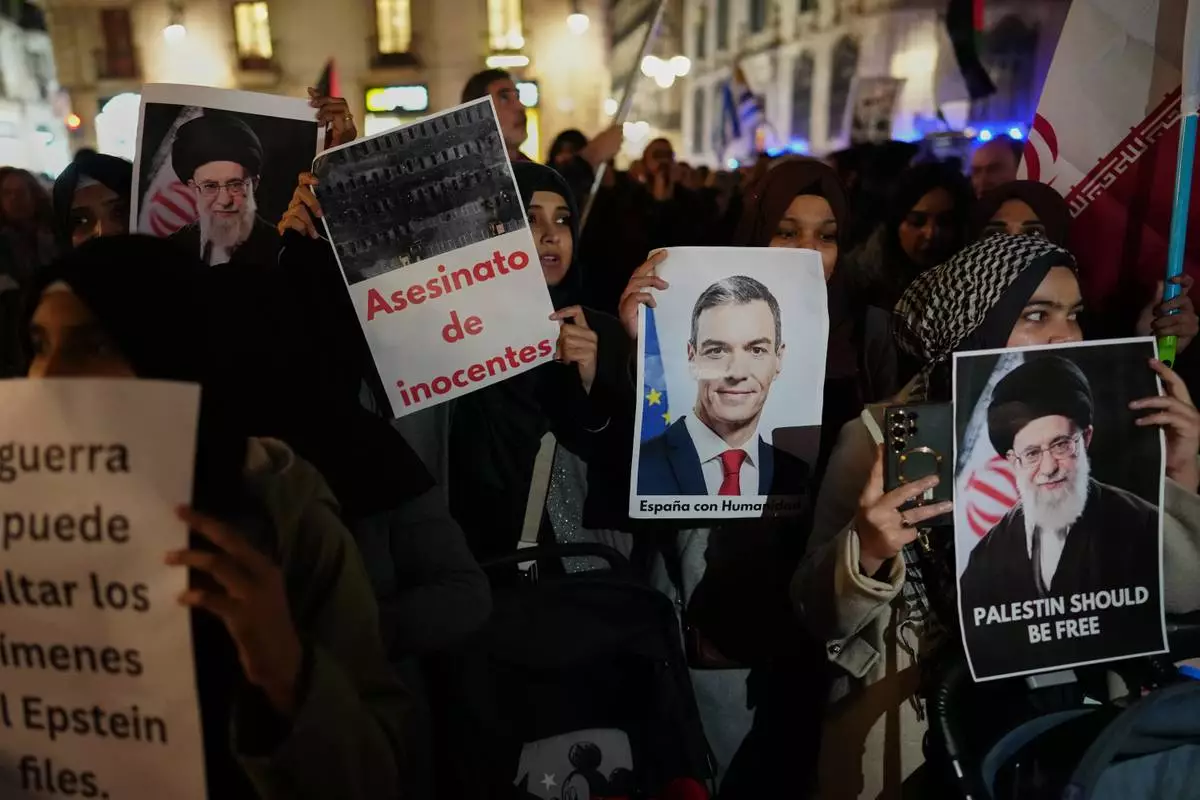
Demonstrators hold photographs of Spanish Prime Minister Pedro Sanchez during a protest against U.S. and Israeli intervention in Iran in Barcelona, Spain, Wednesday, March 4, 2026. (AP Photo)

Demonstrators hold photographs of Spanish Prime Minister Pedro Sanchez during a protest against U.S. and Israeli intervention in Iran in Barcelona, Spain, Wednesday, March 4, 2026. (AP Photo)

Spain's Foreign Minister Jose Manuel Albares Bueno speaks with the media as he arrives for a meeting of EU foreign ministers at the European Council building in Brussels, Monday, Feb. 23, 2026. (AP Photo/Virginia Mayo)
Spain's Foreign Minister Jose Manuel Albares Bueno speaks with the media as he arrives for a meeting of EU foreign ministers at the European Council building in Brussels, Monday, Feb. 23, 2026. (AP Photo/Virginia Mayo)

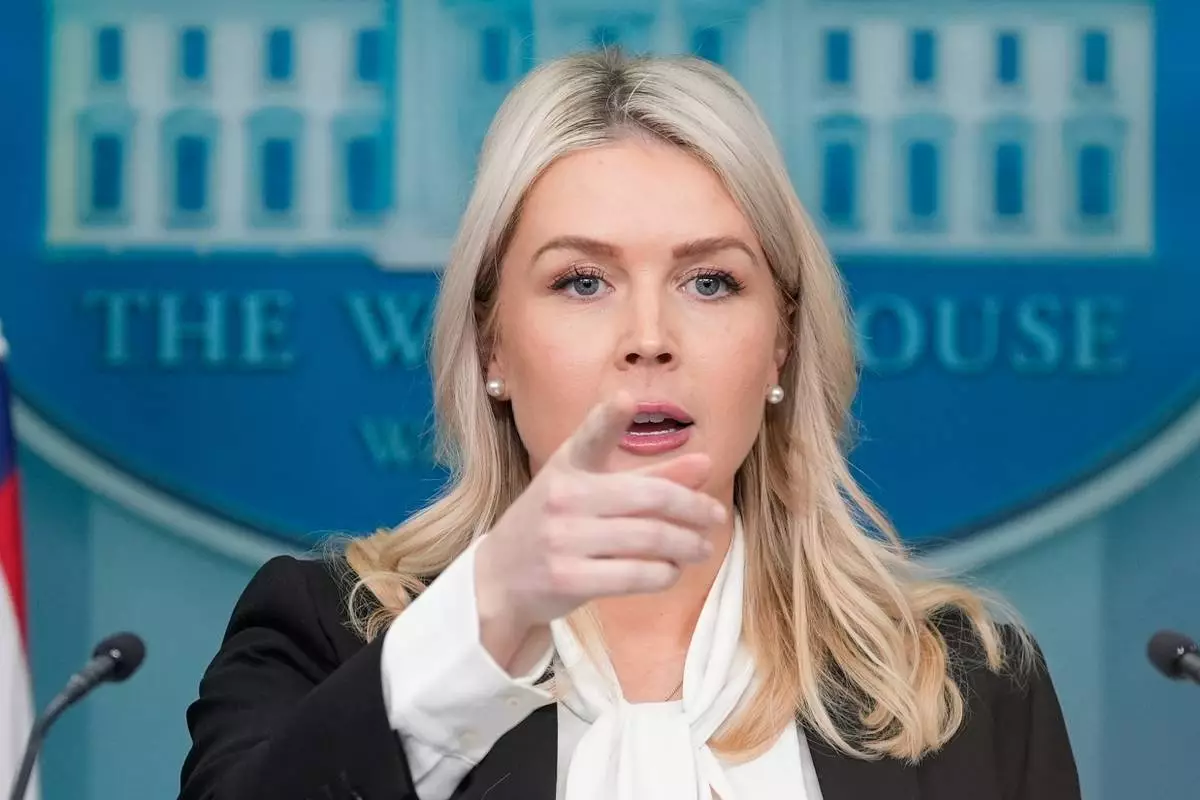
White House press secretary Karoline Leavitt speaks with reporters in the James Brady Press Briefing Room at the White House, Wednesday, March 4, 2026, in Washington. (AP Photo/Alex Brandon)


White House press secretary Karoline Leavitt speaks with reporters in the James Brady Press Briefing Room at the White House, Wednesday, March 4, 2026, in Washington. (AP Photo/Alex Brandon)
A U.S. submarine sank an Iranian warship in international waters, Defense Secretary Pete Hegseth said Wednesday. In addition to striking Tehran, Israel hit the Iranian-backed Hezbollah militant group in Lebanon, while Iran fired on Bahrain, Kuwait and Israel.

As the U.S.-Israeli war on Iran spirals, the U.S. Senate is heading to vote on a war powers measure demanding congressional approval before further attacks. The resolution and a twin House bill face long odds in the Republican-controlled Congress, and Trump would almost certainly veto them anyway.

The war has killed more than 1,000 people in Iran, more than 50 in Lebanon and around a dozen in Israel, according to officials in those countries. The United Nations says 100,000 people fled the Iranian capital in the war’s first two days alone.

Oil prices have soared following Iranian attacks on traffic through the Strait of Hormuz, and global stock markets have been hammered over worries that the spike in oil prices may grind down the world economy. U.S. stocks appeared steadier at Wednesday’s opening.

Here is the latest:

The ongoing strikes deepen an “unprecedented state of hostility” with Iran's neighbors in the Gulf, said Arab League chief Ahmed Aboul Gheit in a statement Wednesday.

He demanded Tehran stop the attacks, which he called a “strategic mistake,” saying “Iran must come to its senses.”

The Arab League, made up of 22 member states, promotes regional cooperation. However, it is widely seen as toothless and has long struggled to help solve conflicts.

The Israeli military says the strikes on the Iranian capital are targeting “military infrastructure.”

U.S.-Israeli strikes have killed more than 1,000 people in Iran so far.

In his first public address since joining the war, Hezbollah leader Naim Kassem said the Lebanese militant group rejects the government’s plan to disarm its fighters.

“As long as the (Israeli) occupation is present, then the resistance and its weapons are a legitimate right,” Kassem said.

Lebanon’s leaders say Hezbollah’s rocket fire into Israel is illegal and urged the Lebanese army to crack down on groups possessing weapons outside state control.

Lebanon’s cash-strapped military, backed by the U.S. and other governments, has been deploying in recent months across southern Lebanon where Hezbollah has a strong military presence. However, it’s unclear if the army is able or willing to disarm Hezbollah by directly confronting them.

The U.N. refugee agency, basing its estimates on Iranian officials, also said around 1,000 to 2,000 vehicles per day were reported leaving the capital, mostly toward the north.

Geneva-based UNHCR spokesman Babar Baloch said the latest reports on Wednesday indicated no increase in cross-border movements linked to the recent conflict “but the situation remains fluid.”

Spanish Foreign Minister José Manuel Albares on Wednesday denied that the government had changed its position on supporting the U.S. military operations against Iran, contradicting a White House spokesperson.

“I can refute (the White House spokesperson),” Albares told Spanish radio station Cadena Ser. “The position of the Spanish government regarding the war in the Middle East, the bombing of Iran and the use of our bases has not changed one iota.”

Albares spoke in Madrid shortly after White House press secretary Karoline Leavitt had said that Spain had changed its position and “they’ve agreed to cooperate with the U.S. military.”

The Israeli military said the two were wounded Wednesday by anti-tank fire while operating in southern Lebanon.

Hezbollah says its fighters attacked Israeli troops advancing toward the village of Khiyam and released video showing a missile striking a tank.

Israel said Tuesday its forces were moving deeper into Lebanon to establish “forward defensive positions” to protect northern Israel.

The president’s top spokeswoman pushed back against criticisms that the administration didn’t do enough to ensure Americans could leave the Middle East following the U.S. war in Iran.

Leavitt insisted that “there have been plans in place” and that the State Department has been clear to those in the region to leave immediately.

“We will help every single American who wants to come home if they’re making that request of the State Department,” she said.

Leavitt also said a State Department hotline that told callers not to rely on help from the U.S. government to leave the region has been corrected.

Asked if U.S. strikes hit a girls school in Iran — as officials in the region have suggested — Leavitt said, “Not that we know of.”

She said U.S. defense officials are “investigating this matter” and added that she wanted to say “very strongly, the United States of America does not target civilians, unlike the rouge Iranian regime.”

Iran’s top diplomat posted on social media on Monday an aerial photo showing rows of graves that he said were for more than 160 girls killed during a U.S.-Israeli strike on an elementary school in Minab.

U.S. Central Command spokesperson Capt. Tim Hawkins said then that he was “aware of reports” that a school was struck and that officials were looking into them.

The White House press secretary said Wednesday the U.S. launched its operation partly out of concern Iran might strike American personnel and assets in the region first.

Leavitt said a phone call between Trump and Israeli Prime Minister Benjamin Netanyahu before they launched the war was “important with respect to the timeline.”

However, she said, “I think the president, prior to that phone call, had a good feeling that the Iranian regime was going to strike the United States assets and our personnel in the region.”

Leavitt was asked about reports that Trump had a conversation with Kurdish leaders in Iraq and has sought military support for Iranian Kurdish groups.

“He did speak to Kurdish leaders with respect to our base that we have in northern Iraq. But as for any report suggesting that the president has agreed to any such plan is completely false and should not be written,” Leavitt said.

Asked if Trump thinks that Americans support the Israel-U.S. war in Iran — even though Trump hasn’t given a national address to personally make the case — Leavitt said, “I think he does.”

“This was a rogue terrorist regime that has been threatening the United States, our allies and our people for 47 years,” she said. “And the American people are smart enough to know that, and they’re smart enough to listen to the president himself — not just over the past year, in the second term, but during his first term as president.”

Recent polling shows that, prior to the U.S.-Israel strikes that started last weekend, 61% of Americans said Iran was an “enemy” of the U.S., but only about 3 in 10 Americans said they had “a great deal” or “quite a bit” of trust in Trump.

The White House on Wednesday said Spain has agreed to cooperate with U.S. operations in the Mideast after Trump had threatened to cut off trade with Madrid.

“With respect to Spain, I think they heard the president’s message yesterday loud and clear,” White House press secretary Karoline Leavitt said. “And it’s my understanding over the past several hours, they’ve agreed to cooperate with the US military. And so I know that the US military is coordinating with their counterparts in Spain.”

Trump on Tuesday said he was going to “cut off all trade with Spain,” the day after Foreign Minister José Manuel Albares said his country would not allow the U.S. to use jointly operated bases in southern Spain in any strikes not covered by the United Nations’ charter.

Leavitt said she would not take away military options on behalf of the president by ruling it out, saying that leaders in the past take options off the table “without having a full understanding of how things could develop.”

“It’s not part of the current plan, but I’m not going to remove an option for the president that is on the table,” Leavitt said.

Trump plans to attend the dignified transfer at Dover Air Force Base of U.S. troops killed in the Middle East conflict, the White House said Wednesday, one of the most solemn duties undertaken by the commander in chief.

The Pentagon is working to schedule the transfer. The U.S. has said six soldiers were killed.

“These heroes represent the very best among us,” White House press secretary Karoline Leavitt said Wednesday.

Columns of heavy smoke could be seen rising in the western and eastern parts of the capital on Wednesday, as anti-aircraft batteries thudded intermittently and ambulances sped by.

Security forces and plainclothes officers were on the streets while fewer civilians than usual walked by briskly.

Groceries and bakeries were less crowded than usual. Mostly, customers stocked up on bottled water and dried thin breads — a sign they were preparing for a longer war.

“I preferred to stay in my city since I love this city more than any other place,” said Bagher Abbasi, a 32-year-old taxi driver. “Maybe I can be more useful here in helping those who may need my service.”

Mexican President Claudia Sheinbaum announced the figure Wednesday. The foreign ministry said on X that most of the evacuees left by land from Israel, the United Arab Emirates, Lebanon and Qatar, and that they left through Egypt, Jordan and Turkey.

Internet access in Iran is almost entirely shut down, meaning residents use the brief windows of connectivity to send messages to the outside world.

A 23-year-old in Tehran told The Associated Press on Wednesday he hopes U.S. and Israeli strikes topple the Islamic Republic.

“It has to fall or they will take their revenge on us,” he wrote. He said that in January, he had joined anti-government protests in which security forces shot thousands of demonstrators and arrested tens of thousands more.

Another resident in the capital’s Velenjak neighborhood told the AP that “conditions in Tehran are falling apart fast” under the air campaign. As she spoke, ambulance sirens wailed and pro-government slogans blared from nearby mosque loudspeakers.

“The possibility of moving around isn’t as much as before,” she said, adding: “I hope whatever is good for Iran, happens.”

By Amir-Hussein Radjy in Cairo.

Merchant ship MV Safeen Prestige, which flies the Maltese flag and owned by an Egyptian company, was hit by two missiles Wednesday afternoon while passing through the Strait of Hormuz. That’s according to Malta’s minister for transport, infrastructure and public works, Chris Bonett, speaking in Parliament.

He said that the ship caught fire, primarily in the engine room, and that the vessel suffered relatively heavy damage. However, the 24 seafarers aboard — 21 Egyptians and 3 Ukrainians — did not suffer injuries and were rescued by Oman’s navy, he said.

Earlier Wednesday, a British military agency, the United Kingdom Maritime Trade Operations, announced that the vessel was heading east through the Strait of Hormuz when it was hit by an unknown projectile, and that the ship had a fire in its engine room.

Lebanon’s health ministry said Wednesday that 72 people have been killed and 437 wounded in Israeli strikes since the latest escalation with Hezbollah began three days ago.

More than 83,000 people have been displaced, Social Affairs Minister Haneed Sayed said.

Iran-allied Hezbollah entered the conflict Monday, firing missiles and drones into Israel for the first time in more than a year. Israel has responded with widespread strikes and warned residents to evacuate parts of southern Lebanon.

The U.S. State Department said Wednesday it has offered them assistance or information about leaving the region.

The department is trying to arrange charter flights and other transportation despite embassy closures and Iranian missile and drone strikes that have shut airports and airspace across the region. It was not immediately clear whether any U.S.-arranged flights have departed.

More than 17,500 Americans have returned to the United States since Saturday, including over 8,500 on Tuesday. Most traveled on commercial flights without government assistance.

The military issued more warnings Wednesday evening about incoming missiles from Iran, sending millions of Israelis into shelters.

The strikes from Iran and Lebanon have targeted Israel throughout the day, with most of the projectiles intercepted or falling in open areas.

President Recep Tayyip Erdogan said Wednesday that Turkey is issuing “warnings” to prevent further incidents after NATO defenses intercepted an Iranian ballistic missile.

Erdogan made the comment at a Ramadan meal after Turkey summoned Iran’s ambassador to protest the incident.

Lebanon’s health ministry, cited by U.N. children’s agency, said Wednesday that seven children were killed and 38 injured in Israeli airstrikes across the country in the past 24 hours.

Nearly 60,000 people, including about 18,000 children, were displaced in the last 24 hours, UNICEF said, adding to tens of thousands already uprooted.

“No child should ever be killed or left to bear the lifelong physical and emotional scars of violence,” UNICEF’s Lebanon representative Marcoluigi Corsi said.

The electricity ministry said Wednesday the national power grid has “completely shut down across all Iraqi provinces.”

The cause was not immediately clear. Officials said crews were working to restore power stations and transmission lines.

Outages had already hit the semiautonomous Kurdish region after a key gas field halted operations over security concerns. Iraq’s oil ministry also said Tuesday it stopped production at a major field near Basra, citing a tanker shortage in the Persian Gulf amid the conflict.

Iranian President Masoud Pezeshkian said Wednesday his government pursued diplomacy to avoid war but was forced to defend itself after U.S. and Israeli attacks.

“We respect your sovereignty,” Pezeshkian said on X in a message to neighboring countries and allies, “and believe the region’s security and stability has to be achieved through the collective efforts of its states.”

Iran has fired missiles and drones at Israel and U.S. bases in the Gulf, although many munitions and debris from interceptions have hit civilian areas.

The Israeli military said it attacked a compound in eastern Tehran housing the headquarters for the Islamic Revolutionary Guard Corps, the elite Quds Force, the intelligence directorate, Basij paramilitary force, Iran’s cyber unit, and a “unit in Internal Security responsible for suppressing protests.”

More than 250 bombs were dropped by over 100 fighter jets in the “wide-scale” strike, according to an Israeli military official who spoke on condition of anonymity because he was not authorized to speak publicly.

Tracer rounds light the sky as people fire live rounds into the air during a televised speech by Hezbollah leader Naim Kassem in Dahiyeh, Beirut's southern suburbs, Lebanon, Wednesday, March 4, 2026. (AP Photo/Hassan Ammar)

Tracer rounds light the sky as people fire live rounds into the air during a televised speech by Hezbollah leader Naim Kassem in Dahiyeh, Beirut's southern suburbs, Lebanon, Wednesday, March 4, 2026. (AP Photo/Hassan Ammar)

A man inspects a damaged house struck by a rocket fired from Lebanon, in Hatzor HaGlilit, northern Israel, Wednesday, March 4, 2026. (AP Photo/Ariel Schalit)

A man inspects a damaged house struck by a rocket fired from Lebanon, in Hatzor HaGlilit, northern Israel, Wednesday, March 4, 2026. (AP Photo/Ariel Schalit)

Exposing himself to the danger of unexploded ordnance, a boy tries to climb on an unexploded Iranian projectile that landed in an open field in the outskirts of Qamishli, eastern Syria, Wednesday, March 4, 2026.(AP Photo/Baderkhan Ahmad)

Exposing himself to the danger of unexploded ordnance, a boy tries to climb on an unexploded Iranian projectile that landed in an open field in the outskirts of Qamishli, eastern Syria, Wednesday, March 4, 2026.(AP Photo/Baderkhan Ahmad)

Shiite Muslims shout slogans during a candlelit protest against the killing of Iran's Supreme Leader Ayatollah Ali Khamenei, in Srinagar, Indian controlled Kashmir, Wednesday, March 4, 2026. (AP Photo/Mukhtar Khan)

Shiite Muslims shout slogans during a candlelit protest against the killing of Iran's Supreme Leader Ayatollah Ali Khamenei, in Srinagar, Indian controlled Kashmir, Wednesday, March 4, 2026. (AP Photo/Mukhtar Khan)

A cleric leads a group of volunteers in prayer next to a police facility struck during the U.S.–Israeli military campaign in Tehran, Iran, Wednesday, March 4, 2026. (AP Photo/Vahid Salemi)

A cleric leads a group of volunteers in prayer next to a police facility struck during the U.S.–Israeli military campaign in Tehran, Iran, Wednesday, March 4, 2026. (AP Photo/Vahid Salemi)

A group of men inspect the ruins of a police station struck Monday amid the U.S.–Israeli military campaign in Tehran, Iran, Tuesday, March 3, 2026. (AP Photo/Vahid Salemi)

A group of men inspect the ruins of a police station struck Monday amid the U.S.–Israeli military campaign in Tehran, Iran, Tuesday, March 3, 2026. (AP Photo/Vahid Salemi)

The sun sets behind a plume of smoke rising after a U.S.–Israeli military strike in Tehran, Iran, Tuesday, March 3, 2026. (AP Photo/Vahid Salemi)

The sun sets behind a plume of smoke rising after a U.S.–Israeli military strike in Tehran, Iran, Tuesday, March 3, 2026. (AP Photo/Vahid Salemi)

Defense Secretary Pete Hegseth and Chairman of the Joint Chiefs of Staff Gen. Dan Caine, speak during a press briefing at the Pentagon, Wednesday, March 4, 2026, in Washington. (AP Photo/Konstantin Toropin)

Defense Secretary Pete Hegseth and Chairman of the Joint Chiefs of Staff Gen. Dan Caine, speak during a press briefing at the Pentagon, Wednesday, March 4, 2026, in Washington. (AP Photo/Konstantin Toropin)

A man carries an Iranian flag to place on the rubble of a police facility struck during the U.S.–Israeli military campaign in Tehran, Iran, Wednesday, March 4, 2026. (AP Photo/Vahid Salemi)

A man carries an Iranian flag to place on the rubble of a police facility struck during the U.S.–Israeli military campaign in Tehran, Iran, Wednesday, March 4, 2026. (AP Photo/Vahid Salemi)

The rubble of a police facility struck during the U.S.–Israeli military campaign is seen in Tehran, Iran, Wednesday, March 4, 2026. (AP Photo/Vahid Salemi)

The rubble of a police facility struck during the U.S.–Israeli military campaign is seen in Tehran, Iran, Wednesday, March 4, 2026. (AP Photo/Vahid Salemi)

Workers remove the rubble of a police facility struck during the U.S.–Israeli military campaign in Tehran, Iran, Wednesday, March 4, 2026. (AP Photo/Vahid Salemi)

Workers remove the rubble of a police facility struck during the U.S.–Israeli military campaign in Tehran, Iran, Wednesday, March 4, 2026. (AP Photo/Vahid Salemi)

A man carries an Iranian flag to place on the rubble of a police facility struck during the U.S.–Israeli military campaign in Tehran, Iran, Wednesday, March 4, 2026. (AP Photo/Vahid Salemi)

A man carries an Iranian flag to place on the rubble of a police facility struck during the U.S.–Israeli military campaign in Tehran, Iran, Wednesday, March 4, 2026. (AP Photo/Vahid Salemi)

Israeli tanks maneuver near the Israel-Lebanon border, in northern Israel, Wednesday, March 4, 2026. (AP Photo/Ariel Schalit)

Israeli tanks maneuver near the Israel-Lebanon border, in northern Israel, Wednesday, March 4, 2026. (AP Photo/Ariel Schalit)

An Iranian flag is placed among the ruins of a police station struck Monday during the U.S.–Israeli military campaign in Tehran, Iran, Tuesday, March 3, 2026. (AP Photo/Vahid Salemi)

An Iranian flag is placed among the ruins of a police station struck Monday during the U.S.–Israeli military campaign in Tehran, Iran, Tuesday, March 3, 2026. (AP Photo/Vahid Salemi)

Firefighters inspect the rubble as smoke rises from a building hit by an Israeli airstrike in Dahiyeh, a southern suburb of Beirut, Lebanon, Tuesday, March 3, 2026. (AP Photo/Hassan Ammar)

Firefighters inspect the rubble as smoke rises from a building hit by an Israeli airstrike in Dahiyeh, a southern suburb of Beirut, Lebanon, Tuesday, March 3, 2026. (AP Photo/Hassan Ammar)

Jewish men covered in prayer shawls pray in an underground parking garage as a precaution against possible Iranian missile attacks, in Tel Aviv, Israel, Tuesday, March 3, 2026. (AP Photo/Oded Balilty)

Jewish men covered in prayer shawls pray in an underground parking garage as a precaution against possible Iranian missile attacks, in Tel Aviv, Israel, Tuesday, March 3, 2026. (AP Photo/Oded Balilty)

A coffin is carried during the funeral of mostly children killed in what Iranian officials said was an Israeli-U.S. strike Feb. 28 at a girls' elementary school in Minab, Iran, Tuesday, March 3, 2026. (Abbas Zakeri/Mehr News Agency via AP)

A coffin is carried during the funeral of mostly children killed in what Iranian officials said was an Israeli-U.S. strike Feb. 28 at a girls' elementary school in Minab, Iran, Tuesday, March 3, 2026. (Abbas Zakeri/Mehr News Agency via AP)

A man takes shelter in an underground metro station as a precaution against possible Iranian missile attacks, in Ramat Gan, Israel Monday, March 2, 2026. (AP Photo/Oded Balilty)

A man takes shelter in an underground metro station as a precaution against possible Iranian missile attacks, in Ramat Gan, Israel Monday, March 2, 2026. (AP Photo/Oded Balilty)

Smoke rises from Israeli airstrikes in Dahiyeh, a southern suburb of Beirut, Lebanon, Tuesday, March 3, 2026. (AP Photo/Hussein Malla)

Smoke rises from Israeli airstrikes in Dahiyeh, a southern suburb of Beirut, Lebanon, Tuesday, March 3, 2026. (AP Photo/Hussein Malla)

Recommended Articles