|
The Brain Prize 2026 is awarded to Professors David Ginty (US) and Patrik Ernfors (Sweden) for their pioneering discoveries on how the nervous system detects and processes touch and pain. Their work has rewritten textbooks and opened new avenues for the development of targeted treatments for conditions such as chronic pain and hypersensitivity to touch.
COPENHAGEN, Denmark, March 5, 2026 /PRNewswire/ -- The somatosensory system provides us with the sense of our own body and its physical interactions with the world. Our sense of touch enables us to perceive a passing breeze, feel the shape and texture of objects in our hands or the physical contact of others. It provides crucial sensory feedback that controls how we move our body and respond to the outside world. The somatosensory system also encompasses our ability to feel pain. Pain can be caused by mechanical stimuli, heat and noxious chemicals. While unpleasant, it is essential for our survival, acting as a warning system that protects us from what is harmful. Disruptions in our normal ability to sense touch and pain can lead to severe and debilitating conditions, including hypersensitivity to touch - observed in many developmental disorders - and chronic pain which affects millions of people worldwide.
Although touch and pain have been studied for more than 150 years, Patrik Ernfors (Karolinska Institutet, Sweden) and David Ginty (Harvard Medical School, US) have revolutionised the field by identifying how nerve cells in the skin transform painful, thermal and mechanical stimulation, such as stroking, vibration, or indentation, into neural signals. They have further mapped how these signals are transmitted to and processed within the spinal cord and then sent to the brain where the perception of – and the emotional and behavioral reactions to – our interactions with the physical world are created.
Together, their discoveries have rewritten textbook principles of somatosensation and provided the foundation for a new generation of targeted interventions for pain and somatosensory dysfunction based on specific cell types and neural pathways.
Professor Andreas Meyer-Lindenberg is Chair of The Brain Prize Selection Committee and explains the reasoning for awarding Professors David Ginty and Patrik Ernfors the Brain Prize 2026:
"Somatosensation defines the integrity of the body and the boundary between the body and the world and is thus crucial for our sense of physical self and our interactions with the world around us. The ability to detect and interpret touch, pain, itch, and temperature depends on an extraordinary diversity of peripheral sensory neurons, supporting cells, and precisely organised spinal cord and brainstem circuits. By discovering and categorising distinct sensory neuron types, linking them to specific end organs and pathways, and providing novel widely used genetic and molecular tools, their work has created a blueprint for understanding normal touch and for pinpointing where things go wrong in disorders such as chronic pain, and hyper- and hyposensitivity that may be associated with diseases of the nervous system."
On behalf of the Lundbeck Foundation, CEO Lene Skole extends her warmest congratulations to the two prize recipients:
"Our ability to feel touch and pain is perhaps the most underappreciated of our senses. It gives us our sense of self and of our interactions with the world. Without it we would feel disembodied. This is hard to imagine and to really appreciate how profound it is, we need only look at what happens when the sense of touch and pain goes wrong. The fundamental new insights into the neuroscience of touch and pain provided by Patrik Ernfors and David Ginty are truly remarkable and carry hope for patients living with disorders such as chronic pain. It is a true pleasure to award these outstanding scientists with The Brain Prize 2026."
MORE INFO
brainprize.org
The Brain Prize 2026 is awarded to Professors David Ginty (US) and Patrik Ernfors (Sweden) for their pioneering discoveries on how the nervous system detects and processes touch and pain. Their work has rewritten textbooks and opened new avenues for the development of targeted treatments for conditions such as chronic pain and hypersensitivity to touch.
COPENHAGEN, Denmark, March 5, 2026 /PRNewswire/ -- The somatosensory system provides us with the sense of our own body and its physical interactions with the world. Our sense of touch enables us to perceive a passing breeze, feel the shape and texture of objects in our hands or the physical contact of others. It provides crucial sensory feedback that controls how we move our body and respond to the outside world. The somatosensory system also encompasses our ability to feel pain. Pain can be caused by mechanical stimuli, heat and noxious chemicals. While unpleasant, it is essential for our survival, acting as a warning system that protects us from what is harmful. Disruptions in our normal ability to sense touch and pain can lead to severe and debilitating conditions, including hypersensitivity to touch - observed in many developmental disorders - and chronic pain which affects millions of people worldwide.
Although touch and pain have been studied for more than 150 years, Patrik Ernfors (Karolinska Institutet, Sweden) and David Ginty (Harvard Medical School, US) have revolutionised the field by identifying how nerve cells in the skin transform painful, thermal and mechanical stimulation, such as stroking, vibration, or indentation, into neural signals. They have further mapped how these signals are transmitted to and processed within the spinal cord and then sent to the brain where the perception of – and the emotional and behavioral reactions to – our interactions with the physical world are created.
Together, their discoveries have rewritten textbook principles of somatosensation and provided the foundation for a new generation of targeted interventions for pain and somatosensory dysfunction based on specific cell types and neural pathways.
Professor Andreas Meyer-Lindenberg is Chair of The Brain Prize Selection Committee and explains the reasoning for awarding Professors David Ginty and Patrik Ernfors the Brain Prize 2026:
"Somatosensation defines the integrity of the body and the boundary between the body and the world and is thus crucial for our sense of physical self and our interactions with the world around us. The ability to detect and interpret touch, pain, itch, and temperature depends on an extraordinary diversity of peripheral sensory neurons, supporting cells, and precisely organised spinal cord and brainstem circuits. By discovering and categorising distinct sensory neuron types, linking them to specific end organs and pathways, and providing novel widely used genetic and molecular tools, their work has created a blueprint for understanding normal touch and for pinpointing where things go wrong in disorders such as chronic pain, and hyper- and hyposensitivity that may be associated with diseases of the nervous system."
On behalf of the Lundbeck Foundation, CEO Lene Skole extends her warmest congratulations to the two prize recipients:
"Our ability to feel touch and pain is perhaps the most underappreciated of our senses. It gives us our sense of self and of our interactions with the world. Without it we would feel disembodied. This is hard to imagine and to really appreciate how profound it is, we need only look at what happens when the sense of touch and pain goes wrong. The fundamental new insights into the neuroscience of touch and pain provided by Patrik Ernfors and David Ginty are truly remarkable and carry hope for patients living with disorders such as chronic pain. It is a true pleasure to award these outstanding scientists with The Brain Prize 2026."
MORE INFO
brainprize.org
** This press release is distributed by PR Newswire through automated distribution system, for which the client assumes full responsibility. **

The world's largest brain research prize awarded for groundbreaking discoveries on how we sense touch and pain
KUALA LUMPUR, Malaysia, March 5, 2026 /PRNewswire/ -- KPJ Healthcare Berhad ("KPJ Healthcare" or "the Group") today launched its first Neuroscience and Stroke Centre of Excellence ("CoE") at Damansara Specialist Hospital 2 ("DSH2"), marking the second Centre of Excellence established under the KPJ Health System ("KPJHS") and expanding the Group's specialised capability in complex neurological and stroke care.
The establishment of the Neuroscience and Stroke CoE advances KPJHS by extending structured clinical pathways into high-acuity specialties that require rapid coordination across emergency care, imaging, intensive care and rehabilitation. This development reflects the Group's continued focus on strengthening specialised services while maintaining consistent standards of care across its network.
The Centre brings together multidisciplinary teams across neurology, neurosurgery, emergency medicine, radiology, intensive care and rehabilitation within a coordinated system designed for neurological emergencies. This integrated model enables faster decision-making, timely intervention and continuity of care throughout the critical stages of stroke treatment and recovery.
Datuk Syed Mohamed Syed Ibrahim, President and Chief Executive of Johor Corporation (JCorp) and Chairman of KPJ Healthcare University said, "The establishment of this Centre of Excellence marks another important step in our journey to build the KPJ Health System as a fully integrated ecosystem that connects hospitals, education and research. By strengthening clinical protocols, advancing innovation and continuously benchmarking ourselves against global leaders, we are building a system that delivers better outcomes for patients while remaining future-ready. Our aspiration is clear: to ensure KPJ Healthcare not only keeps pace with global standards, but steadily positions itself among the institutions shaping the future of healthcare in the region."
Chin Keat Chyuan, President and Managing Director of KPJ Healthcare said, "This Centre strengthens our operational capability in managing complex neurological emergencies within a coordinated system framework. By aligning specialised facilities, clinical expertise and structured governance, we ensure timely intervention and continuity of care in line with our commitment to Care for Life."
The DSH2 CoE delivers an integrated stroke pathway from immediate activation in the Emergency Department through hyperacute intervention, critical care and structured early rehabilitation. The Centre provides 24-hour access to advanced CT and MRI imaging, as well as mechanical thrombectomy services to remove blood clots in acute stroke cases. DSH2 has achieved door-to-needle thrombolysis, a clot-dissolving treatment for eligible patients, within 60 minutes through coordinated hyperacute workflows aligned to international benchmarks.
The Centre aligns its protocol-driven stroke and critical care with evidence-based medicine and Mayo Clinic Care Network ("MCCN") standards, including adoption of the CERTAIN ("Checklist for Early Recognition and Treatment of Acute Illness and Injury") critical care framework to support standardised ICU workflows and structured clinical oversight in managing complex neurological emergencies including stroke Through its MCCN membership, DSH2 also has access to clinical benchmarking resources and knowledge exchange that support continuous quality improvement in stroke and neurological care.
Rehabilitation begins early within the acute phase and involves personalised neurorehabilitation supported by standardised clinical assessments, a dedicated Activities of Daily Living ("ADL") Lab and robotic-assisted therapy to support functional recovery and long-term independence. A dedicated Stroke Nurse Navigator provides a single point of coordination for patients and families, ensuring continuity from emergency admission through rehabilitation and post-discharge follow-up.
Beyond acute stroke care, the Centre strengthens subspecialty capability in movement disorders and Parkinson's disease, supported by neurology and neurosurgery expertise and future Deep Brain Stimulation capability. SMART Ward features and PACS-enabled digital integration support real-time monitoring, documentation and multidisciplinary coordination.
The CoE framework serves as a reference model for neuro and stroke service development across the KPJ network. Beyond clinical services, the Centre supports structured education and training initiatives and contributes to clinical research in neurology and stroke management under KPJHS. It also supports the ongoing development of digitally enabled stroke care solutions in collaboration with KPJ Healthcare University, reinforcing the Group's commitment to advancing innovation in neurological care.
The launch forms part of KPJ Healthcare's roadmap to establish 15 Centres of Excellence by 2030 under KPJHS.
ENDS
About KPJ Healthcare Berhad
KPJ Healthcare operates 30 hospitals across Malaysia and four Ambulatory Care Centres, serving 3.3 million patients annually with 1,491 medical consultants. Nineteen hospitals are accredited by MSQH and four by JCI. As Malaysia's first private healthcare provider to establish an Academic Health System, KPJHS integrates practice, education and research & innovation to drive clinical excellence and patient experience. Beyond hospitals, KPJ Healthcare operates Klinik Waqaf An-Nur (KWAN) clinics, dialysis centres and mobile clinics nationwide, and offers more than 40 academic programmes at KPJ Healthcare University (KPJU). KPJ Healthcare has been a constituent of the Bursa Malaysia FTSE4Good Index since 2016.
** This press release is distributed by PR Newswire through automated distribution system, for which the client assumes full responsibility. **
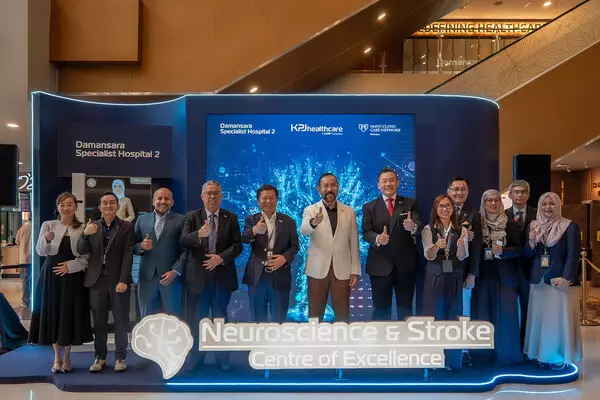
KPJ Healthcare Launches First Neuroscience and Stroke Centre of Excellence at DSH2 under KPJ Health System