|
- Published today in Science, the discovery marks the creation and observation of the first molecule with a half-Möbius electronic topology.
- It shows how quantum computers can directly contribute to understanding complex molecular behavior.
YORKTOWN HEIGHTS, N.Y., March 6, 2026 /PRNewswire/ -- An international team of scientists from IBM (NYSE: IBM), The University of Manchester, Oxford University, ETH Zurich, EPFL and the University of Regensburg have created and characterized a molecule unlike any previously known — one whose electrons travel through its structure in a corkscrew-like pattern that fundamentally alters its chemical behavior. Published today in Science, it is the first experimental observation of a half-Möbius electronic topology in a single molecule.
To the scientists' knowledge, a molecule with such topology has never before been synthesized, observed, or even formally predicted. Understanding this molecule's behavior at the electronic structure level required something equally fundamental: a high fidelity quantum computing simulation.
The discovery advances science on two fronts. For chemistry, it demonstrates that electronic topology — the property governing how electrons move through a molecule — can be deliberately engineered, not merely found in nature. For quantum computing, it is a concrete demonstration of a quantum simulation doing what it was designed to do: representing quantum mechanical behavior directly, at the molecular scale, to produce scientific insight that would otherwise have remained out of reach.
"First, we designed a molecule we thought could be created, then we built it, and then we validated it and its exotic properties with a quantum computer," said Alessandro Curioni, IBM Fellow, Vice President, Europe and Africa, and Director of IBM Research Zurich. "This is a leap towards the dream laid out by renowned physicist Richard Feynman decades ago to build a computer that can best simulate quantum physics and a demonstration where, as he said, 'There's plenty of room at the bottom.' The success of this research signals a step towards this vision, opening the door for new ways to explore our world and the matter within it."
A Never-Before-Seen Molecule
The molecule, with the formula C₁₃Cl₂, was assembled atom-by-atom at IBM from a custom precursor synthesized at Oxford University, with individual atoms removed one at a time using precisely calibrated voltage pulses under ultra-high vacuum at near-absolute-zero temperatures.
Experiments with scanning tunneling and atomic force microscopy, both techniques pioneered at IBM, combined with quantum computing to reveal an electronic configuration with no counterpart in chemistry's existing record: an electronic structure that undergoes a 90-degree twist with each circuit, requiring four complete loops to return to the starting phase.
This half-Möbius topology is qualitatively distinct from any previously known molecule and can be reversibly switched between clockwise-twisted, counterclockwise-twisted and untwisted states — demonstrating that electronic topology is not a property to be discovered, but one that can now be deliberately engineered under specific conditions.
A Disruptive Scientific Tool: Quantum-Centric Supercomputing
The scientists in this experiment created a molecule that had never existed. Now they had to figure out why it worked, a task which challenged conventional computers. The electrons within C₁₃Cl₂ interact in deeply entangled ways — each influencing all the others simultaneously. Modeling that behavior requires tracking every possible configuration of those interactions at once, requiring computational demands that grow exponentially and can quickly overwhelm classical machines.
Quantum computers are different by nature because they operate according to the same quantum mechanical laws that govern electrons in molecules, and they can represent these systems directly rather than approximate them. They "speak" the same fundamental language as the matter they are built to study and that distinction, once largely theoretical, can now contribute to concrete scientific results.
This capability offers tremendous potential for quantum computers to support real-world experimentation with quantum-centric supercomputing workflows. By integrating quantum processing units (QPUs), CPUs, and GPUs, quantum-centric supercomputing allows complex problems to be broken into parts that are orchestrated and solved according to each system's strengths — achieving what no single compute paradigm can deliver alone.
Utilizing an IBM quantum computer within such a workflow, the team found helical molecular orbitals for electron attachment, a fingerprint of the half-Möbius topology. Moreover, simulation via quantum computing helped reveal the mechanism behind the formation of the unusual topology: a helical pseudo-Jahn-Teller effect.
This achievement builds on IBM's long legacy in nanoscale science. The scanning tunneling microscope (STM) was invented at IBM in 1981, for which IBM scientists Gerd Binnig and Heinrich Rohrer were awarded the Nobel Prize in 1986. Its creation enabled researchers to image surfaces atom by atom. In 1989, IBM scientists developed the first reliable method for manipulating individual atoms. Over the past decades, the IBM team has extended these techniques to build and control increasingly exotic molecular structures.
RESEARCHER QUOTES
Dr. Igor Rončević, paper co-author, Lecturer in Computational and Theoretical Chemistry at Manchester University:
"Chemistry and solid-state physics advance by finding new ways to control matter. In the second half of the 20th century, substituent effects were very popular. For example, researchers explored how the potency of a drug or the elasticity of a material changes if, for example, a methyl is replaced with chlorine. The turn of the century brought us spintronics, introducing electron spin as a new degree of freedom to play with, and transforming data storage. Today, our work shows that topology can also serve as a switchable degree of freedom, opening a new powerful route for controlling material properties.
"The non-trivial topology of this molecule, and the exotic behavior of many other systems, arises from interactions between their electrons. Simulating electrons with classical computers is very hard – a decade ago we could exactly model 16 electrons, and today we can go up to 18. Quantum computers are naturally well-suited for this problem because their building blocks – qubits – are quantum objects, which mirror electrons. Using IBM's quantum computer, we were able to explore 32 electrons. However, the most exciting part is this is just the start. Quantum hardware is advancing rapidly, and the future is quantum."
Dr. Harry Anderson, paper co-author, Professor of Chemistry at Oxford University:
"It is remarkable that the Lewis structure of C₁₃Cl₂ already indicates it is chiral, as confirmed by the experiment and quantum chemical calculations. It is also amazing that the enantiomers can be interconverted by applying voltage pulses from the probe tip."
Dr. Jascha Repp, paper co-author, Professor of Physics at the University of Regensburg:
"I'm really excited to be part of a project where quantum hardware does real science, not just demos. It's fascinating that a tiny molecule can have such a complex electronic structure that is challenging to simulate classically, and is so twisted and strange that it almost twists your mind."
For more about this research, please read the blog: Quantum simulates properties of the first-ever half-Möbius molecule, designed by IBM and researchers
About IBM
IBM is a leading global hybrid cloud and AI, and business services provider, helping clients in more than 175 countries capitalize on insights from their data, streamline business processes, reduce costs and gain the competitive edge in their industries. Thousands of governments and corporate entities in critical infrastructure areas such as financial services, telecommunications and healthcare rely on IBM's hybrid cloud platform and Red Hat OpenShift to affect their digital transformations quickly, efficiently and securely. IBM's breakthrough innovations in AI, quantum computing, industry-specific cloud solutions and business services deliver open and flexible options to our clients. All of this is backed by IBM's legendary commitment to trust, transparency, responsibility, inclusivity and service.
For more information, visit https://research.ibm.com.
Media Contact:
Erin Angelini
IBM Communications
Edlehr@us.ibm.com
Dave Mosher
IBM Research
dave.mosher@ibm.com
- Published today in Science, the discovery marks the creation and observation of the first molecule with a half-Möbius electronic topology.
- It shows how quantum computers can directly contribute to understanding complex molecular behavior.
YORKTOWN HEIGHTS, N.Y., March 6, 2026 /PRNewswire/ -- An international team of scientists from IBM (NYSE: IBM), The University of Manchester, Oxford University, ETH Zurich, EPFL and the University of Regensburg have created and characterized a molecule unlike any previously known — one whose electrons travel through its structure in a corkscrew-like pattern that fundamentally alters its chemical behavior. Published today in Science, it is the first experimental observation of a half-Möbius electronic topology in a single molecule.
To the scientists' knowledge, a molecule with such topology has never before been synthesized, observed, or even formally predicted. Understanding this molecule's behavior at the electronic structure level required something equally fundamental: a high fidelity quantum computing simulation.
The discovery advances science on two fronts. For chemistry, it demonstrates that electronic topology — the property governing how electrons move through a molecule — can be deliberately engineered, not merely found in nature. For quantum computing, it is a concrete demonstration of a quantum simulation doing what it was designed to do: representing quantum mechanical behavior directly, at the molecular scale, to produce scientific insight that would otherwise have remained out of reach.
"First, we designed a molecule we thought could be created, then we built it, and then we validated it and its exotic properties with a quantum computer," said Alessandro Curioni, IBM Fellow, Vice President, Europe and Africa, and Director of IBM Research Zurich. "This is a leap towards the dream laid out by renowned physicist Richard Feynman decades ago to build a computer that can best simulate quantum physics and a demonstration where, as he said, 'There's plenty of room at the bottom.' The success of this research signals a step towards this vision, opening the door for new ways to explore our world and the matter within it."
A Never-Before-Seen Molecule
The molecule, with the formula C₁₃Cl₂, was assembled atom-by-atom at IBM from a custom precursor synthesized at Oxford University, with individual atoms removed one at a time using precisely calibrated voltage pulses under ultra-high vacuum at near-absolute-zero temperatures.
Experiments with scanning tunneling and atomic force microscopy, both techniques pioneered at IBM, combined with quantum computing to reveal an electronic configuration with no counterpart in chemistry's existing record: an electronic structure that undergoes a 90-degree twist with each circuit, requiring four complete loops to return to the starting phase.
This half-Möbius topology is qualitatively distinct from any previously known molecule and can be reversibly switched between clockwise-twisted, counterclockwise-twisted and untwisted states — demonstrating that electronic topology is not a property to be discovered, but one that can now be deliberately engineered under specific conditions.
A Disruptive Scientific Tool: Quantum-Centric Supercomputing
The scientists in this experiment created a molecule that had never existed. Now they had to figure out why it worked, a task which challenged conventional computers. The electrons within C₁₃Cl₂ interact in deeply entangled ways — each influencing all the others simultaneously. Modeling that behavior requires tracking every possible configuration of those interactions at once, requiring computational demands that grow exponentially and can quickly overwhelm classical machines.
Quantum computers are different by nature because they operate according to the same quantum mechanical laws that govern electrons in molecules, and they can represent these systems directly rather than approximate them. They "speak" the same fundamental language as the matter they are built to study and that distinction, once largely theoretical, can now contribute to concrete scientific results.
This capability offers tremendous potential for quantum computers to support real-world experimentation with quantum-centric supercomputing workflows. By integrating quantum processing units (QPUs), CPUs, and GPUs, quantum-centric supercomputing allows complex problems to be broken into parts that are orchestrated and solved according to each system's strengths — achieving what no single compute paradigm can deliver alone.
Utilizing an IBM quantum computer within such a workflow, the team found helical molecular orbitals for electron attachment, a fingerprint of the half-Möbius topology. Moreover, simulation via quantum computing helped reveal the mechanism behind the formation of the unusual topology: a helical pseudo-Jahn-Teller effect.
This achievement builds on IBM's long legacy in nanoscale science. The scanning tunneling microscope (STM) was invented at IBM in 1981, for which IBM scientists Gerd Binnig and Heinrich Rohrer were awarded the Nobel Prize in 1986. Its creation enabled researchers to image surfaces atom by atom. In 1989, IBM scientists developed the first reliable method for manipulating individual atoms. Over the past decades, the IBM team has extended these techniques to build and control increasingly exotic molecular structures.
RESEARCHER QUOTES
Dr. Igor Rončević, paper co-author, Lecturer in Computational and Theoretical Chemistry at Manchester University:
"Chemistry and solid-state physics advance by finding new ways to control matter. In the second half of the 20th century, substituent effects were very popular. For example, researchers explored how the potency of a drug or the elasticity of a material changes if, for example, a methyl is replaced with chlorine. The turn of the century brought us spintronics, introducing electron spin as a new degree of freedom to play with, and transforming data storage. Today, our work shows that topology can also serve as a switchable degree of freedom, opening a new powerful route for controlling material properties.
"The non-trivial topology of this molecule, and the exotic behavior of many other systems, arises from interactions between their electrons. Simulating electrons with classical computers is very hard – a decade ago we could exactly model 16 electrons, and today we can go up to 18. Quantum computers are naturally well-suited for this problem because their building blocks – qubits – are quantum objects, which mirror electrons. Using IBM's quantum computer, we were able to explore 32 electrons. However, the most exciting part is this is just the start. Quantum hardware is advancing rapidly, and the future is quantum."
Dr. Harry Anderson, paper co-author, Professor of Chemistry at Oxford University:
"It is remarkable that the Lewis structure of C₁₃Cl₂ already indicates it is chiral, as confirmed by the experiment and quantum chemical calculations. It is also amazing that the enantiomers can be interconverted by applying voltage pulses from the probe tip."
Dr. Jascha Repp, paper co-author, Professor of Physics at the University of Regensburg:
"I'm really excited to be part of a project where quantum hardware does real science, not just demos. It's fascinating that a tiny molecule can have such a complex electronic structure that is challenging to simulate classically, and is so twisted and strange that it almost twists your mind."
For more about this research, please read the blog: Quantum simulates properties of the first-ever half-Möbius molecule, designed by IBM and researchers
About IBM
IBM is a leading global hybrid cloud and AI, and business services provider, helping clients in more than 175 countries capitalize on insights from their data, streamline business processes, reduce costs and gain the competitive edge in their industries. Thousands of governments and corporate entities in critical infrastructure areas such as financial services, telecommunications and healthcare rely on IBM's hybrid cloud platform and Red Hat OpenShift to affect their digital transformations quickly, efficiently and securely. IBM's breakthrough innovations in AI, quantum computing, industry-specific cloud solutions and business services deliver open and flexible options to our clients. All of this is backed by IBM's legendary commitment to trust, transparency, responsibility, inclusivity and service.
For more information, visit https://research.ibm.com.
Media Contact:
Erin Angelini
IBM Communications
Edlehr@us.ibm.com
Dave Mosher
IBM Research
dave.mosher@ibm.com
** This press release is distributed by PR Newswire through automated distribution system, for which the client assumes full responsibility. **

IBM and University Researchers Create a Never-Before-Seen Molecule and Prove its Exotic Nature with Quantum Computing

IBM and University Researchers Create a Never-Before-Seen Molecule and Prove its Exotic Nature with Quantum Computing
|
- Vipboss Lithium Batteries Address Key Power Challenges in RV, Marine, and Golf Cart Use This Spring
NEW YORK, March 6, 2026 /PRNewswire/ -- As spring marks the start of peak outdoor travel and recreation season, Vipboss has announced the launch of its latest campaign, encouraging consumers to refresh their power of RV, marine, and golf carts this spring. For travelers seeking dependable energy for early‑season trips, Vipboss offers savings of up to 50% on its LiFePO4 lithium battery lineup. It also highlights Vipboss's focus on enhancing outdoor experiences through reliable power, addressing the increasing challenges faced by users rely on traditional lead-acid batteries during spring travel.
Responding to Growing Spring Power Needs
Long the standard power source for RVs, boats, and golf carts, lead-acid batteries are increasingly falling short of the demands of modern outdoor travel. Their substantial weight, limited usable range, and slow charging times often constrain vehicle performance and cut trips short. As outdoor recreation evolves toward longer, more energy-intensive use, battery technology has become a critical factor.
Vipboss is addressing these challenges with its lithium iron phosphate (LiFePO4) battery lineup, engineered to deliver lighter weight, faster charging, and longer runtime. Compared with traditional lead-acid batteries, Vipboss LiFePO4 models are approximately 50% lighter and provide about 30% more usable energy, while typically recharging to full capacity within one to two hours.
At the center of the portfolio is the Vipboss 12V Bluetooth LiFePO4 battery series, offered in 105Ah, 210Ah, and 320Ah configurations. Built with Grade A lithium-iron-phosphate cells, the batteries support more than 4,000 charge cycles, enabling a service life of up to ten years. An integrated battery management system safeguards against overcharging, deep discharge, short circuits, excessive current, and temperature extremes, including automatic low-temperature charging protection.
Designed for outdoor environments, the batteries feature IP65-rated enclosures for water and dust resistance and support real-time monitoring via Bluetooth-enabled mobile apps. Scalable 4P4S expansion allows systems up to 51.2V, while maintenance-free operation and reduced environmental impact position the series as a practical alternative for RV, marine, and leisure mobility users.
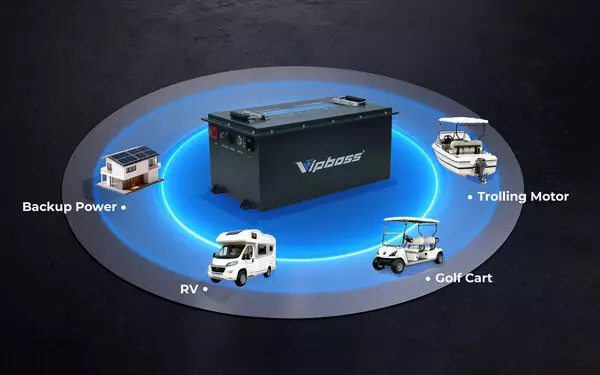
For golf cart users, Vipboss offers lithium battery conversion kits tailored to both 36V and 48V platforms, available in 105Ah and 150Ah options. The higher-capacity models support ranges of up to 70 miles per charge, while the 105Ah versions provide up to 50 miles, covering a full day of use or an 18-hole round. All models are significantly lighter than lead-acid batteries, improving vehicle efficiency, handling, and acceleration. High continuous discharge capability ensures stable power delivery, while Bluetooth monitoring and external LED displays provide clear visibility into battery health. The rugged metal housing enhances durability, and compatibility extends beyond golf carts to include home energy storage, solar systems, and marine use.
As outdoor travel begins accelerating for spring, energy reliability becomes more important than ever. Vipboss's spring sale campaign is not just a promotion, it's a timely opportunity for users to secure dependable, long‑lasting power that keeps their light and warmth protected during early‑season adventures.
About Vipboss
Vipboss is a specialist in the lithium battery industry, focusing on the research, production, and manufacturing of lithium iron phosphate (LiFePO4) battery packs. The company is committed to advancing battery technology with an emphasis on reliable performance, safety, and extended service life. Its mission is to deliver safe, efficient, and environmentally responsible energy solutions that contribute to a cleaner, more sustainable future.
For more information, please visit: https://vipbosspower.com/.
- Vipboss Lithium Batteries Address Key Power Challenges in RV, Marine, and Golf Cart Use This Spring
NEW YORK, March 6, 2026 /PRNewswire/ -- As spring marks the start of peak outdoor travel and recreation season, Vipboss has announced the launch of its latest campaign, encouraging consumers to refresh their power of RV, marine, and golf carts this spring. For travelers seeking dependable energy for early‑season trips, Vipboss offers savings of up to 50% on its LiFePO4 lithium battery lineup. It also highlights Vipboss's focus on enhancing outdoor experiences through reliable power, addressing the increasing challenges faced by users rely on traditional lead-acid batteries during spring travel.
Responding to Growing Spring Power Needs
Long the standard power source for RVs, boats, and golf carts, lead-acid batteries are increasingly falling short of the demands of modern outdoor travel. Their substantial weight, limited usable range, and slow charging times often constrain vehicle performance and cut trips short. As outdoor recreation evolves toward longer, more energy-intensive use, battery technology has become a critical factor.
Vipboss is addressing these challenges with its lithium iron phosphate (LiFePO4) battery lineup, engineered to deliver lighter weight, faster charging, and longer runtime. Compared with traditional lead-acid batteries, Vipboss LiFePO4 models are approximately 50% lighter and provide about 30% more usable energy, while typically recharging to full capacity within one to two hours.
At the center of the portfolio is the Vipboss 12V Bluetooth LiFePO4 battery series, offered in 105Ah, 210Ah, and 320Ah configurations. Built with Grade A lithium-iron-phosphate cells, the batteries support more than 4,000 charge cycles, enabling a service life of up to ten years. An integrated battery management system safeguards against overcharging, deep discharge, short circuits, excessive current, and temperature extremes, including automatic low-temperature charging protection.
Designed for outdoor environments, the batteries feature IP65-rated enclosures for water and dust resistance and support real-time monitoring via Bluetooth-enabled mobile apps. Scalable 4P4S expansion allows systems up to 51.2V, while maintenance-free operation and reduced environmental impact position the series as a practical alternative for RV, marine, and leisure mobility users.
For golf cart users, Vipboss offers lithium battery conversion kits tailored to both 36V and 48V platforms, available in 105Ah and 150Ah options. The higher-capacity models support ranges of up to 70 miles per charge, while the 105Ah versions provide up to 50 miles, covering a full day of use or an 18-hole round. All models are significantly lighter than lead-acid batteries, improving vehicle efficiency, handling, and acceleration. High continuous discharge capability ensures stable power delivery, while Bluetooth monitoring and external LED displays provide clear visibility into battery health. The rugged metal housing enhances durability, and compatibility extends beyond golf carts to include home energy storage, solar systems, and marine use.
As outdoor travel begins accelerating for spring, energy reliability becomes more important than ever. Vipboss's spring sale campaign is not just a promotion, it's a timely opportunity for users to secure dependable, long‑lasting power that keeps their light and warmth protected during early‑season adventures.
About Vipboss
Vipboss is a specialist in the lithium battery industry, focusing on the research, production, and manufacturing of lithium iron phosphate (LiFePO4) battery packs. The company is committed to advancing battery technology with an emphasis on reliable performance, safety, and extended service life. Its mission is to deliver safe, efficient, and environmentally responsible energy solutions that contribute to a cleaner, more sustainable future.
For more information, please visit: https://vipbosspower.com/.
** This press release is distributed by PR Newswire through automated distribution system, for which the client assumes full responsibility. **
Vipboss Kicks Off Campaign to Refresh Your Power Ahead of Spring Adventure Season