WAUKESHA, Wis. (AP) — A Wisconsin teenager who killed his parents and stole their money to fund his plan to kill President Donald Trump with a bomb dropped from a drone was sentenced to life in prison on Thursday.
Nikita Casap, 18, pleaded guilty in January to two counts of first-degree intentional homicide in Waukesha County Circuit Court in connection with the shooting deaths of his mother, Tatiana Casap, and stepfather, Donald Mayer, in 2025. Prosecutors dropped seven other charges in a plea deal, including two counts of hiding a corpse and theft.
First-degree intentional homicide carries a mandatory life sentence. The only question as Judge Ralph Ramirez began the sentencing hearing Thursday afternoon was whether he would make Casap eligible for parole at some point.
Calling Casap's offenses “horrific" and “inexplicable,” Ramirez ultimately handed down two life sentences with no chance at extended supervision, the term the Wisconsin criminal justice system uses for parole. The judge said he didn't have a “crystal ball” that would tell him when Casap would change, if ever.
“I choose to find he’s not eligible for extended release because I do not know ... when and if and whether a profound and significant change can occur,” Ramirez said.
According to a criminal complaint, investigators believe Casap shot his stepfather and mother at their home in the village of Waukesha on or around Feb. 11, 2025.
He lived with the decomposing bodies for two weeks before fleeing across the country in his stepfather’s SUV with $14,000 in cash, jewelry, passports, his stepfather’s gun and the family dog, according to the complaint. He was eventually arrested during a traffic stop in Kansas on Feb. 28 after four days on the run.
Federal authorities have accused Casap of planning his parents’ murders, buying a drone and explosives and sharing his plans with others, including a Russian speaker. They said in a federal search warrant that he wrote a manifesto calling for Trump’s assassination and was in touch with others about his plot to overthrow the U.S. government
“The killing of his parents appeared to be an effort to obtain the financial means and autonomy necessary to carrying out his plan,” that warrant said.
Detectives found several messages on Casap’s cellphone from January 2025 in which Casap asks how long he will have to hide before he is relocated to Ukraine. An unknown individual responded in Russian, the complaint said, but the document doesn’t say what that person told Casap. In another message Casap asks: “So while in Ukraine, I’ll be able to live a normal life? Even if it’s found out I did it?”
District Attorney Lesli Boese told the judge Thursday that Casap was too dangerous to ever be released from prison.
Pulling from an interview Casap gave to the FBI, Boese said that Casap and his mother moved to the United States from the Republic of Moldova when Casap was a grade-schooler but he became increasingly addicted to what she called “disturbing websites” as he grew older. She didn't elaborate, but at one point said he had been researching serial killers and school shootings.
Boese said Casap developed a plan in late 2024 to target Trump with an AK-47 rifle attached to a drone. The teen later decided he wanted to drop explosives on Trump from a drone and then flee by ship to Ukraine, where he planned to hide for a decade, according to the district attorney. Casap told agents he wouldn't have cared how many people around Trump got hurt during the assassination attempt.
He started talking with two people online who offered to sell him the drone and the explosives. He sent one of them $8,700 in bitcoin from his stepfather Mayer's account without realizing they were scamming him and there was never a drone or any explosives, Boese said.
“He walked right into it,” she said.
Casap's attorney, Paul Rifelj, asked Ramirez to make Casap eligible for parole after 20 years. He said that news of a doctor who drove his car into a Christmas market in Magdeburg, Germany, in December 2024 sent Casap into a rage. The teen decided then that he wanted to change the world by killing a politician, Rifelj said.
The two contacts who promised to help him kill Trump convinced him that he was part of a larger military strategy, offering him direction and purpose at a time when he was becoming isolated at school, according to Rifelj.
“Children are more than their worst deeds,” he said.
Casap appeared to tremble as he listened to both sides make their cases. He gave a tearful speech, saying that he loved his mother and he was worried about her all the time, even when she was reaching for something on a high shelf. He said he wasn't as close with Mayer, but Mayer still treated him like a son.
But he became obsessed with hateful thoughts.
“I thought I was part of a revolution,” he said. “I thought I was part of a war. I told myself bad things had to happen.”

FILE - Judge Ralph Ramirez presides over the arraignment of Nikita Casap, May 7, 2025, in Waukesha County Circuit Court in Waukesha, Wis. (Mark Hoffman/Milwaukee Journal-Sentinel via AP, Pool, File)

FILE - Nikita Casap appears at his arraignment on May 7, 2025, in Waukesha County Circuit Court, in Waukesha, Wis. (Mark Hoffman/Milwaukee Journal-Sentinel via AP, Pool, File)
WASHINGTON (AP) — The House narrowly rejected a war powers resolution Thursday to halt President Donald Trump's attacks on Iran, an early sign of unease in Congress over the rapidly widening conflict that is reordering U.S. priorities at home and abroad.
It's the second vote in as many days, after the Senate defeated a similar measure. Lawmakers are confronting the sudden reality of representing wary Americans in wartime and all that entails — with lives lost, dollars spent and alliances tested by a president's unilateral decision to go to war with Iran.
While the tally in the House, 212-219, was expected to be tight, the outcome provided a clarifying snapshot of political support for, and opposition to, the U.S.-Israel military operation and Trump's rationale for bypassing Congress, which alone has the power to declare war. At the Capitol, the conflict has quickly carried echoes of the long wars in Afghanistan and Iraq, and many Sept. 11-era veterans now serve in Congress.
“Donald Trump is not a king, and if he believes the war with Iran is in our national interest, then he must come to Congress and make the case," said Rep. Gregory Meeks, the top Democrat on the House Foreign Affairs Committee.
House Speaker Mike Johnson warned that it would be “dangerous” to limit the president’s authority while the U.S. military is already in conflict.
“We are not at war," said Johnson, R-La., a close ally of Trump, contradicting others. He said the operation is limited in scope and duration, and the "mission is nearly accomplished.”
Trump’s Republican Party, which narrowly controls the House and Senate, largely sees the conflict with Iran not as the start of a new war, but the end of a government that has long menaced the West. The operation has killed Iran’s Supreme Leader Ayatollah Ali Khamenei, which some view as an opportunity for regime change, though others warn of a chaotic power vacuum.
Republican Rep. Brian Mast of Florida, chairman of the House Foreign Affairs Committee, publicly thanked Trump for taking action against Iran, saying the president is using his own constitutional authority to defend the U.S. against the “imminent threat” the country posed.
Mast, an Army veteran who worked as a bomb disposal expert in Afghanistan, said the war powers resolution was effectively asking “that the president do nothing.”
For Democrats, Trump's attack on Iran, influenced by Israeli Prime Minister Benjamin Netanyahu, is a war of choice that is testing the balance of powers in the Constitution.
“The framers weren’t fooling around,” said Rep. Jamie Raskin, D-Md., arguing that the Constitution is clear that only Congress can decide matters of war. “It’s up to us.”
Crossover coalitions emerged among those in Congress. Two Republicans joined most Democrats in voting for the war powers resolution, while four Democrats joined Republicans to reject it.
The war powers resolution, if signed into law, would have immediately halted Trump's ability to conduct the war unless Congress approved the military action. The president would likely veto it.
Trump has scrambled to win support for the nearly week-old conflict as Americans of all political persuasions take stock. Administration officials spent hours behind closed doors on Capitol Hill this week trying to reassure lawmakers that they have the situation under control.
Six U.S. military members were killed over the weekend in a drone strike in Kuwait, and Trump has said more Americans could die. Thousands of Americans abroad have scrambled for flights, many lighting up phone lines at congressional offices as they sought help trying to flee the Middle East.
Trump said Thursday he must be involved in choosing Iran’s new leader. Yet Johnson, R-La., said this week that America has enough problems at home and is not about to be in the “nation-building business.”
Defense Secretary Pete Hegseth said that the war could extend eight weeks, twice as long as the president first estimated. Trump has left open the possibility of sending U.S. troops into what has largely been a bombing campaign. More than 1,230 people in Iran have died.
The administration said the goal is to destroy Iran's ballistic missiles that it believes are shielding its nuclear program. It has also said Israel was ready to act, and American bases would face retaliation if the U.S. did not strike Iran first. The U.S. said Wednesday it torpedoed an Iranian warship near Sri Lanka.
"This administration can't even give us a straight answer of as to why we launched this preemptive war," said Rep. Thomas Massie, the Republican from Kentucky, an outlier in his party.
Massie and Rep. Ro Khanna, D-Calif., who had teamed up to force the release the Jeffrey Epstein files, also pushed the war powers resolution to the floor, past objections from Johnson's GOP leadership. Republican Rep. Warren Davidson of Ohio, a former Army Ranger, also voted for it. Democratic Reps. Henry Cuellar of Texas, Jared Golden of Maine, Greg Landsman of Ohio and Juan Vargas of California voted against.
“Congress must stand with the president to finally close, once and for all, this dark chapter of history,” said Rep. Michael McCaul, R-Texas.
Rep. Yassamin Ansari, D-Ariz., said that as the daughter of Iranian immigrants who fled their homeland, she opposes the regime but is concerned that a democratic transition for the people of Iran never seems to a priority for Trump or the officials who briefed Congress.
“War carries profound and deadly consequences for our troops, for the American people and for the entire world," she said. “It’s the most serious decision that a nation can make.”
Other Democrats have proposed an alternative resolution that would allow the president to continue the war for 30 days before he must seek congressional approval. The House also approved a separate measure affirming that Iran is the largest state sponsor of terrorism.
In the Senate, Republican leaders have successfully, though narrowly, defeated a series of war powers resolutions pertaining to several other conflicts during Trump's second term. This one, however, was different.
Underscoring the gravity Wednesday, Democratic senators sat at their desks as the voting got underway.
Senate Democratic leader Chuck Schumer of New York said that every senator will pick a side. “Do you stand with the American people who are exhausted with forever wars in the Middle East?" he asked. Or with Trump and Hegseth "as they bumble us headfirst into another war?”
Sen. John Barrasso, second in Senate Republican leadership, said, “Democrats would rather obstruct Donald Trump than obliterate Iran’s national nuclear program."
The legislation failed on a 47-53 tally mostly along party lines, with Sen. Rand Paul, R-Ky., in favor and Sen. John Fetterman, D-Pa., against.
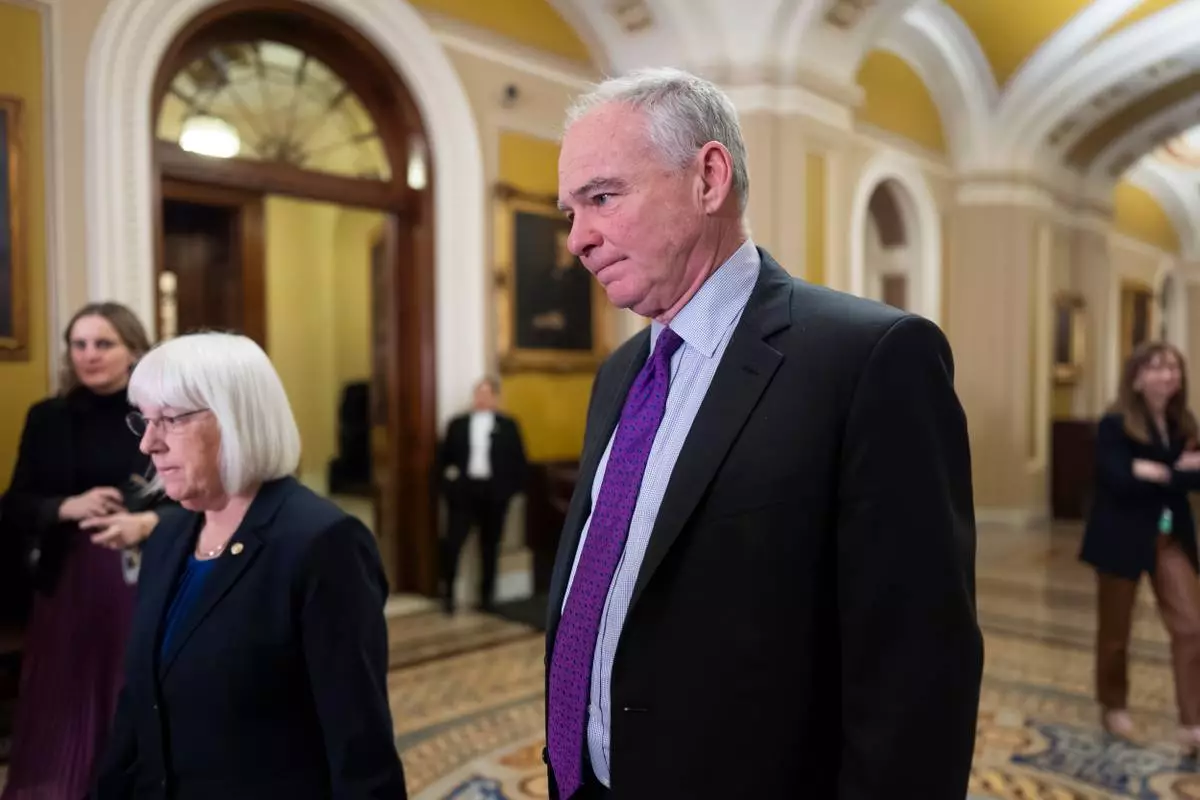
Sen. Tim Kaine, D-Va., center, and Sen. Patty Murray, D-Wash., left, arrive to speak with reporters at the Capitol in Washington, Tuesday, March 3, 2026. Kaine is leading an effort to advance a swift vote on a war powers resolution that would restrain President Donald Trump's military attack on Iran. (AP Photo/J. Scott Applewhite)
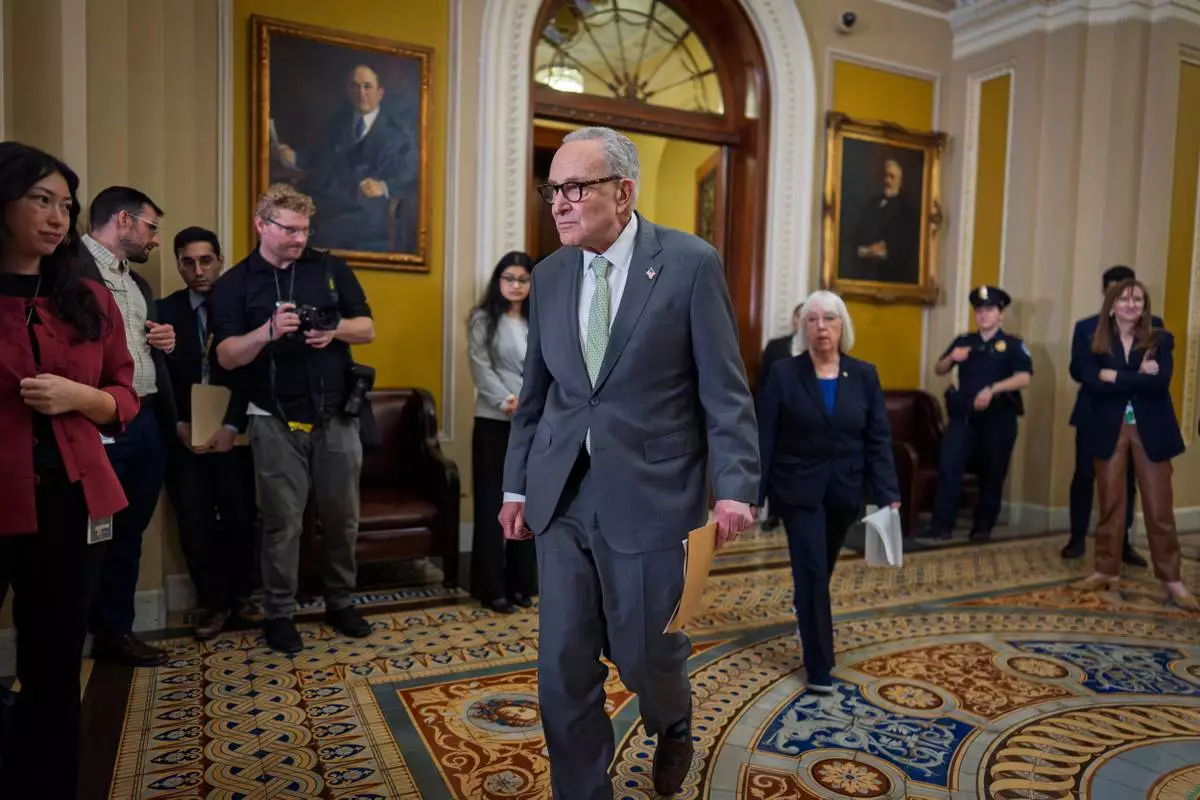
Senate Minority Leader Chuck Schumer, D-N.Y., arrives to speak with reporters at the Capitol in Washington, Tuesday, March 3, 2026. (AP Photo/J. Scott Applewhite)
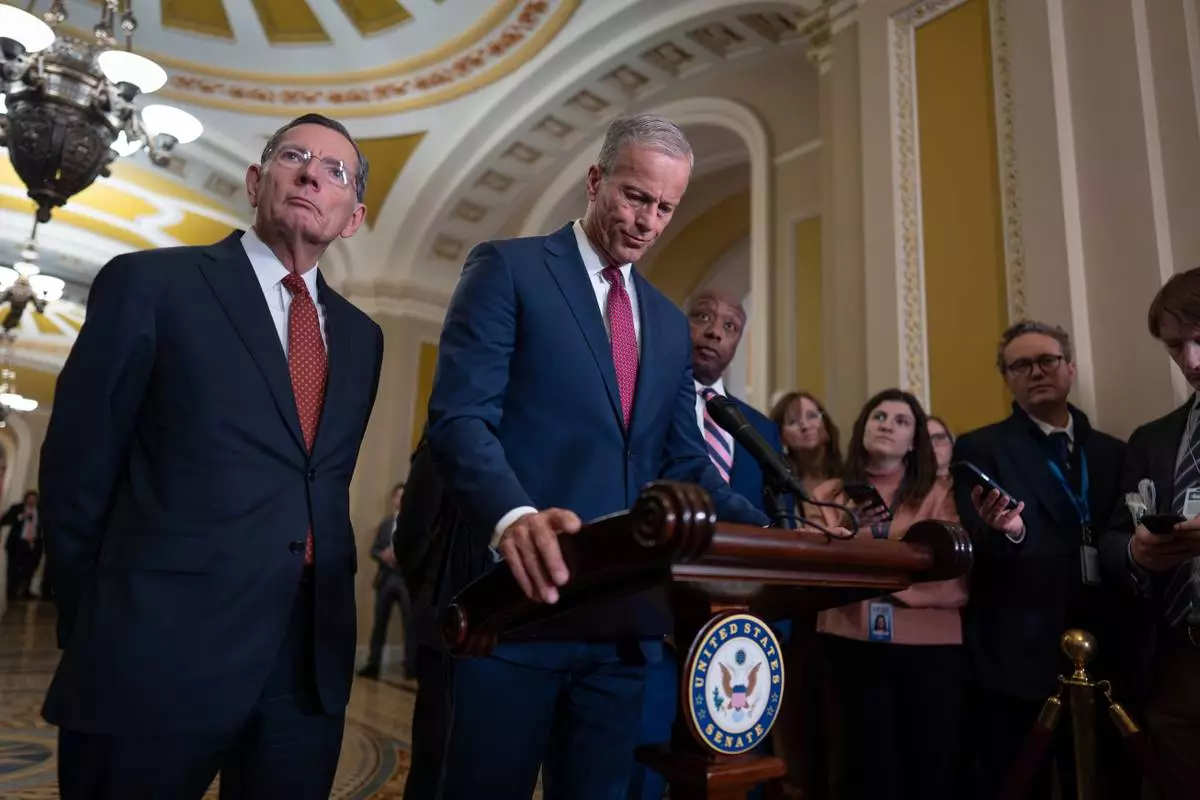
Senate Majority Leader John Thune, R-S.D., center, joined at left by Sen. John Barrasso, R-Wyo., the GOP whip, speaks to reporters at the Capitol in Washington, Tuesday, March 3, 2026. (AP Photo/J. Scott Applewhite)

Rep. Jason Crow, D-Colo., a combat veteran, joins the House Democratic leadership in demanding a congressional approval for embarking on a war with Iran, during a news conference at the Capitol in Washington, Wednesday, March 4, 2026. (AP Photo/J. Scott Applewhite)

Speaker of the House Mike Johnson, R-La., gestures as he and the GOP leadership talk about the war against Iran, during a news conference at the Capitol in Washington, Wednesday, March 4, 2026. (AP Photo/J. Scott Applewhite)