CLEVELAND (AP) — A Cleveland judge set bail at $2 million Friday for a woman accused of killing her two young daughters and burying them in suitcases in shallow graves.
Aliyah Henderson, 28, faces two counts of aggravated murder in the deaths of Mila Chatman and Amor Wilson, whose bodies were recovered after a dog walker alerted police to one of the suitcases on Monday.
Henderson said little during the brief court appearance. Prosecutors said they found no criminal record for her, and Henderson's public defender said she has a place to live and had been looking for a job.
Mila's father, DeShaun Chatman, described her as happy-go-lucky — a “kid's kid” who was always smiling. He said he hadn't seen Mila for five years and had unsuccessfully sought emergency custody.
Cullen Sweeney, the chief public defender in Cuyahoga County, declined to comment on the case after the hearing. It's not clear who will represent Henderson going forward.
The county Medical Examiner’s Office has said Mila would have been 8 years old, her half-sister Amor 10, and that DNA relationship testing helped identify them. Authorities said a third child, apparently healthy, was in the hands of child welfare authorities after being found in a home that investigators searched.

Nichelle Wilson, the grandmother of one of the girls whose bodies were found earlier this week, Amor Wilson, holds her hand to her face as she arrives at the memorials at that site, in Cleveland, Thursday, March 5, 2026. (AP Photo/Sue Ogrocki)

DeShaun Chatman, the father of Mila Chatman, one of the two girls whose bodies were found earlier this week, shows a photo of his daughter Mila Chatman, taken in 2020, at the site the bodies were found, in Cleveland, Thursday, March 5, 2026. (AP Photo/Sue Ogrocki)

Aliyah Henderson, 28, attends a bond hearing in Cleveland on Thursday, March 6, 2026, on charges she killed her two daughters. (WKYC via AP)
NEW YORK (AP) — Oil shot to its highest price since 2023 after surging again because of the Iran war, and a weak update on the U.S. job market knocked stocks lower to cap Wall Street’s worst week since October. The S&P 500 dropped 1.3% Friday. The Dow Jones Industrial Average plunged as many as 945 points before finishing with a loss of roughly 450, and the Nasdaq composite sank 1.6%. The combination of a weak economy and high inflation is a worst-case scenario for investors because the Federal Reserve has no good tool to fix both problems at the same time.
THIS IS A BREAKING NEWS UPDATE. AP’s earlier story follows below.
NEW YORK (AP) — Oil shot to its highest price since 2023 on Friday as the Iran war kept escalating, while a weak update on the U.S. job market highlighted the economy's precarious position. It all raised the risk of a worst-case scenario for financial markets, and stocks are falling toward the finish of Wall Street's worst week since November.
The S&P 500 dropped 1% after a report showed U.S. employers cut more jobs last month than they created and after oil prices spiked above $90 per barrel. It’s a combination that investors fear because neither the Federal Reserve nor any other central bank around the world has a good tool to fix both a weak economy and high inflation at the same time.
The Dow Jones Industrial Average was down 425 points, or 0.9%, with roughly an hour remaining in trading, and the Nasdaq composite was 1.1% lower.
“You can’t sugarcoat this report,” according to Brian Jacobsen, chief economic strategist at Annex Wealth Management. “A negative payrolls number combined with a big jump in oil prices will have traders worrying about stagflation risks.”
Stagflation is what economists call a stagnating economy combined with high inflation, and a separate report released Friday added to the sour mix after showing that U.S. retailers made less money in January than economists expected. It raised the disconcerting possibility that spending by U.S. households, the main engine of the economy, may be stretched near its maximum.
Usually when the economy is unsteady and the job market is weakening, the Federal Reserve cuts interest rates to give things a boost. Lower rates can make it more affordable for households to get mortgages and companies to raise money to expand, while also helping prices for stocks and other investments. The Fed cut its main interest rate several times last year and had indicated more were to come this year.
But lower interest rates can also make inflation worse. And the Fed’s hands may be increasingly tied because spiking oil prices are pushing inflation higher due to disruptions for the energy industry.
The price for a barrel of Brent crude, the international standard, shot up another 8.5% to settle at $92.69. It briefly rose above $94 to touch its highest level since September 2023.
A barrel of benchmark U.S. crude jumped 12.2% to $90.90 and topped $90 per barrel for the first time since the autumn of 2023.
Oil prices have surged, with Brent up from near $70 late last week, as the war has expanded and included areas critical to the production and movement of oil and gas in the Middle East. Much will depend on what happens with the Strait of Hormuz off Iran's coast, where roughly a fifth of the world’s oil typically sails.
The U.S. government gave details Friday about a plan President Donald Trump announced earlier offering insurance to ships crossing the strait, but it had little effect on the market.
If oil prices spike further, like to $100 per barrel, and stay there, some analysts and investors say it could be too much for the global economy to withstand.
To be sure, the U.S. stock market has a history of bouncing back relatively quickly following conflicts in the Middle East and elsewhere, as long as oil prices don’t jump too high for too long. Uncertainty about just how high oil prices will go this time around and for how long has caused frenetic swings across financial markets through the week, sometimes hour by hour.
On Monday, for example, the S&P 500 tumbled to an immediate 1.2% loss at the start of trading but made it all back and ended the day with a tiny gain.
Trump’s most recent signal on the war was that he wants an “unconditional surrender” of Iran, apparently ruling out negotiations.
In the bond market, Treasury yields wavered, with higher oil prices pushing upward on them and the discouraging updates on the U.S. economy pulling downward.
The yield on the 10-year Treasury initially rose toward 4.19% before pulling back to 4.12%. That's down slightly from 4.13% late Thursday but still well above its 3.97% level from a week earlier.
Smaller companies often feel the bite of high borrowing costs more because many need to borrow to grow. Smaller companies can also be more dependent on the strength of the U.S. economy for their profits than big multinational rivals, and the smallest stocks on Wall Street took Friday's sharpest dives.
The Russell 2000 index of small stocks fell a market-leading 2%.
Among the big companies in the S&P 500, companies with high fuel bills helped lead the way lower. Old Dominion Freight Line sank 7%, cruise line Carnival fell 5.2% and Southwest Airlines lost 6.2%.
Costco Wholesale was among the few stocks to rise. It added 1.9% after reporting a stronger profit for the latest quarter than analysts expected. The retailer said the quarter benefited from a later Lunar New Year on this year's calendar, which gave a particularly big revenue boost to its warehouses outside the United States.
In stock markets abroad, indexes slumped in Europe following a better finish in Asia. France’s CAC 40 fell 0.7%, and Germany’s DAX lost 0.9%, while Hong Kong’s Hang Seng jumped 1.7% and Japan’s Nikkei 225 added 0.6%.
South Korea's Kospi was nearly unchanged after plunging 12.1% Wednesday for its worst loss in history and then rising 9.6% Thursday.
AP Business Writers Chan Ho-him and Matt Ott contributed.

Michael Gagliano works on the floor at the New York Stock Exchange in New York, Friday, March 6, 2026. (AP Photo/Seth Wenig)
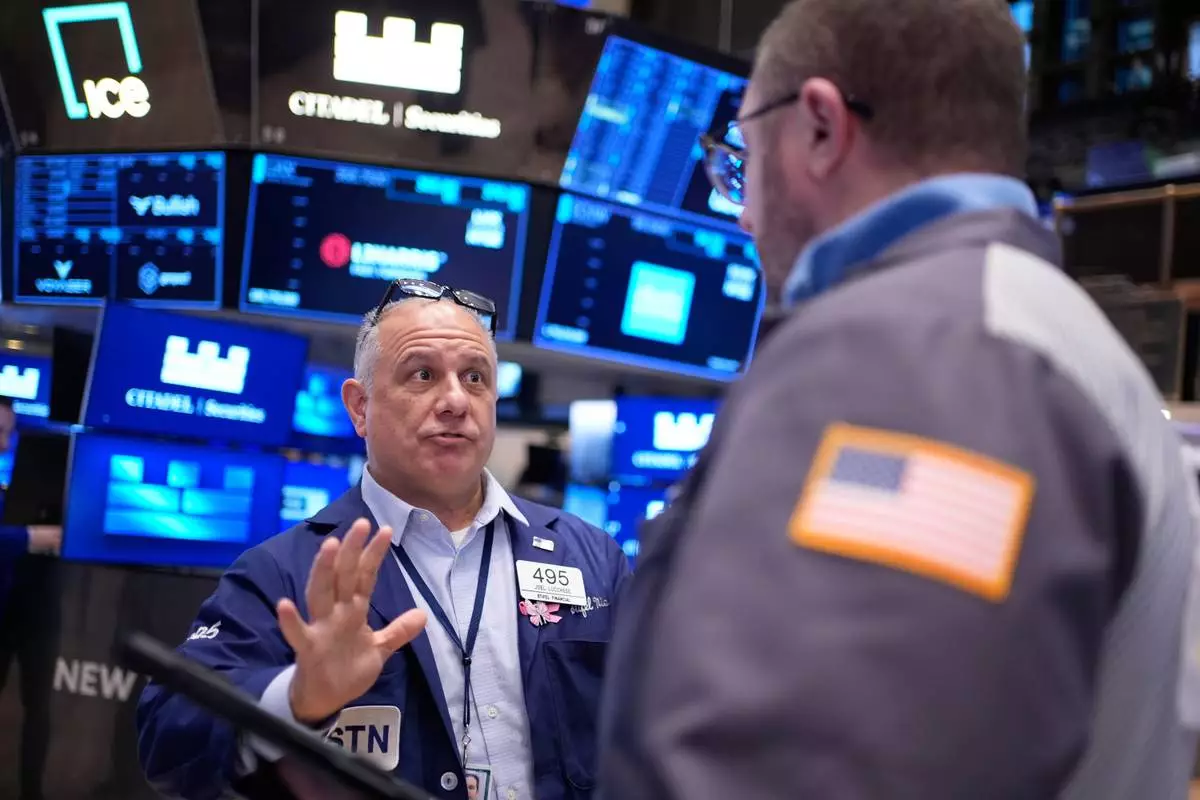
Joel Lucchese works on the floor at the New York Stock Exchange in New York, Thursday, March 5, 2026. (AP Photo/Seth Wenig)

Ryan Falvey works on the floor at the New York Stock Exchange in New York, Thursday, March 5, 2026. (AP Photo/Seth Wenig)
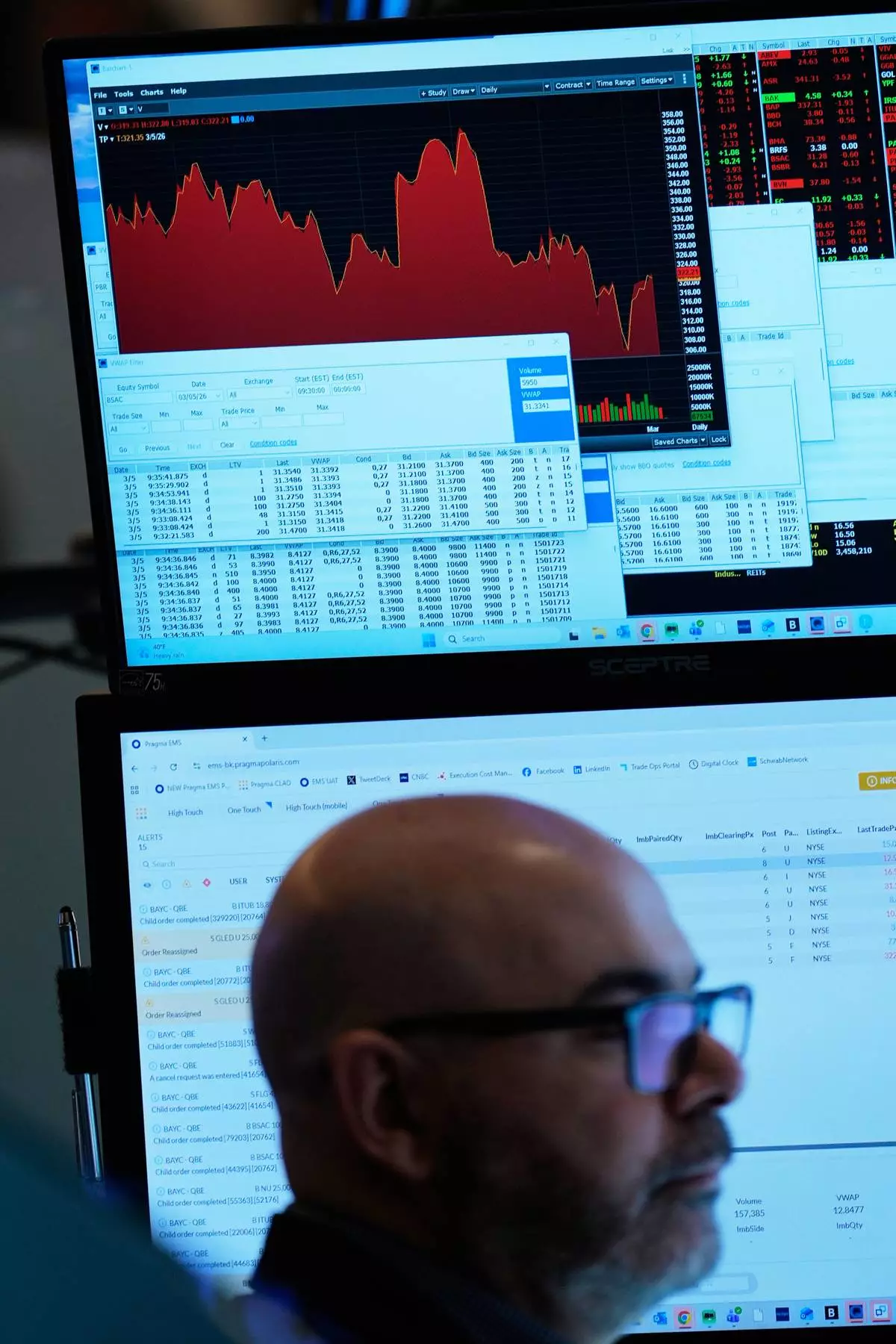
Screens display financial news on the floor at the New York Stock Exchange in New York, Thursday, March 5, 2026. (AP Photo/Seth Wenig)

Currency traders work near a screen showing the Korea Composite Stock Price Index (KOSPI), top left, and the foreign exchange rate between U.S. dollar and South Korean won, top center, at the foreign exchange dealing room of the Hana Bank headquarters in Seoul, South Korea, Friday, March 6, 2026. (AP Photo/Ahn Young-joon)

Currency traders watch monitors near a screen showing the Korea Composite Stock Price Index (KOSPI), top center, and the foreign exchange rate between U.S. dollar and South Korean won, top center left, at the foreign exchange dealing room of the Hana Bank headquarters in Seoul, South Korea, Friday, March 6, 2026. (AP Photo/Ahn Young-joon)

A currency trader talks on the phone near a screen showing the Korea Composite Stock Price Index (KOSPI), top left, and the foreign exchange rate between U.S. dollar and South Korean won at the foreign exchange dealing room of the Hana Bank headquarters in Seoul, South Korea, Friday, March 6, 2026. (AP Photo/Ahn Young-joon)