Skip to Content Facebook Feature Image

Fox News apologizes for showing old video of a hatless Donald Trump at a dignified transfer ceremony

News

Fox News apologizes for showing old video of a hatless Donald Trump at a dignified transfer ceremony
News

News

Fox News apologizes for showing old video of a hatless Donald Trump at a dignified transfer ceremony

2026-03-09 07:12 Last Updated At:11:45

Fox News apologized for airing old video of a hatless President Donald Trump during coverage Sunday of his attendance at the dignified transfer ceremony for U.S. soldiers killed in the Middle East war, insisting it was an honest mistake.

In a polarized time, some online critics suggested without evidence that it wasn't an error — that the network was trying to make Trump look better by not showing him wearing a baseball cap during what is considered one of the most solemn duties of a commander in chief. The return of the bodies of six soldiers took place Saturday at Dover Air Force Base.

But Fox News said archival footage of Trump at an earlier ceremony was inadvertently pulled up by a staff member and used on two Sunday morning telecasts. A spokeswoman noted the correct footage was used at other times, including on Saturday.

“We regret the error and apologize for the incorrect footage,” Fox said in a statement.

Fox News anchor Griff Jenkins issued an on-the-air correction Sunday, saying “we extend our respect and condolences” to the families of the service members killed.

The apology didn't sit well with some critics. “If any other network did this it would be a huge scandal, Fox would lead the chorus of criticisms and faux-outrage, and people would lose their jobs,” said Mehdi Hasan, founder of the online site Zeteo.

Johnny “Joey” Jones, a veteran and co-host of “The Big Weekend Show” on Fox News Channel, said on social media that he was “embarrassed and ashamed” that this happened.

“My belief was that this was an honest mistake, but that doesn't make it an acceptable one,” Jones wrote. “Few things are more sacred than our heroes who give their lives in the line of duty.”

Jones said that “if posting snarky comments and insults is your way of reacting to this, please direct them at me. I'm the one with sharp words on these issues. If you are using this as a way to take a partisan jab at my hard working colleagues, check your watch.”

David Bauder writes about the intersection of media and entertainment for the AP. Follow him at http://x.com/dbauder and https://bsky.app/profile/dbauder.bsky.social.
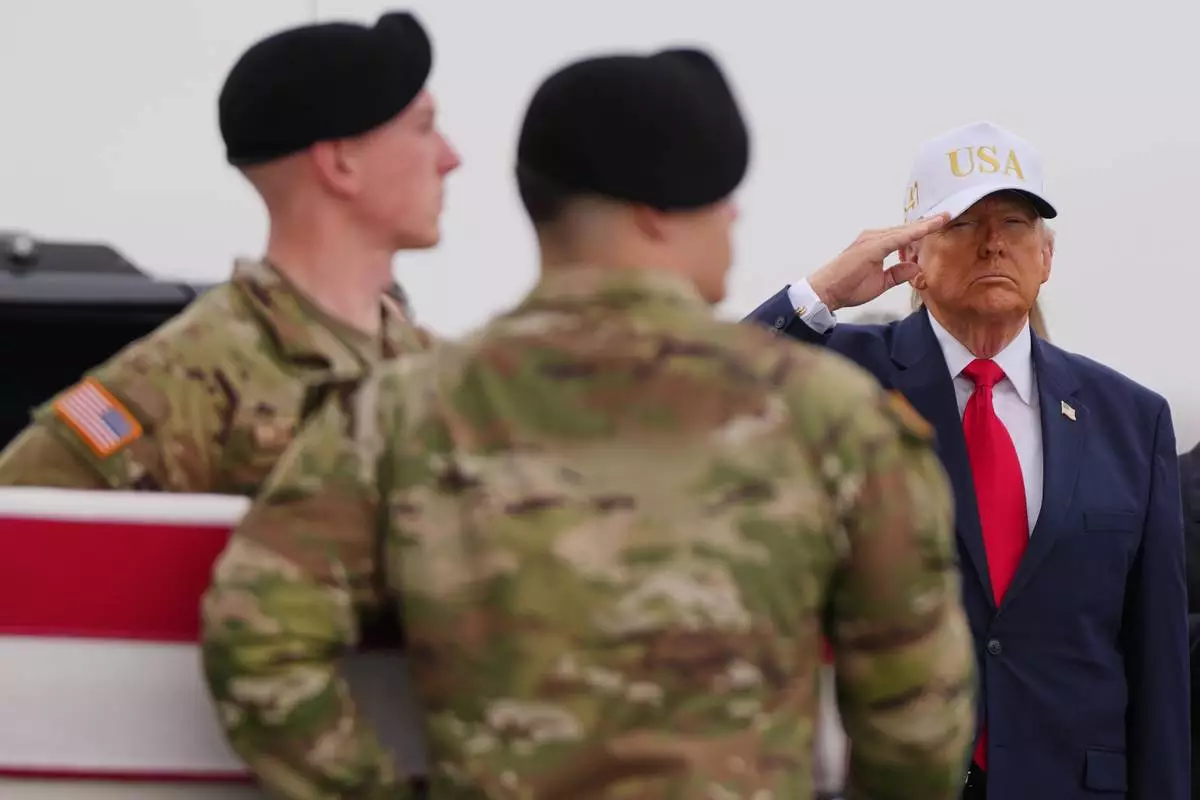
President Donald Trump salutes as an Army carry team moves the flag-draped transfer case containing the remains of U.S. Army Reserve Sgt. Declan Coady, 20, of West Des Moines, Iowa, who was killed in a drone strike at a command center in Kuwait after the U.S. and Israel launched its military campaign against Iran, during a casualty return Saturday, March 7, 2026, at Dover Air Force Base, Del. (AP Photo/Julia Demaree Nikhinson)

President Donald Trump salutes as an Army carry team moves the flag-draped transfer case containing the remains of U.S. Army Reserve Sgt. Declan Coady, 20, of West Des Moines, Iowa, who was killed in a drone strike at a command center in Kuwait after the U.S. and Israel launched its military campaign against Iran, during a casualty return Saturday, March 7, 2026, at Dover Air Force Base, Del. (AP Photo/Julia Demaree Nikhinson)

LA PAZ, Bolivia (AP) — Supporters of Bolivia’s influential ex-President Evo Morales clashed with police on Monday in the capital city as they called on the president to resign, joining a nationwide protest movement fueled by the worst economic crisis in a generation.

Thousands of Morales' followers converged on the plaza outside the government headquarters as Bolivia remains paralyzed by road blockades that have strangled cities and triggered food and fuel shortages in the last two weeks.

The unrest presents the biggest challenge yet for President Rodrigo Paz, a business friendly centrist who came to power six months ago as a wave of conservative electoral wins swept the region.

Security forces pushed back protesters who tried to break police ranks with canisters of tear gas before they could reach Congress or the presidential palace. Dynamite blasts rumbled, forcing staffers and lawmakers to evacuate. “Homeland or death, we will win!” demonstrators chanted, ripping shop doors off their hinges and setting fire to looted sofas used as barricades.

The public prosecutor announced 90 arrests.

“They can march if it’s peaceful, but we will take action if they commit crimes,” said Deputy Interior Minister Hernán Paredes.

Paz's shock victory last year highlighted Bolivians' disillusionment with two decades of political domination by Morales’ Movement Toward Socialism, or MAS, party, as the country reeled from its worst economic crisis in 40 years. But his victory over more right-wing candidates also revealed the nation's unwillingness to support drastic austerity measures.

As Bolivia's first elected conservative leader since 2006, Paz has sought to balance belt-tightening with the need to placate Morales' powerful allies who could disrupt his presidency.

To rein in a massive budget deficit, he eliminated fuel subsidies that represented a pillar of the MAS economic model. But he maintained social welfare programs and offered new benefits to informal workers to blunt the blow of inflation.

That wasn't enough for many Bolivians. The protest movement began with the national labor union demanding wage hikes. Then farmers furious about poor quality fuel joined. Then miners strapped for dynamite piled on pressure. Now loyalists of Morales want Paz gone.

“Small things have been accumulating — the wage issue, the economic crisis, dirty gasoline that people say is ruining their cars, diesel shortages," said Veronica Rocha, a Bolivia political analyst. “There’s a huge portion of the population that feels orphaned politically. They don’t trust anyone anymore, and because of that, anything can happen.”

Paz accuses Morales of orchestrating the unrest to undermine his administration. Road blockades have long been a main weapon of social movements tied to Morales that claim to represent Bolivia’s rural Indigenous majority.

Over the past 16 days, the protest tactic has stranded around 5,000 trucks on highways, leaving supermarket shelves empty and hospitals without some medical supplies. Critics say it's a perverse way to protest economic pain — business chambers report the blockades cause over $50 million in losses a day.

Paz has negotiated with some protest groups, reaching deals in recent days with striking miners and teachers who agreed to end their demonstrations. He deployed thousands of police and military officers across La Paz to try to break the blockades over the weekend.

But the crisis continues, worrying the wider region. Eight allied Latin American governments, from Chile to Costa Rica, released a joint statement rejecting “any action aimed at destabilizing the democratic order.” Neighboring Argentina said it would start a weeklong humanitarian airlift to alleviate shortages in the country.

The United States, now rebuilding relations with Bolivia after years in which Morales defined the country in opposition to Washington, said it supported Paz’s efforts “to restore order for the peace, security and stability of the Bolivian people.” The State Department issued an alert this week urging U.S. citizens traveling to Bolivia to be vigilant.

Morales marshaled the latest march from his hideout in Bolivia's remote tropics. He has been holed up in the highlands for the past year and a half, evading an arrest warrant on charges relating to his sexual relationship with a 15-year-old girl. He says the allegations are politically motivated.

Right-wing politicians have seized on the protests to demand authorities arrest Morales, who was held in contempt of court last week after he failed to appear for a trial.

But Morales' enduring influence “is only one piece of the puzzle,” Rocha said. "If the government wants to survive politically, it will have to make drastic changes.”

DeBre reported from Ushuaia, Argentina.

Follow AP’s coverage of Latin America and the Caribbean at https://apnews.com/hub/latin-america

A protester returns a tear gas canister to police during an anti-government protest in La Paz, Bolivia, Monday, May 18, 2026. (AP Photo/Juan Karita)

A protester returns a tear gas canister to police during an anti-government protest in La Paz, Bolivia, Monday, May 18, 2026. (AP Photo/Juan Karita)

A protester returns a tear gas canister to police during an anti-government protest in La Paz, Bolivia, Monday, May 18, 2026. (AP Photo/Juan Karita)

A protester returns a tear gas canister to police during an anti-government protest in La Paz, Bolivia, Monday, May 18, 2026. (AP Photo/Juan Karita)

Military police stand outside the government palace while anti-government protests take place in La Paz, Bolivia, Monday, May 18, 2026. (AP Photo/Juan Karita)

Military police stand outside the government palace while anti-government protests take place in La Paz, Bolivia, Monday, May 18, 2026. (AP Photo/Juan Karita)

Police stand guard behind a fence during anti-government protests near the government palace in La Paz, Bolivia, Monday, May 18, 2026. (AP Photo/Juan Karita)

Police stand guard behind a fence during anti-government protests near the government palace in La Paz, Bolivia, Monday, May 18, 2026. (AP Photo/Juan Karita)

A miner launches a firecracker at police during an anti-government protest in La Paz, Bolivia, Monday, May 18, 2026. (AP Photo/Juan Karita)

A miner launches a firecracker at police during an anti-government protest in La Paz, Bolivia, Monday, May 18, 2026. (AP Photo/Juan Karita)

Recommended Articles