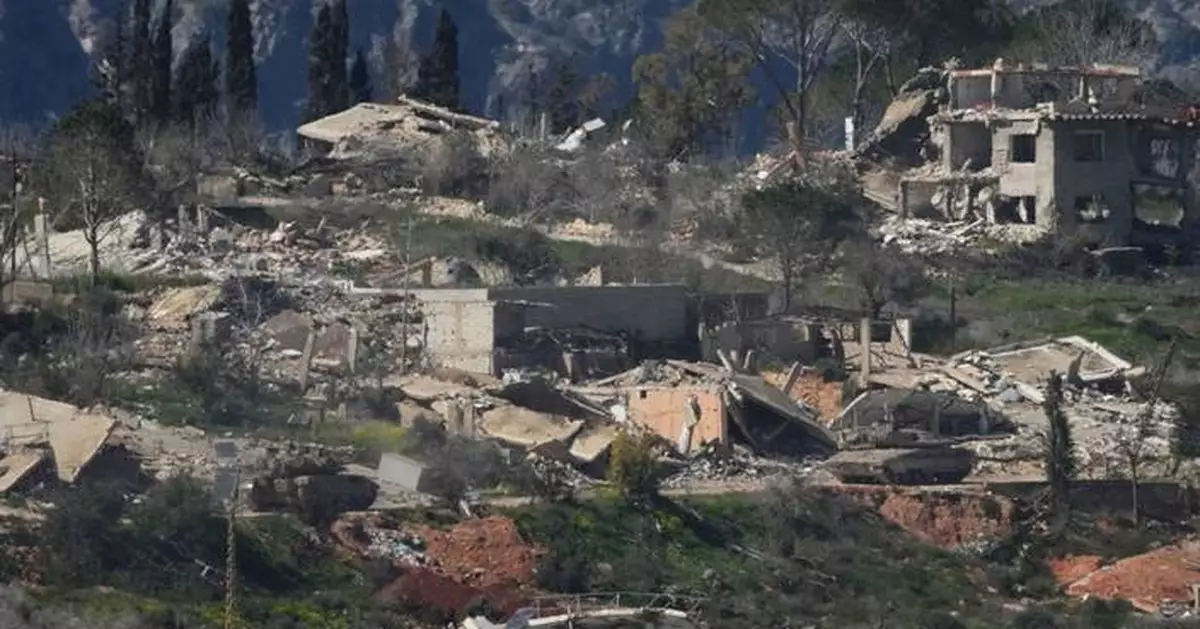
BEIRUT (AP) — The Lebanese parliament extended its term by two years on Monday due to the U.S.-Israel war with Iran, which has pushed the region into an escalating conflict, and Israel stepping up its attacks on Lebanon following renewed strikes with the militant group Hezbollah.
The Israeli military said Monday it was targeting Hezbollah’s financial arm, al-Qard Al-Hasan, as its ground forces in Lebanon's south launched “focused raids” against what it called the group’s infrastructure.
Meanwhile, Human Rights Watch has accused Israeli forces of using white phosphorus incendiary shells in strikes on residential areas in a Lebanese village in violation of international law.
Lebanon’s state news agency said 76 legislators voted in favor of the decision, 41 were against, and four abstained. Hezbollah’s 13-member bloc in parliament voted in favor of the extension.
The ongoing war with Israel that began last week has displaced over half a million people in Lebanon and made it difficult to hold a vote in large parts of the country.
The parliamentary elections were scheduled for May.
Residents of Beirut’s southern suburb, widely known as Dahiyeh, were ordered to evacuate before Israel launched strikes.
Smoke billowed over Beirut after the attacks. The first strike destroyed a building housing an office of al-Qard al-Hasan in the southern suburb of Chiyah. A Lebanese journalist on site told The Associated Press he was wounded in the leg and taken to a nearby hospital. Video footage showed what appeared to be two strikes on the building that were minutes apart.
The strikes on Chiyah were followed by more airstrikes on nearby areas, forcing Lebanese troops to close roads where al-Qard al-Hasan branches are located to ensure people's safety.
Israel says Hezbollah uses al-Qard al-Hasan to finance its military activities and has targeted several of the group's branches in southern and eastern Lebanon last week.
In southern Lebanon, the Israeli military said it launched a “focused raid” to eliminate Hezbollah operatives and infrastructure using a brigade combat team under the command of the 36th Division.
The military said before they initiated the operation, its forces launched a combined air and ground attack in the area.
Hezbollah, meanwhile, said it struck Israeli troops inside Lebanon with anti-tank missiles and that it fired a volley of rockets on the northern Israeli city of Kiryat Shmona in retaliation for Israeli strikes on cities, towns and villages in Lebanon.
The group also said it had repelled an attempted Israeli helicopter landing in the eastern town of Nabi Chit, in the same area where a commando force landed two days earlier to search for the remains of Ron Arad, an Israeli navigator who has been missing for nearly 40 years after crashing in Lebanon.
The Israeli army said it was “not aware" of another attempted landing.
The latest round of fighting between Israel and Hezbollah beganon Feb. 2 when the group fired rockets and drones on northern Israel following the killing of Iran’s Supreme Leader Ayatollah Ali Khamenei two days earlier in a joint U.S.-Israeli strike. Israel retaliated with large waves of airstrikes and Israeli troops captured several new posts in southern Lebanon.
The Lebanese government last week declared Hezbollah’s military activities illegal and ordered the country’s security forces to detain those who were behind the strikes on Israel.
Three Hezbollah members were also detained last week while carrying weapons on their way to southern Lebanon and were questioned by judicial authorities. On Monday, the military court in Beirut ordered them released on a $20 bail each, judicial officials said.
The officials said the judge asked the three men what they were doing and they responded that they were heading to southern Lebanon to fight against Israeli forces. They spoke in condition of anonymity as they are not allowed to speak to the media.
The human rights group said in a report Monday the Israeli military “unlawfully” hit a village in southern Lebanon with shells containing white phosphorus, a controversial incendiary munition.
Through geolocating and verifying seven images, Human Rights Watch said Israel fired white phosphorus using artillery at residential areas in the southern Lebanese village of Yohmor. It happened hours after the Israeli military warned the residents of the village and dozens of others in southern Lebanon to evacuate.
Human Rights Watch said it couldn’t independently identify if any residents were still in the area or if anyone was harmed.
The Israeli military said in a statement that it is “currently unaware and cannot confirm use of shells that contain white phosphorous in Lebanon as claimed.” It added that any weapons that contain white phosphorus are used in line with international law.
Human rights advocates say the use of white phosphorus is illegal under international law when the white-hot chemical substance is fired into populated areas. It can set buildings on fire and burn human flesh down to the bone. Survivors are at risk of infections and organ or respiratory failure, even if their burns are small.
“The Israeli military’s unlawful use of white phosphorus over residential areas is extremely alarming and will have dire consequences for civilians,” said Ramzi Kaiss, Lebanon researcher at Human Rights Watch.
Organizations like Human Rights Watch and Amnesty International said the munition was used in Israel’s last war with Hezbollah, over a year ago, on numerous occasions in southern Lebanon, while civilians were still present.
Melzer reported from Nahariya, Israel.
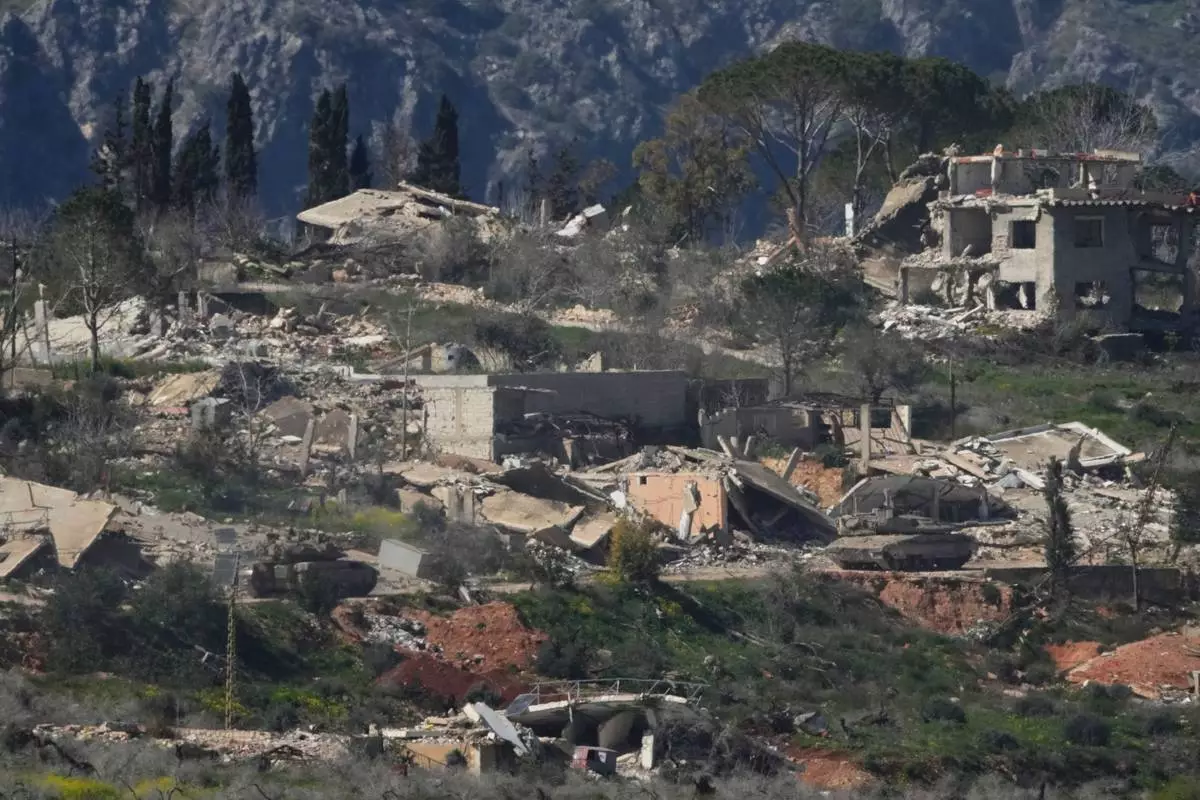
An Israeli tank maneuvers in southern Lebanon near the border with Israel, Sunday, March 8, 2026. (AP Photo/Ariel Schalit)
Iran launched more attacks on Israel and Gulf countries Monday, hours after Iranian state TV said Ayatollah Mojtaba Khamenei, son of the country’s late supreme leader and long considered a contender, had been named his successor.
Iran’s powerful paramilitary Revolutionary Guard answers to the supreme leader and the younger Khamenei will have a central say in the war strategy.
Oil prices skyrocketed Monday, leading to more worries that higher energy costs will fuel inflation and lead to less spending by U.S. consumers, the main engine of the economy. Tokyo’s benchmark Nikkei 225 index plunged as much as 7% in early Monday trading, while other Asian markets also tumbled.
Saudi Arabia sharpened its warnings to Iran, telling Tehran Monday it would be the “biggest loser” if it continues to attack Arab states. The Saudi statement came after a new drone attack apparently targeted its massive Shaybah oil field.
Here is the latest:
The United Arab Emirates announced Monday the deaths of two noncombat members of its armed forces following the crash of a helicopter due to a “technical malfunction.”
This comes as the ministry continues to work against what it said were hundreds of missiles and drones fired by Iran toward the country in a war that started over a week ago.
President Abdel-Fattah el-Sissi on Monday also urged deescalating the conflict in the region to avoid further “unprecedented repercussions” that could impact global economy and energy security.
“The national security of Arab countries is an integral part of Egyptian national security,” he said during an EU video conference held with some Arab leaders to discuss U.S.-Israel war on Iran, according to a statement by the president’s office.
El-Sissi also called for supporting Lebanon and exerting efforts to “prevent Israel from invading Lebanon during this difficult stage” and targeting the country’s infrastructure.
The secretary of state says the United States is “well on our way” to destroying Iran’s ability to threaten its neighbors and the world with missiles.
Speaking Monday at a State Department ceremony to honor Americans wrongfully detained abroad in countries including in Iran, Rubio said the goal of the continuing U.S. air strikes is to eliminate Iran’s ballistic missile stockpile, its ability to produce them and its ability to launch them.
“We are well on our way to achieving that objective” he said, adding that it is being done “with overwhelming force, with overwhelming precision.”
The Trump administration has designated the Sudan branch of the Muslim Brotherhood a terrorist organization, accusing it of getting training and other support from Iran. It’s the fourth chapter of the group the U.S. has hit with the label.
The State Department said Monday that the Sudan branch would be classified as a “specially designated global terrorist” group with immediate effect and would be labeled a “foreign terrorist organization” once a congressional review of the move is complete on March 16. It said the group was responsible for “mass executions of civilians” among other things.
The SDGT designation imposes sanctions but the FTO designation ramps up those penalties to include making it a crime to provide material support for the group or its members.
The administration has previously designated the Lebanese branch of the group an FTO and the chapters in Egypt and Jordan as SDGTs.
German Chancellor Friedrich Merz said Monday that “it is up to this regime and the so-called Revolutionary Guard alone to stop the fighting.”
He added that “so long as this not the case, I assume that Israel and America will continue their defense against this regime.”
Merz said the threat posed by the Iranian government reaches far beyond the region, pointing to its support for Russia in the war in Ukraine. He said that “Iran is the center of international terrorism, and this center must be closed. And the Americans and Israelis are doing that in their way.”
Qatar’s Defense Ministry said Monday it intercepted all 17 missiles and six drones launched from Iran toward the Gulf nation on Monday, as Iran continues to attack neighboring Arab states. There was no damage or casualties, the ministry said.
President Volodymyr Zelenskyy said Monday that Ukraine had received 11 requests from countries seeking assistance in countering threats linked to Iran. They include Iran’s neighbors, European countries and the United States.
Writing on social media, Zelenskyy said the requests focus on Ukraine’s experience in defending against drones, including interceptor systems, electronic warfare and training.
He said Kyiv is ready to help those who helped defend Ukrainian lives and independence. He added that Kyiv had already responded to some requests with specific decisions and support, and would consider further assistance as long as it does not weaken Ukraine’s own defenses.
“Ukraine’s priority is clear: the Iranian regime must not gain any advantage over those defending lives, and everyone must work together to achieve tangible stabilization both in the region and in global markets,” Ukrainian leader said.
Japanese Foreign Minister Toshimitsu Motegi said he condemned Iran’s attacks on civilians in Gulf nations and other actions that threaten freedom of navigation and safety in the Strait of Hormuz during a phone call with his Iranian counterpart, Abbas Araghchi.
Motegi said he repeated Japan’s position that Iran must never possess nuclear weapons. He also insisted that Iran promptly release two Japanese nationals. Motegi said Araghchi provided Iran’s position and promised his country’s full cooperation in ensuring the safety of Japanese nationals.
Turkey’s Defense Ministry said debris from the downed Iranian missile fell on empty fields in Gaziantep province, in southern Turkey. There was no damage or casualties.
The ministry stressed that while Turkey values peaceful relations and stability in the region, it would not hesitate to act if its land or airspace is threatened.
“We once again emphasize that all necessary steps will be taken firmly and without hesitation against any threat directed at our country’s territory or airspace,” the statement read. “We remind everyone that complying with Turkey’s warnings in this regard is in everyone’s interest.”
The statement said the missile was downed by NATO units stationed in the eastern Mediterranean.
Monday’s interception was second since the start of the Iran war. Iran has fired missiles and drones at several countries across the region since the United States and Israel attacked it over a week ago.
The United Arab Emirates says 15 ballistic missiles and 18 drones were fired on the Gulf country on Monday.
That has brought the total projectiles fired at the UAE since the start of the U.S. and Israel war against Iran to 253 missiles and 1,440 drones, the Emirati Defense Ministry said. Four foreign nationals have been killed and 117 people wounded in the attacks, it said.
The U.S. State Department on Monday ordered non‑emergency staff and family members to leave the U.S. Consulate in Adana, in southern Turkey. It also advised American citizens to depart southeast Turkey.
The decision marks the 10th U.S. diplomatic mission placed on ordered departure since the start of the war with Iran, and the first such move involving a NATO ally.
Israel said it had begun “a wide-scale wave of strikes” in Tehran, Isfahan and in southern Iran.
In the early days of the war there were barrages with dozens of missiles, but that has dropped to less than 10 or 20 missiles being launched at a time, said Israeli military spokesperson Lt. Col. Nadav Shoshani.
Iran is still firing missiles frequently toward Israel, sending people running for shelter multiple times per day, especially in central Israel.
Shoshani noted that Iran still has “a significant amount” of missiles, as Israel has concentrated on attacking Iran’s missile launchers rather than its weapons arsenals. Israel claimed previously it has destroyed around 60% of Iran’s launchers and has also targeted missile production facilities.
Funeral processions were held Monday for two Palestinian women and a 12-year-old girl who were killed in an Israeli attack in the Gaza Strip.
The three were killed Sunday when tank shelling hit two tents in Abu Shemeis camp for displaced people in central Gaza, according to Awda Hospital. A 6-month-old boy was severely wounded, it said.
The camp is located around 5 kilometers (3 miles) from the so-called Yellow Line separating Israeli-controlled areas from the rest of Gaza. The dead included a journalist, Amal Shamali, who worked for Radio Qatar, according to the hospital.
The Israeli military didn’t respond to a request for comment.
Lebanon’s state news agency said legislators voted 76-41 with four abstentions. Hezbollah’s 13-member bloc in parliament voted in favor of the extension.
The latest conflict with Israel that began last week has displaced over half a million people and made it difficult to organize a vote in large parts of the country. The next parliamentary elections had been scheduled for May.
Iran has been using cluster munitions against Israel on a “nearly daily basis,” an Israeli military spokesperson said Monday. He said Iran had fired similar missiles at Israel during the 12-day war last June.
Lt. Col. Nadav Shoshani said that the cluster munitions fired at Israel so far have targeted Israel’s most “densely populated civilian areas” in Jerusalem and central Israel.
A cluster munition is a bomb that opens in the air and releases smaller “bomblets” across a wide area. The bomblets are designed to take out tanks and equipment, as well as troops, hitting multiple targets at the same time.
Russian President Vladimir Putin sent a telegram to Ayatollah Mojtaba Khamenei to congratulate him on becoming Iran’s new leader.
The message, published on the Kremlin’s website Monday, reaffirmed Moscow’s “unwavering support for Tehran,” and said that “Russia has been and will remain a reliable partner of the Islamic Republic.”
“At a time when Iran is opposing armed aggression, your tenure in this high post will undoubtedly require great courage and dedication. I am sure that you will honorably continue your father’s work and unite the Iranian people,” Putin’s message read.
There was no advance warning, suggesting rocket fire from Lebanon.
In naming Mojtaba Khamenei as the new supreme leader, the Assembly of Experts and Iranian state media referred to him as “ayatollah,” one of the highest titles given to clerics within Shiite Islam. Khamenei’s father, Ali, similarly became an ayatollah with his appointment as supreme leader in 1989.
French President Emmanuel Macron says Group of Seven nations could dip into their emergency oil stockpiles in response to soaring energy prices.
Speaking to reporters en route to a visit to Cyprus, Macron said “the use of strategic reserves is an envisaged option.” He said G7 leaders could meet this week to coordinate a response to climbing energy prices, expected via a call or a video conference. France currently holds the rotating presidency of the G7 group.
Separately, finance ministers from the G7 nations are meeting Monday afternoon by video conference to discuss the repercussions from the Iran war.
The man was killed in an attack that targeted central Israel.
It marked the first death from missiles in Israel in a week.
China’s government said the authorities “have noted” the reports of Iran naming Mojtaba Khamenei as new supreme leader and called on all parties to go back to negotiations to avoid further escalation.
“This is a decision made by the Iranian side in accordance with the country’s constitution,” Foreign Ministry spokesperson Guo Jiakun said Monday.
He added that “China opposes interference in other countries’ internal affairs under any pretext” and said that the sovereignty and territorial integrity of Iran “should be respected.”
Around 70,000 Syrians have crossed the border from Lebanon “under duress in a rush to Syria because they were so afraid of what is happening in Lebanon,” Karolina Lindholm Billing, the representative of the U.N. refugee agency in Lebanon, said Monday.
Lebanon was at one point hosting more than 1 million Syrian refugees, but the numbers have declined, particularly since the ouster of former Syrian President Bashar Assad in December 2024. Today around 532,000 registered refugees remain, with potentially hundreds of thousands more believed to be unregistered.
The United States and Iran have offered sharply different accounts of the sinking of an Iranian warship in the Indian Ocean.
Washington has rejected Tehran’s claim that the warship IRIS Dena was unarmed when it was sunk in a submarine attack near Sri Lankan waters on March 4.
In a statement Sunday on X, the U.S. Indo-Pacific Command called Iran’s assertion that the vessel was unarmed “false.”
Iranian officials say the vessel was operating in a noncombat role as it returned home after taking part in a naval exercise in India.
Iran’s Deputy Foreign Minister Saeed Khatibzadeh said last week the warship was “unarmed.”
Israel said Monday it has carried out airstrikes in Beirut.
The Israeli army earlier Monday said it would operate against targets associated with the Hezbollah-linked financial institution al-Qard Al-Hasan. It repeated the warning to residents of Beirut’s Dahiyeh suburb to flee.
Israel says Hezbollah uses al-Qard al-Hasan to finance its military activities.
Smoke billowed over Beirut after the attacks. The first strike destroyed a building housing an office of al-Qard al-Hasan in the southern suburb of Chiyah.
Israel’s military targeted several branches of al-Qard al-Hasan in southern and eastern Lebanon last week.
During the last Israel-Hezbollah war in 2024, Israel’s military carried strikes that destroyed more than a dozen branches of al-Qard al-Hasan across Lebanon.
Emirati authorities have reported another missile attack in the capital, Abu Dhabi, urging people to remain in safe locations.
Israel has identified another launch on northern Israel shortly after a previous warning of an incoming missile attack from Iran on Monday.
Israel said in a new warning Monday that it has identified missiles launched from Iran toward northern and southern Israel.
Sirens sounded in Israel warning of a missile attack from Iran for the sixth time Monday.
Bangladesh on Monday closed all universities, bringing forward the break for Eid al-Fitr as part of emergency measures to conserve electricity during the conflict in the Middle East.
The South Asian country, which depends on imports for 95% of its energy requirements, already has experienced instances of panic buying. Car owners and drivers have struggled to collect fuel as shortages are reported.
The government has shut most fertilizer factories, redirecting available gas to power plants to avoid widespread outages.
Islam’s biggest festival is expected to be held either March 20 or 21, depending on the moon sighting, at the end of a month-long fasting ritual.
Energy Minister Iqbal Hasan Mahmud urged people to remain calm, saying Bangladesh has sufficient fuel stocks.
The capital of the United Arab Emirates came under Iranian attack Monday, with two people hurt by shrapnel from interceptions in Abu Dhabi, authorities said.
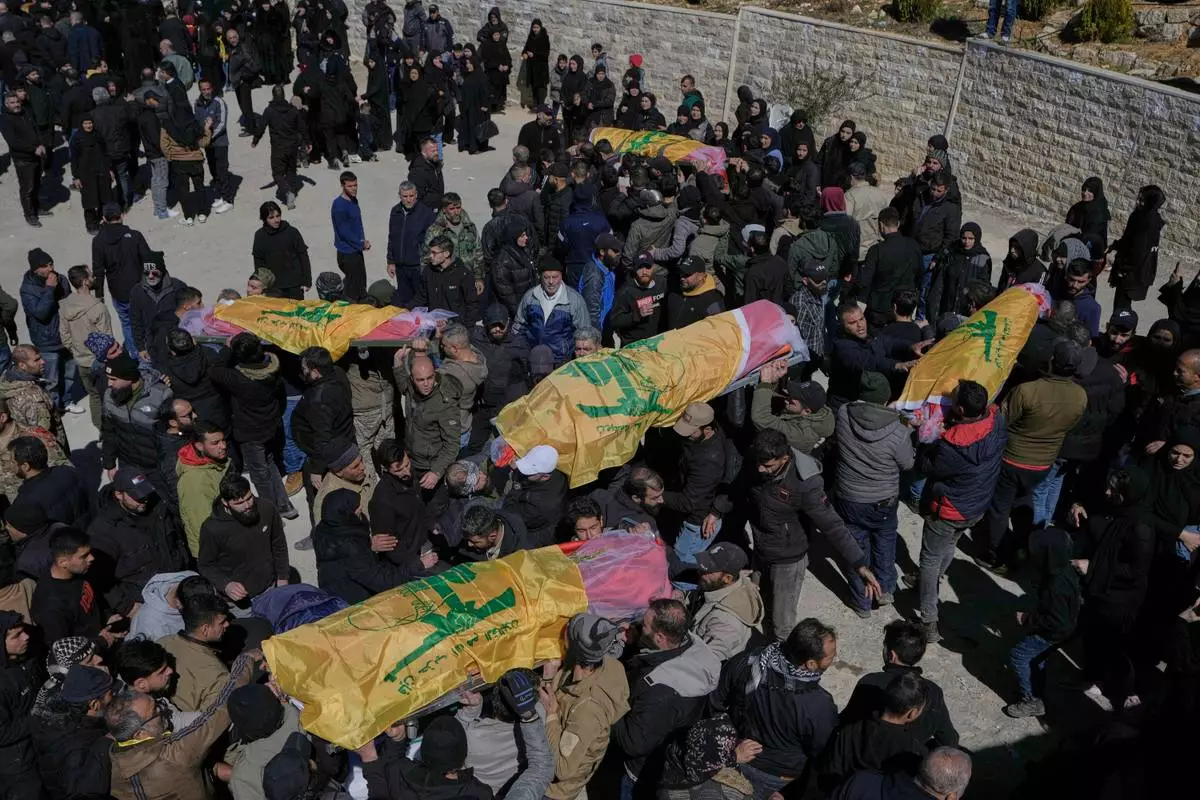
Mourners carry the bodies of Hezbollah fighters who were killed by Israeli airstrikes during their funeral procession in Khraibeh village, eastern Lebanon, Sunday, March 8, 2026. (AP Photo/Bilal Hussein)
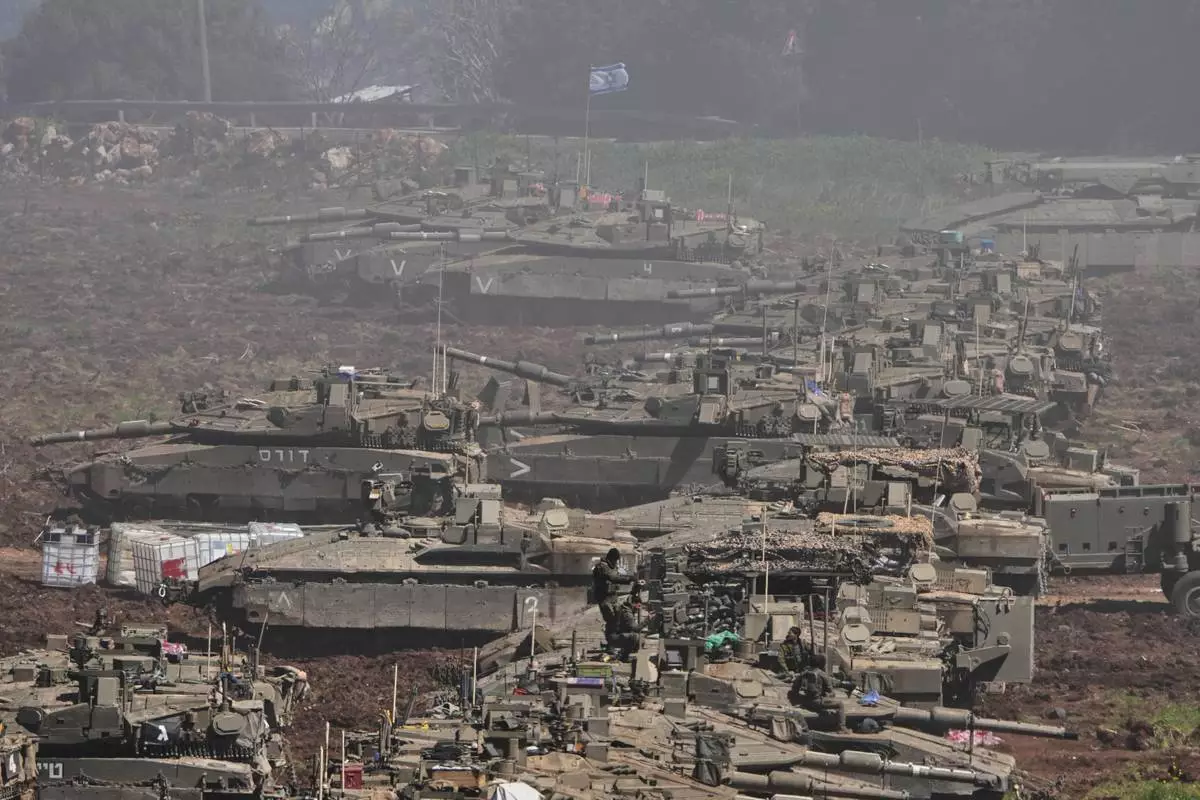
Israeli tanks are parked in a staging area in northern Israel near the border with Lebanon, Israel, Sunday, March 8, 2026. (AP Photo/Ariel Schalit)
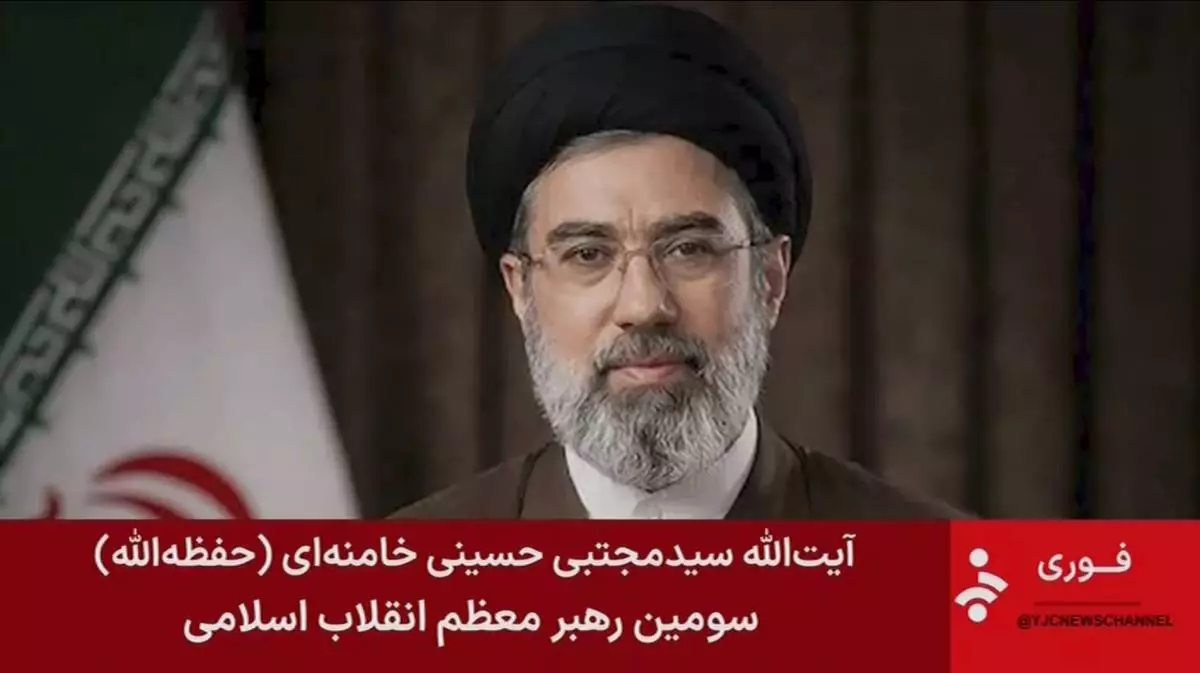
This image taken from video provided by Iran state TV shows Mojtaba Khamenei, a son of Iran's slain supreme leader, who has been named as the Islamic Republic's next ruler, authorities announced Monday, March 9, 2026. (Iran state TV via AP)
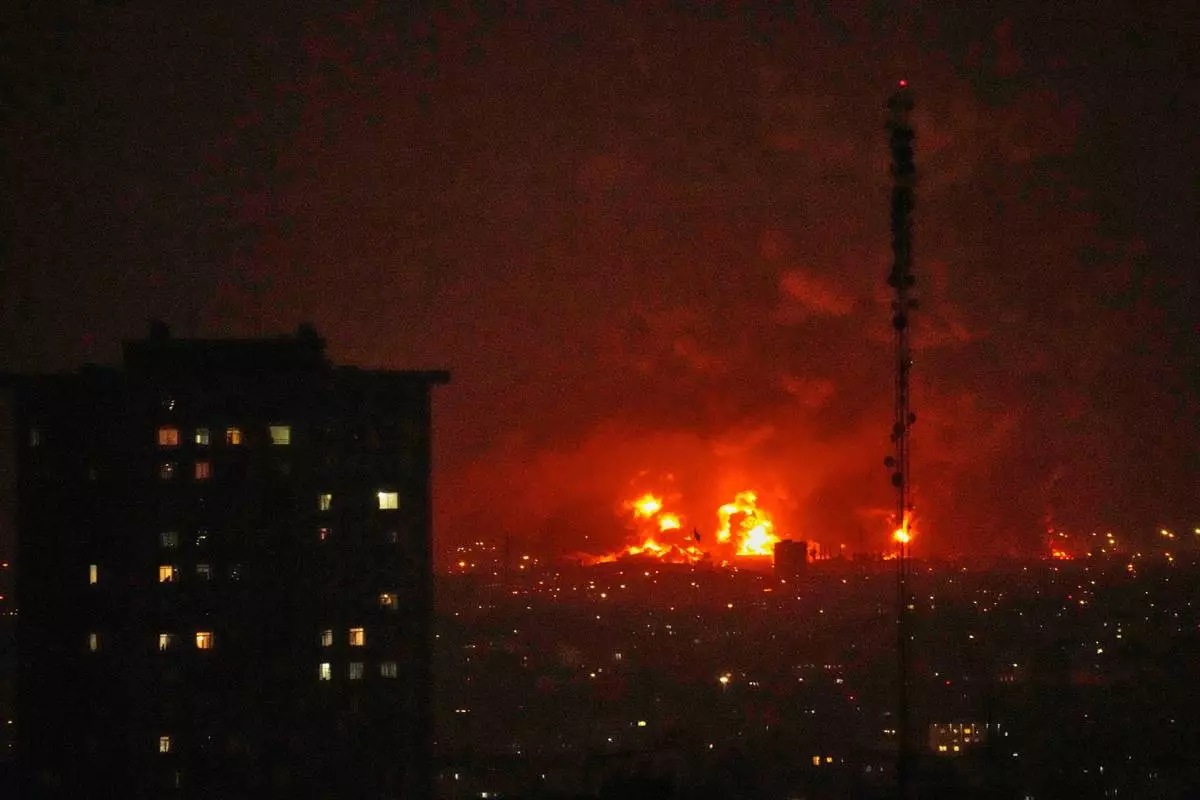
Flames rise from an oil storage facility south of the capital Tehran as strikes hit the city during the U.S.–Israel military campaign, Iran, Saturday, March 7, 2026. (AP Photo/Vahid Salemi)