HONG KONG, March 9, 2026 /PRNewswire/ -- Shrewsbury International School Hong Kong proudly marked the official launch of its Key Stage 3 programme with a vibrant ceremony that underscored the institution's dedication to educational excellence. The event was graced by esteemed guests, including Mr Brian Davidson CMG, the British Consul General to Hong Kong and Macao, alongside Governors Ms Carla Howarth, Ms Sarah Canning-Jones, Ms Gráinne Walters, and School Supervisor Mr Stephen Wong.
The ceremony began with lively performances by students, followed by congratulatory videos sent from notable figures such as Mr Bernard Charnwut Chan, Chairman of the Board of Governors; Mr Leo Winkley, Headmaster of Shrewsbury School UK; Mr Robert Millar, Principal of Shrewsbury International School Bangkok Riverside; and Ms Amanda Dennison, Principal of Shrewsbury International School Bangkok City Campus.
In his inspiring address, Mr Brian Davidson CMG spoke on the transformative potential of the new Key Stage 3 programme. "This moment not only signifies a significant development for Shrewsbury but also strengthens the educational partnership between the UK and China Hong Kong. We are dedicated to enhancing educational development across these regions, and today's event is a testament to that commitment," he emphasised.
Echoing this sentiment, Ms Carla Howarth, Governor, highlighted the seamless educational pathways facilitated by Key Stage 3 leading to Shrewsbury School in the UK. "With this new addition, students can now extend their academic journey up to Year 8 in Hong Kong, ensuring a smooth transition to Shrewsbury School in the UK in Year 9 or to their chosen destination. This initiative helps bridge our educational systems and enriches the opportunities available to students here in Hong Kong. Together, we are nurturing a global educational landscape," she articulated.
Principal Ms Priya Kanthan addressed an audience that included media representatives, corporate partners, relocation agents, and the parents of students in Years 4 to 6. She remarked, "Today, we celebrate not just the launch of Key Stage 3 but also our community's commitment to educational excellence. Our curriculum is designed to inspire, challenge, and engage our students, ensuring they are well-prepared for their future academic pursuits."
A highlight of the event was the creation of a collaborative handprint mural by distinguished guests, symbolising unity and the community spirit within the school. This artwork will serve as a lasting testament to the collective efforts and aspirations of the students and the academic team at Shrewsbury International School Hong Kong.
The introduction of Key Stage 3 marks a significant milestone in Shrewsbury's ongoing commitment to nurturing the potential of young learners and establishing robust educational pathways for their future success.
About Shrewsbury International School Hong Kong
Shrewsbury International School Hong Kong draws directly from the heritage of one of Britain's most distinguished independent schools. Founded by Royal Charter in 1552, Shrewsbury School UK has an exceptional record of excellence in broad academic study. We share a commitment to cultivating confident, articulate, and independent learners.
As the only premium provider of British education in the region, our inspirational educational programme is grounded in the English National Curriculum, designed to nurture creativity and confidence. Conveniently located just 20 minutes from Central, we offer an exceptional range of experiences for students aged 3 to 13.
www.shrewsbury.edu.hk
@shrewsburyhkg
#WeAreShrewsbury
#TogetherWeFlourish
Media Kit:
https://shorturl.at/GkyZA
** This press release is distributed by PR Newswire through automated distribution system, for which the client assumes full responsibility. **

Shrewsbury International School Hong Kong Launches Key Stage 3 with Celebratory Ceremony
HONG KONG, March 9, 2026 /PRNewswire/ -- In recent years, social engineering attacks have grown increasingly sophisticated. By posing as colleagues or trusted business partners, attackers lure employees into clicking malicious links or disclosing login credentials, often leading to system abuse and sensitive data leaks. At the same time, internal operational errors combined with external attack vectors have placed corporate security frameworks under mounting pressure.
Email, as the backbone of business communication and information exchange, has consequently become a prime entry point for such attacks. A single misjudgment in an email interaction can set off a chain reaction of risks, ranging from data breaches to costly business fraud.
Against this backdrop, companies need to adopt a more systematic approach to email security and protection to mitigate the combined risks of account abuse and phishing attacks. Coremail, a company with over 27 years of experience in email security, recently shared its insights on emerging trends in enterprise email security, noting that as cyberattack techniques continue to evolve, enterprise email protection is gradually moving away from traditional reactive defenses toward a more intelligent and structured security defense architecture.
Tim Lin, CTO of Coremail, said that the continued advancement of generative AI and social engineering tactics is reshaping the risk landscape for enterprise email security. "To strengthen overall cyber resilience, organizations need a multi-layered defense framework that integrates AI-driven analysis with robust governance and management practices."
Establishing the First Line of Defense with an LLM-Powered Email Security Gateway
Conventional email security systems that largely rely on rules and signature databases often struggle to keep pace with attacks involving semantic deception, identity spoofing and constantly evolving variants. As phishing campaigns and increasingly sophisticated Business Email Compromise (BEC) scams continue to evolve, companies need more proactive and forward-looking protection capabilities.
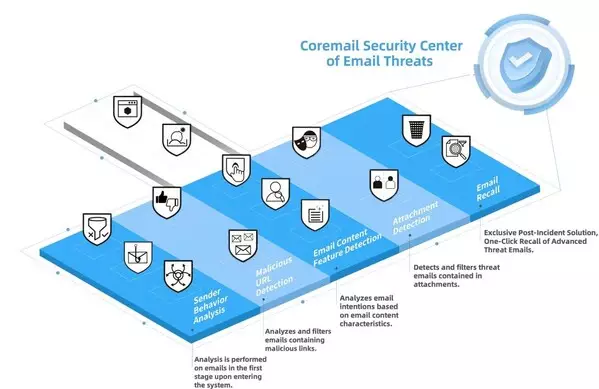
Coremail's CACTER Secure Email Gateway enhances traditional machine learning frameworks by incorporating large language models (LLMs) and multimodal analysis technologies, forming a proactive "AI versus AI" defense architecture.
Leveraging four key AI capabilities including deep semantic understanding, multimodal correlation analysis, zero-shot threat detection and attacker profiling, the CACTER Secure Email Gateway can:
- Accurately detect and block phishing emails, spam, malware and covert BEC attacks to strengthen overall email protection
- Perform dynamic URL inspection to prevent newly emerging malicious link attacks
- Improve detection of unknown and variant threats
- Provide administrators with clear threat visibility and intelligent policy recommendations
By adopting a full lifecycle email security and email data protection framework covering prevention, detection and response, the gateway creates a closed-loop process for email filtering and threat monitoring. Test results show that it can block up to 99.8% of spam emails, while keeping the false positive rate below 0.02%. This allows organizations to strengthen email security without disrupting normal business operations.
Lowering Human Risk Through Regular Anti-Phishing Drills
In many company email security incidents, human error remains the key trigger. Attackers frequently exploit trust relationships by posing as senior executives or business partners to mislead employees. For this reason, organizations should adopt continuous, scenario-based anti-phishing drills that help employees recognise suspicious requests and malicious links, rather than relying solely on one-off training sessions.
CACTER's anti-phishing simulation service offers a range of customizable scenarios that replicate real-world attack situations, enabling companies to strengthen their risk awareness through practical exercises. Experience shows that regular simulations can significantly reduce the likelihood of employee mistakes and help prevent security incidents at their source.
Strengthening Governance and Security Awareness
Beyond technical safeguards, strong organizational governance is equally important. Companies should strengthen permission management and access control, enforce the principle of least privilege and adopt multi-factor authentication (MFA) to reduce the risk of account misuse.
At the same time, practical security training and clearly defined compliance responsibilities can help embed security awareness into everyday operations, enabling organizations to shift from a reactive approach to risk management toward a more proactive model of prevention.
As internal risks and external cyber threats increasingly converge, enterprise email systems have become a critical point in the security landscape. Relying on a single layer of protection is no longer sufficient to address increasingly complex threats. Organizations need a multi-layered, intelligent and continuously evolving security framework to effectively mitigate compounded risks.
By integrating AI-driven email security gateways, strengthening employee preparedness, and reinforcing governance frameworks, enterprises can enhance overall security resilience and safeguard business stability in an increasingly complex digital environment.
For more information, please visit: www.coremail.ai
About Coremail: Coremail is a leading enterprise email and collaboration solutions provider with over 27 years of innovation in secure communication technologies. Serving over 20,000 enterprise customers and supporting over 1 billion end users, Coremail is recognized for its stability, scalability, and AI-driven capabilities, with solutions widely adopted across government, finance, education, healthcare, and energy sectors.
** This press release is distributed by PR Newswire through automated distribution system, for which the client assumes full responsibility. **
Coremail Shares Insights on Strengthening Enterprise Email Security Amid Evolving Threats