World leaders have tried and failed to curb climate change by appealing to nations to act for the common good. Now, the Iran war and its costly energy crunch have some experts wondering if selfishness and nationalism may be a more likely way to save the planet, by boosting support for homegrown renewables over imported fossil fuels.
Bombed refineries, disrupted shipping channels for oil and liquefied natural gas and skyrocketing fuel prices should point even the most reluctant leaders to a cleaner fossil free future, hope some experts.
But others are dismissive, noting the same speculation emerged, and then quickly flopped, as recently as Russia's invasion of Ukraine. That prompted some European nations to replace gas with even dirtier coal.
“Just wishful thinking,” said Stanford University climate scientist Rob Jackson, who tracks global emissions of carbon dioxide.
The head of the United Nations will argue otherwise on Monday.
“The turmoil we are witnessing today in the Middle East makes it evident that we are facing a global energy system largely tied to fossil fuels — where supply is concentrated in a few regions and every conflict risks sending shock waves through the global economy,” U.N. Secretary-General António Guterres said in an email to The Associated Press. “In past oil shocks, countries had little choice but to absorb the pain. Now they have an exit ramp.
“Homegrown renewable energy has never been cheaper, more accessible, or more scalable,” Guterres said. “The resources of the clean energy era cannot be blockaded or weaponized.”
Annual U.N. climate conferences aimed at global cooperation have accomplished little. The most recent meeting in Brazil, known as COP30, ended with a statement that didn’t even mention the words “fossil fuels,” much less include a timeline to reduce their use. Guterres said then that he “cannot pretend that COP30 has delivered everything that is needed.” Under President Donald Trump, whose attack on Iran has sparked new energy concerns, the U.S. didn't even participate in the Brazil meeting.
Even though renewable energy use and new installations are soaring globally, outpacing fossil fuel growth, the world continues to increase its fossil fuel use every year with emissions of heat-trapping carbon dioxide and methane rising to new highs year after. That's driving atmospheric warming that increases costly and deadly extreme weather, including dangerous heat, around the world.
“The bottom line is that for at least another five years and maybe longer, emissions reduction will in fact be dealt with largely unilaterally,” said Michael Oppenheimer, a Princeton climate and international affairs professor. “If countries see the Israel-U.S.-Iran war as a further reason to head for the exits on fossil fuels by loosening domestic opposition to the necessary policies, that will be accomplished unilaterally at the domestic level.”
Caroline Baxter, director of the Converging Risks Lab at the Council on Strategic Risks in Washington, said there has already been a “dramatic slowdown” in the movement of fossil fuels to various ports due to the conflict. And for countries like Japan or South Korea that depend on tankers arriving in their ports to deliver energy, this is a really big deal, she said.
Baxter said she “wouldn’t be surprised” if some shift to green energy because of the conflict, if only because renewable energy offers more stability than fossil fuels do.
“I think there is an opportunity, rightly or wrongly, for countries to really turn inward and try to power themselves in a way that cuts off their dependence on other nations for that source,” said Baxter, who was U.S. deputy assistant secretary of defense for force education and training from 2021 to 2024 under the Biden administration.
Baxter said if she’s right and if “everyone does it in their backyard,” it will limit future climate change “without the thorny diplomatic negotiations and the glad-handing and the machinations behind closed doors” of international climate conferences.
The war will lead to more solar panels and heat pumps installed in coming months, said energy analyst Ana Maria Jaller-Makarewicz, of IEEFA Europe.
More skeptical analysts point to the Russian invasion of Ukraine a few years ago, which put a massive kink in Europe’s natural gas supply, yet didn’t change the world’s fossil fuel dependence. Politicians often pivot to other fossil fuels to address war-oriented energy insecurity, such as coal, which releases even higher amounts of heat-trapping gases.
“We have seen this at the European level where actors post-2022 slowly wanted to move away from the energy transition which is exactly the wrong lesson,” said war studies lecturer Pauline Heinrichs at King’s College in the United Kingdom.
Just as Europe did then, many countries, like China and India — already the world's No. 1 and No. 3 carbon-emitting countries — could turn to more coal use, said Ohio University's Geoff Dabelko, an expert on climate and conflict, and University of St. Andrews' Neta Crawford, author of “The Pentagon, Climate Change, and War: Charting the Rise and Fall of U.S. Military Emissions.”
Whatever happens with nations' energy choices, the war itself will spike emissions.
Even before it began, reports showed that the world's militaries are responsible for 5.5% of Earth's heat-trapping emissions each year, more than any country except China, the United States and India.
Crawford, co-founder of the Costs of War project at Brown University’s Watson Institute for International and Public Affairs, said fighter jets consuming vast quantities of fuel, releasing carbon dioxide and other pollutants, is just one example.
“The consequences of war on emissions will far exceed any incremental offset in emissions due to increased enthusiasm for a green transition,” she said.
Borenstein reported from Washington and McDermott from Providence, Rhode Island.
The Associated Press’ climate and environmental coverage receives financial support from multiple private foundations. AP is solely responsible for all content. Find AP’s standards for working with philanthropies, a list of supporters and funded coverage areas at AP.org.

A person rides a scooter behind the gasoline price board of a gas station in San Francisco, Thursday, March 5, 2026. (AP Photo/Jeff Chiu)
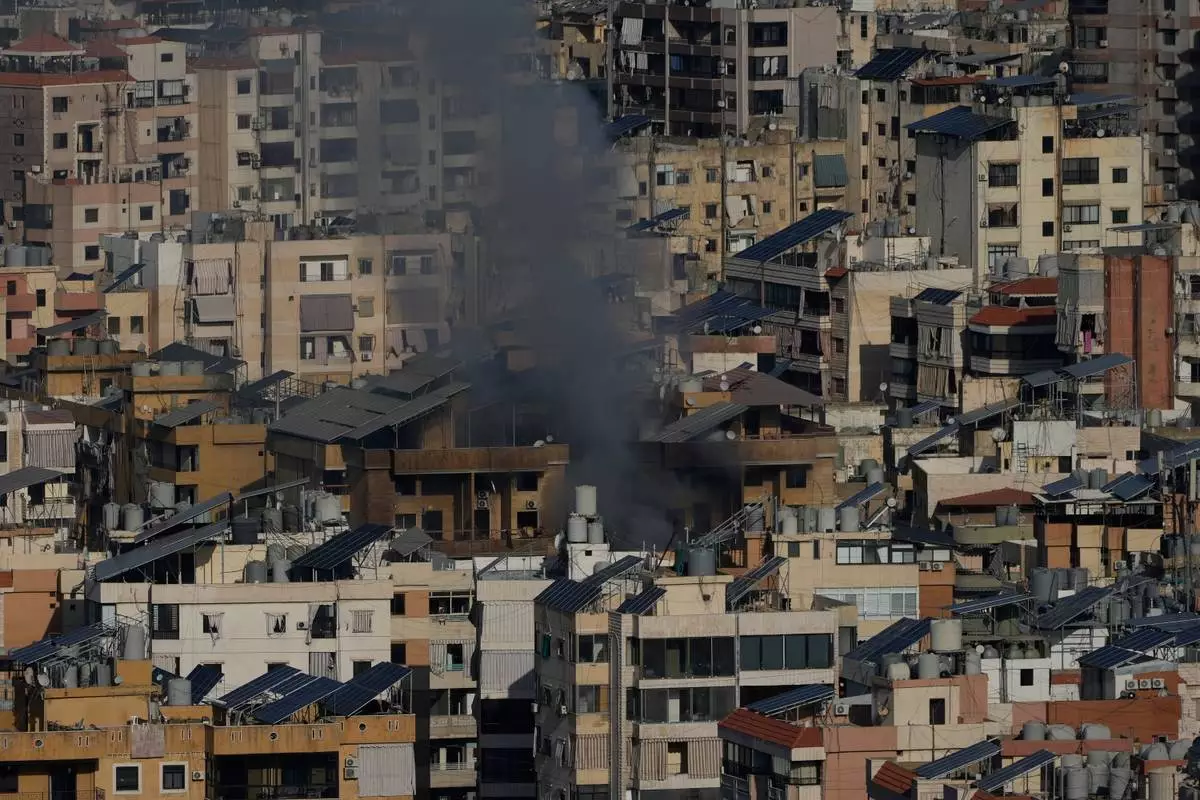
Smoke rises from an earlier Israeli airstrike in Dahiyeh, Beirut's southern suburbs, Lebanon, Friday, March 6, 2026. (AP Photo/Hussein Malla)
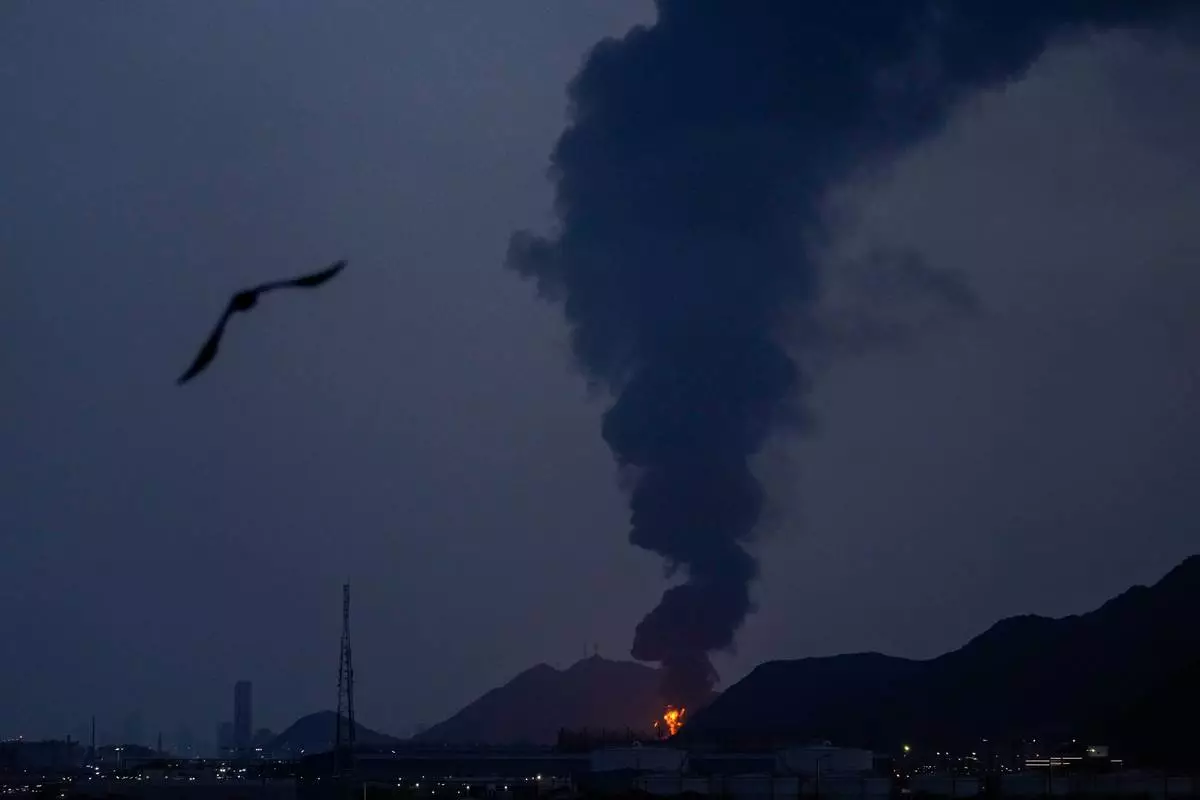
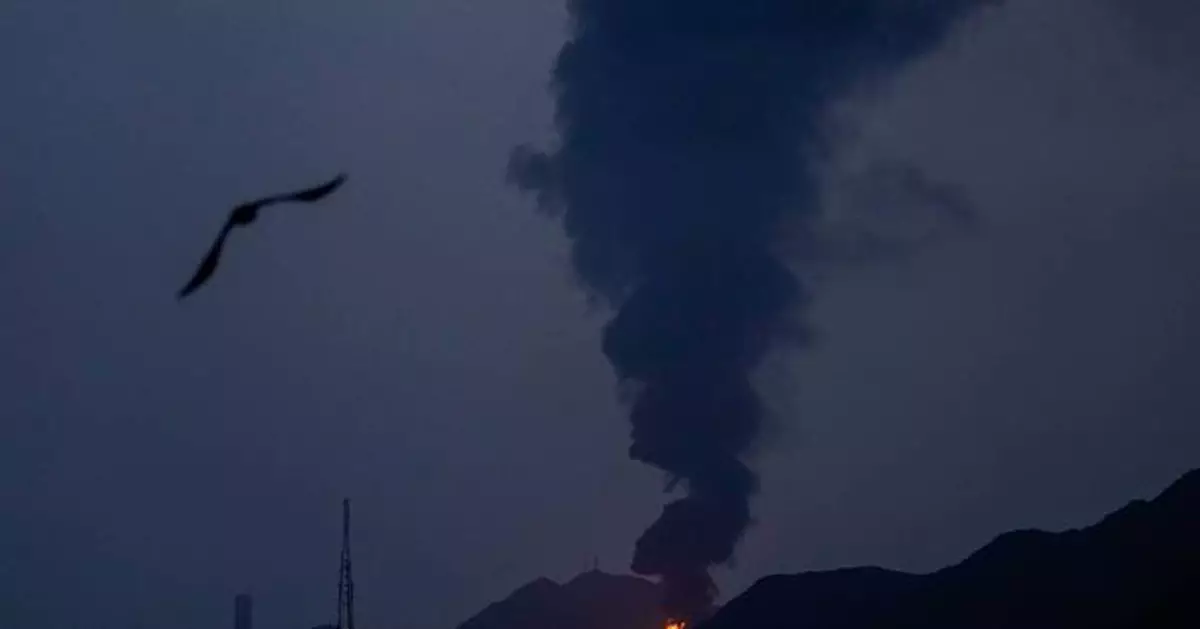
Large fire and plume of smoke is visible after, according to the authorities, debris of an Iranian intercepted drone hit the Fujairah oil facility, in Fujairah, United Arab Emirates, Tuesday, March 3, 2026. (AP Photo/Altaf Qadri)
Iran has launched more attacks on Israel and Gulf countries while more than a week of heavy U.S. and Israeli bombardment continues. Iranian state TV announced early Monday that Ayatollah Mojtaba Khamenei has been named supreme leader in defiance of threats by U.S. President Donald Trump.
Here is the latest:
Joseph Aoun told a group of European officials in a video meeting that armed groups in his country had provoked Israel into pummeling Lebanon, saying the militants sprang an “ambush for Lebanon, the Lebanese state, and the Lebanese people.”
Without naming Hezbollah directly, Aoun sharply criticized the Iran-allied militant group, saying it “does not give any weight to the interest of Lebanon or the lives of its people.”
Israel began striking Lebanon after Hezbollah fired missiles at Israel in retaliation for the U.S.-Israeli war on Iran and the killing of Iran’s supreme leader.
The team’s coach had said they want to return home as soon as possible. However, Trump has said he wants Australia to grant the team asylum, saying, “The U.S. will take them if you won’t.”
The president said on social media Monday that five members of the team have “already been taken care of, and the rest are on their way.” He said some feel they must go back to Iran because they’re worried about the safety of their families.
Trump did not elaborate on how Australia was resolving the issue, after speaking to the country’s prime minister.
▶ Read more about the Iranian women’s soccer squad.
As the missiles swooshed through the sky, consecutive loud booms reverberated in the streets of Tel Aviv and people ran for shelter.
Israel’s army said the barrage of projectiles came from Lebanon, where it is fighting with Hezbollah. Projectiles from Hezbollah don’t have a pre-warning like missiles do from Iran, which can leave people scrambling as the sirens ring.
France and four other European members of the Security Council requested the urgent meeting Monday as Israeli strikes have continued to pound Lebanon since Hezbollah struck Israel in retaliation for the U.S.-Israeli war on Iran.
The United States, which holds the council presidency this month, has not yet scheduled a session on Lebanon.
Israel’s U.N. ambassador, Danny Danon, said another council meeting would not change the situation on the ground.
“Discussions will not disarm Hezbollah,” he said.
“The Lebanese government must disarm Hezbollah and take full control of southern Lebanon,” Danon said. “If Lebanon does not do so, Israel will disarm Hezbollah to protect its citizens.”
Turkey’s NATO air defense systems intercepted the ballistic missile Monday, however the country’s president warned Iran to avoid “provocative steps.”
Speaking at the end of a Cabinet meeting, President Recep Tayyip Erdogan said his country values its friendship with Iran and has been working toward preventing the conflict, but that Tehran risks damaging “Turkey’s friendship.”
“No one should engage in calculations that would leave deep wounds in our nation’s heart and mind,” Erdogan said. “In light of today’s incident, I once again remind (Iran) to avoid persisting in mistakes and stubbornness.”
The Pentagon last week formally designated the San Francisco tech company a “supply chain risk” over its refusal to allow unrestricted military use of its technology.
The lawsuits aim to undo the designation and block its enforcement, and come after an unusually public dispute over how Anthropic’s AI chatbot Claude could be used in warfare.
Anthropic filed two separate lawsuits Monday, one in California federal court and another in the federal appeals court in Washington, D.C., each challenging different aspects of the Pentagon’s actions against the company.
▶ Read more about Anthropic and the U.S. military
The Pentagon has identified the seventh U.S. service member killed in combat during the Iran war as Army Staff Sgt. Benjamin N. Pennington, 26, of Glendale, Kentucky.
Pennington died Sunday after being wounded during an attack on March 1 at Prince Sultan Air Base, Saudi Arabia, a Pentagon statement said.
He was assigned to 1st Space Battalion, 1st Space Brigade that is based at Fort Carson, Colorado. The unit’s mission focused on “missile warning, GPS, and long-haul satellite communications,” according to its website.
Pennington was posthumously promoted to staff sergeant, according to an Army press release.
Six Army reservists were killed in Kuwait when an Iranian drone struck an operations center at a civilian port
President Masoud Pezeshkian, a relative moderate in Iran’s Shiite theocracy, wrote on X that “solving the country’s problems can be achieved through his wise leadership and by creating an atmosphere built on people’s trust and participation.”
The supreme leader, chosen by a clerical body, has the final say on all major policies, including war, peace and the country’s disputed nuclear program.
Cluster bombs travel through the air then burst open before landing, breaking up into dozens or hundreds of smaller bomblets to maximize the likelihood of hitting targets.
Col. Jonathan Raz of Israel’s Home Front Command said Monday that the area of Yehud in the country’s center was hit by a cluster bomb, killing at least one person and leaving others in critical condition.
Israel’s military said Iran has been using cluster bombs on a “nearly daily basis,” noting that Iran fired similar projectiles during the previous 12-day war last June.
The U.N. children’s agency says deaths and injuries to children since Israel retaliated in Lebanon for Hezbollah strikes are “staggering.”
UNICEF’s Middle East director Edouard Beigbeder said that according to the latest reports at least 83 children have been killed and 254 wounded since March 2.
That’s more than 10 children killed, and approximately 36 injured, every day, he said in a statement.
Beigbeder said the figures “are a stark testament to the toll that conflict is taking on children.”
“As military strikes continue across the country, children are being killed and injured at a horrifying rate, families are fleeing their homes in fear, and thousands of children are now sleeping in cold and overcrowded shelters,” he said.
Checkpoints on the border between Iran and Turkmenistan have begun operating 24 hours a day to facilitate the transit of those seeking to leave Iran amid the war with the U.S. and Israel, Turkmenistan’s officials said Monday.
So far, some 250 people from 16 countries have crossed into the Central Asian nation from Iran, officials said. Those crossing into Turkmenistan are being offered food and assistance in contacting their families or embassies.
Turkmenistan, a former Soviet country that has remained largely isolated under autocratic rule since it gained independence, shares a 1,148-kilometer (713-mile) border with Iran. During the Israel-Iran war in 2025, Turkmenistan, despite its harsh visa policies, provided an evacuation corridor for more than 4,000 people from 52 countries who sought to leave Iran.
The United Arab Emirates announced Monday the deaths of two noncombat members of its armed forces following the crash of a helicopter due to a “technical malfunction.”
This comes as the ministry continues to work against what it said were hundreds of missiles and drones fired by Iran toward the country in a war that started over a week ago.
President Abdel-Fattah el-Sissi on Monday also urged deescalating the conflict in the region to avoid further “unprecedented repercussions” that could impact global economy and energy security.
“The national security of Arab countries is an integral part of Egyptian national security,” he said during an EU video conference held with some Arab leaders to discuss U.S.-Israel war on Iran, according to a statement by the president’s office.
El-Sissi also called for supporting Lebanon and exerting efforts to “prevent Israel from invading Lebanon during this difficult stage” and targeting the country’s infrastructure.
The secretary of state says the United States is “well on our way” to destroying Iran’s ability to threaten its neighbors and the world with missiles.
Speaking Monday at a State Department ceremony to honor Americans wrongfully detained abroad in countries including in Iran, Rubio said the goal of the continuing U.S. air strikes is to eliminate Iran’s ballistic missile stockpile, its ability to produce them and its ability to launch them.
“We are well on our way to achieving that objective” he said, adding that it is being done “with overwhelming force, with overwhelming precision.”
The Trump administration has designated the Sudan branch of the Muslim Brotherhood a terrorist organization, accusing it of getting training and other support from Iran. It’s the fourth chapter of the group the U.S. has hit with the label.
The State Department said Monday that the Sudan branch would be classified as a “specially designated global terrorist” group with immediate effect and would be labeled a “foreign terrorist organization” once a congressional review of the move is complete on March 16. It said the group was responsible for “mass executions of civilians” among other things.
The SDGT designation imposes sanctions but the FTO designation ramps up those penalties to include making it a crime to provide material support for the group or its members.
The administration has previously designated the Lebanese branch of the group an FTO and the chapters in Egypt and Jordan as SDGTs.
German Chancellor Friedrich Merz said Monday that “it is up to this regime and the so-called Revolutionary Guard alone to stop the fighting.”
He added that “so long as this not the case, I assume that Israel and America will continue their defense against this regime.”
Merz said the threat posed by the Iranian government reaches far beyond the region, pointing to its support for Russia in the war in Ukraine. He said that “Iran is the center of international terrorism, and this center must be closed. And the Americans and Israelis are doing that in their way.”
Qatar’s Defense Ministry said Monday it intercepted all 17 missiles and six drones launched from Iran toward the Gulf nation on Monday, as Iran continues to attack neighboring Arab states. There was no damage or casualties, the ministry said.
President Volodymyr Zelenskyy said Monday that Ukraine had received 11 requests from countries seeking assistance in countering threats linked to Iran. They include Iran’s neighbors, European countries and the United States.
Writing on social media, Zelenskyy said the requests focus on Ukraine’s experience in defending against drones, including interceptor systems, electronic warfare and training.
He said Kyiv is ready to help those who helped defend Ukrainian lives and independence. He added that Kyiv had already responded to some requests with specific decisions and support, and would consider further assistance as long as it does not weaken Ukraine’s own defenses.
“Ukraine’s priority is clear: the Iranian regime must not gain any advantage over those defending lives, and everyone must work together to achieve tangible stabilization both in the region and in global markets,” Ukrainian leader said.
Japanese Foreign Minister Toshimitsu Motegi said he condemned Iran’s attacks on civilians in Gulf nations and other actions that threaten freedom of navigation and safety in the Strait of Hormuz during a phone call with his Iranian counterpart, Abbas Araghchi.
Motegi said he repeated Japan’s position that Iran must never possess nuclear weapons. He also insisted that Iran promptly release two Japanese nationals. Motegi said Araghchi provided Iran’s position and promised his country’s full cooperation in ensuring the safety of Japanese nationals.
Turkey’s Defense Ministry said debris from the downed Iranian missile fell on empty fields in Gaziantep province, in southern Turkey. There was no damage or casualties.
The ministry stressed that while Turkey values peaceful relations and stability in the region, it would not hesitate to act if its land or airspace is threatened.
“We once again emphasize that all necessary steps will be taken firmly and without hesitation against any threat directed at our country’s territory or airspace,” the statement read. “We remind everyone that complying with Turkey’s warnings in this regard is in everyone’s interest.”
The statement said the missile was downed by NATO units stationed in the eastern Mediterranean.
Monday’s interception was second since the start of the Iran war. Iran has fired missiles and drones at several countries across the region since the United States and Israel attacked it over a week ago.
The United Arab Emirates says 15 ballistic missiles and 18 drones were fired on the Gulf country on Monday.
That has brought the total projectiles fired at the UAE since the start of the U.S. and Israel war against Iran to 253 missiles and 1,440 drones, the Emirati Defense Ministry said. Four foreign nationals have been killed and 117 people wounded in the attacks, it said.
The U.S. State Department on Monday ordered non‑emergency staff and family members to leave the U.S. Consulate in Adana, in southern Turkey. It also advised American citizens to depart southeast Turkey.
The decision marks the 10th U.S. diplomatic mission placed on ordered departure since the start of the war with Iran, and the first such move involving a NATO ally.
Israel said it had begun “a wide-scale wave of strikes” in Tehran, Isfahan and in southern Iran.
In the early days of the war there were barrages with dozens of missiles, but that has dropped to less than 10 or 20 missiles being launched at a time, said Israeli military spokesperson Lt. Col. Nadav Shoshani.
Iran is still firing missiles frequently toward Israel, sending people running for shelter multiple times per day, especially in central Israel.
Shoshani noted that Iran still has “a significant amount” of missiles, as Israel has concentrated on attacking Iran’s missile launchers rather than its weapons arsenals. Israel claimed previously it has destroyed around 60% of Iran’s launchers and has also targeted missile production facilities.
Funeral processions were held Monday for two Palestinian women and a 12-year-old girl who were killed in an Israeli attack in the Gaza Strip.
The three were killed Sunday when tank shelling hit two tents in Abu Shemeis camp for displaced people in central Gaza, according to Awda Hospital. A 6-month-old boy was severely wounded, it said.
The camp is located around 5 kilometers (3 miles) from the so-called Yellow Line separating Israeli-controlled areas from the rest of Gaza. The dead included a journalist, Amal Shamali, who worked for Radio Qatar, according to the hospital.
The Israeli military didn’t respond to a request for comment.
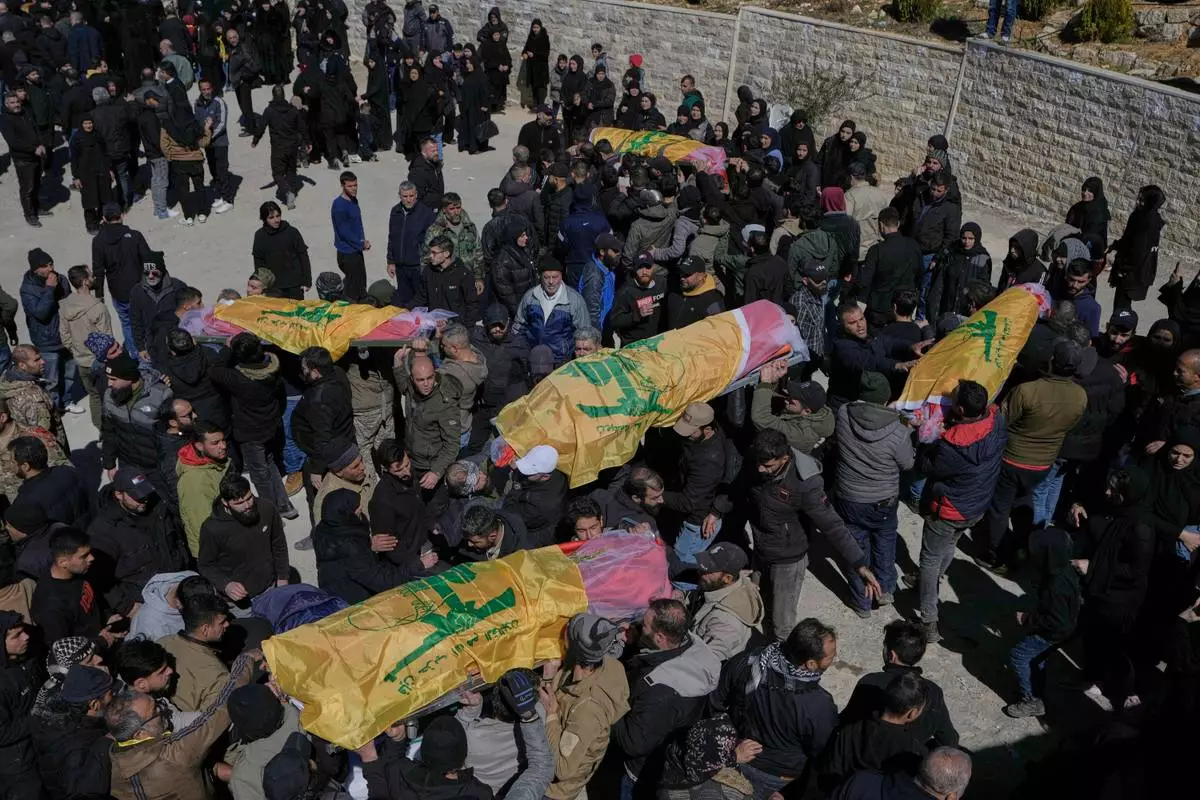
Mourners carry the bodies of Hezbollah fighters who were killed by Israeli airstrikes during their funeral procession in Khraibeh village, eastern Lebanon, Sunday, March 8, 2026. (AP Photo/Bilal Hussein)
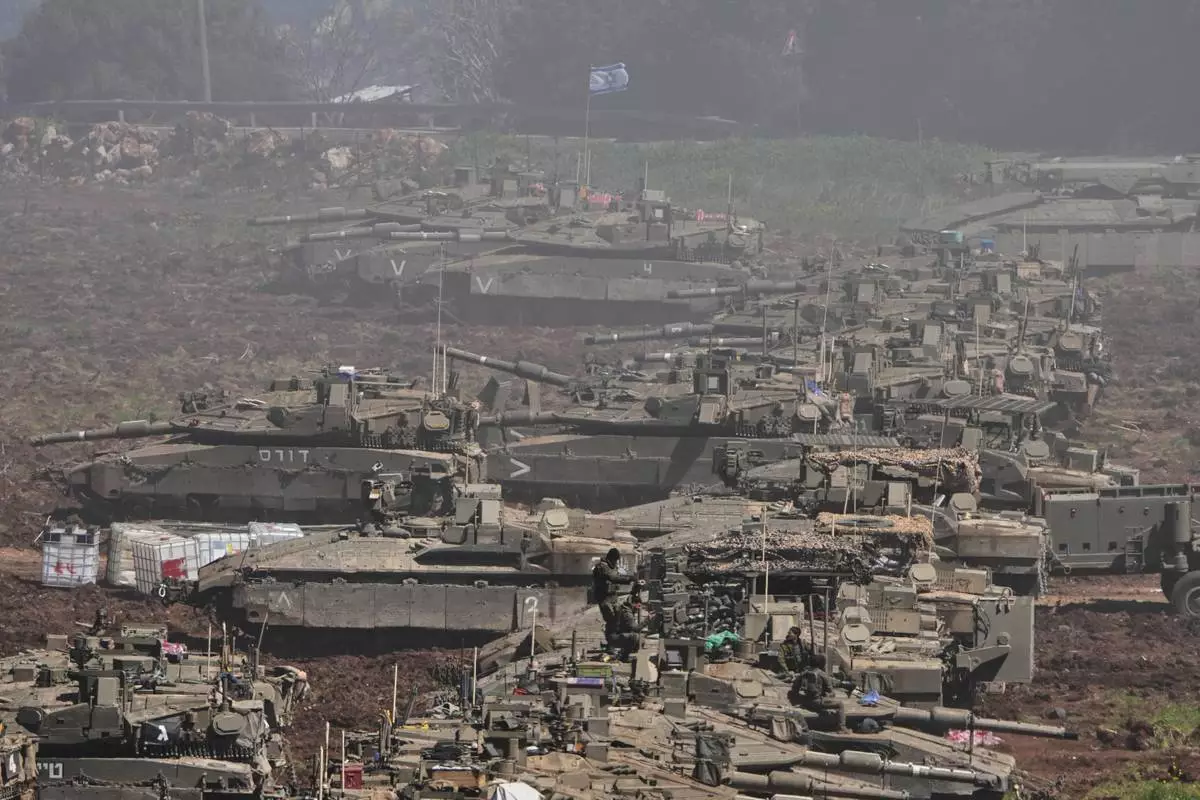
Israeli tanks are parked in a staging area in northern Israel near the border with Lebanon, Israel, Sunday, March 8, 2026. (AP Photo/Ariel Schalit)
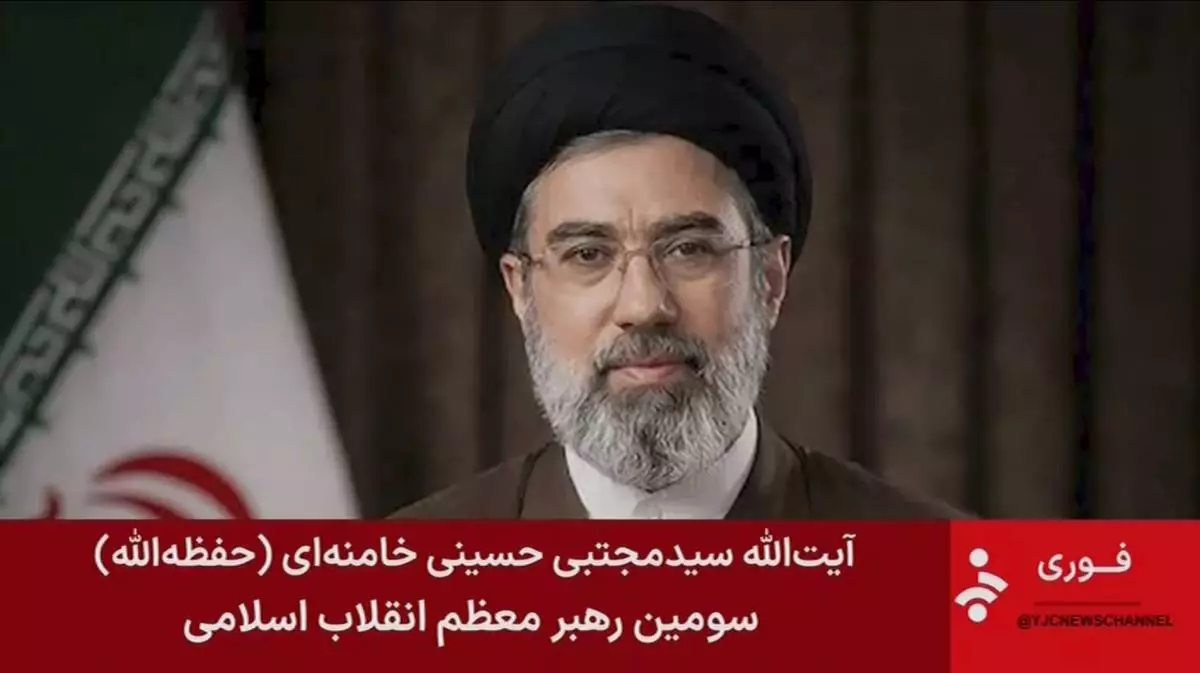
This image taken from video provided by Iran state TV shows Mojtaba Khamenei, a son of Iran's slain supreme leader, who has been named as the Islamic Republic's next ruler, authorities announced Monday, March 9, 2026. (Iran state TV via AP)
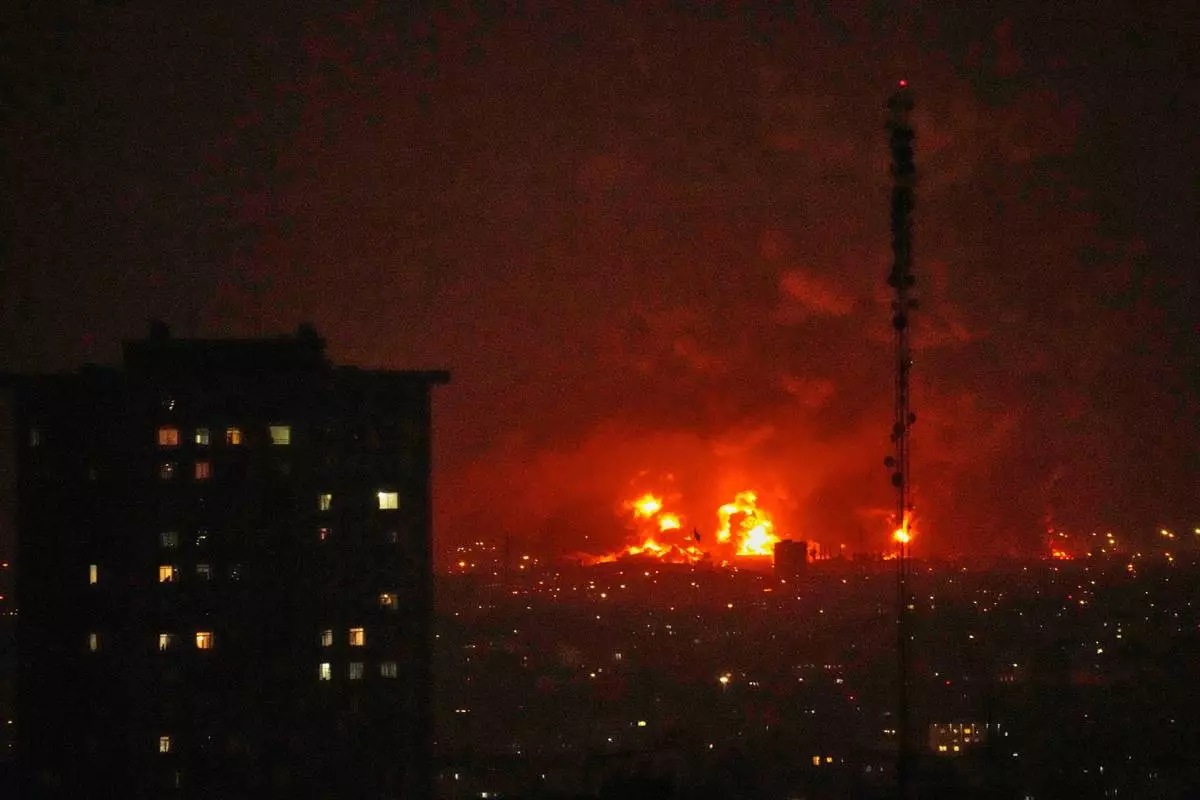
Flames rise from an oil storage facility south of the capital Tehran as strikes hit the city during the U.S.–Israel military campaign, Iran, Saturday, March 7, 2026. (AP Photo/Vahid Salemi)