PHOENIX (AP) — The Republican leader of Arizona's state Senate said Monday he has handed over records related to the 2020 presidential election to the FBI in the latest sign that the Trump administration is acting on the president's longstanding falsehoods about a race he lost to Democrat Joe Biden.
Senate President Warren Petersen said in a social media post that he complied “late last week” with a federal grand jury subpoena for records related to a controversial audit of the election in Maricopa County that had been ordered by legislative Republicans.
“The FBI has the records,” Petersen said.
He did not immediately respond to requests for additional comment, and a spokesperson for Senate Republicans said in an email that Petersen “does not have anything to add outside of his X post at this time.” The FBI office in Phoenix did not immediately respond to a request for comment.
It marks the second time this year that the FBI has obtained records related to the 2020 election from the most populous county in a presidential battleground state, both of which Trump lost as he sought reelection. In January, the FBI seized ballots and other records from Georgia's Fulton County, which includes Atlanta, after the Justice Department sought a search warrant from a judge. The search warrant affidavit showed that the request relied on years-old claims, many of which had been thoroughly investigated and found to have no connection to widespread fraud.
Arizona Attorney General Kris Mayes, a Democrat, issued a scathing statement in response to Petersen's post, noting that multiple audits, independent investigations and legal challenges related to the 2020 presidential election found no evidence of widespread fraud that could have affected the outcome.
“Warren Petersen knows all of this. He has known it for years. He spread false stories of election fraud in 2020, and he remains an unrepentant election denier,” Mayes said. “What the Trump administration appears to be pursuing now is not a legitimate law enforcement inquiry. It is the weaponization of federal law enforcement in service of crackpots and lies.”
A firm hired by Republican lawmakers spent six months in 2021 searching for evidence of fraud in the previous year's presidential election, a process experts said was marred by bias and a flawed methodology. It explored outlandish conspiracy theories, such as dedicating time to checking for bamboo fibers on ballots to see if they were secretly shipped in from Asia.
The audit ended without producing proof to support former President Donald Trump’s false claims of a stolen election — and in fact found that Biden received 360 more votes than stated in the certified results for Maricopa County, which includes Phoenix.
The firm, Cyber Ninjas, also acknowledged that there were “no substantial differences” between its hand count of the ballots and the official count.
Previous reviews of the 2.1 million ballots by nonpartisan professionals who followed state law found no significant problem with the 2020 election in Maricopa County, which was run by Republicans then and now. Biden won the county by 45,000 votes and went on to win Arizona by 10,500 votes.
Federal officials took different routes to obtain election records in the two states. The Georgia case involved a judicially-approved search warrant that required the FBI to articulate grounds that probable cause exists to believe a crime was committed. In Arizona, the FBI relied on subpoenas, a law enforcement maneuver that does not require judicial sign-off or for prosecutors to assert that there’s probable cause of a crime.
The investigations into the 2020 election come as the Justice Department has clashed with a number of states, including some controlled by Republicans, over access to detailed voter data that includes names, dates of birth, addresses and partial Social Security numbers. Election officials have expressed concerns that providing the information would violate both state and federal data privacy laws, and that it could be used to remove people from state voter rolls.
Arizona is among the states the Justice Department has sued to obtain the voter information. Secretary of State Adrian Fontes, a Democrat, suggested that at least some Maricopa County voter files could be among the records Petersen gave the FBI. In a statement Monday, Fontes said his office was considering legal options “to secure personal voter information in the 2020 data that was shared.”
Calli Jones, a secretary of state spokesperson, said the office is assessing what was released to the FBI.
“This could be an end run by the Department of Justice to obtain unredacted voter files,” she said.
Associated Press writer Eric Tucker in Washington contributed to this report.

FILE - Supporters of President Donald Trump rally outside the Maricopa County Recorder's Office, Friday, Nov. 6, 2020, in Phoenix. (AP Photo/Ross D. Franklin)
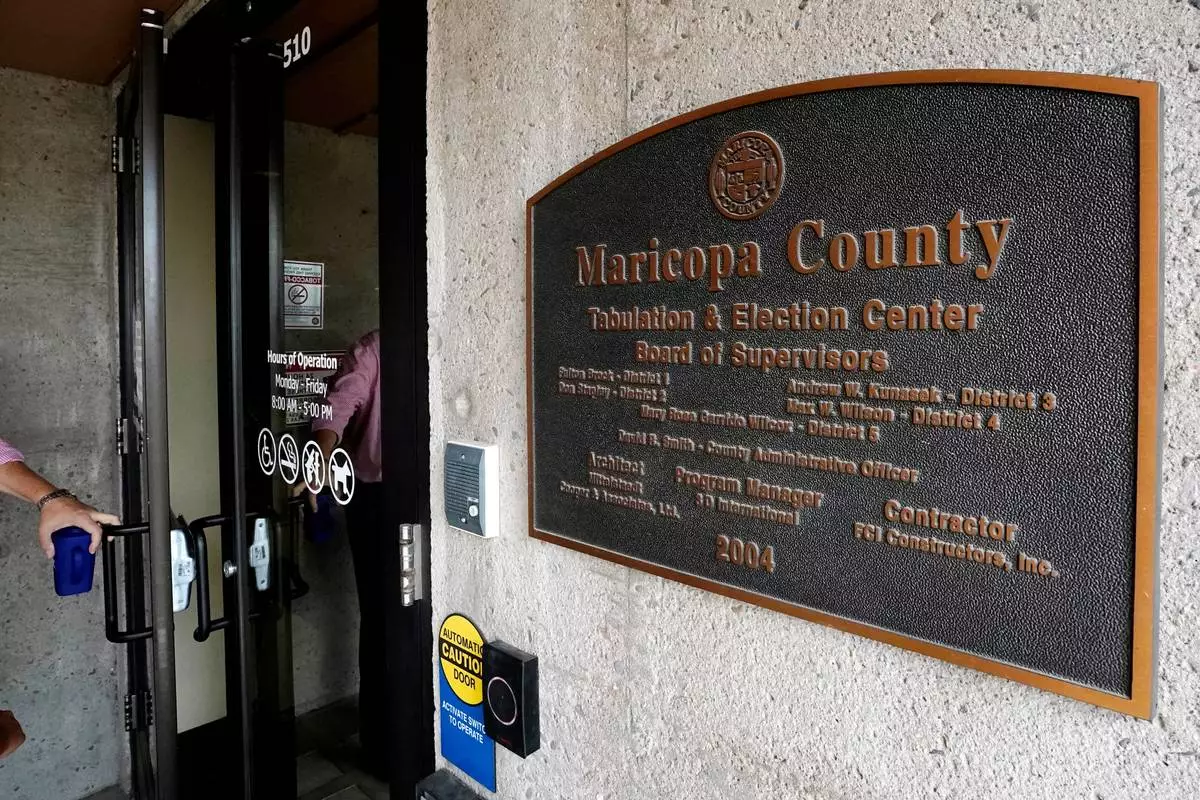
FILE - The main entrance at the Maricopa County Elections Department in Phoenix, Sept. 8, 2022. (AP Photo/Ross D. Franklin, File)