|
TEANECK, N.J., March 11, 2026 /PRNewswire/ -- Cognizant (Nasdaq: CTSH) released new research showing that companies pursuing AI adoption overwhelmingly prefer IT services firms - such as "AI Builder" firms, a new services model defined by designing and building custom, full stack AI solutions - to deliver real enterprise value from AI.
The research, based on a quantitative study of 600 AI decision makers and qualitative interviews with 38 senior executives, finds that organizations rank custom solutions and flexible engagement models as the most important factor when selecting an AI partner, ahead of pricing and time to value. Pricing and proven AI case studies remain important, but rank below capabilities that enable AI to be embedded directly into business operations and value chains.
At the same time, enterprises cite generic, off-the-shelf AI solutions as a leading reason to reject an AI provider, along with lack of industry-specific expertise, inability to integrate into existing technology stacks, and inadequate support and maintenance. According to the research, the top three challenges organizations face in enterprise AI adoption are regulatory and compliance concerns, difficulty demonstrating return on investment and lack of clear AI strategy and vision.
"AI success is not about deploying isolated models—it's about engineering intelligence into the enterprise with purpose-built solutions," said Ravi Kumar S, CEO of Cognizant. "The most trusted path to an AI future is working with an AI Builder—one that brings deep industry context, systems engineering expertise, and operational accountability. At Cognizant, we focus on building the bridge from AI experimentation to measurable enterprise value."
Key findings from the study include:
Enterprises face a "messy middle" in scaling AI: AI builders can create the bridge to enterprise value -- solving complex, real-world problems:
- 63% of enterprises report moderate-to-large gaps between their AI ambitions and current capabilities.
- The biggest barriers to scaling AI are operational and organizational:
- 33% cite regulatory and compliance challenges
- 31% struggle to demonstrate ROI
- 27% report shortages in talent
- 27% report inadequate data readiness
AI investment is long term, not experimental: Enterprises are committing sustained capital to AI, signaling long-term infrastructure building rather than speculative investment:
- 84% of enterprises maintain formal AI budgets
- 91% expect AI budgets to grow in the next two years
- 50% anticipate double-digit increases in AI budgets over the next two years
- 52% are already investing $10M or more annually on AI initiatives
AI is augmenting human workforces, not replacing them: Enterprise leaders are not forecasting workforce collapse, they're forecasting redesign of workflows for human-AI collaboration.
- Across 13 enterprise functions, the highest expected level of full automation is only 20% (in sales)
- Even in customer service, where 76% of leaders expect workflows to become AI-dominant, only 9% believe they will be fully automated.
In qualitative interviews conducted as part of the research, enterprise leaders said "out‑of‑the‑box" AI is inadequate; they want tailored solutions AI builders can develop and tune.
A Vice President in the UK banking sector shared, "A lot of vendors come in thinking that the off-the-shelf solutions they have would fit our needs, but often enough they find that that's not the case. And it takes them a number of years, more than they planned, and a lot of money, both from us … to get those software working. And these are not just AI software."
A US-based insurance industry CIO stated, "It depends on where I'm inserting this particular ingredient in our value. And so sometimes I want a builder and an engineer, sometimes I want an integrator, sometimes I want an activator. Because they're playing more of a coordinating function—a weaving, stitching-together function."
Together, these research insights underscore a clear shift in enterprise expectations: from experimenting with AI tools to partnering with AI Builders that can design, build, integrate, and operate AI systems at scale— in alignment with client governance, security, and risk‑management frameworks and with lasting business impact.
These findings align with recent remarks by Babak Hodjat, Chief AI Officer at Cognizant, who noted that enterprises are far from being able to rely on AI "out of the box." In interviews with Fortune and Reuters, Hodjat emphasized that while agentic and generative AI systems are advancing rapidly, organizations still need significant help engineering, integrating, governing, and operating these systems in ways that support client safety, reliability and governance requirements within complex enterprise environments.
AI decision makers rated IT services firms like AI builders highest in their ability to assist with their AI adoption (ahead of SaaS providers, cloud providers, AI model companies, AI startups and management consultancies). The research also finds that IT services firms are trusted across the AI adoption lifecycle—especially in ongoing management of AI-enabled systems, but also in AI strategy, custom AI solution development, increasing organizational productivity and scaling AI across the enterprise. IT services firms have a 23% trust advantage over management consultancies in AI adoption. While management consultancies benefit from strong brand recognition, they are seen as less credible in hands-on AI implementation.
About the Research
Cognizant's research findings are based on quantitative research conducted in November 2025 with 600 AI decision makers, and qualitative interviews conducted in October 2025 with 38 business and technology leaders in the United States, Germany, Singapore and Australia with AI decision making responsibility. The full report can be found here: How ai is reshaping business & empowering workforces | Cognizant
About Cognizant
Cognizant (NASDAQ: CTSH) is an AI builder and technology services provider, building the bridge between AI investment and enterprise value by building full-stack AI solutions for our clients. Our deep industry, process and engineering expertise enables us to build an organization's unique context into technology systems that amplify human potential, realize tangible returns and keep global enterprises ahead in a fast-changing world. See how at www.cognizant.com or @cognizant.
For more information, contact:
U.S.
Name: Gabrielle Gugliocciello
Email: gabrielle.gugliocciello@cognizant.com
Europe / APAC
Name: Sarah Douglas
Email: sarah.douglas@cognizant.com
India
Name: Vipin Nair
Email: Vipin.Nair@cognizant.com
TEANECK, N.J., March 11, 2026 /PRNewswire/ -- Cognizant (Nasdaq: CTSH) released new research showing that companies pursuing AI adoption overwhelmingly prefer IT services firms - such as "AI Builder" firms, a new services model defined by designing and building custom, full stack AI solutions - to deliver real enterprise value from AI.
The research, based on a quantitative study of 600 AI decision makers and qualitative interviews with 38 senior executives, finds that organizations rank custom solutions and flexible engagement models as the most important factor when selecting an AI partner, ahead of pricing and time to value. Pricing and proven AI case studies remain important, but rank below capabilities that enable AI to be embedded directly into business operations and value chains.
At the same time, enterprises cite generic, off-the-shelf AI solutions as a leading reason to reject an AI provider, along with lack of industry-specific expertise, inability to integrate into existing technology stacks, and inadequate support and maintenance. According to the research, the top three challenges organizations face in enterprise AI adoption are regulatory and compliance concerns, difficulty demonstrating return on investment and lack of clear AI strategy and vision.
"AI success is not about deploying isolated models—it's about engineering intelligence into the enterprise with purpose-built solutions," said Ravi Kumar S, CEO of Cognizant. "The most trusted path to an AI future is working with an AI Builder—one that brings deep industry context, systems engineering expertise, and operational accountability. At Cognizant, we focus on building the bridge from AI experimentation to measurable enterprise value."
Key findings from the study include:
Enterprises face a "messy middle" in scaling AI: AI builders can create the bridge to enterprise value -- solving complex, real-world problems:
- 63% of enterprises report moderate-to-large gaps between their AI ambitions and current capabilities.
- The biggest barriers to scaling AI are operational and organizational:
- 33% cite regulatory and compliance challenges
- 31% struggle to demonstrate ROI
- 27% report shortages in talent
- 27% report inadequate data readiness
AI investment is long term, not experimental: Enterprises are committing sustained capital to AI, signaling long-term infrastructure building rather than speculative investment:
- 84% of enterprises maintain formal AI budgets
- 91% expect AI budgets to grow in the next two years
- 50% anticipate double-digit increases in AI budgets over the next two years
- 52% are already investing $10M or more annually on AI initiatives
AI is augmenting human workforces, not replacing them: Enterprise leaders are not forecasting workforce collapse, they're forecasting redesign of workflows for human-AI collaboration.
- Across 13 enterprise functions, the highest expected level of full automation is only 20% (in sales)
- Even in customer service, where 76% of leaders expect workflows to become AI-dominant, only 9% believe they will be fully automated.
In qualitative interviews conducted as part of the research, enterprise leaders said "out‑of‑the‑box" AI is inadequate; they want tailored solutions AI builders can develop and tune.
A Vice President in the UK banking sector shared, "A lot of vendors come in thinking that the off-the-shelf solutions they have would fit our needs, but often enough they find that that's not the case. And it takes them a number of years, more than they planned, and a lot of money, both from us … to get those software working. And these are not just AI software."
A US-based insurance industry CIO stated, "It depends on where I'm inserting this particular ingredient in our value. And so sometimes I want a builder and an engineer, sometimes I want an integrator, sometimes I want an activator. Because they're playing more of a coordinating function—a weaving, stitching-together function."
Together, these research insights underscore a clear shift in enterprise expectations: from experimenting with AI tools to partnering with AI Builders that can design, build, integrate, and operate AI systems at scale— in alignment with client governance, security, and risk‑management frameworks and with lasting business impact.
These findings align with recent remarks by Babak Hodjat, Chief AI Officer at Cognizant, who noted that enterprises are far from being able to rely on AI "out of the box." In interviews with Fortune and Reuters, Hodjat emphasized that while agentic and generative AI systems are advancing rapidly, organizations still need significant help engineering, integrating, governing, and operating these systems in ways that support client safety, reliability and governance requirements within complex enterprise environments.
AI decision makers rated IT services firms like AI builders highest in their ability to assist with their AI adoption (ahead of SaaS providers, cloud providers, AI model companies, AI startups and management consultancies). The research also finds that IT services firms are trusted across the AI adoption lifecycle—especially in ongoing management of AI-enabled systems, but also in AI strategy, custom AI solution development, increasing organizational productivity and scaling AI across the enterprise. IT services firms have a 23% trust advantage over management consultancies in AI adoption. While management consultancies benefit from strong brand recognition, they are seen as less credible in hands-on AI implementation.
About the Research
Cognizant's research findings are based on quantitative research conducted in November 2025 with 600 AI decision makers, and qualitative interviews conducted in October 2025 with 38 business and technology leaders in the United States, Germany, Singapore and Australia with AI decision making responsibility. The full report can be found here: How ai is reshaping business & empowering workforces | Cognizant
About Cognizant
Cognizant (NASDAQ: CTSH) is an AI builder and technology services provider, building the bridge between AI investment and enterprise value by building full-stack AI solutions for our clients. Our deep industry, process and engineering expertise enables us to build an organization's unique context into technology systems that amplify human potential, realize tangible returns and keep global enterprises ahead in a fast-changing world. See how at www.cognizant.com or @cognizant.
For more information, contact:
U.S.
Name: Gabrielle Gugliocciello
Email: gabrielle.gugliocciello@cognizant.com
Europe / APAC
Name: Sarah Douglas
Email: sarah.douglas@cognizant.com
India
Name: Vipin Nair
Email: Vipin.Nair@cognizant.com
** This press release is distributed by PR Newswire through automated distribution system, for which the client assumes full responsibility. **

Cognizant Research Shows Plug-and-Play AI is a Myth
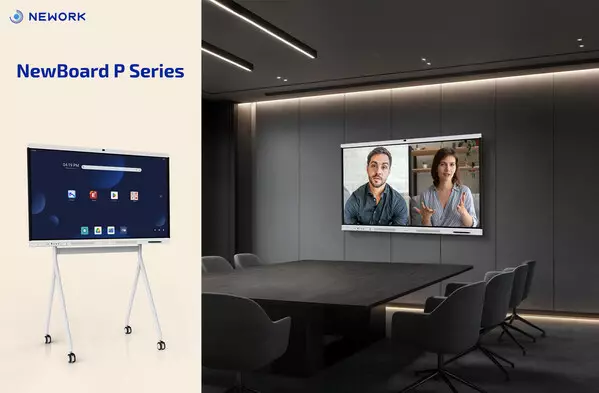
POMONA, Calif., March 11, 2026 /PRNewswire/ -- Nework, an audiovisual and collaborative solutions provider for education, business, and home, has unveiled the NewBoard P Series, a professional audio‑visual collaboration system designed to elevate enterprise meeting environments with integrated camera, speakerphone, and interactive display technologies.
The P Series was designed to address a recurring challenge in workplaces, where large interactive displays often lack the professional audio and video capabilities required for effective meetings, said CTO of Nework. By embedding high‑performance AV modules directly into the display, the system enables a seamless and comprehensive meeting experience in a single device.
The NewBoard P Series represents Nework's effort to move beyond the limitations of conventional interactive displays. In many meeting environments, traditional smart boards require external cameras, microphones, and speakerphones to support video conferencing, which can introduce complexity, additional costs, and inconsistent audio-visual performance. By integrating these professional-grade components directly into its structure, the P Series supports clearer conversations, more natural video communication, and faster deployment across a variety of room sizes.
At the center of the system is a 48MP Sony IMX586 4K camera that produces ultra‑clear, true‑to‑life visuals. AI‑powered auto‑exposure, auto‑focus, and auto‑white‑balance algorithms continuously optimize the image, while the wide field of view ensures comprehensive room coverage. Combined with ultra‑low distortion and accurate color reproduction, the camera is built to deliver consistent performance in huddle rooms, mid-sized meeting spaces, and open collaboration areas.
Complementing the video system is an AQUA DSP 8‑microphone array engineered for far‑field voice pickup ranging from 12 to 16 meters. Advanced noise suppression filters over 300 types of background interference, enabling natural and uninterrupted communication even in dynamic environments. Full‑duplex echo cancellation supports smooth two‑way conversation, addressing the most common acoustic challenges found in remote and hybrid meetings.
The NewBoard P Series further differentiates itself through its seamless, multi-purpose integration. As a true all‑in‑one conferencing device, it combines professional audio‑video hardware with a responsive interactive display featuring 20‑point infrared touch and ultra‑low latency writing. Anti‑glare glass supports comfortable viewing, while the system's intuitive interface enables efficient annotation, screen sharing, and collaborative interaction.
Connectivity is streamlined through a single USB‑C cable that delivers video, audio, touch control, data transfer, and 65W charging. This reduces desktop clutter and simplifies room deployment, particularly in organizations standardizing USB‑C across devices. The system is powered by an octa‑core processor with 8GB RAM and 64GB storage and runs on Android 14 by default. An optional Windows OPS module offers dual‑OS flexibility for enterprises with mixed software environments.
The device is Google EDLA certified, granting secure access to Google apps and services while supporting enterprise management standards. Available in 55-inch, 65-inch, and 75-inch configurations, the P Series accommodates room configurations ranging from small huddle areas to extra‑large conference rooms. The package includes a wall mount, Wi-Fi module, and essential accessories, with optional mobile carts available for organizations requiring flexible deployment. Pricing ranges from $2,399.99 to $2,999.99, depending on size.
With the introduction of the NewBoard P Series, Nework continues to expand its portfolio of enterprise collaboration technologies. By introducing the NewBoard P Series as an advanced alternative to standard interactive displays, the company aims to provide organizations with a more efficient and immersive approach to hybrid meetings and workplace collaboration.
For more information, please visit https://nework.us/, or connect with Nework:
Facebook: https://www.facebook.com/neworkus
LinkedIn: https://www.linkedin.com/company/nework-us/
X: https://x.com/Nework_us
Instagram: https://www.instagram.com/nework.us
YouTube: https://www.youtube.com/@Nework-us
** This press release is distributed by PR Newswire through automated distribution system, for which the client assumes full responsibility. **
Nework Introduces NewBoard P Series, a Professional All‑in‑One Collaboration System for Next-Generation Enterprise Meetings