SUNNYVALE, Calif.--(BUSINESS WIRE)--Mar 11, 2026--
CloudWalk, the technology company behind JIM.com in the United States and InfinitePay in Brazil, closed 2025 with $990 million in revenue - a 104% increase year-over-year on a foreign exchange neutral basis - while crossing a $1.3 billion annualized revenue run rate in December and achieving $1.8 million in revenue per employee with a lean team of 720 people. Net income totaled $110 million in 2025, up 90% year over year.
This press release features multimedia. View the full release here: https://www.businesswire.com/news/home/20260311778452/en/
Scale usually comes at the cost of speed. CloudWalk scaled and accelerated.
The defining milestone came in July 2025, when the company crossed $1 billion in annualized revenue - just six years after generating $2 million with the launch of InfinitePay in Brazil in 2019. That trajectory represents a 186% compound annual growth rate.
Autonomous AI as the Operating Model
These results come from a different kind of infrastructure. Powered by proprietary large language models pre-trained on its dedicated GPU cluster, a new generation of autonomous AI agents now independently build software, underwrite credit, prevent fraud, close sales, resolve customer issues, and create marketing campaigns - with humans setting policy, handling exceptions, and governing risk.
“Every fintech says they use AI. We are an AI company that happens to do finance,” said Luis Silva, CEO and founder of CloudWalk. “Our agents do not assist employees - they perform the work. And now, through JIM.com, they perform the work for our customers too. That is how we reached a $1.3 billion run rate with only 720 people.”
US Expansion: JIM.com
JIM.com, the first product built entirely on this autonomous AI model, launched in the United States in early 2025. It solves one urgent problem for micro-merchants and gig workers: instant access to their money. The app turns any smartphone into a payment terminal with immediate settlement and one of the most competitive flat-fee structures in the market.
Adoption accelerated quickly through word of mouth, reaching tens of thousands of merchants across all 50 states within months. But JIM.com is not a payments app. It is the first autonomous financial agent that works for the seller, not the other way around. When a payment declines, the agent diagnoses and resolves it before the seller picks up the phone. When cash flow is at risk, the agent acts before the merchant even knows. When a seller needs a website, the agent builds and publishes it from transaction data alone. “There is no dashboard. No manual. No learning curve. The agent runs the business and the merchant runs their life,” said Silva.
Brazil: Over 6.3 Million Sellers
In Brazil, InfinitePay grew from 3 million to over 6.3 million active sellers in 2025 and became the most downloaded finance app in the Brazilian App Store in December. CloudWalk secured a full credit institution license from the Central Bank, gaining complete autonomy over credit operations and unlocking investment products. Fitch Ratings assigned the company its first rating: AA-(bra) with Positive Outlook.
The Road Ahead
CloudWalk is building Self-Driving Finance - an autonomous financial system where AI agents manage payments, credit, settlement, and strategic decisions with minimal human intervention. With operations in the United States and Brazil, and a model that compounds efficiency as it scales, the company is positioned for its next phase of global expansion.
“Most companies slow down as they grow. We doubled revenue with just 720 people,” said Silva. “The model is proven. Now it scales.”

Luis Silva, CEO of CloudWalk
MINNEAPOLIS (AP) — Blake Cashman led an onslaught of pressure all afternoon. Harrison Smith had the game-sealing interception.
The Minnesota Vikings aren't scoring much, but a near-impenetrable defense has so far had all the support it's needed to fuel the NFC's last undefeated team.
Kyler Murray and the Vikings overcame another sluggish start and remained unbeaten with a 16-10 victory over the spiraling Indianapolis Colts on Sunday.
“We feel really comfortable and confident to win football games when we don’t turn it over and we win the field position and boring stuff like that, because we know over the course of 60 minutes what that side can do,” Vikings coach Kevin O'Connell said.
Cashman, the eighth-year linebacker who is thriving as the primary communicator for defensive coordinator Brian Flores, had 12 tackles, two sacks, four passes defensed and three hits on quarterback Daniel Jones for the Vikings (6-0), who have allowed a league-low 74 points.
Smith picked off Jones around midfield with about a minute left to kill the last-ditch drive by the Colts (2-5) before it ever got going. It was his 40th career interception. Smith planted the ball on the 40-yard line to mark the occasion as the crowd at U.S. Bank Stadium chanted: “Harry! Harry! Harry!”
“There’s a lot of fight in this group,” said Smith, a six-time Pro Bowl safety who decided right before the regular season to return for his 15th year with the Vikings.
Will Reichard made three field goals for the Vikings, including a 52-yarder with 1:39 left after his 59-yard try was blocked by Grover Stewart earlier in the fourth quarter.
Jonathan Taylor gave the Colts the lead they kept for more than three quarters of the game with a 38-yard touchdown run on their opening drive, but Spencer Shrader missed two field goals in the second half.
The miss from 56 yards that coach Shane Steichen called for on fourth-and-2 set the Vikings up for their only touchdown, when Murray used a 35-yard run to get in range for a short scoring pass to T.J. Hockenson. That was just the 10th touchdown for the offense in six games.
“We’ll continue to get better. I know we will. I know we keep saying that, but I felt like we moved the ball well today,” said Murray, who was 14 for 24 for 150 yards. “We’ve just got to put the ball in the end zone.”
Jones went 13 for 22 for 108 yards and lost 44 yards on four sacks, with Flores relentlessly sending blitzers into the backfield.
“I think we expected it to be this kind of game, kind of an ugly game, and credit to them on defense,” said Jones, who spent the last half of the 2024 season as a backup with the Vikings. “They have a good system and do good stuff.”
Jones has just four touchdown passes and seven interceptions in seven games, but Steichen said afterward he's not considering a switch.
“I've got a ton of faith in Daniel,” Steichen said.
Reichard hit from 28 and 47 yards in the second quarter to set the franchise record with 35 consecutive made field goals, which was the longest active streak in the league — until the block.
Shrader, who leads the NFL in scoring this season with 70 points, had his streak of 22 straight made field goals end with his wide-left miss that had heavy pressure off the edge by former Colts cornerback Isaiah Rodgers. That also stopped Shrader's run of seven makes in a row from 50-plus yards.
Colts: With standout Sauce Gardner (calf) inactive, the CB depth chart was chewed up in the second half when Justin Walley (knee) and Cam Taylor-Britt (groin) left with injuries. ... TE Tyler Warren (groin) missed his second straight game. LB Jaylon Carlies (ribs) returned to the starting lineup after missing two games.
Vikings: RB Aaron Jones aggravated a nagging knee injury in the fourth quarter when he took a low hit at the end of a 17-yard run. He didn't return.
Colts: at Jacksonville next Sunday.
Vikings: at Detroit next Sunday.
See AP’s full NFL coverage here
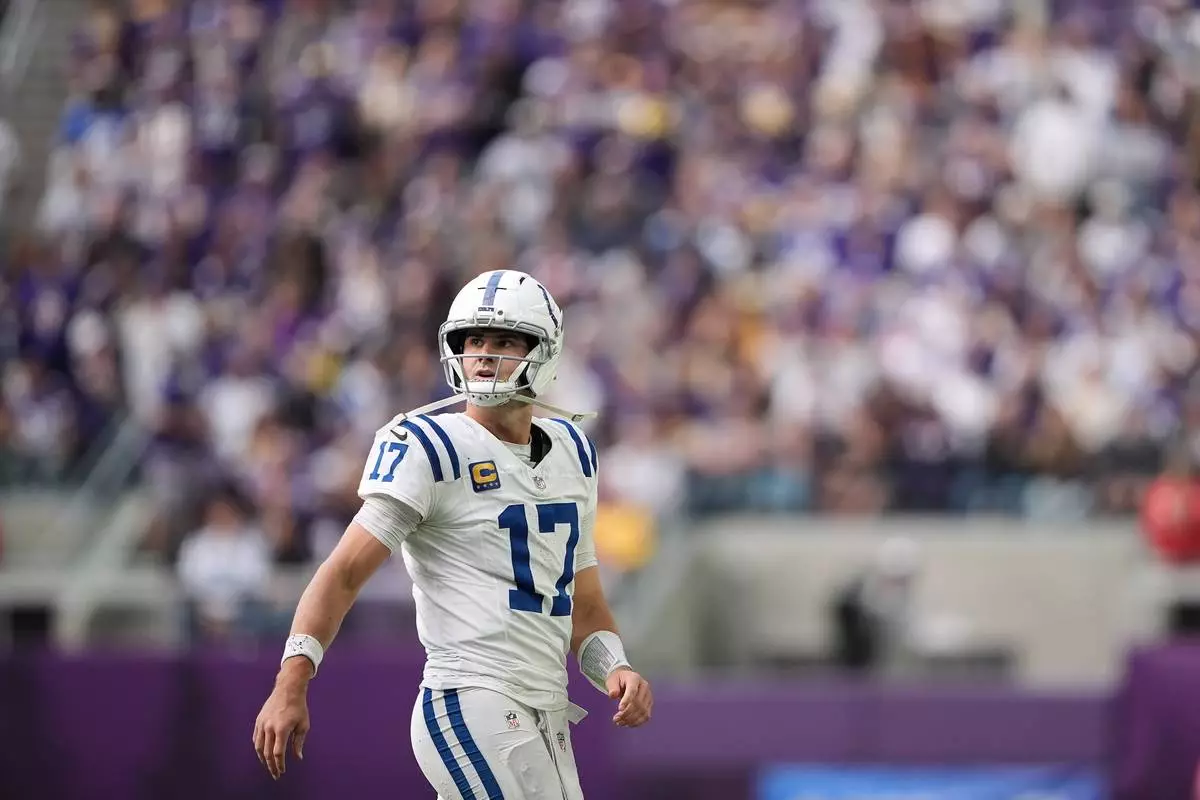
Indianapolis Colts quarterback Daniel Jones (17) walks on the field during the first half of an NFL football game against the Minnesota Vikings in Minneapolis, Sunday, Oct. 25, 2026. (AP Photo/Ellen Schmidt)
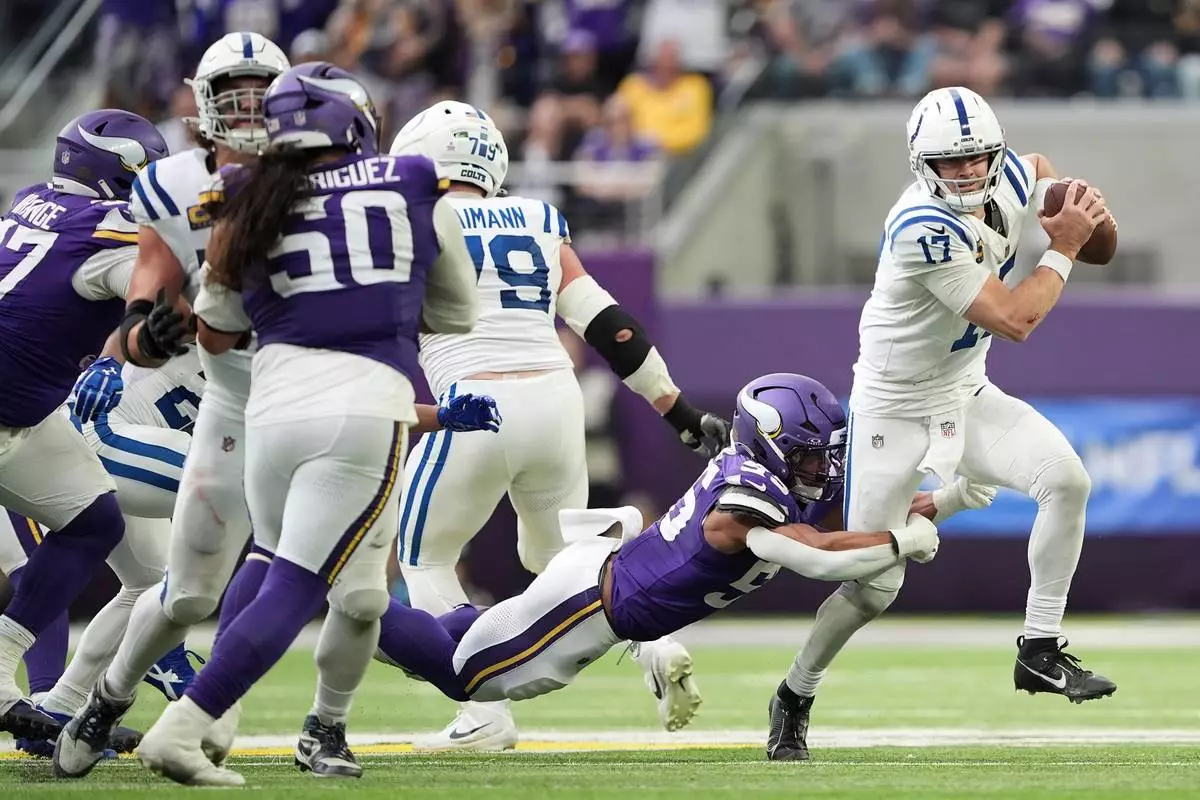
Indianapolis Colts quarterback Daniel Jones (17) tries to scramble away from Minnesota Vikings linebacker Eric Wilson, bottom, during the second half of an NFL football game in Minneapolis, Sunday, Oct. 25, 2026. (AP Photo/Ellen Schmidt)
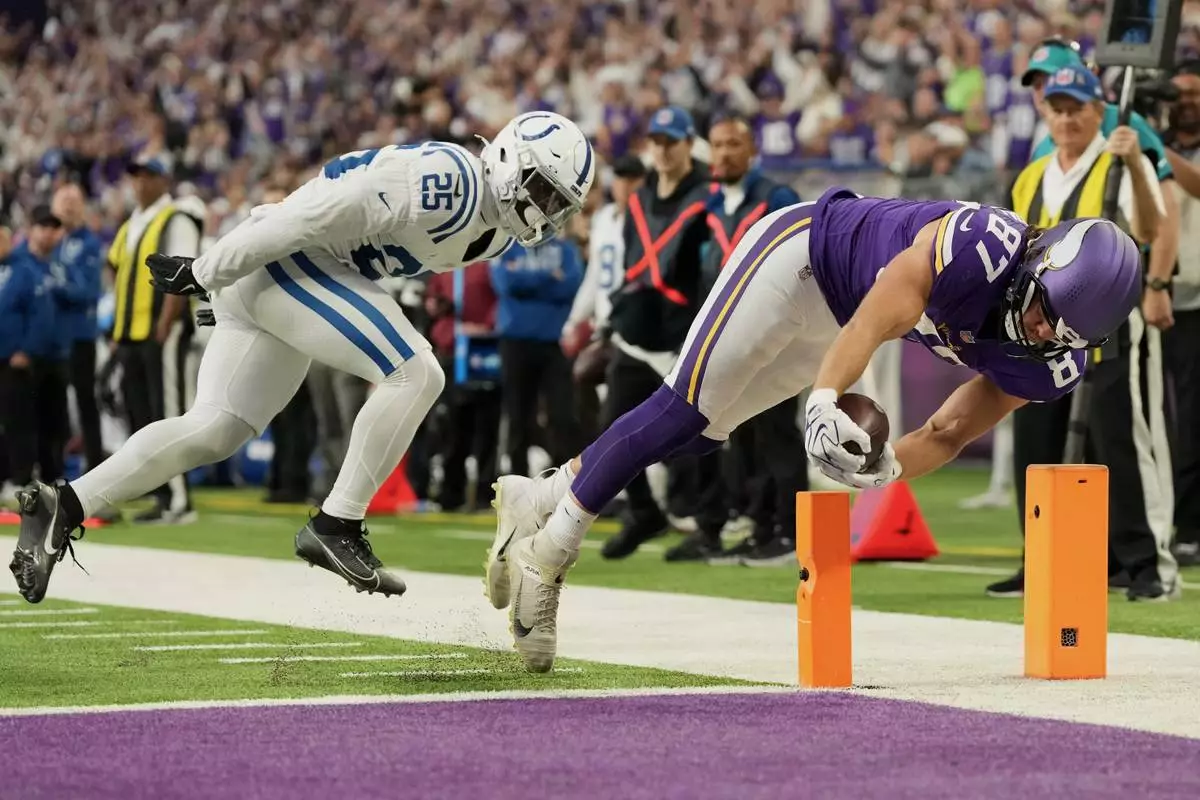
Minnesota Vikings tight end T.J. Hockenson (87) scores past Indianapolis Colts safety A.J. Haulcy (25) during the second half of an NFL football game in Minneapolis, Sunday, Oct. 25, 2026. (AP Photo/Ellen Schmidt)
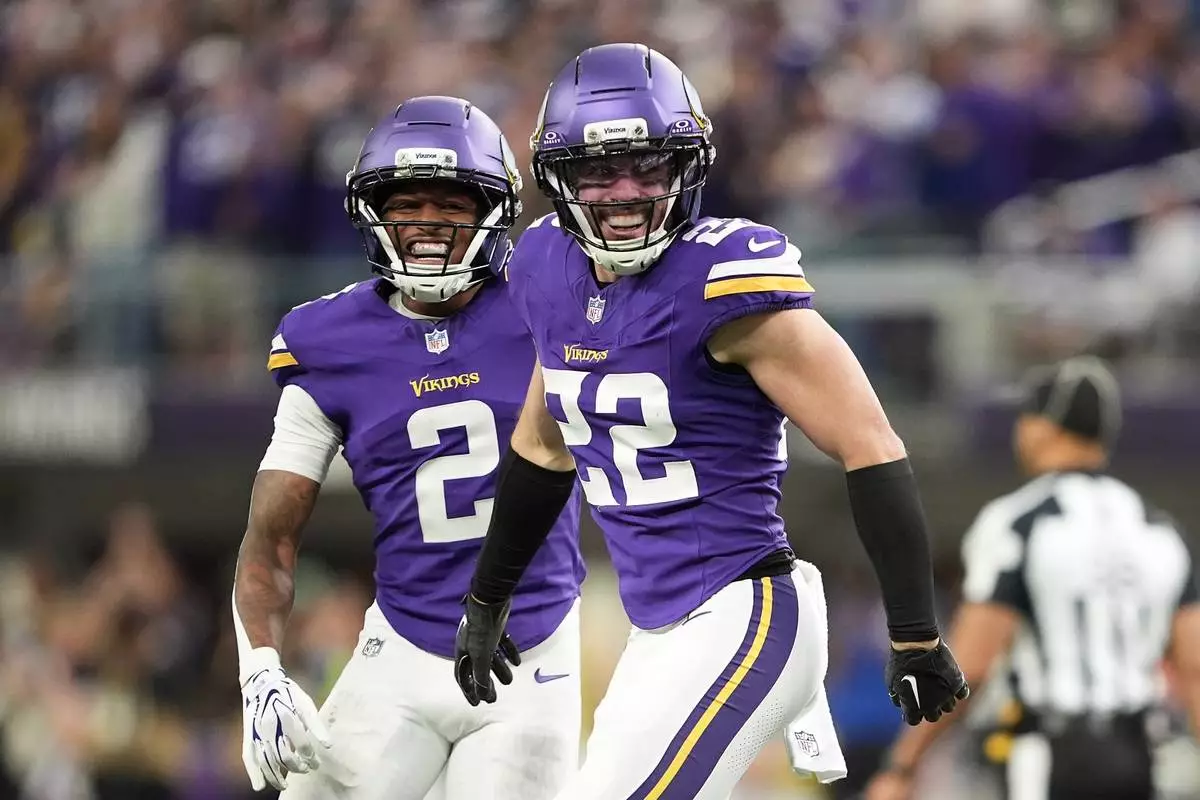
Minnesota Vikings safety Harrison Smith (22) celebrates with cornerback Isaiah Rodgers (2) after intercepting a pass against the Indianapolis Colts during the second half of an NFL football game in Minneapolis, Sunday, Oct. 25, 2026. (AP Photo/Ellen Schmidt)