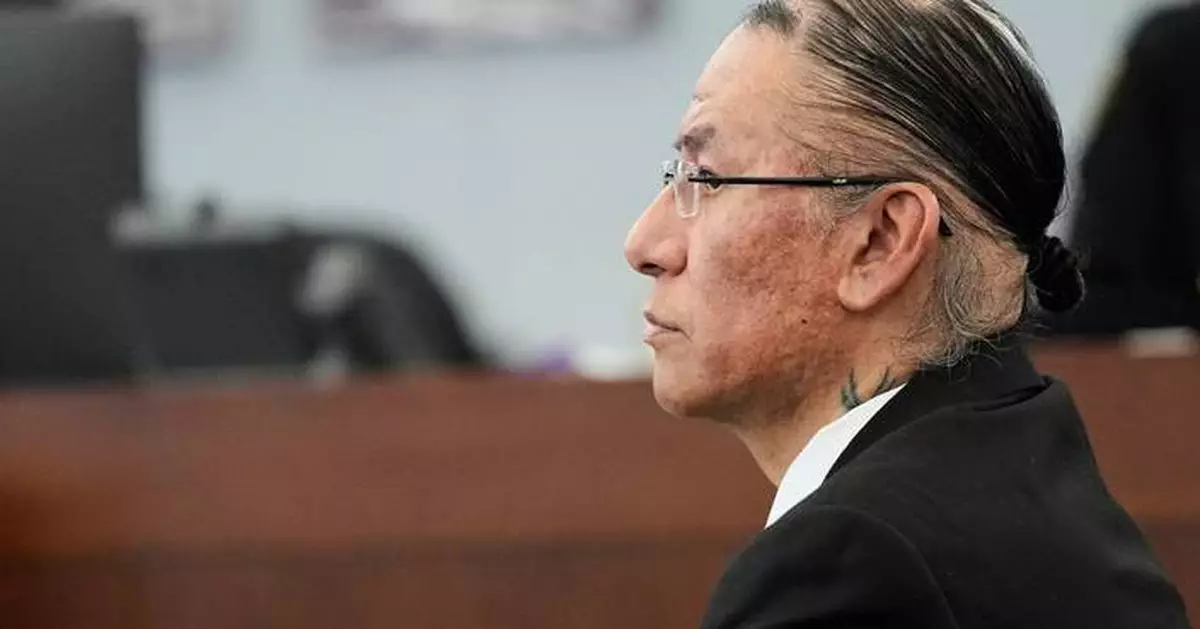
LAS VEGAS (AP) — The sentencing for Nathan Chasing Horse following his conviction for sexual assault of Indigenous women and girls has been delayed by a week.
The sentencing was scheduled to take place Wednesday, but Judge Jessica Peterson agreed to move the hearing to March 18. It will bring to a close a case that sent shock waves through Indian Country.
The sentencing of the “Dances With Wolves” actor comes about a month after a Nevada jury convicted him on 13 of the 21 charges he faced. Most related to his conduct with a victim who was 14 when he began assaulting her. Chasing Horse was acquitted of some sexual assault charges.
He faces a minimum of 25 years in prison.
Following the trial, Chasing Horse’s attorney Craig Mueller filed a motion for a new trial, arguing a witness was not qualified to talk about grooming and that the statute of limitations had expired. That motion was denied.
The sentencing wraps a yearslong effort to prosecute the former actor after he was first arrested and indicted in 2023. That initial arrest reverberated around Indian Country, with law enforcement in other states and Canada following up with more criminal charges.
The British Columbia Prosecution Service said Chasing Horse was charged with sexual assault in February 2023, though the date of the alleged offense took place in September 2018 near Keremeos, a village about four hours east of Vancouver. In November 2023, the case paused due to Chasing Horse’s charges in the United States, but resumed the following year.
After all of Chasing Horse’s appeals have been exhausted, British Columbia prosecutors will assess next steps, Damienne Darby, communications counsel for the British Columbia Prosecution Service, said in an email Tuesday.
The Tsuut’ina Nation Police Service in Alberta said in a statement following Chasing Horse’s conviction that a warrant remains outstanding against him and said that it is in contact with the Alberta Crown Prosecutors Office regarding the warrant.
Nevada prosecutors said Chasing Horse used his reputation as a Lakota medicine man to prey on Indigenous women and girls.
Deputy District Attorney Bianca Pucci told the jury that for almost 20 years, Chasing Horse “spun a web of abuse” that ensnared many women.
Jurors heard from three women who said Chasing Horse sexually assaulted them. The jury returned guilty verdicts on some charges related to all three.
Following his appearance as Smiles a Lot in Kevin Costner’s Oscar-winning film “Dances With Wolves,” Chasing Horse, born on the Rosebud Reservation in South Dakota, traveled across Indian Country to attend powwows and perform healing ceremonies.
Multiple victims described how they participated in his ceremonies or went to Chasing Horse for medical help.
The main accuser was 14 in 2012 when Chasing Horse allegedly told her the spirits wanted her to give up her virginity to save her mother, who was diagnosed with cancer. He then sexually assaulted her and told her that if she told anyone, her mother would die, according to Pucci. The sexual assaults continued for years, Pucci said.
He denied the allegations and his attorney questioned the main accuser’s credibility, calling her a “scorned woman.”
FILE - Nathan Chasing Horse appears in court for his trial on charges of sexually abusing Indigenous women and girls, Jan. 20, 2026, in Las Vegas. (AP Photo/John Locher, File)
JERUSALEM (AP) — When Hersh Goldberg-Polin was in the tunnels in Gaza, fellow hostages say he often quoted a line from Holocaust survivor Viktor Frankl: “Those who have a ‘why’ to live can bear with almost any ‘how.’”
Through his long months in captivity, family and friends hoped that, like Frankl, he would come back with a message of hope. Then, in August 2024, after nearly a year in captivity, he and five other hostages were shot dead by their captors deep underground, likely as Israeli forces were closing in.
The quest for his why has fallen to his family, who led a high-profile campaign for his release. His mother, Rachel Goldberg-Polin, has a new book released Tuesday.
“When We See You Again” has no narrative arc, no tidy uplifting message, no score settling with the Hamas militants who killed her son or the Israeli leaders who many blamed for his death — only a searing account of her grief.
She hasn’t yet decided whether the book is an exceptionally painful love story, or a love-filled pain story.
“I’m still trying to figure out with clarity what is my why, but it’s clear to me that my why is not done,” Goldberg-Polin said, a photo of a smiling Hersh behind her. “I just really wanted to tell the truth. It’s very ugly.”
Hersh was among the 251 people abducted by Hamas in its Oct. 7, 2023, attack. His hand was blown off by a grenade before he was dragged into Gaza and eventually into the militant group’s labyrinth of tunnels.
The war sparked by the attack led to the killing of over 70,000 Palestinians and the destruction of much of Gaza before a ceasefire deal in October led to the release of all the remaining hostages. Hersh had been killed, along with five other hostages, more than a year earlier.
Rachel had campaigned tirelessly for her son’s release, appearing in countless media interviews, meeting with then-President Joe Biden and addressing the Democratic National Convention. She also joined mass protests in Israel accusing the government of failing to reach a deal sooner.
Her son was among the best-known hostages. Posters and graffiti with his name and face still appear across the country, often bearing the line popularized by Frankl.
In her memoir, Rachel takes care not to mythologize him. She notes that he picked his scabs as a kid and was bad at doing dishes.
“Hersh has become a symbol to many,” Goldberg-Polin writes in the book. “I don’t know what to do with that. But it’s OK. If people need Hersh to be something, he will be that. That is the essence of service, being what is needed.”
Rachel grew up in Chicago and moved to Israel with her husband and three children when Hersh, the oldest, was 6. She tells stories from the “before time”: of how Hersh as a child would wow people with his encyclopedic knowledge of U.S. presidents, and how he loved Jerusalem's local soccer team and their sister team in Bremen, Germany.
She only briefly touches on his capture and the details of his captivity, which have been widely reported. She writes about their desperate search for information in the chaotic and terrifying days after the attack, their long fight for his release and the news of Hersh's killing, along with five others, after 328 days.
The book is mostly a “very raw, peeled, oozing, throbbing pain,” Goldberg-Polin said. She describes “hundreds of sodden days dripping with anguish.”
“The book really started just as a way of taking this tremendous weight of suffering that was causing my soul to buckle,” she said in an interview in Jerusalem.
The writing came out in bursts, without a plan for a final project, just a question of “How do I survive the next 15 minutes?” she said.
The book emerged in part from her frustration when people asked how she was. “I think, ‘Well, do you not see this dagger sticking out of my chest at my heart? How can you possibly be asking me that?’” she said. “But I realized they don’t see it. And it’s not because they’re mean or insensitive. They simply don’t see it.”
“Someone who’s born blind doesn’t know what blue is, and it’s very difficult to describe blue to someone who’s blind. But I’m desperate for people to see my blue, and I’m yearning for people to feel my pain,” she said.
Then there were those who wanted to share their own stories of death and loss, even during her son’s shiva, the traditional Jewish week of mourning after the funeral. It’s an experience that she describes as overwhelming and eye-opening, revealing the “surplus of suffering” in the world.
“They’re not trying to comfort me, they’re saying: ‘Let me stand next to you and we’ll be in this together,’” she said.
During the campaign to release the hostages, one of Rachel’s mantras was “Hope is mandatory,” even when it felt impossible. Now, wherever they go, people ask her and her husband for a bit of their creased and crumpled hope.
She has no easy answers, as she tells Hersh in a letter addressed to her dead son near the end of the book.
“I will carry your why,” she writes. “I'll do it, I’ll carry your why around the world.”
FILE - Jon Polin, left, and Rachel Goldberg, parents of Hersh Goldberg-Polin, pictured on screen speak during the Democratic National Convention Wednesday, Aug. 21, 2024, in Chicago. (AP Photo/J. Scott Applewhite, File)
FILE - Friends and supporters of Israeli-American hostage Hersh Goldberg-Polin, who was kidnapped to the Gaza Strip on Oct. 7, 2023, protest outside of Israeli Prime Minister Benjamin Netanyahu's residence to demand a deal for the immediate release of all hostages, after Hamas released a video of Goldberg-Polin, in Jerusalem, Wednesday, April 24, 2024. (AP Photo/Maya Alleruzzo, File)
FILE - Jonathan Polin and Rachel Goldberg, parents of Israeli-American hostage Hersh Goldberg-Polin, who was killed in Hamas captivity in the Gaza Strip, attend their son's funeral in Jerusalem, Monday, Sept. 2, 2024. (Gil Cohen-Magen/Pool via AP, File)
Rachel Goldberg-Polin, whose 23-year-old son, Hersh, was kidnapped on Oct. 7, 2023 Hamas cross border attack on Israel and killed in Gaza nearly a year later, poses for a photo in Jerusalem, Wednesday, April 15, 2026. (AP Photo/Ohad Zwigenberg)
Rachel Goldberg-Polin, whose 23-year-old son, Hersh, was kidnapped on Oct. 7, 2023 Hamas cross border attack on Israel and killed in Gaza nearly a year later, poses for a photo with her new book "When We See You Again," in Jerusalem, Wednesday, April 15, 2026. (AP Photo/Ohad Zwigenberg)