-
- Globalization holds firm at a record level while trade flows in Asia expand and diversify
- Despite geopolitical tensions and rising uncertainty, countries largely maintain trade and investment ties with their traditional partner countries
- Record-long trade distances, AI-driven commerce, and resilient cross‑border flows paint a surprisingly robust picture of globalization
- U.S.–China trade fell to 2.0% of global trade, down from 2.7% in 2024
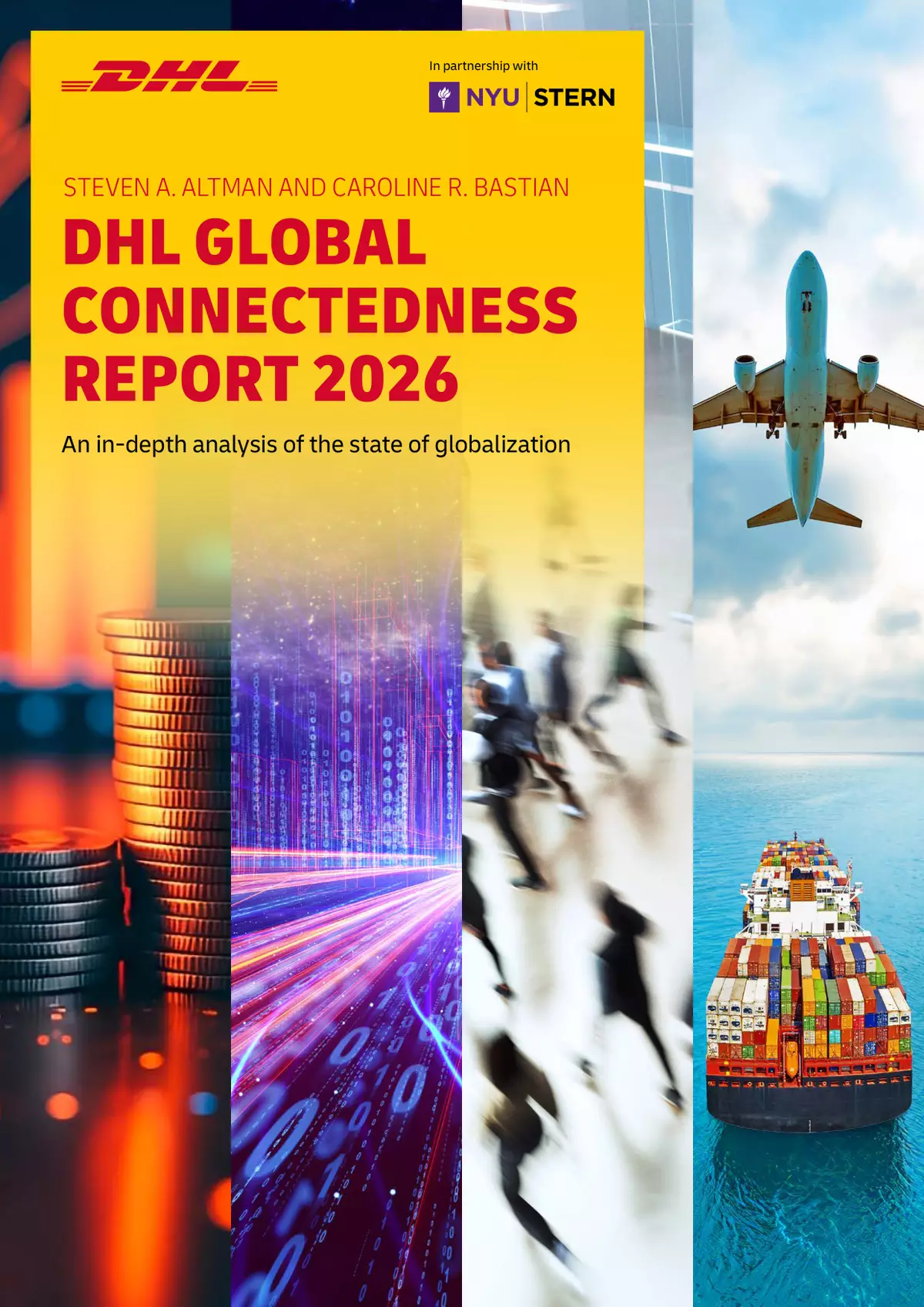
SINGAPORE / HANOI, VIETNAM / NEW YORK, US - Media OutReach Newswire - 13 March 2026 - Globalization remains at a historically high level at 25% in 2025 – despite escalating geopolitical tensions, rising U.S. tariffs, and uncertainty about future trade policies. Equally, the Asia Pacific region features prominently in this year's DHL Global Connectedness Report, with Singapore ranked #1 globally. A broad swath of regional economies in the Asia Pacific region has also strengthened its position on cross-border flows. The DHL Global Connectedness Report 2026 is produced with New York University's Stern School of Business. It examines four 'pillars' measuring the depth and breadth of trade, capital, information, and people flows.
DHL Global Connectedness Report 2026
Asia Pacific remains a global anchor in cross-border trade
The Asia Pacific region is one of the world's strongest pillars of global connectedness with several markets continuing to post strong breadth and depth of international ties. In fact, broad-based gains were observed across the Southeast Asia, Northeast Asia, and Oceania regions. The report shows East Asia & Pacific's share of world trade has climbed from 24% (2001) to 32% (2025), underscoring the region's long-run momentum. Several other economies in Asia Pacific also advanced sharply in the global connectedness ranking: Malaysia (#16; +13 ranks), Thailand (#27; +7), Korea (#31; +6), Taiwan (#32; +4), and Vietnam (#36; +3).
Intra-Asia trade has also strengthened since 2023. The report's country profiles show that Asia-Pacific economies are deeply networked within the region, with most major trade and investment flows anchored in Asian partner markets. At the same time, China's redirected exports to ASEAN markets—up 13% (+USD 79 billion) in 2025 — further cement ASEAN's position as a fast growing trade corridor.
Singapore leads the country ranking
Singapore has retained the top position among 180 economies – reflecting exceptional depth in trade and capital flows. The country is ranked first on the trade pillar (out of 180 countries) and second on the capital pillar (out of 158 countries). Particularly on trade flows, Singapore ranks first on 'depth' (up one place from 2019), with the largest international flows relative to its domestic economy. Additionally, the city-state stands out most for the breadth of its inward foreign domestic investment (FDI) stocks (ranked first worldwide).
"Asia Pacific continues to demonstrate extraordinary resilience and adaptability," said Ken Lee, CEO of DHL Express Asia Pacific. "The DHL Global Connectedness Report shows that countries across our region – from Singapore to Malaysia, Thailand, Vietnam and beyond – are deepening their global ties and attracting new trade flows. Even as global patterns shift, Asia remains a central engine of global trade. This is why we continue to invest in and enhance our Asia Pacific network, particularly in the eight fast-growing markets that DHL Group has identified. Our priority is to support businesses to stay connected and diversify their markets."
AI boom and race to beat tariff hikes fueled trade in 2025
Global trade grew faster in 2025 than in any year since 2017, excluding the volatile Covid-19 period. U.S. importers accelerated shipments early in the year ahead of tariff increases. U.S. imports dropped below prior-year levels, but rising Chinese exports to non-U.S. markets helped sustain global trade volumes.
Trade in AI-related goods surged as countries and companies raced to build AI infrastructure. AI-related products drove 42% of goods trade growth in the first three quarters of 2025, according to WTO figures. In fact, AI hardware and data infrastructure are amplifying Asia Pacific's trade. Notably, Taiwan, Korea, Singapore and Malaysia's tech supply chains are benefitting from the surge in demand for AI chips, servers and data center buildouts. In answer, DHL Express has added significant payload capacity for flights out of Hanoi to support Vietnam's rapidly expanding tech manufacturing sector.
Trade outlook: growth continues, even with higher tariffs
Looking ahead, recent U.S. tariff increases are expected to modestly slow trade growth in 2026 – but not stop it. Global goods trade is projected to expand by an average of 2.6% per year through 2029, in line with the past decade.
One reason trade can keep growing despite U.S. tariff hikes is that most trade does not involve the U.S. In 2025, 13% of imports went to the U.S., and 9% of exports came from the U.S. In addition, many countries are pursuing new trade agreements to secure access to alternative markets, such as the recently minted India-EU free trade agreement.
Information flows face barriers, people flows reach new highs
The report notes that people flows – travel, migration, and student mobility – have fully recovered and reached record highs. This trend is especially pronounced in Asia Pacific, where highly connected hubs such as Singapore and Hong Kong continue to attract substantial cross‑border movement.
Many of the region's most connected markets, such as Hong Kong SAR, Japan, and Korea – remain deeply tied to global data and digital exchanges as these have risen in ranks in the information pillar since 2019. Capital flows remain resilient overall in the region, where there is no broad shift of investment from foreign to domestic markets.
U.S.–China tensions affect only small share of global flows
The report also finds that ties between the world's two largest economies – the U.S. and China – continue to weaken. However, these ties are surprisingly small in a global perspective. For example, trade between the U.S. and China accounted for 3.6% of world trade at its peak in 2015, before falling to 2.7% in 2024 and to only 2.0% during the first three quarters of 2025. The U.S.–China share of international business investment is even smaller – less than 1% in 2025.
No global split into rival blocs
Even as the U.S. and China decouple, most countries – including those in Asia – continue to engage with their longstanding partners. Over the past decade, only 4–6% of global goods trade, greenfield FDI, and cross-border M&A have shifted away from geopolitical rivals. Of these flows, most have not moved to close allies but to countries with flexible geopolitical positions, such as India and Vietnam. Overall, the world economy remains far from a broad split into rival blocs.
"The politics and policy surrounding globalization are much more volatile than the actual flows between countries," said Prof. Steven A. Altman, Director of the DHL Initiative on Globalization at NYU Stern's Center for the Future of Management. "In Asia Pacific, as in the rest of the world, the data shows that cross‑border flows have remained remarkably resilient despite heightened geopolitical tensions. Sound decision‑making in this region requires a calibrated view of how much global business ties are really changing. The risks to globalization are real, but so is the resilience of global flows, and Asia Pacific continues to play a pivotal role in sustaining that connectivity."
The DHL Global Connectedness Report
Published regularly since 2011, the DHL Global Connectedness Report provides reliable insights on globalization by analyzing 14 types of international trade, capital, information, and people flows. The 2026 edition is based on more than 9 million data points. It ranks the connectedness of 180 countries, accounting for 99.6 percent of global gross domestic product and 99.0 percent of the world's population. A set of 180 one-page country profiles summarizes each country's pattern of globalization.
The report was commissioned by DHL and authored by Steven A. Altman and Caroline R. Bastian of New York University Stern School of Business.
Note to editors:
-
-
- The report and further resources are available at dhl.com/gcr.
- DHL Group's "GT20 Initiative" refers to 20 markets worldwide that the Group has identified to benefit strongest from Geographic Tailwind. Eight of them are in Asia Pacific including China, India, Indonesia, Malaysia, the Philippines, Singapore, Thailand, and Vietnam.
-
Hashtag: #DHL
The issuer is solely responsible for the content of this announcement.
DHL – The logistics company for the world
DHL Group is the world's leading logistics company. The Group connects people and markets and is an enabler of global trade. It aspires to be the first choice for customers, employees, investors and green logistics worldwide. To this end, DHL Group is focusing on accelerating sustainable growth in its profitable core logistics businesses and Group growth initiatives. The Group contributes to the world through sustainable business practices, corporate citizenship, and environmental activities. By the year 2050, DHL Group aims to achieve net-zero emissions logistics.
DHL Group is home to two strong brands: DHL offers a comprehensive range of parcel, express, freight transport, and supply chain management services as well as e-commerce logistics solutions. Deutsche Post is the largest postal service provider in Europe and the market leader in the German mail market. DHL Group employs approximately 584,000 people in over 220 countries and territories worldwide. The Group generated revenues of approximately 82.9 billion Euros in 2025.
The logistics company for the world.
New York University Stern School of Business
New York University Stern School of Business, located in the heart of Greenwich Village and deeply connected to the City after which it is named, is one of the United States' premier management education schools and research centers. NYU Stern offers a broad portfolio of transformational programs at graduate, undergraduate, and executive levels, all of them enriched by the dynamism and deep resources of one of the world's business capitals. NYU Stern is a welcoming community that inspires its members to embrace and lead change in a rapidly transforming world. Visit www.stern.nyu.edu.
** This press release is distributed by Media OutReach Newswire through automated distribution system, for which the client assumes full responsibility. **