Skip to Content Facebook Feature Image

US weather to go nuts with blizzard, polar vortex, heat dome, atmospheric river all at once

News

US weather to go nuts with blizzard, polar vortex, heat dome, atmospheric river all at once
News

News

US weather to go nuts with blizzard, polar vortex, heat dome, atmospheric river all at once

2026-03-13 12:03 Last Updated At:15:27

Nearly every part of the United States is getting walloped by wild weather or just about to be.

Days of downpours have begun in Hawaii. The Southwest will soon bake with day after day of record 100-degree-plus (38 Celsius-plus) heat. Two storms will dump snow by the foot over northern Great Lakes states. And the dreaded polar vortex will again invade the Midwest and East with soul-crushing Arctic chill.

More Images
A person walks through falling snow at the White House on Thursday, March 12, 2026, in Washington. (AP Photo/Allison Robbert)

A person walks through falling snow at the White House on Thursday, March 12, 2026, in Washington. (AP Photo/Allison Robbert)

People cover themselves from the heat with umbrellas while waiting at a food distribution site Wednesday, March 11, 2026, in Los Angeles. (AP Photo/Damian Dovarganes)

People cover themselves from the heat with umbrellas while waiting at a food distribution site Wednesday, March 11, 2026, in Los Angeles. (AP Photo/Damian Dovarganes)

Construction workers spray water during an unseasonably hot day at MacArthur Park on Thursday, Mar. 12, 2026 in Los Angeles. (AP Photo/Ryan Sun)
Construction workers spray water during an unseasonably hot day at MacArthur Park on Thursday, Mar. 12, 2026 in Los Angeles. (AP Photo/Ryan Sun)

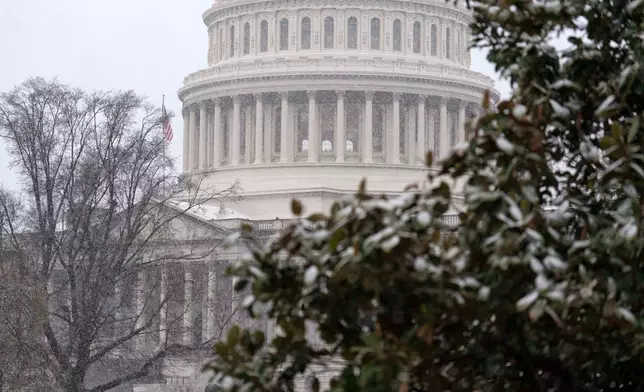
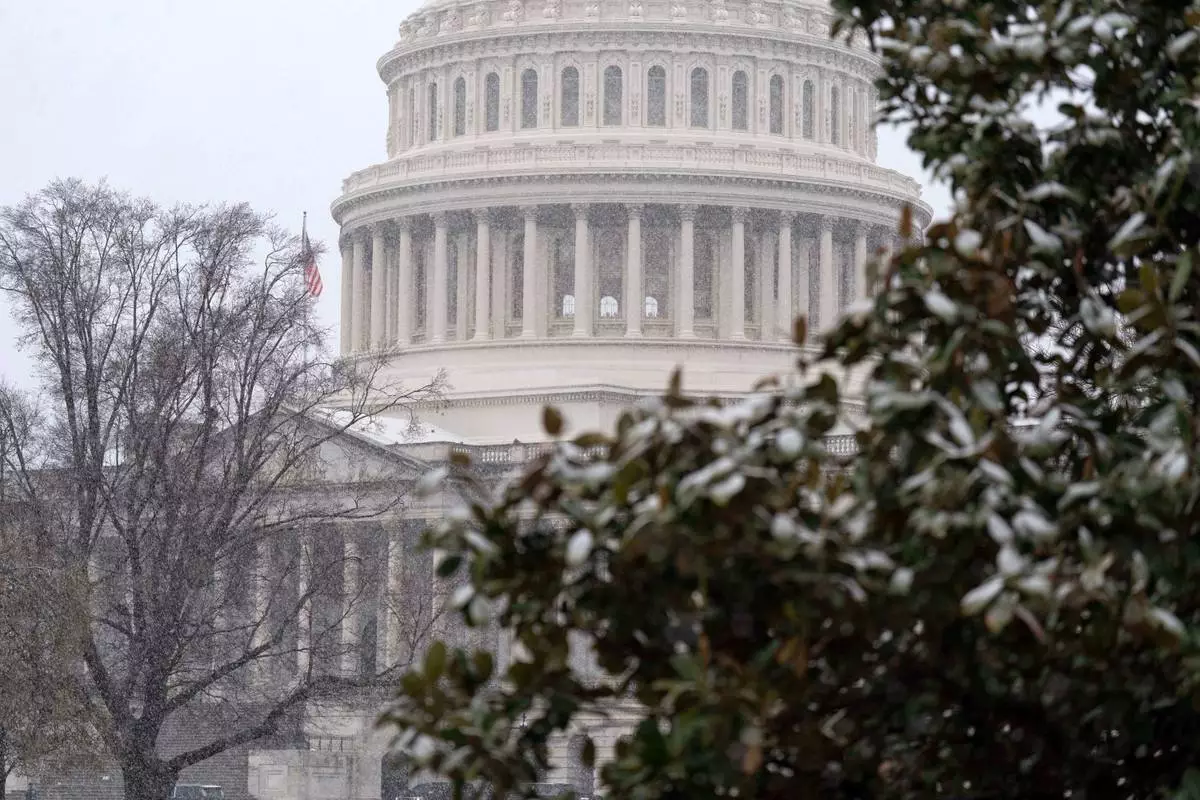
The U.S. Capitol is seen during a snowy day on Capitol Hill Thursday, March 12, 2026, in Washington. (AP Photo/Jose Luis Magana)

The U.S. Capitol is seen during a snowy day on Capitol Hill Thursday, March 12, 2026, in Washington. (AP Photo/Jose Luis Magana)

A pedestrian holds a cloud themed umbrella under a sunny day next to Los Angeles City Hall in Los Angeles Thursday, March. 12, 2026. (AP Photo/Damian Dovarganes)

A pedestrian holds a cloud themed umbrella under a sunny day next to Los Angeles City Hall in Los Angeles Thursday, March. 12, 2026. (AP Photo/Damian Dovarganes)

This forecast of extremes comes as weather whiplash already hit much of the East. On Wednesday, Washington, D.C. residents walked around in shorts in record-breaking 86 degrees Fahrenheit (about 30 Celsius). On Thursday, it snowed.

“All of the country, even if you’re not necessarily seeing extremes, are going to see generally changing from cold to warm, or warm to cold to warm,” said meteorologist Marc Chenard of the weather service’s Weather Prediction Center in Maryland.

Former National Oceanic and Atmospheric Administration chief scientist Ryan Maue said he expects extreme weather in all 50 states.

A heat dome will form early next week and park over the Southwest, baking temperatures to triple digits that haven't been seen this early in the year, Maue and Chenard said.

Some forecasts see 98 (almost 37 Celsius) in Phoenix on Tuesday, followed by 103, 105 and two days of 107 (almost 42 C). In 137 years of record-keeping, Phoenix never hit 100 before March 26 and usually hit its first 100-degree day in early May, according to the weather service, which warned people: “Since we are not acclimated to this level of heat this early in the year, it will be more impactful than usual.”

It has already started in Los Angeles with unusual 90-degree March weather that had people in shorts and tank tops seeking shade anywhere they could get it, even if it was as slender as a light post.

Shane Dixon, 40, usually runs about 5 miles near his home in Culver City without much effort, he said, his face glistening with sweat and his T-shirt tucked into his shorts. But Thursday was hard because of the heat, and he had to cut it short.

“The back of my neck was melting,” he said. But he preferred it to the cold and snow that will hit elsewhere.

“I could go literally soak myself and walk out in the sun and I’ll make it home fine. If it was freezing cold I could not do this,” he said.

Around the same time as the heat starts blasting Phoenix, the polar vortex — a system that usually keeps frigid air penned up near the North Pole — is forecast to send its chill deep into the Midwest and East, even bordering some of the Southeast, Maue said

Minneapolis will hover around zero for a low, and Chicago will be in the single digits Tuesday. The next day “temperatures in the teens and 20s in the northeast and 20s in the Mid-Atlantic,” Maue said. Even Atlanta could drop to the 20s.

Two storm systems in a row — one Friday, then another Sunday into Monday — will chug along the country's northern tier and Great Lakes and between them could dump 3 to 4 feet of snow in places, Maue said.

That bigger second storm system will see its barometric pressure drop so quickly and sharply — meaning it is intensifying and winds are strengthening — that it will qualify as a bomb cyclone, which is quite unusual to develop over land. Normally bomb cyclones get their energy from warm ocean waters, but this one will draw power from the polar vortex.

Maue said Hawaii is getting an atmospheric river that will have such persistent heavy rain that flooding will be a major issue. Oahu is under a flash flood warning.

And Alaska is normally frigid now, but it will be about 30 degrees colder than usual, he said.

It is “the time of year where we can see stuff like this,” Chenard said. “But this does seem even anomalous from what you would typically see. I mean, some of these areas will be setting records. Record-high temperatures for March and maybe multiple times.”

In the past week or so, tornadoes have killed at least eight people in Oklahoma, Michiganand Indiana. The forecast for severe storms doesn't look as big or widespread for the next week, but dangerous thunderstorms could pop up “anywhere from the Mississippi Valley toward the East Coast” on Sunday or Monday, Chenard said.

Underlying this is a jet stream gone wild, Maue and Chenard said.

The jet stream is the river of air that moves weather from west to east on a roller-coaster-like path. Usually the plunges are as mild as a kiddie roller coaster. But now that jet stream is going on near-vertical, scream-inducing drops following by straight-up ascents.

“Which means you get a lot of extremes next to each other,” Maue said. Storm fronts coming from the Pacific hit that high pressure heat dome in the Southwest and are pushed north to climb that mountainous jet stream peak, “grab access to that cold air reservoir up there" and bring it back down south down the other side of the hill, he said.

Numerous studies have connected unusual jet stream and polar vortex activity to shrinking Arctic sea ice and human-caused climate change.

But there is hope.

“The first day of spring is 20th (of March), and then after that we get recovery,” Maue said.

Associated Press writer Dorany Pineda contributed from Los Angeles.

The Associated Press’ climate and environmental coverage receives financial support from multiple private foundations. AP is solely responsible for all content. Find AP’s standards for working with philanthropies, a list of supporters and funded coverage areas at AP.org.

A person walks through falling snow at the White House on Thursday, March 12, 2026, in Washington. (AP Photo/Allison Robbert)

A person walks through falling snow at the White House on Thursday, March 12, 2026, in Washington. (AP Photo/Allison Robbert)

People cover themselves from the heat with umbrellas while waiting at a food distribution site Wednesday, March 11, 2026, in Los Angeles. (AP Photo/Damian Dovarganes)

People cover themselves from the heat with umbrellas while waiting at a food distribution site Wednesday, March 11, 2026, in Los Angeles. (AP Photo/Damian Dovarganes)

Construction workers spray water during an unseasonably hot day at MacArthur Park on Thursday, Mar. 12, 2026 in Los Angeles. (AP Photo/Ryan Sun)
Construction workers spray water during an unseasonably hot day at MacArthur Park on Thursday, Mar. 12, 2026 in Los Angeles. (AP Photo/Ryan Sun)

The U.S. Capitol is seen during a snowy day on Capitol Hill Thursday, March 12, 2026, in Washington. (AP Photo/Jose Luis Magana)

The U.S. Capitol is seen during a snowy day on Capitol Hill Thursday, March 12, 2026, in Washington. (AP Photo/Jose Luis Magana)

A pedestrian holds a cloud themed umbrella under a sunny day next to Los Angeles City Hall in Los Angeles Thursday, March. 12, 2026. (AP Photo/Damian Dovarganes)

A pedestrian holds a cloud themed umbrella under a sunny day next to Los Angeles City Hall in Los Angeles Thursday, March. 12, 2026. (AP Photo/Damian Dovarganes)
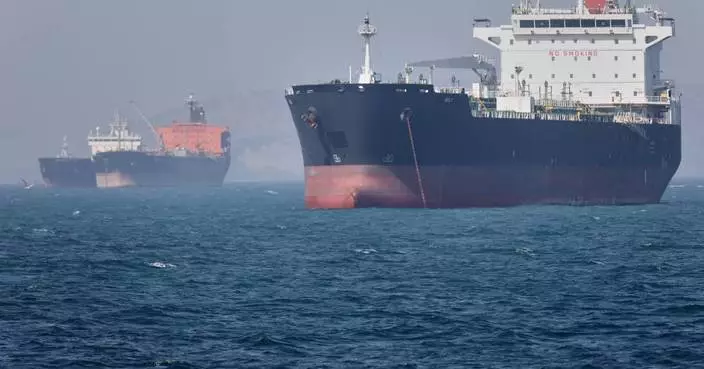
DUBAI, United Arab Emirates (AP) — Iran has sent its response to the latest U.S. ceasefire proposal via Pakistani mediators and wants negotiations to focus on permanently ending the war, Iran’s state-run media said Sunday. Pakistan confirmed receiving it.

Iran seeks to end the war on all fronts, including in Lebanon, where Israel fights the Iranian-backed Hezbollah militant group, and to ensure the security of shipping, its state TV said. Washington’s latest proposal addressed a deal to end the war, reopen the Strait of Hormuz and roll back Iran’s nuclear program, an issue that Tehran would rather discuss later.

The White House had no immediate comment about Iran’s reply. President Donald Trump is giving diplomacy “every chance we possibly can before going back to hostilities,” the U.S. ambassador to the United Nations, Mike Waltz, told ABC.

Iran's new supreme leader, Mojtaba Khamenei, who has not been seen or heard publicly since the war began, “issued new and decisive directives for the continuation of operations and the powerful confrontation with the enemies” while meeting with the head of the joint military command, the state broadcaster reported, with no details.

Meanwhile, the fragile ceasefire was tested when a drone ignited a small fire on a ship off Qatar and the United Arab Emirates and Kuwait reported drones entering their airspace. The UAE blamed Iran. No casualties were reported, and no one immediately claimed responsibility.

Qatar's Foreign Ministry called it a “dangerous and unacceptable escalation that threatens the security and safety of maritime trade routes and vital supplies in the region."

Iran and armed allied groups like Hezbollah in Lebanon have used drones to carry out hundreds of strikes since the war began with U.S. and Israeli attacks on Feb. 28.

Trump has reiterated threats to resume full-scale bombing if Iran does not accept an agreement to reopen the strait and roll back its nuclear program. Iran has largely blocked the strategic waterway that's key to the global flow of oil, natural gas and fertilizer since the war began, rattling world markets.

The U.S. in turn has blockaded Iranian ports and on Friday struck two Iranian oil tankers it said were trying to breach the blockade. Iran’s Revolutionary Guard navy says any attack on Iranian oil tankers or commercial vessels would be met with a “heavy assault” on one of the U.S. bases in the region and enemy ships.

The American military said Sunday that it has turned back 61 commercial vessels and disabled four since the blockade began April 13.

Another sticking point in negotiations is Iran’s highly enriched uranium. The U.N. nuclear agency says Iran has more than 440 kilograms (970 pounds) of uranium that is enriched up to 60% purity, a short, technical step from weapons-grade levels.

In an interview with state media posted late Saturday, an Iranian military spokesperson said its forces were on “full readiness” to protect nuclear sites where uranium is stored.

“We considered it possible that they might intend to steal it through infiltration operations or heli-borne operations,” Brig. Gen. Akrami Nia told the IRNA news agency.

Israeli Prime Minister Benjamin Netanyahu in an excerpt of an interview with CBS scheduled to air later Sunday said the war isn't over because the enriched uranium needs to be taken out of Iran. “Trump has said to me, ‘I want to go in there,’ and I think it can be done physically,” he said.

Russian President Vladimir Putin said Saturday that Moscow’s proposal to take enriched uranium from Iran to help negotiate a settlement remains on the table.

The majority of Iran’s highly enriched uranium is likely at its Isfahan nuclear complex, the International Atomic Energy Agency director-general told The Associated Press last month. The facility was bombarded by U.S.-Israeli airstrikes in the 12-day war last year and faced less intense attacks this year.

Pakistan oversaw face-to-face talks between the U.S. and Iran last month and continues to pursue mediation. In rare public comments, army chief Field Marshal Asim Munir said Islamabad remains committed to helping end the conflict. Prime Minister Shehbaz Sharif spoke by phone with his Qatari counterpart.

The UAE's Defense Ministry said it shot down two drones and blamed Iran.

In Kuwait, Defense Ministry spokesperson Brig. Gen. Saud Abdulaziz Al Otaibi said hostile drones entered Kuwait’s airspace and forces responded “in accordance with established procedures.” The ministry did not say where the drones came from.

Qatar's Defense Ministry said a drone targeted a commercial ship coming from Abu Dhabi, setting a small fire that was extinguished. The United Kingdom Maritime Trade Operations Center said the attack happened 23 nautical miles (43 kilometers) northeast of the capital, Doha. It gave no details about the ship’s owner or origin, and there was no claim of responsibility.

Several attacks against ships in the Persian Gulf have occurred over the past week, and a U.S. effort to “guide” ships through the strait was soon paused.

South Korea announced initial findings from a investigation that said two unidentified airborne objects struck the South Korean-operated vessel HMM NAMU about one minute apart while it was anchored in the Strait of Hormuz last week, causing an explosion and fire. A foreign ministry spokesperson said officials have yet to determine who was responsible.

Magdy reported from Cairo. Associated Press writers Munir Ahmed in Islamabad; Melanie Lidman in Tel Aviv, Israel; Tong-hyung Kim in Seoul; Julia Frankel in Jerusalem; and Josh Boak in Washington contributed to this report.

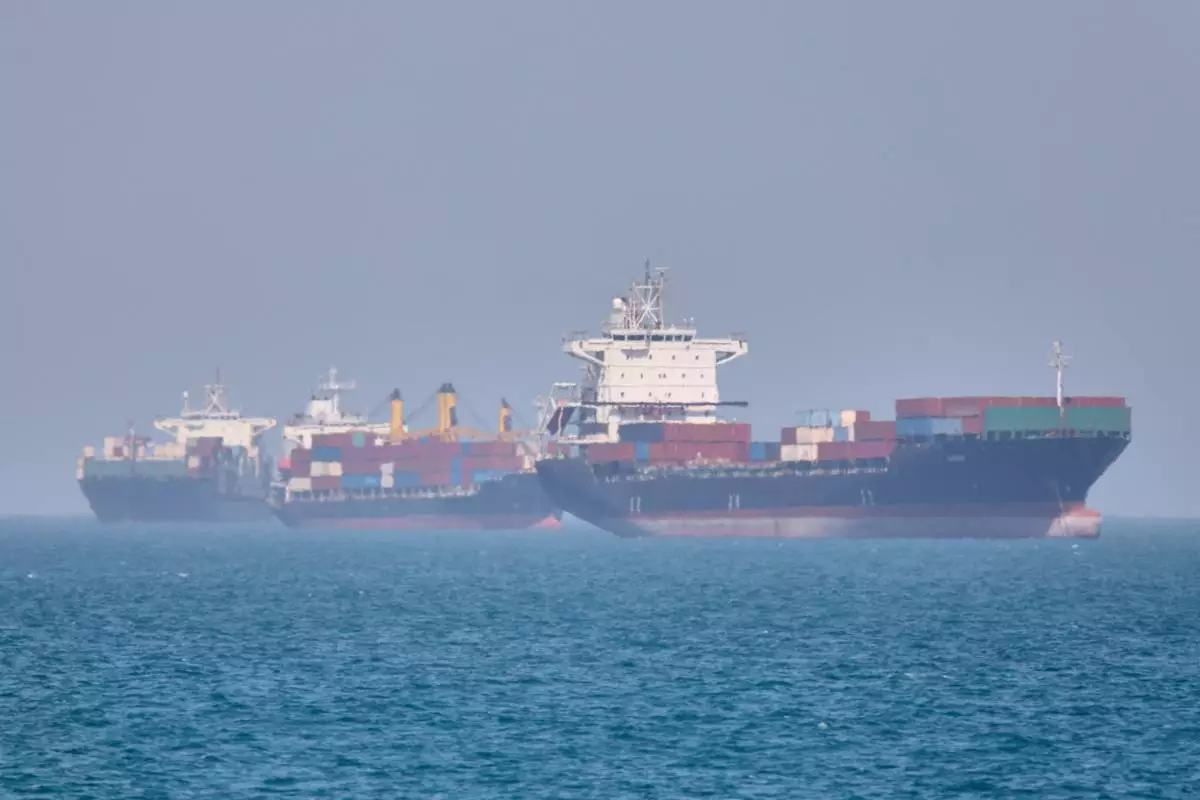
Container ships sit at anchor in the Strait of Hormuz off Bandar Abbas, Iran, Saturday, May 2, 2026.(Amirhosein Khorgooi/ISNA via AP)

Container ships sit at anchor in the Strait of Hormuz off Bandar Abbas, Iran, Saturday, May 2, 2026.(Amirhosein Khorgooi/ISNA via AP)

Recommended Articles