In the news release, Higgsfield Launches Similarity-Scoring Tool for Responsible AI Use in Media and Entertainment, issued 13-Mar-2026 by Higgsfield over PR Newswire, we are advised by the company that the photo of the release need to be updated, as originally issued inadvertently. The complete release with the updated photo follows:
Higgsfield Launches Similarity-Scoring Tool for Responsible AI Use in Media and Entertainment
As the generative AI industry matures, Higgsfield is taking an important step towards equipping creators and studios with a new tool designed to help assess potential similarity with characters, celebrity likeness, and brands.
SAN FRANCISCO, March 14, 2026 /PRNewswire/ -- Higgsfield, the AI-native video and image platform for professional creators, announced the launch of a similarity-scoring feature for Team Plan customers. The tool evaluates AI-generated content and flags potential visual similarities to celebrity likenesses, characters, brand logos, and other potential intellectual property.
The feature arrives as Higgsfield's platform scales rapidly into commercial production. The company has doubled its user base in under two months, surpassing 20 million users, with a growing share of usage now coming from production teams running commercial campaigns. As AI-generated content moves deeper into professional workflows and elite festivals, creators and teams are increasingly expected to consider similarity, likeness, and whether a generated asset may resemble something protected.
Despite this rapid mainstream adoption, the lack of standardized safeguards remains a bottleneck for wider commercial use. Recognizing this industry-wide challenge, Higgsfield is introducing new features that empower users to make safer choices when using AI generated assets.
The new tool evaluates generated content and assigns it a similarity score to help users identify potential conflicts. Going beyond basic detection, Higgsfield's system is designed to be more nuanced than existing market solutions. The feature evaluates content to known properties, including:
- Characters from popular movies, TV, and video games (e.g., Harry Potter, Spider-Man).
- Likeness of public figures, including stylistic alterations (e.g., a celebrity rendered in unusual forms or wearing obscuring props).
- Brand logos and text assets, such as trademarked taglines.
- Famous artworks and distinct visual concepts.
- Cinematic signatures, such as distinct visual styles associated with specific directors or films (e.g., Wes Anderson, Denis Villeneuve, Alfred Hitchcock).
- Audio content, such as music and other audio content incorporated into video output.
To validate the system's efficacy, the Higgsfield Research Team conducted internal benchmark studies across diverse datasets of AI-generated and reference media. In video detection, Higgsfield's model achieved an 86.6% overall accuracy rate. Higgsfield also significantly reduced false positive rates, flagging incorrect similarities in video only 13.4% of the time.
When a potential similarity is detected, the tool identifies the nature of the similarity, the possible rights holder, and exactly where the similarity occurs in the video. Building on this initiative, Higgsfield has also launched an image model "Soul Cast", which limits image reference uploads, reducing the risk of generating someone else's likeness.
"Generative video is still a new frontier and studios, platforms, and policy experts are all still navigating the complexities of IP and likeness," said Higgsfield CEO Alex Mashrabov. "By activating our content-scoring feature, we give creators a practical way to understand their outputs before final production. We believe that proactive similarity tools like this will soon become standard across the entire generative AI ecosystem."
Higgsfield's initiative reflects a broader company commitment to the ethical and responsible commercialization of AI. For example, the company recently launched the Higgsfield Action Contest with a $500,000 prize pool, accepting nearly 8,800 submissions from all over the world. Content safety is integral to the review process along with originality and storytelling as part of the company's broader approach to building responsibly in this emerging space.
By building tools that empower human creativity while respecting intellectual property, Higgsfield aims to encourage the responsible use of AI technologies.
For more information about Higgsfield's new content-scoring feature, visit https://higgsfield.ai/app/similarity-score.
About Higgsfield
Higgsfield is an AI-native generative video platform built for professional creators, brands, agencies, and marketing teams producing high-fidelity videos at scale. The company develops its own generative video and image models and integrates leading third-party models such as OpenAI's Sora, Google's Veo and Nano Banana, Alibaba's WAN, Kuaishou's Kling, Bytedance's Seedream and Seedance, MiniMax, and others into a single, production-ready workflow, allowing teams to select the best model for each creative task without rebuilding pipelines.
** This press release is distributed by PR Newswire through automated distribution system, for which the client assumes full responsibility. **

Higgsfield Launches Similarity-Scoring Tool for Responsible AI Use in Media and Entertainment

Higgsfield Launches Similarity-Scoring Tool for Responsible AI Use in Media and Entertainment
Collaboration supports EU CRA readiness and cybersecurity planning for industrial and edge AI applications.
TAIPEI, Oct. 16, 2026 /PRNewswire/ -- Advantech, a global leader in IoT intelligent systems and embedded platforms, has signed a memorandum of understanding (MOU) with DEKRA, a global testing, inspection and certification organization, to strengthen cooperation on industrial cybersecurity compliance.
As the European Union's Cyber Resilience Act (CRA) is implemented in stages, manufacturers of industrial equipment and edge AI products need to address cybersecurity requirements earlier in product development. The partnership combines Advantech's industrial computing and application experience with DEKRA's cybersecurity testing and international certification expertise. It aims to help end customers and system integrators plan for EU CRA requirements and international standards such as IEC 62443, reduce compliance risks and avoid delays caused by late-stage changes.
Stan Zurkiewicz, CEO of DEKRA, said: "Digital trust is essential for industrial innovation to succeed in global markets. As AI and connected technologies become integral to manufacturing, energy and transportation, companies need verifiable evidence of safety and cybersecurity to build confidence in new technologies. Our collaboration with Advantech combines its industry experience with DEKRA's independent third-party testing and certification expertise. DEKRA's role is to provide independent assurance, helping companies navigate evolving international requirements and build trust in new technologies."
Miller Chang, President of Advantech's Embedded Sector, said at the signing ceremony: "As edge AI advances, customers increasingly need to consider compliance from the outset of product design. By combining Advantech's industrial computing and edge AI expertise with DEKRA's global testing and certification expertise, we aim to help customers identify regulatory requirements earlier, reduce compliance risks and shorten time to market, bringing trustworthy edge AI innovations to global markets more efficiently."
Planning for Cybersecurity Compliance from the Design Stage
The collaboration aims to help manufacturers consider cybersecurity and compliance requirements at an early stage of product development, drawing on DEKRA's independent testing and certification expertise. It will help customers identify regulatory and technical requirements across markets, plan assessment and certification pathways, and address potential cybersecurity gaps during development.
The scope includes independent technical assessments, documentation reviews, certification readiness assessments and cybersecurity testing to help manufacturers identify and address potential compliance gaps. Early planning can help reduce the time and costs associated with late-stage design changes and establish a clear compliance process from product concept and development through testing and market deployment.
First Milestone: AFE-E630 Security Functions Meet IEC 62443-4-2 SL2 Requirements
As an initial outcome of the collaboration, Advantech's AFE-E630 industrial edge system has passed an independent assessment by DEKRA and received an Attestation of Conformity (AoC). Designed for commercial and industrial energy storage management applications, the AFE-E630 has security functions that meet the relevant Security Level 2 (SL2) requirements of IEC 62443-4-2:2019 within the assessed scope. The assessment results provide a verified basis for product cybersecurity in these applications and a reference for customers' subsequent product integration and system-level compliance assessments.
Exploring Further Applications in Edge AI and Industry
Beyond existing industrial applications, Advantech and DEKRA plan to extend their cooperation to AI-enabled industrial systems, semiconductor manufacturing, robotics, drones and other safety-critical industrial applications, as well as energy and transportation applications.
As edge AI is integrated into physical equipment, product safety, functional safety and cybersecurity need to be considered together. The companies will combine Advantech's edge computing platforms and application experience with DEKRA's testing, cybersecurity and functional safety expertise to support the safety and trustworthiness of next-generation intelligent devices.
Through the MOU, Advantech and DEKRA will continue to develop their technical cooperation, helping customers address market-specific compliance requirements and prepare industrial and edge AI products for international deployment.
About DEKRA
For more than 100 years, DEKRA has been a trusted name in safety. Founded in 1925 with the original goal of improving road safety through vehicle inspections, DEKRA has grown to become the world's largest independent, non-listed expert organization in the field of testing, inspection, and certification. Today, as a global partner, the company supports its customers with comprehensive services and solutions to drive safety and sustainability forward. In 2025, DEKRA generated revenue of 4.4 billion euros. More than 48,000 employees are providing qualified and independent expert services in approximately 60 countries across five continents. DEKRA holds a Platinum sustainability rating from EcoVadis, placing it among the top 1% of the globally assessed companies.
** This press release is distributed by PR Newswire through automated distribution system, for which the client assumes full responsibility. **
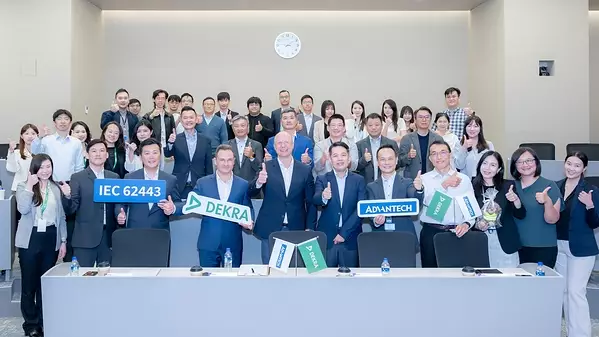
Advantech and DEKRA Sign MOU to Advance Industrial Cybersecurity Compliance
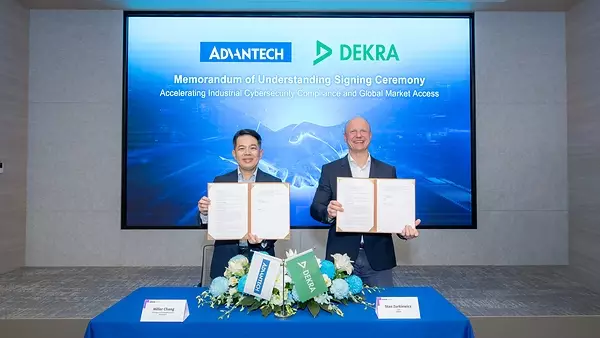
Advantech and DEKRA Sign MOU to Advance Industrial Cybersecurity Compliance