ROME (AP) — The inclusion of Russia in the line-up of the 2026 Venice Biennale art fair has sparked international outcry, with the European Commission threatening to withhold funding and 22 European countries demanding Moscow stay away again over its war in Ukraine.
The scandal at the world’s oldest and most important contemporary art fair has put Italy’s Culture Ministry in the crosshairs. It comes just weeks after the Italian government had to stand by as the International Paralympic Committee allowed Russian and Belarusian athletes to compete under their national flags at the Milano Cortina 2026 Winter Paralympics.
Culture Minister Alessandro Giuli is trying to manage the diplomatic fallout, voicing clear opposition to the Biennale's decision but acknowledging that its governing foundation is independent of the government and acted autonomously when it included Russia in the line-up for its 61st arts festival.
Russia has a permanent, historic pavilion in the Giardini exhibition area and under the rules governing the arts fair, has a streamlined process allowing it to participate in the show. But Moscow hasn’t appeared since the Ukraine war began: In 2022, the Russian pavilion was shuttered after its artists withdrew following Moscow’s invasion. In the 2024 edition, the pavilion was loaned to Bolivia for its exhibition.
The Venice Biennale Foundation on March 4 announced the line-up for its 2026 edition, which runs May 9-Nov. 22. Ninety-nine nations are participating, including seven for the first time.
Russia’s return to the fair was not highlighted by the Biennale, but it was merely included in the list of participating countries with an exhibition entitled “The Tree is Rooted in the Sky,” and some three dozen Russian artists participating.
As the outcry mounted, Giuli this week fired the ministry official who sits on the Biennale board, Tamara Gregoretti, accusing her of having failed to disclose to the ministry that Russia had indicated it would be participating and that she had supported its inclusion.
Giuli also launched an investigation to determine if Russia's participation was compatible with the EU sanctions regime. Specifically, he demanded that the Biennale urgently provide all documentation, including correspondence with Moscow, about Russia’s plan to set up and manage the pavilion during the fair.
He spoke by telephone Friday with his Ukrainian counterpart, Tetyana Berezhna, and “reiterated the Italian government’s commitment to protecting Ukraine’s cultural identity, which has been under threat for over four years due to the Russian invasion, and reaffirmed his personal commitment and that of the government to the reconstruction of Ukraine’s cultural heritage,” the ministry said.
Berezhna, for her part, told Giuli that Russia’s participation was “unacceptable for Kiev and contrasts with the strong support for Ukraine maintained by the Italian government,” Giuli’s office said.
The head of the Biennale Foundation, Pietrangolo Buttafuoco, has defended the decision and framed it as an act opposing censorship.
He announced that this year’s edition will be accompanied by two dedicated exhibition spaces for “dissident” art. And he recalled that last year’s Venice Film Festival featured the world premiere of “The Wizard of the Kremlin,” an unflattering portrait starring Jude Law about Russian President Vladimir Putin’s rise to power.
But 22 European countries wrote a letter to Buttafuoco expressing their “profound concern” over Russia’s participation. They warned that Moscow could exploit it to “project an image of legitimacy and international acceptance that stands in stark contrast to the reality of Russia’s ongoing war against Ukraine and the destruction of Ukrainian cultural heritage, as well as to European and international sanctions.”
The European Commission, for its part, condemned the Biennale decision and threatened to withhold EU funds for the fair, which would amount to some 2 million euros over three years.
“Should the Biennale Foundation proceed with its decision to allow Russia to participate, we will consider further measures, including the suspension or termination of ongoing EU funding to the Biennale Foundation,” said a statement from Commissioners Henna Virkkunen and Glenn Micallef.
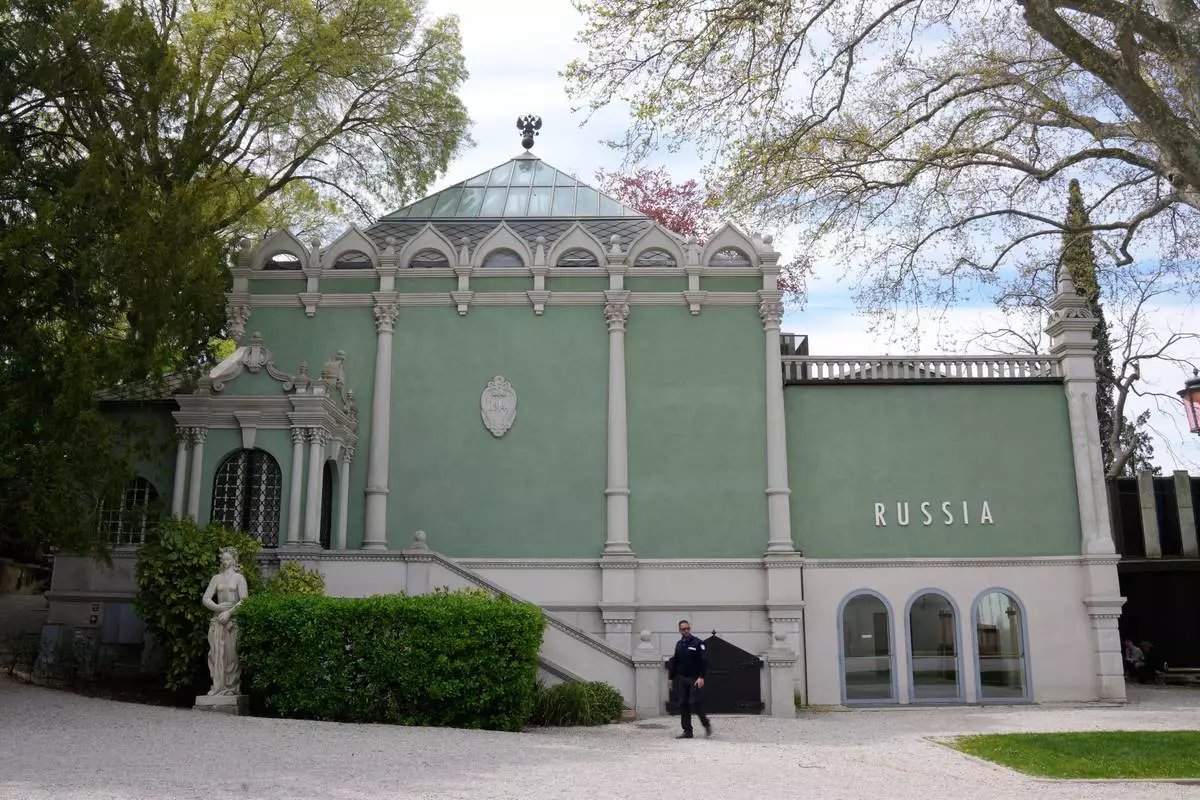
FILE - A private security officer walks next to the Russian pavilion at the 59th Biennale of Arts exhibition in Venice, Italy, Tuesday, April 19, 2022. (AP Photo/Antonio Calanni, File)
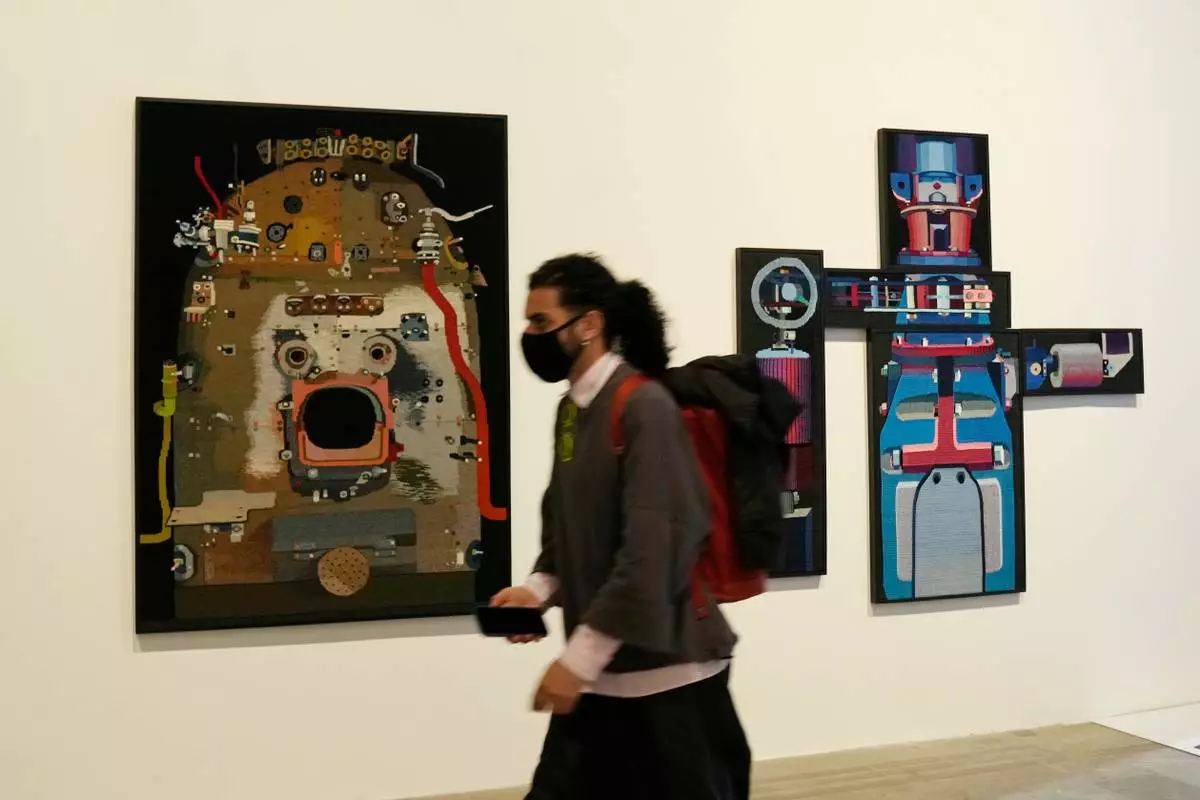
FILE - A man walks by installations by Russian artist Zhenya Machneva at the 59th Biennale of Arts exhibition in Venice, Italy, Tuesday, April 19, 2022. (AP Photo/Antonio Calanni, File)
Leaders at the Group of Seven summit wrap up three days of talks in the French Alps on Wednesday with discussions on the contentious future of artificial intelligence and U.S. dominance of the industry.
U.S. President Donald Trump and other national leaders are closing the formal talks of the leading industrial nations in the lakeside resort of Evian-les-Bains with a session on the future of artificial intelligence and another on fostering economic growth.
The heads of several leading AI companies will attend the discussions, including OpenAI CEO Sam Altman, Google DeepMind CEO Demis Hassabis and Anthropic CEO Dario Amodei.
Trump plans to stop outside Paris for a glitzy dinner at the Palace of Versailles before he jets back to Washington on Wednesday.
The G7 leaders spent the bulk of the meetings Tuesday discussing the war between Russia and Ukraine and a tentative deal to end the Iran war. Trump did not reveal details of the agreement expected to be signed by the United States and Iran on Friday at a resort on Switzerland’s Lake Lucerne.
The G7 includes France, Canada, Germany, Italy, Japan, the U.S. and the United Kingdom. Guest nations at this summit include Brazil, Egypt, India, Kenya, South Korea, Qatar, Ukraine and the United Arab Emirates.
Here is the latest:
Trump offered a round of applause for Macron at the beginning of the G7 session on global economic imbalances, saying the French president is “doing great” and paying tribute to the Evian summit’s organisation, a diplomat informed of the talks said.
An AP reporter close to the meeting’s room was able to hear the applause.
A senior French diplomatic official later described the Evian gathering as “the best G7” in years, citing the quality of informal exchanges among leaders. The official said those discussions helped secure endorsement from all G7 members, including Trump, of a joint statement on key geopolitical issues, including the Middle East and Ukraine.
Officials would not speak publicly about the leader’s talks that were behind closed doors.
High-profile AI industry figures will take part in a rare huddle with political leaders on the meeting’s final day.
The leaders of three of the world’s most powerful AI companies — OpenAI CEO Sam Altman, Google DeepMind CEO Demis Hassabis and Anthropic CEO Dario Amodei — were due to attend a working lunch on the theme of “Ensuring a safe, rapid and effective deployment of artificial intelligence.”
European AI labs were represented by Arthur Mensch, CEO of France’s Mistral AI; Robin Rombach, CEO of Germany’s Black Forest Labs, Victor Riperbelli of U.K.-based Synthesia and Uljan Sharma, CEO of Italy’s Domyn.
Other AI founders joining the lunch include Aidan Gomez, CEO of Canada’s Cohere, Ren Ito, the founder of Japan’s Sakana AI, Vivek Raghavan of India’s Sarvam AI. Salesforce CEO Marc Benioff was also taking part.
That was his opening phrase as he walked in — late — to the first session of the day at the G7 summit.
The room laughed, and Trump grinned. After exchanging niceties with the U.S. president, Macron then got the meeting underway.
G7 leaders were to discuss concerns that China is flooding export markets with subsidized products, unfairly out-competing their own industries and destroying jobs. They gathered for a session focusing on “promoting balanced, shared and sustainable economic growth” alongside partners including leaders of India, South Korea, Kenya and Brazil.
Talks come as China is redirecting its products away from the U.S. tariff wall and toward more open markets in Europe and elsewhere in Asia.
The shift in Chinese trade risks creating a European sequel to the China Shock that wiped out hundreds of thousands of factory jobs in the American heartland in the 2000s. Despite U.S. sanctions, China notched a record global trade surplus last year.
Leaders of France, the UK, Italy, Germany and Canada have gathered for informal talks ahead of a G7 session on global economic imbalances, French President Emmanuel Macron’s office said.
They then joined the meeting involving partners including India, South Korea, Kenya and India.
Keir Starmer says he isn’t sure whether Trump has made a decision about whether to reimpose sanctions on Russian oil.
The British leader says he talked to Trump about the temporary U.S. sanctions waiver.
Starmer told British broadcaster ITV he and Trump had “a very constructive discussion about Ukraine,” but “I don’t know that a decision has been made yet.”
He said G7 leaders shared “a real determination to stand with Ukraine,” including through more sanctions on Russia.
Trump said on Wednesday that he’s delaying Jay Clayton’s nomination to lead the U.S. intelligence community in a bid to force Congress to act on a voter ID bill that currently lacks enough support for passage.
Trump said in a lengthy post on his social media site that he will keep Bill Pulte, a top U.S. housing official, as acting director of national intelligence. Lawmakers in both parties had opposed Trump’s nomination of Pulte, citing his apparent lack of experience in the intelligence field, which essentially forced Trump to turn to Clayton.
Clayton had been set to appear on Wednesday for a Senate confirmation hearing that was fast-tracked because of the lapse of a crucial surveillance program due to bipartisan anger over Trump’s pick of Pulte.
Carney did not get a bilateral meeting with Trump at the summit, despite the free trade agreement between the countries being up for renewal on July 1.
Carney says he had seven or eight discussions with Trump and he expects to have more Wednesday.
He says they discussed a wide range of subjects, from the economy, relations, his birthday, artificial intelligence, Ukraine and Iran.
Canadian prime ministers usually get a bilateral meeting with an American president at G7 summits. And it is a crucial time for talks to potentially renew the free-trade agreement between the two countries and Mexico. Trump said last week that he may not renew the deal.
Macron is the only G7 leader to get a bilateral meeting thus far. Trump met with the leaders of non-G7 countries of Qatar, UAE, Egypt and India.
The expansive palace is where he’ll have dinner with Macron before the flight back to Washington.
At the final day of the G7 summit in Evian-les-Bains, Trump is set to participate in working sessions with his counterparts from France, Britain, Canada, Germany, Italy and Japan, alongside leaders from some developing nations and tech CEOs.
In between sessions, he’ll hold one-on-one talks with Egypt’s president and India’s prime minister.
Trump is also holding a news conference before the trip to Versailles.
G7 leaders said in a joint statement overnight they would increase military support for Ukraine after recent “progress on the battlefield.”
They also plan to levy harsher sanctions on Russia’s energy sector in the wake of the recent deal to reopen the Strait of Hormuz.
They plan to give more air defense technology including interceptors and grant military production licenses to Ukraine.
Kyiv has sought the permits to construct their own Patriot missiles.
Carney says a tentative deal to end the Iran war could be a game changer in the world.
The Canadian prime minister, speaking on the final day of the summit, said the agreement could have positive effects including the ability to provide additional defensive support in Ukraine.
Carney said here has been a change in tone concerning Ukraine, which was discussed in detail at the summit on Tuesday.
Many countries are vested in making the Iran deal work, he said.
Leaders gathered at the G7 summit issued a joint statement overnight Tuesday on the agreement reached between the U.S. and Iran focused on securing safe passage without tolls in the Persian Gulf.
“We reaffirm that the right of transit passage without restrictions or tolls is the bedrock of international trade,” said the statement of leaders from Canada, France, Germany, Italy, Japan, the United Kingdom and the United States.
Iran floated a similar idea in April to fund reconstruction of areas in the country damaged by war.
The closure of the strait has driven up fuel and fertilizer costs and rattled economies worldwide.
The statement also offered support to a French and British-led naval mission to the Persian Gulf to safeguard ships and remove mines from one of the crucial choke-points in the world’s energy supply chain.
Canadian Prime Minister Mark Carney gave U.S. President Donald Trump a present for his 80th birthday, but said it’s “not gold.”
Trump was “very pleased,” Carney said, adding that he “likes it a lot.”
Carney didn’t specify what the gift was and a spokesperson for the prime minister didn’t immediately know.
Trump is known for his love of gold. An Oval Office makeover at the start of his term included large amounts of fresh gold trim.
Trump and Carney have a positive relationship despite Trump’s previous comments about making Canada the 51st state of the United States.
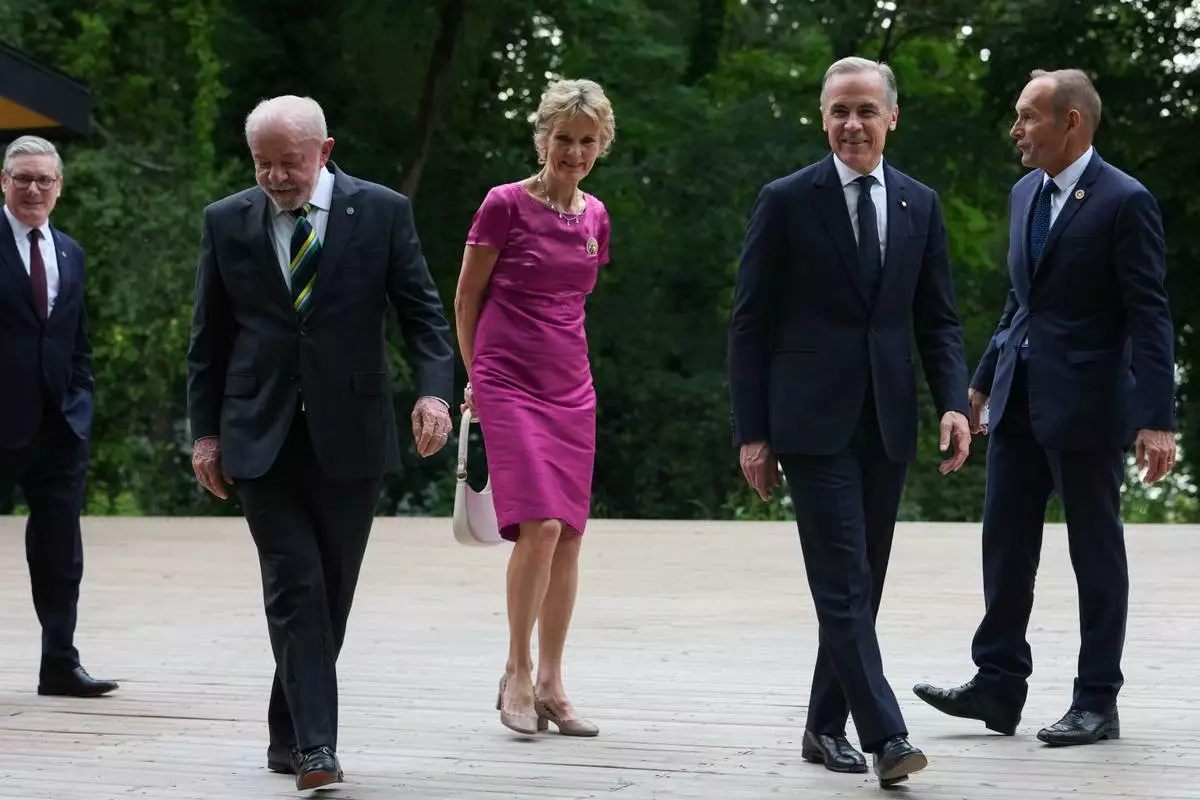
Britain's Prime Minister Keir Starmer, left, Brazil's President Luiz Inacio Lula da Silva, second from left, and Canada's Prime Minister Mark Carney, second from right, arrive for a group photo at the G7 summit, Tuesday, June 16, 2026, in Evian-les-Bains, France. (AP Photo/Julia Demaree Nikhinson)
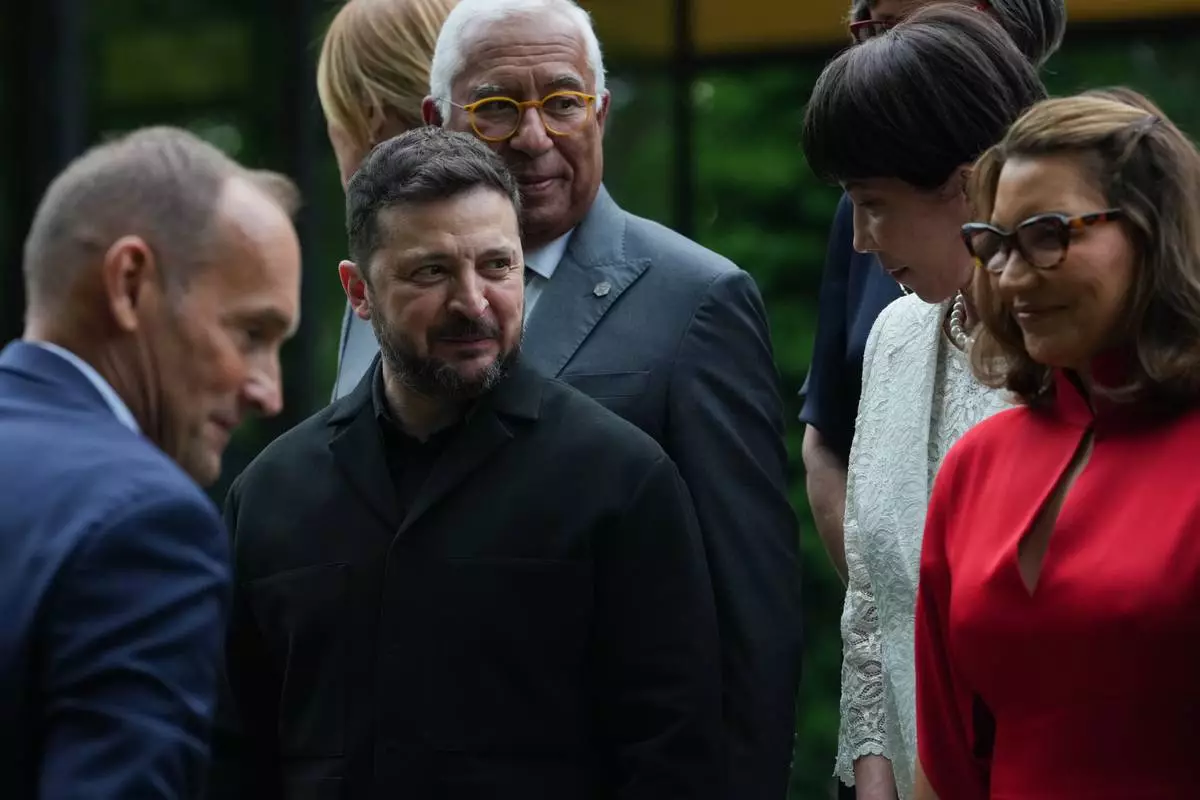
European Council President Antonio Costa, Ukrainian President Volodymyr Zelenskyy, Japan's Prime Minister Sanae Takaichi and others gather for a group photo at the G7 summit, Tuesday, June 16, 2026, in Evian-les-Bains, France. (AP Photo/Julia Demaree Nikhinson)
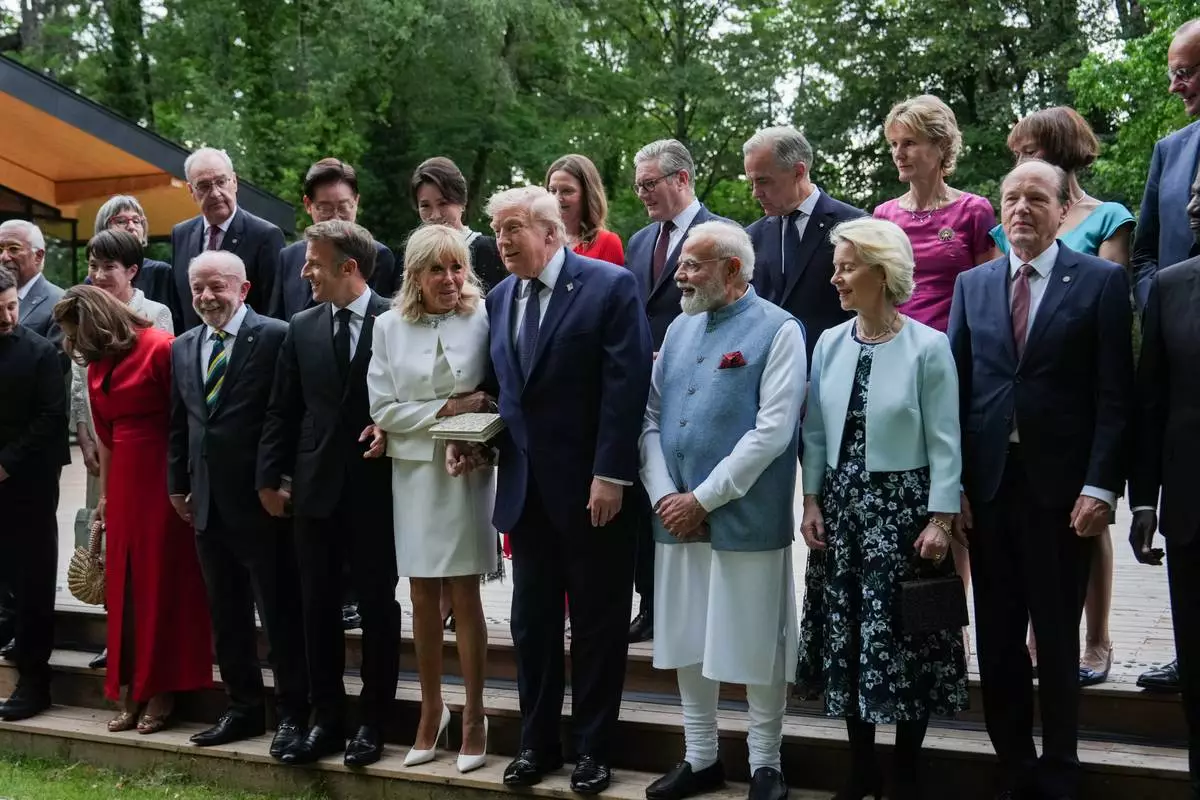
President Donald Trump helps France's first lady Brigitte Macron up a step as she arrives for a group photo with leaders and their spouses at the G7 summit, Tuesday, June 16, 2026, in Evian-les-Bains, France. (AP Photo/Julia Demaree Nikhinson)
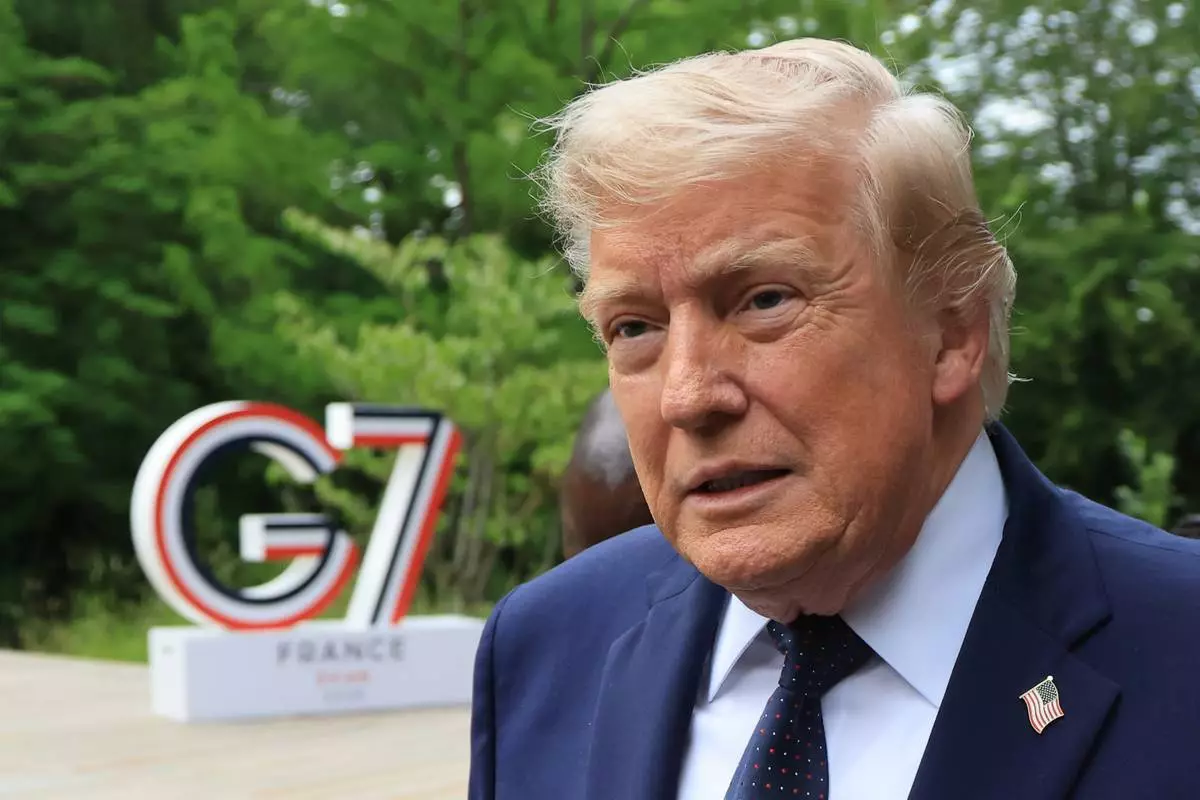
U.S. President Donald Trump arrives to attend a musical interlude before a gala dinner as part of the G7 summit, in Evian-les-Bains, France, Tuesday June 16, 2026. (Ludovic MARIN/Pool Photo via AP)
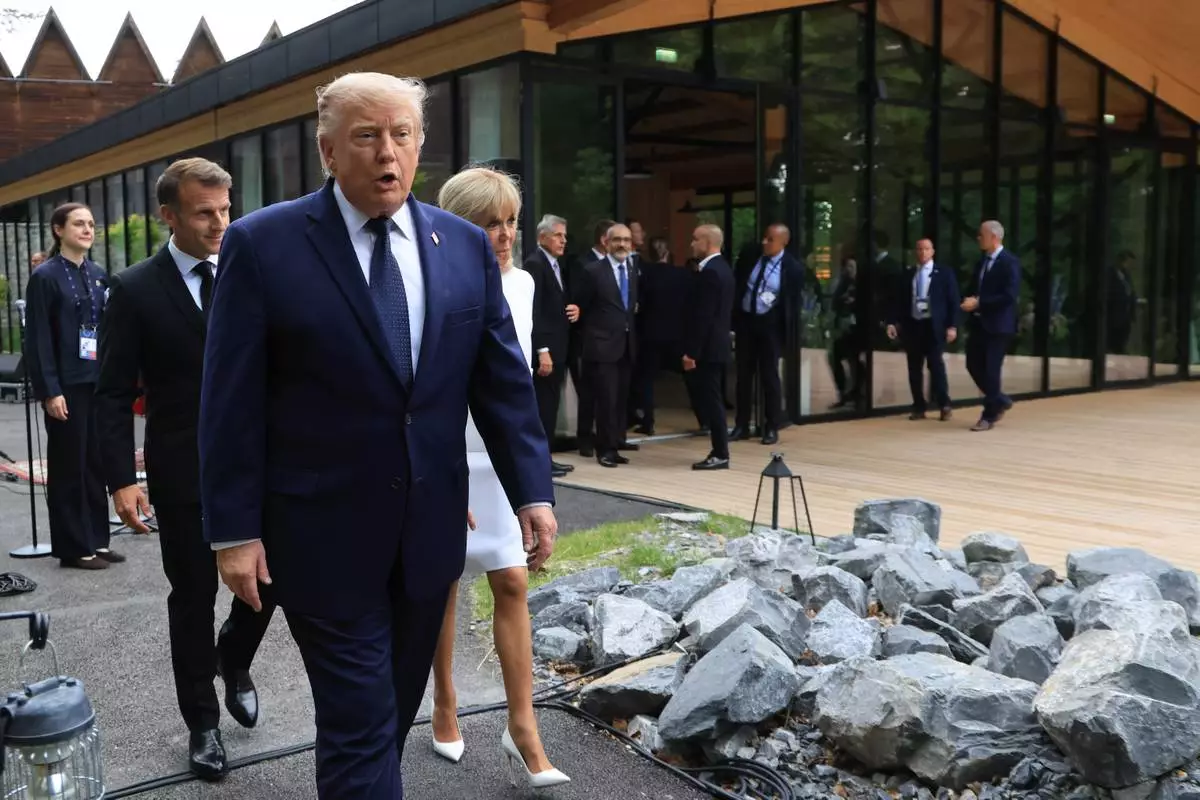
U.S. President Donald Trump walks after posing for a family photo photograph during a gala dinner as part of the G7 summit, in Evian-les-Bains, France, Tuesday June 16, 2026. (Ludovic Marin/Pool Photo via AP)