LONDON, March 14, 2026 /PRNewswire/ -- Lord Ashcroft's collection of Victoria Crosses and George Crosses is to have a new home at the National Army Museum in London.
The collection is the largest of its kind in the world. It has been built up by Lord Ashcroft over the past 40 years and includes nearly 250 VCs and a smaller number of GCs. It was previously housed at the Imperial War Museum, London, which closed the Lord Ashcroft Gallery in September last year after 15 years.
Lord Ashcroft spoke today of his delight at the news: "I am thrilled to have found such a superb location for this unique collection of gallantry medals. I am so pleased that these VCs and GCs, spanning many major wars and conflicts of the past two centuries, will now be enjoyed by the public once again.
"The National Army Museum shares my passion for the decorations themselves and also to tell the incredible stories of bravery that go with them. I look forward to a long and happy partnership with the Museum for many years to come."
Justin Maciejewski, the Director of the National Army Museum, said: "We are honoured to be entrusted with these VCs and GCs from the Lord Ashcroft Medal Collection. We are grateful to Lord Ashcroft for his continued generosity and commitment in championing these stories of extraordinary courage.
"The National Army Museum shares the history and heritage of our soldiers across the globe and down the centuries. Within that wider narrative, these medals, and the individual acts of extraordinary bravery and valour they represent, form a powerful part of the Army's story."
Chris Finney, a Trustee of the National Army Museum and the Chair of the VC and GC Association, said: "This rare and expansive collection spans centuries of military service, sacrifice, and extraordinary bravery across the Armed Forces.
"We are privileged to be given the opportunity to share these medals—and the inspiring personal stories they represent—with visitors, and online for the wider public, where they can continue to inspire people of all ages for generations to come."
Lord Ashcroft began his collection of VCs in 1986 with the purchase of a single medal group at auction. The VC, instituted by Queen Victoria in 1856, is Britain and the Commonwealth's most prestigious decoration for valour in the presence of the enemy. The GC, created by George VI in 1940, is Britain and the Commonwealth's most prestigious decoration for gallantry not in the presence of the enemy and it has been awarded to several civilians for acts of valour.
Lord Ashcroft's VCs and GCs are part of the wider Lord Ashcroft Medal Collection, which includes Special Forces decorations and medals for valour in the skies and at sea. Lord Ashcroft's long passion for gallantry awards was initially inspired by his late father, Eric, who as a young officer took part in the D-Day Landings on June 6 1944.
Lord Ashcroft's collection of VCs includes one of just three VCs and Bars—the equivalent of two VCs—that have been awarded over the past 170 years. This is the medal group awarded to Captain Noel Chavasse VC & Bar, MC, a medical officer who served and was killed during the Great War.
Following the closure of the previous gallery, Lord Ashcroft has made his collection accessible digitally through his website. This new partnership with the National Army Museum will allow the public to visit the collection and be inspired by the remarkable stories they represent.
The VC and GC collection will go on display at the National Army Museum within the next two years. In the meantime, from July onwards some of Lord Ashcroft's medals will go on display at the museum, including pop-up exhibitions.
As the home of the Army's history and heritage, the National Army Museum will be displaying items from the Lord Ashcroft Medal Collection alongside its existing collections of objects, archives and artworks, telling the stories of soldiers and their service—including the origins of the Victoria Cross in the Crimean War.
Lord Ashcroft's VCs and GCs will be shared on a long-term loan with the National Army Museum. Alongside their display, the Museum is planning a programme of exhibitions, educational resources, talks, tours and digital content exploring the human stories of courage behind the decorations.
Further details of the new partnership between Lord Ashcroft and the National Army Museum relating to the display of his VC and GC collection will be released over the coming months.
NOTE TO EDITORS
For more information on Lord Ashcroft's work, visit:
Join in the conversation on:
More information on the Museum:
Opening times:
Tuesday to Sunday
10:00 – 17:00
Address:
National Army Museum, Royal Hospital Road, London, SW3 4HT
Website:
nam.ac.uk
National Army Museum
The National Army Museum shares the history and heritage of our soldiers and their service in the Army, across the globe and down the centuries. Through our collections we explore the history of the Army from its origins to the present day. We aim to engage and inspire everyone with the stories of our soldiers and how their service shapes our world; past, present and future.
** This press release is distributed by PR Newswire through automated distribution system, for which the client assumes full responsibility. **

Lord Ashcroft's VCs and GCs to have a new home at the National Army Museum
SAN FRANCISCO, May 1, 2026 /PRNewswire/ -- Dreame Technology today concluded DREAME NEXT, the company's largest international launch event to date, following four days in San Francisco that saw the debut of its full product ecosystem, more than 100 first-in-industry technologies, and appearances from figures spanning autonomous driving, personal computing, professional sports, and academic science. The final day featured the Humanity Next scientists' forum and three new initiatives from the Yu Hao Foundation.
Over the course of the event, Dreame presented products across smart mobility, smart home appliances, personal devices, and premium personal care for the first time in a single showcase.
Highlights included the global debut of the Nebula NEXT 01 JET Edition rocket-powered vehicle with a 2,160-line LiDAR system. "I would say with the car you see here... put this together with the latest and best self-driving. And you have a driving machine. The world has never, ever seen before," said Sebastian Thrun, the Stanford University professor widely regarded as the father of modern autonomous vehicles and founder of Google X Lab, Udacity.
In smart home appliances, Dreame rewrote the playbook for single-function devices, introducing appliances that actively understand user behavior, environmental changes, and daily habits. The FizzFresh Pro became Dreame's the world's first refrigerator with a built-in sparkling water system, while its OxyPause low-oxygen preservation technology reduces oxygen concentration to as low as 5 percent, keeping produce fresh for up to 21 days. The N1 refrigerator will use multimodal food recognition to identify more than 1,800 ingredients and connect with wearable devices to deliver personalized dietary recommendations. The Dreame Air Conditioner X60 Series and Z Series redefine home climate with two world's first innovations—the world's first dual robotic arm air conditioner and the world's first fully embedded, integrated air conditioner—delivering precision left-right zoned airflow and seamlessly integrated spatial aesthetics.
Home entertainment and laundry were also redefined. The R8000F TV features a world-first dynamic sound engine that tracks user position in real time, delivering sound that follows the viewer. The Dreamind audio-visual smart processor optimizes each frame for a cinema-grade experience. The Z1 Embodied AI Laundry Robot uses a multi-joint robotic arm to autonomously pick up, wash, dry, and retrieve clothing.
In cleaning, the XT Combo vacuum is powered by a world-first 250,000 RPM magnetic levitation high-speed motor, delivering 420AW of suction. The X60 Pro Ultra robot vacuum features a second-generation bionic robotic arm with an 18cm mop extension, enabling it to clean closer to corners, navigate around obstacles, and reach narrow gaps that were previously out of reach.
In personal devices, Dreame's AURORA smartphone introduced modular design, advanced signal capture, and full-focal-range 200-megapixel imaging. Smart rings, pendants, watches, and glasses round out a personal ecosystem offering health management and intelligent connectivity.
In personal care, Dreame combined drying, treatment, and styling in a single product line. The AirStyle Pro HI operates at 130,000 RPM, uses app-based hair analysis to match styling modes, and handles drying, curling, straightening, and shaping in one device.
The guest roster reinforced the cross-industry scope of the event. Sebastian Thrun, widely regarded as the father of modern autonomous vehicles, attended the Drive Next vehicle launch. Apple co-founder Steve Wozniak joined Global President Chang Xinwei on stage at Connect Next. Three-time NBA champion Dwyane Wade appeared at the Living Next product demonstrations.
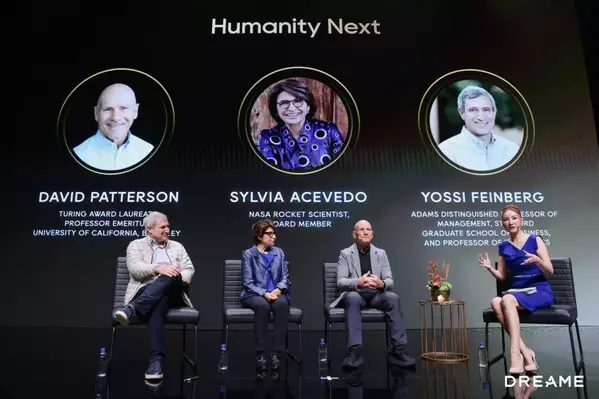
On the final day, three distinguished experts—Turing Award Laureate and UC Berkeley Professor Emeritus David Patterson, NASA rocket scientist and board member Sylvia Acevedo, and the Adams Distinguished Professor of Management at Stanford's Graduate School of Business (who also holds a professorship in economics) — come together to explore the trajectory of human technology over the next decade, tracing the arc from fundamental scientific breakthroughs to emerging questions of technology ethics and the shifting dynamics of the global landscape.
The Humanity Next forum also saw the Yu Hao Foundation announce several new initiatives: the release of the Under 35 Young Scientists Program, and the launch of SkyAxis Program 2.0, an updated innovation platform. During the forum, leading experts engaged in dialogue with SkyAxis Program members on site and connected virtually with Under 35 participants.
The commercial results behind DREAME NEXT are equally significant. In 2025, Dreame's overseas revenue accounted for nearly 80 percent of total sales, and the company has maintained a compound annual revenue growth rate of 100 percent for eight consecutive years. In North America, Q1 2026 revenue grew more than 100 percent year-on-year across multiple categories including robot vacuums, wet and dry vacuums, cordless vacuums, and hair dryers. Dreame's robot vacuums now rank first in market share across 30 countries. The company's products serve more than 42 million households across 120 countries and regions, supported by over 6,500 offline stores worldwide.
"We founded Dreame on a belief that core technology is the root of everything," said Chang Xinwei, Global President of Dreame Technology. "Over four days in San Francisco, we showed what that belief produces when applied across an entire product ecosystem. DREAME NEXT is not the conclusion of a strategy. It is the first chapter of our next ten years."
For Dreame, 'Next' is not just branding. It describes what the company demonstrated over four days in San Francisco: products engineered around breakthroughs that redefine what each category can do, and an ecosystem that reshapes how people live. With its core technologies continuously compounding across industries, Dreame is writing the next chapter not only for its own business but for the future of intelligent living.
For the latest updates, follow Dreame Technology: Website: https://global.dreametech.com/ X: @DreameGlobal Facebook: Dreame Tech Instagram: @dreame_tech
About Dreame Technology
Founded in 2017, Dreame Technology is a global high-end technology brand built on a foundation of high-speed digital motors, intelligent algorithms, and bionic robotic arms. The company's product portfolio spans smartphones, smart vehicles, smart home appliances, intelligent cleaning appliances, outdoor smart devices, and personal care, designed to simplify daily life and give users more time for what matters. Dreame operates in more than 120 countries and regions with over 6,500 offline stores and serves more than 42 million households globally. As of December 31, 2025, the company has filed more than 10,000 patents worldwide and holds over 3,000 granted patents.
** This press release is distributed by PR Newswire through automated distribution system, for which the client assumes full responsibility. **
DREAME NEXT Concludes: Dreame Technology Caps Four-Day Silicon Valley Showcase with Science Forum and Ten-Year Vision

DREAME NEXT Concludes: Dreame Technology Caps Four-Day Silicon Valley Showcase with Science Forum and Ten-Year Vision