Yangtze finless porpoises are making a comeback in China's Yangtze River, thanks to stronger conservation efforts amid a 10-year fishing ban.
Known as "smiling angel", the Yangtze finless porpoise is a unique species in China, where it is under national first-class protection. Its population status serves as a barometer of the Yangtze River's ecological environment.
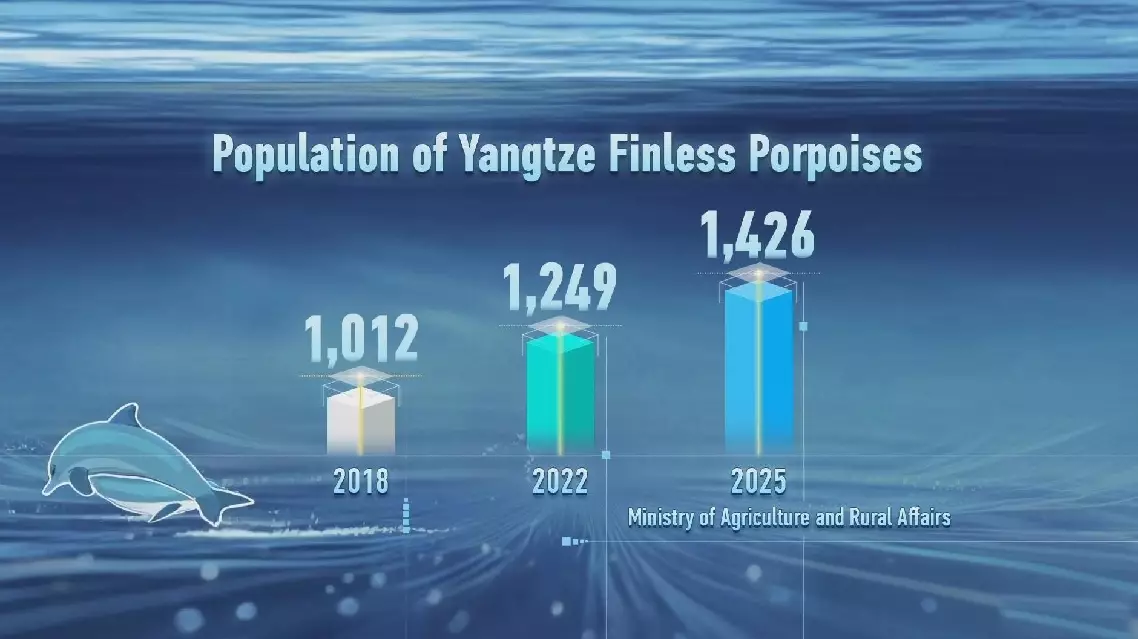
According to official data released in January, the population of the Yangtze finless porpoise has increased to 1,426, up 177 from the 2022 survey, thanks to a 10-year fishing ban in the Yangtze River that started from Jan 1, 2021.
"These river banks used to be factories before the fishing ban and the conservation of the Yangtze. It used to be a shipbuilding area. They are restored to their wetland state. They are suitable for finless porpoises to live," said Jiang Meng, secretary general of Nanjing Finless Porpoise and Aquatic Life Conservation Association in Nanjing City of east China's Jiangsu Province.
Now Jiang's association has over 10 full-time employees. The number of registered volunteers in his association exceeds 10,000.
There are even foreigners who volunteer.
"I fell in love with them the moment I saw them come up, and one thing I know about them and that's what makes me come here every now and then is their smile," said Janeth Katemi, a volunteer from Tanzania.
"There are a lot of buildings, high buildings, and technology is developed. China keeps the nature as well," said Leyli Orayeva, a volunteer from Turkmenistan.
Currently, the number of Yangtze finless porpoise in Nanjing has reached 65, which represents a significant increase compared with before.
"We found that some places used to have no finless porpoise activity, but now do. That means there are more places suitable for porpoises to live. We can also find new babies every year who are playing with their moms in the river," said Jiang.
Over the past decade, water quality in the Yangtze River Economic Belt has improved significantly. The proportion of Grade I to III water, considered suitable for aquatic life, rose from 67 percent in 2015 to 96.5 percent in 2025.
From 2021 to 2025, 351 fish species were monitored in the Yangtze River basin, an increase of 43 species compared with the period before the fishing ban, official data showed.
The pregnancy period of female Yangtze finless porpoise is one year, and each can only give birth to one baby porpoise each time. So Jiang Meng said challenges remain.
"Finless porpoises live close to human beings. So we have to normalize our protection works. We can't relax," he said.
Yangtze finless porpoises make comeback amid stronger conservation efforts