The team that went undefeated in the regular season, racked up more victories than anyone but Duke and Arizona — and fewer losses than any team at all — is anything but your run-of-the-mill basketball behemoth.
In fact, Miami (Ohio), despite that 31-1 record and maybe because of a little chip that's been placed on its shoulder, is one of those plucky underdogs that makes the NCAA Tournament what it is.
Welcome to March Madness with a twist.
While Duke (32-2) took the overall top seed on Selection Sunday, with Arizona (32-2), Michigan (31-3) and defending champion Florida (26-7) also on the top line, the RedHawks barely scratched their way into the bracket.
They are an 11 seed and have to play a First Four game against SMU on Wednesday. But after all the debate and hand-wringing that came with their single loss last week, which immediately turned them from sure thing into bubble team, they now enjoy the same privilege as the other 67 teams in the field.
They will have a chance to win and advance, with no selection committee, bracketologists or former coaches-turned-TV experts deciding their fate.
“I was very confident," Miami forward Eian Elmer said. "I think it’s hard to leave a team that’s 31-0 in a regular season out. It just wouldn’t look right for the sport, diminishing something like that, something that’s very rarely done.”
After the First Four, the full slate of games begins Thursday and Friday, with the national champion set to be crowned in Indianapolis on April 6.
The chair of the selection committee, Keith Gill, tried to explain how Miami of the lightly regarded Mid-American Conference ended up where it did. The RedHawks, he said, were not the last of the 37 at-large teams slotted into the field.
But, he said, they were ranked last of those 37 teams because once they got in, they were compared against other teams close to them, and things like their 339th-ranked strength of schedule and zero wins (in fact, zero games) against top-caliber, or Quadrant 1, opponents worked against them.
Other factors worked for them, including having the nation's second-ranked scoring offense, along with a “strength of record” in the top 30 and “wins above bubble” in the top 40 (each of those statistics would take a small pamphlet to explain).
“They have some really strong resume metrics that show their accomplishments,” Gill said.
For what it's worth, Miami is an 8 1/2-point underdog against SMU and a 2000-1 longshot to win it all, according to BetMGM Sportsbook.
Unlikely, indeed, but still better odds than the much-cited 9.2 quintillion-1 odds a person has of filling out a perfect bracket.
The favorite to win the national championship, according to BetMGM, is Michigan, which was listed at 13-4 shortly after the bracket came out, just a tad ahead of Duke, which was 10-3.
The Wolverines took a mini-hit in the seedings, dropping a notch to overall No. 3 after an eight-point loss to Purdue in the Big Ten title game. The Boilermakers are a 2 seed instead of a 3 with the win, heading to St. Louis to play tournament first-timer Queens.
The conference title did not do as much for St. John's (28-6), which stayed where it's been predicted most of the season — as a No. 5 — even after a 20-point win over UConn for the Big East title.
“Their results in the nonconference did not have kind of the same depth and quality of some of the folks that are ahead of them,” Gill said of the Red Storm's less-than-stellar non-conference showing this season.
Last year, St. John's became the sixth team coach Rick Pitino had led to the tournament. This year, the Johnnies go again but they must travel to San Diego to face Northern Iowa in the first round.
“I said, ‘Don’t take it as a negative,’” Pitino said. “I’ve had teams go to a Final Four that first had to go to Portland and then Arizona from Louisville."
Among those left out were San Diego State, Indiana, Oklahoma and Auburn.
The Tigers had 16 losses but the nation's third-best strength of schedule. The snub drew predictable blowback from Bruce Pearl, their former coach and father of their current coach, who was working for CBS and said “they played the toughest schedule in the country and I don’t know if they were rewarded for it.”
Even with Oklahoma and Auburn left out, the Southeastern Conference led the way by placing 10 teams in the field of 68, four short of its record from last year.
The Big Ten followed with nine, the ACC and Big 12 with eight apiece -- an unsurprising result in an era of massive conference expansion and NIL compensation drawing top players to the biggest spenders.
The Gators are the defending champion, trying to repeat their back-to-back titles from 2006-07. Last season, Florida was part of an all-No. 1 Final Four -- the first time that had happened in 17 seasons.
No. 2 Houston got placed in the South Regional, with its potential Sweet 16 and Elite Eight games scheduled for Houston. In the mix is a possible rematch of last year's national final against Florida, which would essentially be a road team with a better seed.
“If we have to run into that issue, there’s worse problems in the world,” Gators coach Todd Golden said earlier this week. But “I would enjoy somebody else in Houston (rather) than Houston.”
Giving teams home games in regionals is something the NCAA tries to avoid. Gill said it wasn't possible in this case, and pointed out that last year, Houston was a No. 1 seed that beat Purdue in Indianapolis, which is located an hour away from the Boilermakers campus.
“What I would say is, it’s the NCAA Tournament,” Gill said. “You’re going to have to win games away from home against really tough opponents, and that’s why this is the best postseason in sports.”
AP Sports Writers Mike Fitzpatrick and Joe Reedy contributed.
AP March Madness bracket: https://apnews.com/hub/ncaa-mens-bracket and coverage: https://apnews.com/hub/march-madness
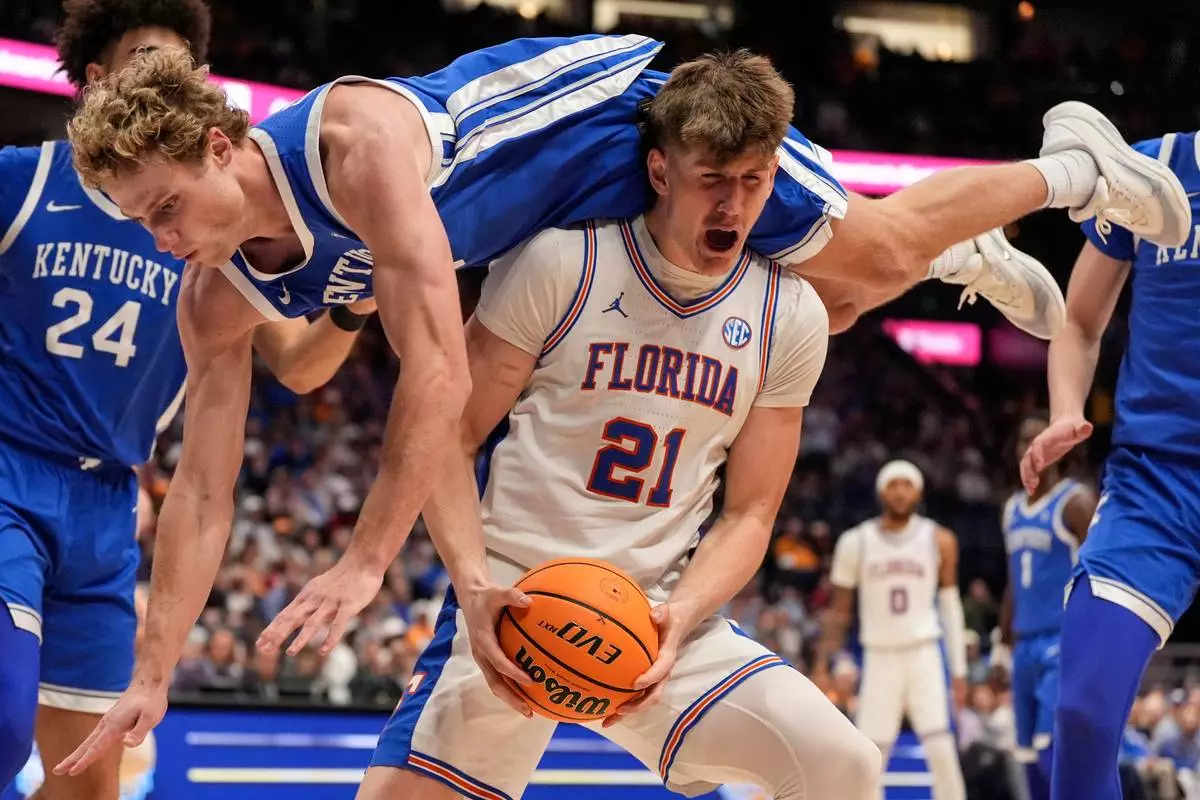
Kentucky guard Collin Chandler (5) falls onto Florida forward Alex Condon (21) during the second half of an NCAA college basketball game in the quarterfinal round of the Southeastern Conference tournament, Friday, March 13, 2026, in Nashville, Tenn. (AP Photo/George Walker IV)

Arizona's Jaden Bradley celebrates after making the game-winning shot at the buzzer to defeat Iowa State during an NCAA college basketball game in the semifinal round of the Big 12 Conference tournament Friday, March 13, 2026, in Kansas City, Mo. (AP Photo/Charlie Riedel)

Gulf countries reported new attacks Sunday morning, a day after Iran called for the evacuation of three major ports in the United Arab Emirates, threatening for the first time a neighboring country’s non-U.S. assets.
Tehran accused the United States of using “ports, docks and hideouts” in the UAE to launch strikes on Kharg Island, home to the main terminal handling Iran’s oil exports, without providing evidence, as the war showed no signs of ending.
U.S. President Donald Trump said he hoped allies would send warships to help secure the vital Strait of Hormuz.
Meanwhile, Israeli strikes have deepened Lebanon's humanitarian crisis, with more than 800 people killed and over 850,000 displaced.
Here is the latest:
Asked whether there are diplomatic talks underway, Trump told reporters: “We’re talking to them, but I don’t think they’re ready. But they’re getting pretty close.”
He said, “I don’t think they’re ready to do what they have to do,” and said any deal has to first address Iran’s nuclear program.
“There will be no nuclear weapons — that’s where it starts. And then on top of that, there’s plenty of things that we’re going to get,” Trump said.
But he also said: “I don’t know if I want to make a deal, because you know what? First of all, nobody even knows who you’re dealing with, because most of their leadership has been killed.”
Japan on Monday began releasing oil reserves worth about 45 days to address concerns about supply shortage and rising prices as the U.S.-Israel war with Iran goes on with no end in sight.
Monday’s release began with 15 days worth of private-sector reserves, followed by a month’s worth of state-held oil, totaling about 80 million barrels or about one-fifth of Japan’s domestic oil reserves.
Prime Minister Sanae Takaichi announced the release plan last week.
Japan imports more than 90 percent of its crude oil from the Middle East.
Most of it comes through the Strait of Hormuz and its closure is expected to start impacting Japan’s oil supply within weeks.
Asked if it is looking more likely that the U.S. was at fault, Trump replied, “We don’t know. That’s under investigation.”
The deadly missile strike on an elementary school in the opening hours of the conflict killed more than 165 people, many of them children.
The AP recently reported that satellite images, expert analysis, a U.S. official and public information released by the U.S. military all suggested it was likely a U.S. strike.
Outdated intelligence likely played a role, the AP also reported, according to a U.S. official and a second person briefed on the findings of a preliminary U.S military investigation into the incident.
Trump didn’t directly answer whether his administration is talking about selling oil futures as a way to cap surging oil prices.
“The prices are going to come tumbling down as soon as it’s over. And it’s going to be over pretty quickly,” he told reporters as he flew back to Washington from Florida aboard Air Force One.
Trump’s Interior Secretary Doug Burgum told Bloomberg Television on the weekend that the administration has talked about that strategy.
Trump wouldn’t say which countries will be part of the coalition he wants to police the Strait of Hormuz to provide security for oil tankers and other commercial ships passing through it.
But he said he won’t forget the countries that decline to help — specifically namechecking British Prime Minister Keir Starmer, who he said initially declined to put British aircraft carriers “into harm’s way.”
“Whether we get support or not, but I can say this, and I said to them: We will remember,” Trump said.
The Dubai Media Office said civil defense crews were working to bring a fire that erupted at Dubai International Airport under control following a drone strike.
No injuries were immediately reported, it added.
The airport, located close to the city center in Dubai, is one of the busiest international airports in the world.
Trump said Sunday that he has “demanded” that about seven countries heavily reliant on Middle East oil join a coalition to police the Strait of Hormuz.
About one-fifth of the world’s traded oil flows through the waterway.
Trump spoke while answering reporters’ questions as he flew back to Washington from Florida aboard Air Force One.
The president declined to name the countries the administration is negotiating with for protection for the strait.
“I’m demanding that these countries come in and protect their own territory, because it is their own territory,” Trump said about the strait, claiming the vital shipping channel is not something the United States needs because of its own access to oil.
Trump said China gets about 90% of its oil from the strait, while the United States gets a minimal amount.
He declined to discuss whether China will join the coalition.
“It would be nice to have other countries police that with us, and we’ll help. We’ll work with them,” Trump said.
Trump on Saturday had listed China, France, Japan, South Korea and the U.K. as countries he hoped would send ships to the strait.
A drone hit the Dubai International Airport early Monday causing a fire, the Dubai Media Office said.
Videos circulating on social media showed a column of smoke billowing from the airport vicinity.
Authorities did not immediately report casualties or the extent of the damage.
In Saudi Arabia, the Defense Ministry said it downed a barrage of 25 drones in under an hour in the eastern region, one of the kingdom’s least dense areas close to Iran and home to major oil installations.
The ministry did not immediately report casualties or damage from the attempted attacks.
Four rockets landed near Baghdad International Airport late Sunday, marking the second such incident in a day, an Iraqi security official said, speaking on condition of anonymity because they were not authorized to brief the media.
Two militia sources said the rockets targeted Victoria Base, a former U.S. base next to the airport that still provides logistical support for American operations.
The attack followed an earlier strike that wounded four airport security personnel and staff. Iran-backed militias in Iraq have launched a series of attacks on U.S. facilities in the country since the U.S. and Israel launched strikes on Iran, triggering the ongoing war in the Middle East.
— By Qassim Abdul-Zahra
One strike in the Tyre district on Sunday killed three people and wounded three others, Lebanon’s health ministry said. Another strike in the Marjeyoun district killed two people and wounded four others.
Israeli strikes have killed 850 people in Lebanon, including 107 children and 66 women, since the conflict between Hezbollah and Israel reignited on March 2 after Hezbollah fired a salvo of rockets toward northern Israel, the ministry said. It added that it also wounded 2026 people.
The price of U.S. crude oil has gone above $100 per barrel as the Iran war continues to hinder shipping and production in the Middle East.
West Texas Intermediate, the light, sweet crude oil produced in the United States, was selling for about $101.02 a barrel shortly after trading resumed on the Chicago Mercantile Exchange, or 2.3% more than its Friday close of $98.71.
The price for a barrel of Brent crude, the international standard, was trading at $ 10 6 . 39 Sunday, up 2 . 4%.
The price for both WTI and Brent has soared more than 40% since the start of the war. Attention is focused on the Strait of Hormuz, through which one-fifth of global oil exports normally pass.
The Israeli military said early Monday it is striking more Hezbollah infrastructure in Beirut. Moments before the announcement, a powerful strike hit Beirut’s southern suburbs.
There were no immediate reports of casualties. The Israeli army had issued evacuation orders for almost the entirety of those neighborhoods in Beirut as well as southern Lebanon, displacing over 800,000 people.
A British spokeswoman says Keir Starmer’s call with Trump discussed “the importance of reopening the Strait of Hormuz to end the disruption to global shipping.” Starmer also spoke with Canada’s prime minister about it separately.
Trump on Saturday called on Britain and other countries to send warships to secure passage for vessels in the Strait of Hormuz off Iran
An internet watchdog said Sunday that Iran’s internet blackout deepened, disrupting even semiofficial Iranian news organizations.
It was not immediately clear what caused the disruption.
“Connectivity rapidly collapses from 12:00 p.m. UTC,” Alp Toker, the founder of NetBlocks, told The Associated Press. Iranian state media social accounts that usually post frequently on X, including Fars News Agency, also abruptly stopped updating around the same time, coinciding with the disruption, he added.
This is the first time a disconnection at that scale happened during the war that is entering its third week, but Netblocks observed “a similar blackout during the early part of the blackout during Iran’s January protests, so it isn’t unprecedented.”
While the Iranian public have been heavily restricted from accessing the internet since the start of the war on Feb. 28, many Iranians were still able to get online using VPNs or Starlink connections. The latest disruption appears to have affected many of those routes, leaving significantly fewer users able to connect
Australian Broadcasting Corp. reports a fifth member of the Iranian women’s soccer team who accepted a refugee visa to stay in Australia has left the country.
Home Affairs Minister Tony Burke’s office on Monday did not immediately confirm the news media report that the player departed on Sunday.
Home Affairs Minister Tony Burke’s office on Monday did not immediately confirm the news media report that the player departed on Sunday. The reported departure leaves two of an initial seven squad members in Australia.
Its statement Sunday said the targets it struck in western and central Iran over the past day included command centers and weapons storage and production sites.
Foreign Minister Johann Wadephul said on ARD television Sunday: “Will we soon be an active part of this conflict? No.”
Wadephul said that “we will only get security for the Strait of Hormuz … if there is a negotiated solution.”
He said he is skeptical about expanding the European Union’s naval mission in the Red Sea, called Operation Aspides, to the Strait of Hormuz because it hasn’t been effective in its current area.
Wadephul added: “It is completely clear that Europe always gives constructive support when it comes to securing sea routes, but I see neither an immediate necessity nor above all Germany participating.”
Iraq’s Security Media Cell, affiliated with the country’s security forces, said Sunday that Baghdad International Airport and its surroundings were hit by rockets, injuring four airport security personnel and staff, as well as an engineer.
Two security officials said a former U.S. base adjacent to the airport, which still provides logistical support to U.S. operations, was targeted with drones and Katyusha rockets.
Iran-backed militias in Iraq have launched a series of attacks on U.S. facilities in the country since the U.S. and Israel launched strikes on Iran, triggering the ongoing war in the Middle East.
The Security Media Cell added that the rocket launch platform was found hidden inside a vehicle in an area west of the capital and seized. It said that authorities have relieved a number of sector commanders and intelligence officers of their duties and initiated legal procedures over the incident.
Ahmed Laibi, spokesperson for the Ministry of Justice, said in a separate statement that attacks on the airport in recent days had landed near the al-Karkh Central Prison nearby “raising concerns regarding the impact on the security of a prison that houses high-risk terrorist inmates.”
— By Qassim Abdul-Zahra
The military’s statement says the territory’s crossing with Egypt will open Wednesday for “limited” movement in both directions: people only, not cargo. It says procedures will be the same as before the crossing closed.
Israel closed Gaza’s crossings on the first weekend of the Iran war. Rafah has been critical for medical evacuations abroad.
The U.N. statement says the gunfire “likely by non-state armed groups” happened while peacekeepers were patrolling around their bases on Sunday. It says two patrols fired back and no peacekeepers were injured.
Director of the National Economic Council Kevin Hassett was speaking on CBS News’ Face the Nation on Sunday.
“The latest number I was briefed on was 12,” Hassett said.
Pentagon estimates provided to Congress said the war would cost $11.3 billion in its first week. Hassett did not specify the time frame for the $12 billion in spending.
Asked whether the U.S. will need to request more money from Congress, Hassett responded: “I think right now we’ve got what we need, whether we have to go back to Congress for more is something that I think that Russ Vought and OMB will look into.”
OMB is the United States Office of Management and Budget.
A strike on the Javadieh neighborhood of southern Tehran on Friday hit a police station and several surrounding buildings.
Elham Movagghari, a resident of the area who spoke to journalists Sunday, said she was shocked by the attack.
“We were confused and didn’t know what had happened,” she said. “We just ran away.”
Another resident, Hossein Ghardashi, said the strike threw him across the room.
“When I got up and came to my senses, I saw that two or three pieces of glass had gone into my face and head” he said.
Gen. Luciano Portolano said the attack on the Ali Al Salem base occurred on Sunday morning and destroyed an Italian drone inside a shelter on the base.
No Italian personnel were injured, he said, in comments posted on X.
Italian troops are stationed at the base as part of a coalition task force combating the Islamic State militant group.
The Chief of Defense Staff’s post said the Italian task force’s assets “had been preemptively reduced” in recent days due to the ongoing war. It said some personnel remain at the base to carry out essential activities. It did not say how many Italians remain.
Some Israelis in northern Israel have little faith their communities will soon quiet down, after seeing the last Israel-Hezbollah ceasefire falter and fall apart. They fear the conflict thundering ahead could continue beyond the Iran war.
“There was a war, there was an agreement, and today again another war and there will be another agreement, and another war, and another agreement,” said Ahmad Zbidat, a renovation foreman at a hotel in Metula, just across the border from Lebanon.
Some 100,000 Israeli troops have amassed along the U.N.-mandated Blue Line that divides the two countries, in an anticipated ground invasion.
Security forces have flocked to the site where a missile fell in Tel Aviv, leaving a small crater in the ground.
It was one of at least 23 sites that the Israeli rescue service United Hatzalah said were damaged in one of several barrages from Iran on Sunday.
Shlomo Shlezinger, head of operations for the Israeli police, said a few cars and a motorcycle were damaged but no one was injured or killed at the site.
“Everyone was inside the safe rooms,” he said. “Thank you to all the civilians for their civilian discipline.”
European soccer’s governing body said Sunday that the security of the marquee game had been plunged into doubt by increasing tensions in the Middle East.
The Finalissima between South American champion Argentina and European champion Spain had been scheduled to take place in Doha on March 27.
Argentina and Spain were to play at Lusail Stadium, which staged the epic 2022 World Cup final. Argentina won a penalty shootout against France after Lionel Messi scored twice and Kylian Mbappé secured a hat trick in a thrilling 3-3 draw.
The violence in the Middle East has impacted international sport beyond the Finalissima. Formula 1’s races in Bahrain and Saudi Arabia, scheduled for April, have been called off due to the war, while Trump has suggested that Iran will not participate in this summer’s World Cup that is co-hosted by the U.S.
The Paris-based agency, which is helping to coordinate the international effort to lower prices, says its member countries in Asia and Oceania plan to release stocks “immediately” and that reserves from Europe and the Americas “will be made available starting from the end of March.”
“This emergency collective action, by far the largest ever, provides a significant and welcome buffer,” it says in a statement.
The IEA announced Wednesday that it will make 400 million barrels of oil available from members’ emergency reserves — more than double the 182.7 million barrels that the IEA’s 32 countries released in 2022 in response to Russia’s full-scale invasion of Ukraine.
The IEA’s update on Sunday said its members have so far committed to making available a total of nearly 412 million barrels from government, industry and other stocks — of which 72% will be crude oil and the rest as oil products.
Benjamin Netanyahu posted his latest video Facebook to seemingly clear up confusion over an earlier post. Some who watched the earlier video thought it was an AI creation because at one point he appeared to have more than 10 fingers, and speculated that the Israeli leader might have died.
In a video filmed in an Israeli cafe and posted online Sunday, Netanyahu picks up a cappuccino with showy ease and pivots to the camera.
“They are saying on the internet that the prime minister’s dead? I’m dying for coffee,” he said.
Then he spread the fingers on each hand to show he has only 10, and sipped his coffee.
An Israeli military source told The Associated Press on Sunday that the country has enough interceptors to continue defending its skies against missiles from Iran.
The source spoke on condition of anonymity in line with military protocol.
The comment appeared to be an effort to tamp down growing speculation that Israel’s vaunted air defense system is running low.
Interceptors are the missiles that Israel’s air defense system uses to destroy incoming rockets before they hit populated areas.
By JULIA FRANKEL
President Abdel Fattah el-Sissi made a series of phone calls Sunday, speaking with Qatari Emir Sheikh Tamim bin Hamad al-Thani; Jordanian King Abdullah II; and UAE President Sheikh Mohammed bin Zayed Al Nahyan.
Egypt’s foreign minister is touring the Gulf region.
El-Sissi said in a statement that Egypt is intensifying efforts seeking a de-escalation of tensions in the region.
Abbas Araghchi told CBS’ “Face the Nation” on Sunday that Iranian negotiators were in talks with U.S. envoys when the decision to attack his country was made.
Araghchi said “we don’t see any reason why we should talk with Americans” about how to end the war and that Iran has had no “good experience talking with Americans.”
Araghchi says Iran is “open to countries who want to talk to us about the safe passage of their vessels” through the Strait of Hormuz and has been approach by “a number’’ of nations about that. He didn’t name them.
Asked about the fate of his country’s nuclear material, the minister said it was under rubble from attacks on Iran’s nuclear facilities and “we have no plan to recover” it from there.
The military said it had struck Ibrahim Ghazali — the brother of Lebanese-born Ayman Ghazali, who attacked the synagogue last week — because he managed weapons for a Hezbollah unit that fired rockets at Israel.
The Associated Press was not able to verify that Ibrahim Ghazali was a militant.
A Lebanese official, who requested anonymity because he could not publicly discuss details of the airstrike, confirmed that Ibrahim Ghazali was killed.
The official told AP that Ghazali’s children, Ali and Fatima, and brother, Kassim, were also killed in the strike that hit their home just after sunset.
Authorities have said 41-year-old Ayman Ghazali attacked the Temple Israel synagogue outside Detroit after learning that four of his family members had been killed in an Israeli strike.
By Bassem Mroue
▶ Read more
Crowds gathered Sunday for the burial of 29-year-old Huseyin Firat in Reyhanli, southern Turkey, the Demiroren News Agency reported.
He died from wounds sustained in a March 6 attack on a convoy returning from Afghanistan to Turkey, according to Turkish media reports.
Video footage taken days later showed his vehicle shredded by shrapnel and a large crater near the city of Zanjan, in northwest Iran.
U.S. Energy Secretary Chris Wright says he’s been “in dialogue” with some of the countries that Trump hopes will send warships to counter Iran’s efforts to restrict shipping in the Strait of Hormuz. He’s not saying which ones.
Asked on NBC’s “Meet the Press” whether shipping through the critical waterway is safe at the moment, Wright responded: “No, it is not.”
He noted that many other countries, especially in Asia, are more dependent than the United States on energy supplies that are shipped through the strait.
“So of course the whole world will be united on the need to open Hormuz and clearly we will have the support of other nations to achieve that objective,” he said.
Wright said he expected China to “be a constructive partner” in efforts to reopen the strait.
Egypt’s President Abdel Fattah el-Sissi promised “full support and solidarity” in a message to Qatari Emir Sheikh Tamim bin Hamad al-Thani.
Chris Wright told NBC’s “Meet the Press” on Sunday that there’s been a “short-term disruption’ to the flow of energy and that “Americans are feeling it right now. Americans will feel it for a few more weeks.”
Asked whether the war will be over in a matter of weeks, Wright said: “I think that’s the likely time frame, yes.”
He said gas prices will start to come back down after the war is over.
“At the end, we will have removed the greatest risk to global energy supplies. We’ll go to a world more abundant in energy, more affordable energy.”
Asked about whether pump prices will fall below $3 per gallon by the summer travel season, Wright said: “there’s a very good chance that’ll be true. There’s no guarantees in war.”
The displaced struggled to keep their tents intact as pouring rain and fierce winds hammered the city’s downtown waterfront area Sunday.
An AP team on the ground witnessed one tent succumb to the winds, blowing away entirely.
Fadi Younes, one displaced man who fled to the beach from Beirut’s southern suburbs, found himself battling with his collapsed tent. He had already rebuilt it once after a storm two days ago, he said.
He gestured to new mattresses, now waterlogged, that he bought after the last ones got soaked through.
“I hope that today things in the country will be set right and everyone can return to their homes. A person only truly feels at ease in their own home,” he said.
Younes is among more than 830,000 people displaced by Israeli strikes and evacuation warnings in Lebanon. The Norwegian Refugee Council says that amounts to one in every seven people.
Waltz was asked on CNN Sunday whether the U.S. president was prepared to target oil facilities on Kharg Island, which handles 90% of Iran’s crude oil exports, and if so, if he was worried that could risk even more of an escalation in the war.
“President Trump’s not going to take any options off the table,” Waltz said. “I would certainly think he would maintain that optionality if he wants to take down their energy infrastructure.”
U.S. Central Command posted on X Saturday that it had struck military targets on the island, but preserved the oil infrastructure.
Iranian Foreign Minister Abbas Araghchi’s comments about the reopening of the crucial Strait of Hormuz came in an interview with the London-based Al-Araby al-Jadeed published Sunday.
“The Strait of Hormuz is not generally closed, but only to the U.S. and its allies, and we will continue this policy as long as the attacks continue,” he was quoted as saying.
The world’s largest aluminum smelter outside China said Sunday it would gradually shut down nearly one-fifth of its production capacity as exports remain blocked through the Strait of Hormuz.
Aluminum Bahrain, or Alba, promised a “controlled and safe shutdown strategy.”
Smelters run at high temperatures and take time to shut down or restart without endangering equipment or damage the containers that hold molten metals.
The company told buyers last week it couldn’t meet its obligations. The timeline of a phased partial shutdown means global aluminum supplies could remain tight even if transit through the Strait of Hormuz quickly returns to normal, keeping upward pressure on prices for products such as construction materials and cars.
Aluminum and oil make up a big part of Bahrain’s economy and limits on production and export threaten to deepen woes in the Persian Gulf Island nation being hit with Iranian airstrikes.
There was no immediate word on damage or casualties.
It was one of the multiple barrages targeting Israel Sunday. It damaged an apartment building in the central Israeli ultra-Orthodox city of Bnei Brak.
The country’s Magen David Adom rescue services said that one man was injured by glass shrapnel. Photos and video showed a blackened hole in place of the apartment’s windows.
Magen David Adom also said paramedics were treating another man in the nearby city of Ramat Gan who sustained blast injuries. It comes after an earlier barrage hit 23 sites in the Tel Aviv area and injured two people.
A bulldozer clears debris from the rubble of buildings destroyed in an Israeli airstrike in Dahiyeh, Beirut's southern suburbs, Lebanon, Sunday, March 15, 2026. (AP Photo/Hassan Ammar)
Debris litters the street as smoke rises from buildings damaged in an Israeli airstrike in Dahiyeh, Beirut's southern suburbs, Lebanon, Sunday, March 15, 2026. (AP Photo/Hassan Ammar)
Policemen stand guard next to the banners showing portraits of the late Iranian Supreme Leader Ayatollah Ali Khamenei at the Enqelab-e-Eslami, or Islamic Revolution, square in downtown Tehran, Iran, Saturday, March 14, 2026. (AP Photo/Vahid Salemi)
A woman displays a poster of the Iranian Supreme Leader Ayatollah Mojtaba Khamenei as she waves her country's flag during a campaign in support of the government at the Enqelab-e-Eslami, or Islamic Revolution, square in downtown Tehran, Iran, Saturday, March 14, 2026. (AP Photo/Vahid Salemi)
Israeli security forces inspect damage at the site of an Iranian missile strike in Holon, central Israel, Sunday, March 15, 2026. (AP Photo/Ohad Zwigenberg)
Two men ride their motorbike past a billboard of the Iranian Supreme Leader Ayatollah Mojtaba Khamenei in downtown Tehran, Iran, Saturday, March 14, 2026. (AP Photo/Vahid Salemi)
A man chants slogan while the body of Gen. Ali Shamkhani, secretary of Iran's Defense Council and a senior adviser to the Supreme Leader who was killed in a strike, is being buried at the courtyard of the Imamzadeh Saleh shrine in Tehran, Iran, Saturday, March 14, 2026. (AP Photo/Vahid Salemi)
Rescue workers inspect an apartment damaged in an Israeli airstrike as thick smoke fills the building in the southern port city of Sidon, Lebanon, Saturday, March 14, 2026. (AP Photo/Mohammad Zaatari)
Fire and plumes of smoke rise from an oil facility in Fujairah, United Arab Emirates, Saturday, March 14, 2026. (AP Photo/Altaf Qadri)