MADRID (AP) — Spain’s monarch said Monday the Spanish conquest of the Americas included “much abuse” and “ethical controversies,” striking a conciliatory tone amid a yearslong row between Spain and Mexico over colonial era abuses committed by the Spanish crown centuries ago.
King Felipe VI made the remarks while speaking with Mexico’s ambassador to Spain, Quirino Ordaz, during a visit to a museum exhibition in Madrid about the role of women in pre-Columbian Mexico.
About the centuries-old Spanish conquest, Felipe said: “There are things that, when we study them, we come to know them, and well, with our current values, they obviously cannot make us feel proud.”
“But they must be understood in their proper context, not with excessive moral presentism, but with an objective and rigorous analysis,” he said.
The Bourbon king’s symbolic remarks came after years of a diplomatic spat between Spain and Mexico over the Mexican government’s demands that Spain apologize for its 1519-1521 conquest of Mexico, which resulted in the death of a large part of the country’s pre-Hispanic population.
Colonial Spain ruled one of the largest empires in history with its territorial holdings spanning 5 continents at its peak between the 16th and 18th centuries. That included much of Central and South America.
Mexico City was the seat of Spain’s colonial power in the Americas after the Spanish and their Indigenous allies toppled the Aztecs in 1521. Mexico City was built over the ruins of the Aztec capital, Tenochtitlan.
In 2019, former Mexican President Andrés Manuel López Obrador demanded that Spain “publicly and officially” recognize the abuses committed during the conquest of Mexico in a letter sent to the Spanish king and Pope Francis. Spain refused to do so, which soured relations between the two governments.
In 2024, Mexican President Claudia Sheinbaum did not invite Felipe to her inauguration over the palace’s refusal to issue a formal apology, a move that Spanish Prime Minister Pedro Sánchez called “unacceptable.” Spain refused to send a representative to Sheinbaum’s inauguration.
But tensions appeared to thaw last fall when Spain’s Foreign Minister José Manuel Albares acknowledged the “pain and injustice” suffered by Mexico’s Indigenous population at the hands of Spanish conquerors. Those comments came at the inauguration of the same museum exhibit attended Monday by the king.
“There has been pain, pain and injustice toward the indigenous peoples to whom this exhibition is dedicated,” Albares said at the time.
Sheinbaum recognized the foreign minister’s remarks as a first step, saying then that “this is the first time that a Spanish government authority has spoken of regretting the injustice.”
Felipe’s comments do not constitute a formal apology by Spain’s royal palace. Sheinbaum on Monday said she would look into his remarks.
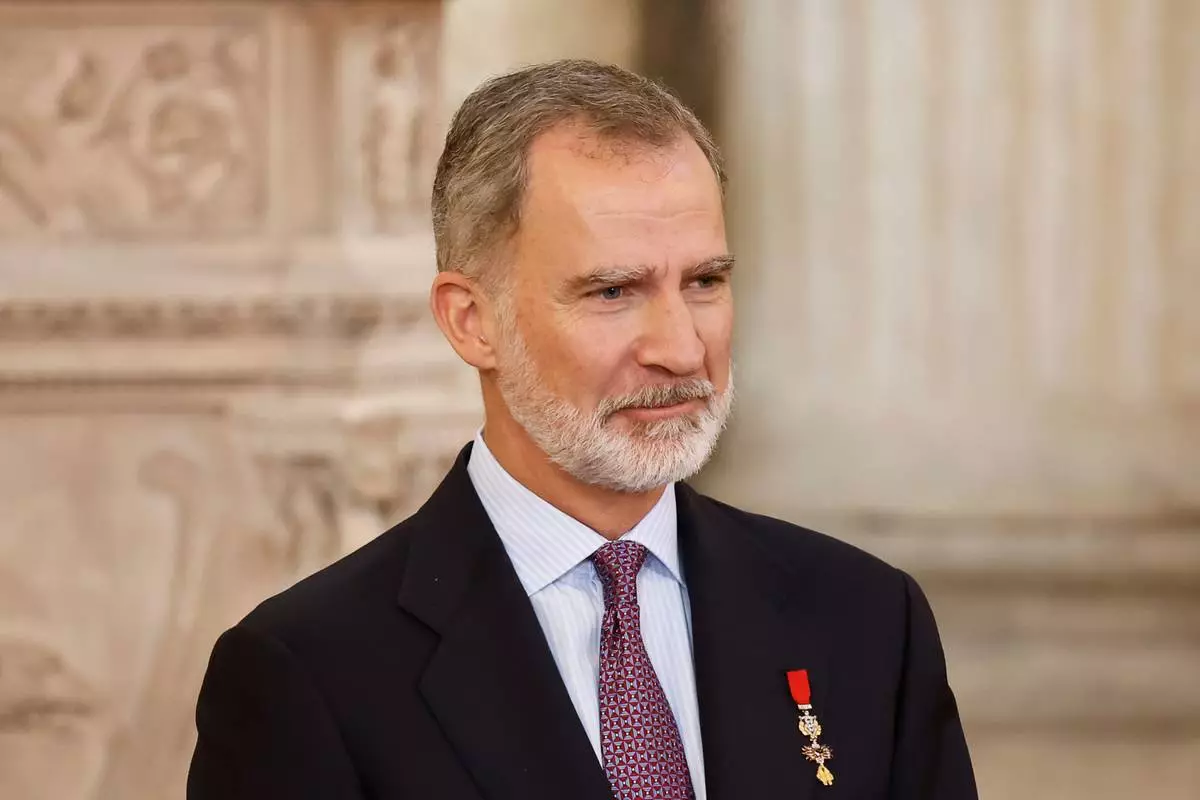
FILE - Spanish King Felipe attends commemorations marking the 10th anniversary of the proclamation of Spain's King Felipe VI at Royal Palace in Madrid, June 19, 2024. (Juan Medina/Pool Photo via AP, File)
PARK CITY, Utah (AP) — Prosecutors on Monday aimed to drive home their argument that a Utah woman who published a children’s book about grief after the death of her husband killed him for his money, while her defense team argued the prosecution's case leaves much to speculation.
Defendant Kouri Richins was $4.5 million in debt and falsely believed she would inherit her husband Eric Richins' estate worth more than $4 million when he died, prosecutors said during closing arguments in her murder trial.
“She wanted to leave Eric Richins but did not want to leave his money,” said Summit County prosecutor Brad Bloodworth.
Prosecutors say Richins, 35, slipped five times the lethal dose of fentanyl into a cocktail that she made for her husband, causing his death in March 2022 at their home just outside the affluent ski town of Park City.
She is also charged with fraudulently claiming insurance benefits after her husband’s death, trying to kill him weeks earlier on Valentine’s Day with a fentanyl-laced sandwich that made him black out, and other felonies, according to court documents. Richins has pleaded not guilty to all charges.
The most serious charge — aggravated murder — carries a sentence of 25 years to life in prison.
What was scheduled to be a five-week trial was cut short last week when Richins waived her right to testify, and her legal team abruptly rested its case without calling any witnesses. Richins’ attorneys said they were confident that prosecutors did not produce enough evidence over the past three weeks to convict her of murder.
“They haven't done their job, and now they want you to make inferences based on paper-thin evidence. They want you to do their job for them. Tell them, ‘No,’” defense attorney Wendy Lewis urged the jury on Monday.
Jurors must reach a unanimous verdict.
Prosecutors said Richins, a real estate agent focused on flipping houses, was deep in debt and planning a future with another man she was seeing on the side. She had opened numerous life insurance policies on her husband without his knowledge, with benefits totaling about $2 million, prosecutors alleged.
They showed the jury text messages between Richins and Robert Josh Grossman, the man with whom she was allegedly having an affair, in which she fantasized about leaving her husband, gaining millions in a divorce and marrying Grossman.
The internet search history from Richins’ phone included “what is a lethal.dose.of.fetanayl (sic),” “luxury prisons for the rich America” and “if someone is poisned (sic) what does it go down on the death certificate as,” a digital forensic analyst testified.
Bloodworth replayed for the jury a clip of Richins’ 911 call from the night of her husband’s death. That’s “not ‘the sound of a wife becoming a widow,’” he said, quoting the defense’s opening statement. “It’s the sound of a wife becoming a black widow.”
Lewis responded that the prosecution “looks at facts one way and sees a witch, but if you look at those facts another way, you see a widow.”
Richins listened to the prosecution’s presentation with a furrowed brow and whispered with her attorneys.
The defense focused on trying to discredit the prosecution's star witness, Carmen Lauber, a housekeeper for the family who claimed to have sold Richins fentanyl on multiple occasions.
Lewis argued Lauber did not deal fentanyl and was motivated to lie for legal protection. Lauber said in early interviews that she never dealt the synthetic opioid, but later said she did after investigators informed her that Eric Richins died of a fentanyl overdose, the defense noted.
Richins had asked Lauber for “the Michael Jackson stuff," which Bloodworth said likely refers to the drug combination that killed the singer.
“She knows she wants it because it is lethal,” he argued.
The housekeeper was already in a drug court program as an alternative to incarceration on other charges when authorities arrested her in connection with the Richins case, investigators said. She had also violated some conditions of drug court.
The defense showed a video of law enforcement warning Lauber that they could pull her drug court deal and that she could face a lengthy prison sentence.
“Give us the details that will ensure Kouri gets convicted of murder,” a man in the video said.
Lauber was granted immunity for her cooperation in the case. She testified that she felt a need to “step up and take accountability of my part in this.”
Shortly before her arrest in May 2023, Richins self-published a children’s book about grief to help her sons process the loss of their father. She promoted the book “Are You with Me?” on local TV and radio stations, which prosecutors have pointed to in arguing that Richins planned the killing and tried to cover it up.
Summit County Sheriff’s detective Jeff O’Driscoll, the lead investigator on the case, testified that Richins paid a ghostwriting company to write the book for her.
O’Driscoll said the sheriff’s office received an anonymous package shortly after Richins’ arrest that contained the book and a note: “There are two sides to every story. This is a true Kouri, a devoted wife and adoring mother. Thought you should know.”
Investigators later learned from Amazon that Richins’ mother sent the package.
Prosecutors showed the jury excerpts of a letter found in Richins’ jail cell that they said appears to outline testimony for her mother and brother. In the six-page letter, Richins instructs her brother to tell her former attorney that Eric Richins confided in him about getting fentanyl from Mexico and “gets high every night."
Defense attorneys have said the letter contains a fictional story Richins had been working on. They have argued that Eric Richins was addicted to painkillers and asked his wife to procure opioids for him.
However, Richins told police on the night of her husband's death that he had no history of illicit drug use, according to body camera footage shown in court.

Defendant Kouri Richins, accused of poisoning her husband in March 2022, listens to closing arguments in Third District Court, Monday, March 16, 2026, in Park City, Utah. (David Jackson/Pool Photo via AP)

Judge Richard Mrazik listens to closing arguments in the Kouri Richins trial where she is accused of poisoning her husband in March 2022, in Third District Court, Monday, March 16, 2026, in Park City, Utah. (David Jackson/Pool Photo via AP)

Defendant Kouri Richins, left, accused of poisoning her husband in March 2022, listens to closing arguments in Third District Court, Monday, March 16, 2026, in Park City, Utah. (David Jackson/Pool Photo via AP)
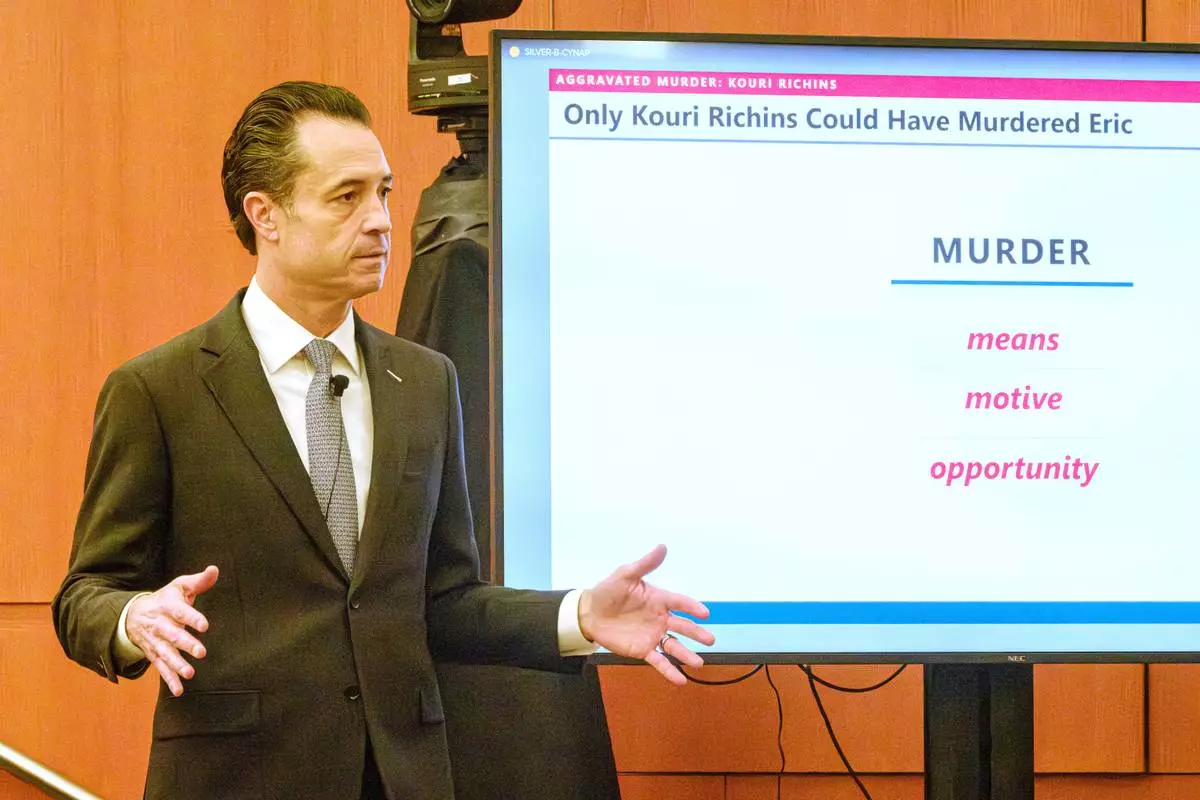
Summit County Prosecutor Brad Bloodworth presenting the state's final arguments in the trial of Kouri Richins, accused of poisoning her husband in March 2022, Monday, March 16, 2026, in Third District Court in Park City, Utah. (David Jackson/Pool Photo via AP)

Defendant Kouri Richins, left, accused of poisoning her husband in March 2022, listens to closing arguments in Third District Court, Monday, March 16, 2026, in Park City, Utah. (David Jackson/Pool Photo via AP)