Skip to Content Facebook Feature Image

MSI Launches XpertStation WS300 on NVIDIA DGX Station Architecture

Business

MSI Launches XpertStation WS300 on NVIDIA DGX Station Architecture
Business

Business

MSI Launches XpertStation WS300 on NVIDIA DGX Station Architecture

2026-03-17 04:30 Last Updated At:05:25

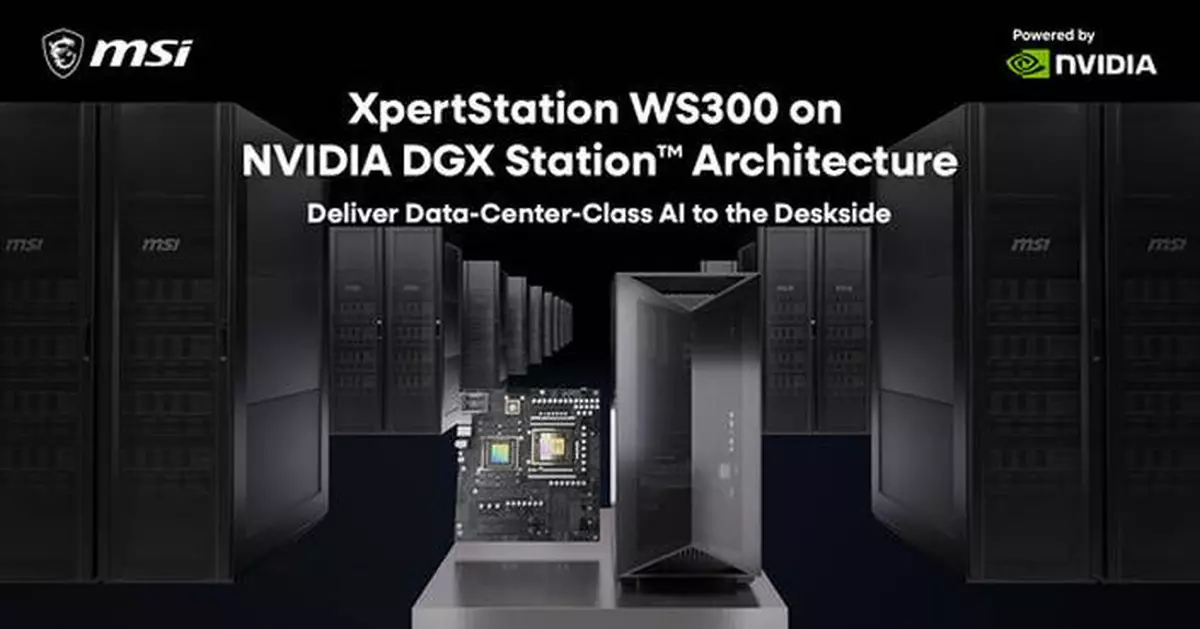
SAN JOSE, Calif., March 17, 2026 /PRNewswire/ -- MSI today announced the launch of XpertStation WS300 on NVIDIA DGX Station Architecture, a next-generation deskside AI supercomputer built to support the accelerating demands of large language models (LLMs), generative AI, and advanced data science workflows. Powered by NVIDIA GB300 Grace Blackwell Ultra Desktop Superchip, supporting up to 748GB of large coherent memory and dual 400GbE networking, the platform extends advanced AI infrastructure capabilities into a compact deskside deployment model and is available for order starting today.

"MSI has a strategic vision to advance AI-first computing," said Danny Hsu, General Manager of MSI's Enterprise Platform Solutions. "With NVIDIA, we are defining the next era of AI infrastructure, bridging centralized performance and distributed innovation, and enabling organizations to move from experimentation to production with greater speed, scale, and confidence."

Bringing Data-Center AI to the Desktop
XpertStation WS300 integrates up to 748GB of large coherent memory, combining high-bandwidth HBM3e GPU memory and LPDDR5X CPU memory into a unified domain to enable efficient CPU-GPU data sharing for large-scale model training and fine-tuning.

With dual 400GbE connectivity powered by NVIDIA ConnectX-8 SuperNIC, the platform delivers up to 800Gb/s of aggregate networking bandwidth to support distributed AI workloads and multi-node scalability. High-speed PCIe Gen5 and Gen6 NVMe storage accelerates dataset ingestion and AI data pipelines, ensuring sustained compute utilization during intensive training and inference operations. Combined with full support for NVIDIA AI Software Stack, the platform provides an integrated hardware-software foundation for seamless AI development and deployment from desktop to data center.

Expanding AI Workflows from Development to Deployment
XpertStation WS300 supports the full AI lifecycle, from large-scale model training and data-intensive analytics to real-time inference and emerging physical AI and robotics workloads. The platform enables organizations to accelerate deep learning models, process massive datasets efficiently, and execute complex AI workloads locally with high-throughput performance.

The system can also function as a centralized AI compute node for collaborative fine-tuning and on-demand deployment, providing teams greater operational flexibility while maintaining control over proprietary data and intellectual property.

By extending data-center-class performance to the deskside, XpertStation WS300 allows organizations to move AI initiatives from experimentation to production with infrastructure-level consistency and reliability.

Supporting Autonomous AI Agents
NVIDIA NemoClaw is an open-source stack installing OpenShell runtime with a policy-controlled sandbox that enables autonomous AI agents to operate continuously more safely. Running OpenShell on XpertStation WS300, developers can run trillion-parameter models locally with up to 20 petaFLOPS of AI compute and 748GB of memory, enabling always-on AI agents at the deskside without relying on cloud infrastructure.

** This press release is distributed by PR Newswire through automated distribution system, for which the client assumes full responsibility. **
MSI Launches XpertStation WS300 on NVIDIA DGX Station Architecture


MSI Launches XpertStation WS300 on NVIDIA DGX Station Architecture

BEIJING, June 26, 2026 /PRNewswire/ -- The Green Agriculture Chain section of the fourth China International Supply Chain Expo (CISCE) brought together more than 100 agribusinesses from around the world. Focused on the future of technology-enabled agriculture, the section showcased innovations spanning the agricultural value chain and provided an international exchange platform to safeguard global agri-food supply chain security.

A coalition of global supply chain partners, including China State Railway Group, ICBC, China Telecom, SINOMACH, COSCO Shipping, Huafeng Meteorological Media Group, Cargill, Louis Dreyfus Company, CP Group, Syngenta, and McDonald's China, led by COFCO, released a Joint Initiative on Building a Secure and Resilient Global Agriculture and Food Supply Chain. The initiative calls on all stakeholders to share supply chain best practices, strengthen risk resilience, accelerate the adoption of new technologies across the agricultural value chain, and support agricultural modernization, digital transformation and sustainable development.

AI was one of the section's key themes. Beidahuang Group presented a compliance-focused agricultural AI model, supported by autonomous farm machinery and a five-dimensional farmland monitoring network. SINOMACH exhibited its portfolio of intelligent agricultural equipment and an AI-powered farming operations platform. Inner Mongolia Jishuo Technology made the global debut of its AI consultation system for livestock, with proprietary sensors enabling long-term animal health monitoring.

Leading Chinese and international food companies presented the full farm-to-table ecosystem. CP Group showcased its Agriculture 4.0 integrated supply chain model. McDonald's China and Yum China highlighted regenerative agriculture partnerships and autonomous logistics solutions capable of supporting temperature-controlled delivery requirements. Syngenta released a practical handbook on regenerative agriculture practices in China. Yili, Feihe, and Junlebao showcased dairy traceability systems and proprietary breeding technologies, while regional exhibition delegations from Qinghai and Tianjin featured highland organic farming products and specialty consumer foods.

The section also featured more cross-border services. Agricultural Bank of China made its debut at the expo and showcased smart agriculture-related solutions. Optimize Integration Group demonstrated how AI can help reduce customs clearance times for agricultural products. International warehousing providers and sustainable soybean certification organizations also participated in the section.

Bringing together multinational firms, leading Chinese agribusinesses, regional industrial clusters, and technology innovators, the section showcased developments in agricultural modernization and digital transformation across the sector. Digital innovation enables more precise and efficient farming, and cross‑border cooperation is enhancing the resilience and sustainability of the global agri-food supply chain.

** This press release is distributed by PR Newswire through automated distribution system, for which the client assumes full responsibility. **

Green Agriculture Chain Section at the 4th CISCE: AI-Driven Innovation Across Global Agri-Food Supply Chains

Green Agriculture Chain Section at the 4th CISCE: AI-Driven Innovation Across Global Agri-Food Supply Chains

Recommended Articles